




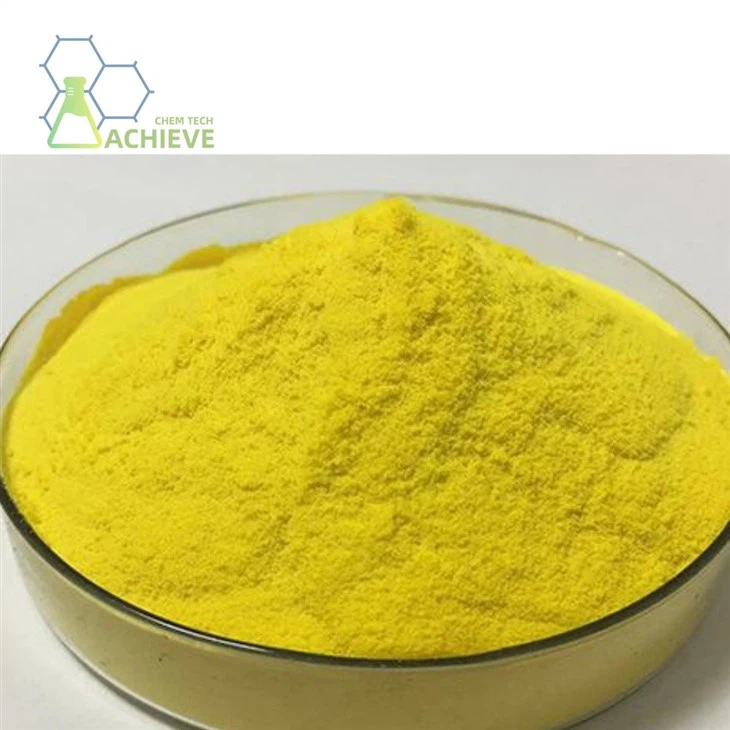


Rosmarinic acid powder, also known as casein, cinnamic acid, or rhodanic acid, is an organic compound that appears as a light yellow to brown powder at low concentrations and a white powder at high concentrations. It has a unique herbal aroma of rosemary, a melting point of 171-175 ℃, and a boiling point of 694.7 ± 55.0 ℃. It is a water-soluble substance with good temperature stability but is sensitive to light. It was originally isolated from the plant rosemary in the family Lamiaceae. It has strong antioxidant and antibacterial activity, and is often used as a food preservative to improve the shelf life of fresh seafood.

Additional information of chemical compound:
|
Chemical Formula |
C18H16O8 |
|
Exact Mass |
360.08 |
|
Molecular Weight |
360.32 |
|
m/z |
360.08 (100.0%), 361.09 (19.5%), 362.09 (1.8%), 362.09 (1.6%) |
|
Elemental Analysis |
C, 60.00; H, 4.48; O, 35.52 |
|
Melting point |
171-175 °C (lit.) |
|
Boiling point |
694.7±55.0 °C(Predicted) |
|
Density |
1.33 |
|
Storage conditions |
2-8℃ |
|
|
|


Rosmarinic acid powder is a natural phenolic acid compound widely found in plants such as the Lamiaceae and Verbenaceae families. Its chemical structure is formed by the condensation of caffeic acid and 3,4-dihydroxyphenyllactic acid, with a molecular formula of C ₁₈ H ₁₆ O ₈ and a molecular weight of 360.315. With its strong antioxidant, antibacterial, anti-inflammatory, and flavor regulating properties, it has become an indispensable natural additive in the food industry, widely used in fields such as preservation, flavor enhancement, health function enhancement, and special food development.

Core function: Natural antioxidant and anti-corrosion preservation
1. Oxidation protection of oily foods
By competitively binding to lipid peroxide groups, the free radical chain reaction is terminated, significantly inhibiting lipid oxidation and rancidity. Adding 0.02% -0.05% rosmarinic acid (rosemaryacid) to animal and vegetable oils, fried foods, and nut products rich in unsaturated fatty acids can extend shelf life while maintaining product color and flavor. For example, Japanese companies use perilla extract (containing rosemaryacid) for fresh seafood packaging, which extends the shelf life of fresh products such as salmon by 3-5 days by inhibiting microbial growth and oxidation reactions.
2. Preservation and Quality Improvement of Meat Products
In processed meat products such as sausages and ham, it can inhibit the rancid taste produced by fat oxidation, and also suppress the proliferation of pathogenic bacteria such as Staphylococcus aureus and Escherichia coli by disrupting the permeability of bacterial cell membranes. Experimental data shows that after storing beef jerky with 0.1% rosemaryacid at 25 ℃ for 28 days, the peroxide value decreased by 62% compared to the control group, and the total bacterial count decreased by 4 orders of magnitude. In addition, it can also break down collagen in muscle fibers, improve meat tenderness, and enhance taste.


3. Stability and flavor optimization of baked goods
In baked goods such as bread and cake, by inhibiting the oxidative cross-linking of gluten in flour, preventing dough hardening, the volume of the finished product increases by 10% -15%, and the tissue structure becomes finer. At the same time, its unique herbal aroma can mask the odor caused by oil oxidation and enhance the flavor level of the product. For example, after adding rosemaryacid to a certain brand of whole wheat bread, consumer sensory ratings showed a 23% increase in "aroma pleasure".
Flavor enhancement: natural spices and seasonings
1. Enhancing the aroma and freshness of soup ingredients and seasonings
It has a unique fresh herbal aroma, which can replace part of the synthetic essence and be used in soup, sauce and seasoning powder. When combined with spices such as black pepper and basil, it can synergistically enhance flavor complexity. For example, adding 0.05% rosmarinic acid to Italian tomato sauce can balance the sour and sweet flavors and enhance the aftertaste.


2. Improvement in taste and stability of beverages
In fruit juice, tea drinks, and functional drinks, not only can it prevent the oxidation and degradation of nutrients such as vitamin C, but it can also inhibit the formation of turbidity and precipitation by chelating metal ions (such as Fe ³ ⁺). After adding rosemaryacid to a certain brand of orange juice, it remained clear and transparent even after being stored at 4 ℃ for 6 months, with a vitamin C retention rate of 92%, while the control group only had 68% remaining.
3. Texture protection of frozen food
In quick-frozen dumplings, rice dumpling and other products, prevent the products from cracking or hardening after thawing by inhibiting the retrogradation of starch. Experiments have shown that after storing frozen dumpling skins with 0.03% rosmarinic acid at -18 ℃ for 3 months, the steaming loss rate is reduced by 18% compared to the control group, and the taste toughness is improved.

Mechanism of Action

Regulation of Antioxidant Pathways and Scavenging of Reactive Free Radicals
Rosmarinic acid powder is a natural bioactive phenolic acid with an ortho-dihydroxybenzene structure in its molecule, which constitutes the core foundation of its antioxidant capacity. This structure donates hydrogen protons to neutralize intracellular reactive oxygen species (ROS) including superoxide anions, hydroxyl radicals and peroxynitrite, thereby terminating lipid peroxidation chain reactions.
Meanwhile, it activates the Nrf2 antioxidant signaling pathway to upregulate the expression of downstream antioxidant enzymes such as HO-1, SOD and GSH-Px, enhancing endogenous cellular antioxidant capacity, alleviating oxidative damage to DNA and membrane lipids induced by oxidative stress, and delaying cellular senescence. Compared with vitamin C and vitamin E, its amphipathic property enables simultaneous action on intracellular aqueous environments and lipid layers of cell membranes, delivering broader antioxidant coverage.


Inhibition of Inflammatory Signaling Pathways and Mitigation of Inflammatory Infiltration
Rosmarinic acid targets and blocks the core NF-κB inflammatory pathway by suppressing the phosphorylation and degradation of IκB, preventing p65 nuclear translocation that initiates the transcription of pro-inflammatory genes, and reducing the secretion of inflammatory factors including TNF-α, IL-6 and IL-1β. It also inhibits the activation of mitogen-activated protein kinases p38 MAPK and ERK, lowers the activities of cyclooxygenase COX-2 and lipoxygenase LOX, and cuts down the production of pro-inflammatory mediators prostaglandins and leukotrienes.
It alleviates skin erythema, mucosal inflammation and systemic low-grade inflammatory responses without the side effects of hormonal anti-inflammatory agents.
Synergistic Effects of Bacteriostasis, Anti-glycation and Skin Protection
Against both Gram-positive and Gram-negative pathogenic bacteria, rosemaryacid exerts bacteriostatic effects by disrupting the lipid structure of bacterial cell membranes and inhibiting bacterial nucleic acid synthesis.


Its molecules trap active aldehydes, intermediate glycation products, to block the formation of advanced glycation end products (AGEs) and reduce collagen cross-linking and aging. Additionally, it suppresses the activity of matrix metalloproteinases (MMPs) to hinder the degradation of collagen and elastin and maintain intact skin barrier function. It is widely applied as a cosmetic raw material in powder formulations for antioxidant, soothing and repairing purposes.

Basic Physicochemical and Solubility Properties
Rosmarinic acid has the molecular formula C₁₈H₁₆O₈. Powder obtained from natural extraction ranges from pale yellow to tan. It exhibits moderate stability at room temperature and is prone to oxidative discoloration under intense light and high temperatures.
Its molecule contains phenolic hydroxyl groups, carboxyl groups and ester linkages, classifying it as an amphiprotic phenolic acid with moderate water solubility.


It dissolves readily in polar organic solvents including methanol, ethanol and acetone, slightly soluble in cold water, and barely soluble in nonpolar solvents such as petroleum ether and n-hexane. Its aqueous solution is weakly acidic with a pH value of 3.5–4.8. Neutralization reactions with alkaline substances produce rosmarinates, which feature markedly improved water solubility.
Oxidative, Acid and Alkali Stability
The ortho-dihydroxybenzene structure endows the molecule with strong reducibility. Upon exposure to air, it is easily oxidized into quinones, resulting in loss of antioxidant activity. Metal ions such as iron and copper accelerate its oxidative degradation.
Under strongly acidic conditions, the intramolecular ester linkage is susceptible to hydrolysis, generating caffeic acid and dihydroxyphenyllactic acid.


In strong alkaline environments, hydrolysis occurs alongside rapid oxidative browning of phenolic hydroxyl groups. Extreme acidic and alkaline conditions must be avoided during storage and processing.
Characteristic Color Reaction and Coordination Reaction
Phenolic hydroxyl groups react with ferric trichloride reagent to produce a blue-green solution, serving as a classic identification method for rosemaryacid.
These hydroxyl groups can form stable complexes with metal ions like aluminum and magnesium, which facilitates chromatographic separation and purification.
The molecule possesses a conjugated aromatic structure with characteristic UV absorption peaks at 280 nm and 330 nm, widely adopted as the basis for content quantification assays.


Natural Plant Extraction (Mainstream Industrial Production Route)
For industrial mass production of rosmarinic acid powder, herbaceous materials rich in phenolic acids such as rosemary, perilla frutescens and salvia miltiorrhiza are prioritized for extraction. Raw material pretreatment serves as the first procedure: materials are dried, crushed and sieved through a 40–60 mesh screen to enlarge solvent contact area.
Reflux extraction is carried out using an ethanol-water composite solvent with an ethanol concentration of 50%–70% and a solid-liquid ratio of 1:10 at 60–70 °C. Low-temperature conditions prevent oxidative decomposition of phenolic acids under high heat; extraction is repeated 2–3 times and all extract liquors are combined.
Organic solvents are removed from the combined extract via vacuum concentration to yield crude extractum, which contains massive impurities including polysaccharides, chlorophyll and flavonoids, requiring multi-stage purification to isolate target rosmarinic acid.
Multi-stage Purification and Refinement for Improved Monomer Purity
The crude extractum is diluted with water and subjected to ethyl acetate extraction to separate lipophilic pigments and lipid impurities. The aqueous phase is loaded onto a macroporous adsorption resin column; nonpolar resins D101 and AB-8 are selected.
Impurities such as saccharides and inorganic salts are washed away with water, and crude rosmarinic acid is enriched via elution with 30% ethanol. The crude eluate is further purified by polyamide chromatography. Polyamide adsorbs phenolic acids through hydrogen bonding, and gradient ethanol elution separates rosmarinic acid from other phenolic impurities.
The high-purity eluate undergoes nanofiltration concentration to remove small-molecule impurities, followed by low-temperature vacuum drying to obtain crude the product with approximately 85% purity. For pharmaceutical-grade purity above 98%, supplementary deep refinement via reversed-phase C18 preparative high-performance liquid chromatography is required.
Total Chemical Synthesis Route (Small-Scale Laboratory Preparation)
Total chemical synthesis adopts caffeic acid and 3,4-dihydroxyphenyllactic acid as starting materials, which undergo esterification catalyzed by DCC condensation to construct the rosmarinic acid backbone. Anhydrous dichloromethane is used as the reaction solvent, with stirring under low temperature and light shielding to avoid oxidation of phenolic hydroxyl groups.
After reaction completion, the catalyst is removed by water washing, and crude products are separated through silica gel column chromatography. The advantages of chemical synthesis include single-component products and no dependence on the origin of plant raw materials.
However, it suffers from high raw material costs and highly toxic catalytic reagents, making large-scale mass production unfeasible; this route is only adopted for pharmacological control experiments.
Aseptic Spray Drying for Powder Preparation and Finished Product Quality Control
The purified concentrated solution of high-purity rosmarinic acid is processed by low-temperature spray drying with the feeding temperature controlled at ≤55 °C to prevent degradation of active ingredients. The dried material is crushed and sieved through an 80-mesh sterile screen to produce homogeneous pale yellow rosemaryacid.
Finished products are tested for content, heavy metals, microbial limits and residual solvents, and subpackaged and stored only after meeting applicable standards for food, cosmetic or pharmaceutical raw materials. The entire process adopts light-shielded and hermetically sealed storage to avoid oxidative deactivation of phenolic acids.
FAQ
What is rosmarinic acid used for?
Rosmarinic acid (RA) is known for its excellent antioxidant properties and is safe and effective in preventing and inhibiting tumors. This review summarizes recent publications on culture techniques, extraction processes, and anti-tumor applications of RA-enriched dietary supplements.
What foods are high in rosmarinic acid?
It is found in species used commonly as culinary herbs such as Ocimum basilicum (basil), Ocimum tenuiflorum (holy basil), Melissa officinalis (lemon balm), Salvia rosmarinus (rosemary), Origanum majorana (marjoram), Salvia officinalis (sage), thyme and peppermint.
Is rosmarinic acid good for hair?
Is rosmarinic acid good for hair?
How fast will rosemary grow your hair?
Studies have shown that rosemary oil for hair has promising positive effects for people with male pattern baldness and alopecia areata [1-3]. In one study, 38% of men saw increases in hair growth after using rosemary oil for male pattern baldness after six months, while 100% of people saw decreased hair loss
Hot Tags: rosmarinic acid powder cas 20283-92-5, suppliers, manufacturers, factory, wholesale, buy, price, bulk, for sale, Tetrahydrobiopterin (BH4) Powder, 4 Fluorotropacocaine, Octreotide Acetate Powder, Chlorhexidine Diacetate CAS 56 95 1, epinephrine hydrochloride powder, cholesterol powder