


Shaanxi BLOOM Tech Co., Ltd. is one of the most experienced manufacturers and suppliers of d-cystine cas 349-46-2 in China. Welcome to wholesale bulk high quality d-cystine cas 349-46-2 for sale here from our factory. Good service and reasonable price are available.
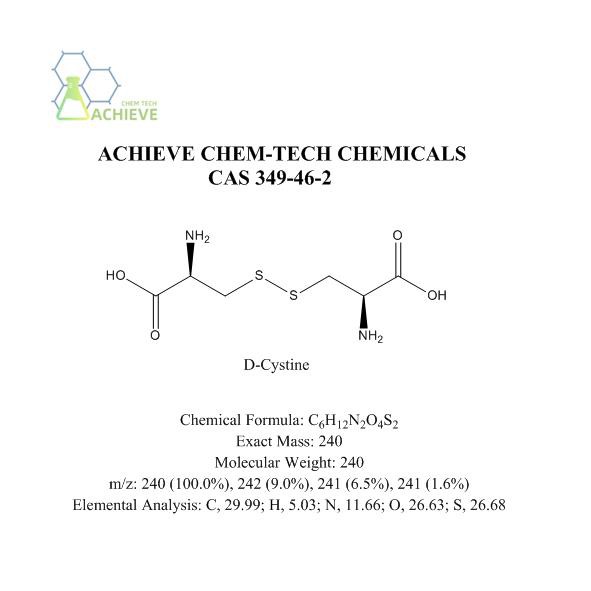
D-Cystine is the enantiomer of L-Cystine, with the chemical name D-3,3'-dithiodialanine (C₆H₁₂N₂O₄S₂). It belongs to non-natural amino acids. It is formed by connecting two molecules of D-cysteine (D-Cysteine) through a disulfide bond (-S-S-). In the solid state, it appears as white crystals or powder, with a melting point of approximately 260°C (decomposition). It is insoluble in water but soluble in dilute acids or alkaline solutions. D-Cystine is rare in nature and is usually obtained through chemical synthesis or enzymatic conversion of L-Cystine. Its optical activity (specific rotation [α]D²⁵ ≈ -215°, c = 1 in 1M HCl) is opposite to that of L-configuration. Due to the general preference of biological systems for L-amino acids, D-Cystine has no direct role in metabolism, but it can be used for chiral synthesis, drug development, and biochemical research, such as as a model molecule for stabilizing disulfide bonds or for preparing D-type peptides. Its reduced state, D-Cysteine, also has applications in heavy metal detoxification and antioxidant research, but it should be noted that high doses may interfere with natural sulfur metabolism.

|
|
|


|
Chemical Formula |
C6H12N2O4S2 |
|
Exact Mass |
240 |
|
Molecular Weight |
240 |
|
m/z |
240 (100.0%), 242 (9.0%), 241 (6.5%), 241 (1.6%) |
|
Elemental Analysis |
C, 29.99; H, 5.03; N, 11.66; O, 26.63; S, 26.68 |

D-Cystine is a non natural amino acid dimer with multiple uses.
1. Pharmaceutical field:
-Antioxidant: It as an antioxidant, can help reduce the production of free radicals and prevent oxidative damage. Oxidative damage is associated with many diseases such as cardiovascular disease, cancer and aging. Therefore, It is widely used in the pharmaceutical field as one of the components of antioxidants.
-Liver protection: Itcan protect liver health by providing thioamino acids. Thioamino acids participate in the detoxification process in the body and help promote liver cell repair and metabolic function recovery.
-Anti inflammatory effect: It has a certain anti-inflammatory effect, which can reduce inflammatory reactions and reduce the risk of related diseases such as arthritis and inflammatory bowel disease.
-Immune enhancement: It can support the function of the immune system and enhance the body's immunity.


2. Beauty and skincare fields:
-Antioxidation and anti-aging: It can counteract the damage of free radicals, reduce the oxidative pressure on skin cells, and thus slow down the aging process of the skin. It can also stimulate the synthesis of collagen, enhance skin elasticity and firmness.
-Preventing hair damage: It can help prevent hair from being damaged by factors such as environmental pollution, ultraviolet radiation, and chemical treatment. It helps to maintain the health, strength, and brightness of hair.
-Nail protection: It can improve the structure and strength of nails, reducing the problem of fragile and brittle nails.
-Nutritional supplements: It as a supplement, can provide the body with the necessary amino acids and improve the health of the skin and hair.
3. Food industry:
-Food seasoning: It has the effect of enhancing freshness and is often used as a seasoning agent to enhance the aroma and flavor of food. It can improve the overall quality of food and enhance the taste experience.
-Food preservation: It can be used as an antioxidant in food, which can extend the shelf life and stability of food. It helps to prevent fat oxidation and food spoilage, thereby maintaining the freshness and quality of food.
-Meat processing: It is widely used in meat products, such as smoked and pickled meat products. It can reduce the use of nitrite and reduce the potential harm of nitrite to human body.
-Antioxidant: It can be used as an antioxidant in food, extending the shelf life of food and preventing quality changes caused by oxidation.


Application in the field of dyeing agents
In the field of dyeing agents, it has also demonstrated its unique application value. Due to its specific chemical structure and properties, it can be used as a synthetic raw material or auxiliary agent for certain dyes, thereby improving their performance and stability.
In addition, it can also be used in the dyeing and finishing process of textiles. By interacting with dye molecules, the dye uptake and fixation rate can be improved, resulting in textiles obtaining more vibrant and long-lasting colors.
Application in the field of dairy additives
In the dairy industry, additives also play an important role. Due to its excellent nutritional value and physiological function, it can be added as a nutritional enhancer to dairy products, thereby enhancing the nutritional value and market competitiveness of the products.
In addition, it can also be used to improve the taste and texture of dairy products. By interacting with other ingredients in dairy products, D-cystine can adjust the taste and texture of the product, making it more in line with consumers' taste needs.


Application in the field of oil antioxidants
Oils and fats are easily affected by oxidation during storage and processing, leading to a decrease in quality and loss of nutritional value. In order to extend the shelf life of oils and maintain their nutritional value, people usually add antioxidants to prevent oxidation from occurring.
As a natural amino acid derivative, it has excellent antioxidant properties. It can bind with free radicals in oils and fats, thereby blocking the occurrence of oxidative chain reactions. Therefore, it is widely used in oil antioxidants to protect oils from oxidative damage.

D-Cys-D-Cys is a kind of unnatural amino acid dimer formed by the connection of two D-cysteine molecules through disulfide bonds. It has a wide range of applications, including in the fields of medicine, food industry, and cosmetics. The following are descriptions of several typical synthesis methods for product:
1. Natural cysteine oxidation method:
This is a commonly used method for synthesizing it. The method is based on the oxidation of natural cysteine, and the product is obtained through multi-step reaction.
-Step 1: Natural cysteine reacts with oxidants (such as hydrogen peroxide or hydrogen peroxide) to produce cysteine dione under neutral or alkaline conditions.
C3H7NO2S+oxidant → cysteine diketone
-Step 2: Cysteine diketone reacts with mercaptan (such as mercaptopropanol) to form mercaptopropanol dipeptide (Cysteamine Cysteamine).
Cysteine diketone+mercaptan → mercaptopropanol dipeptide
-Step 3: The mercaptopropanol dipeptide undergoes an oxidation reaction to form a product.
Mercaptopropanol dipeptide+oxidant → C6H12N2O4S2

2. Enzyme catalyzed method:
Enzymatic catalysis is a synthesis method carried out under biological conditions, using specific enzymes as catalysts to catalyze reactions between substrates and synthesize target products. In the process of synthesizing product, a key enzyme is the Cystine synthase.
4.1. Step 1: Supply of basic substrates
Reaction chemical formula:
L-Cysteine+ATP → L-Cysteinyl AMP+PPi
In this step, the substrate L-Cysteine reacts with ATP (Adenosine triphosphate) to form L-Cysteinyl AMP and inorganic Pyrophosphoric acid (PPi) under the catalysis of enzymes. This is the first Committed step in the catalytic reaction.
4.2. Step 2: Substrate binding and release
Reaction chemical formula:
L-Cysteinyl-AMP+Cysteine → D-Sulfhydrallin+AMP
L-Cysteinyl-AMP reacts with Cysteine, and through enzyme catalysis, Cysteine in the substrate binds to L-Cysteine and releases AMP (adenosine monophosphate). This process leads to the formation of D-Sulfhydrallin, while AMP is released as a byproduct.
4.3. Step 3: Formation and hydrolysis of the core
Reaction chemical formula:
D-Sulfhydrallin+ATP → D-Cysteinyl AMP+PPi
D-Cysteinyl AMP+H2O → D-Cysteine+AMP
D-Sulfhydrallin further reacts with ATP to generate D-Cysteinyl AMP. Then, through the addition of water and further catalytic action of enzymes, D-Cysteinyl-AMP is hydrolyzed into D-Cys-D-Cys and AMP. This process completes the synthesis of product.
It should be noted that the above only lists several common D-Cystine synthesis methods. In fact, there are other synthesis methods, such as multi-step reaction of raw material compounds, Enantioselective synthesis with specific catalysts, etc. The selection of an appropriate synthesis method depends on factors such as experimental conditions, target yield, and purity requirements.

The research history of D-cystine can be traced back to early 19th century Europe. In 1810, British chemist William Hyde Wollaston first isolated a sulfur-containing crystalline substance while analyzing bladder stones and named it "cystine", derived from the Greek word "kystis" (meaning bladder). This is the first time in human history that cysteine has been discovered and named, although its stereoisomers were not distinguished at that time. In 1824, Swedish chemist J ö ns Jacob Berzelius conducted a more detailed study on this substance and confirmed its organic properties. In 1846, German chemist Friedrich W ö hler began to pay attention to the chemical properties of cysteine after artificially synthesizing urea, and discovered that it could be decomposed by strong acids to produce sulfur-containing products. In the second half of the 19th century, with the development of organic chemical analysis techniques, the understanding of cysteine gradually deepened. In 1879, German chemist Ernst Leopold Salkowski discovered that cysteine can be reduced to cysteine under alkaline conditions, revealing for the first time the conversion relationship between these two sulfur-containing amino acids. In 1899, Swiss chemist Emil Fischer first realized that naturally occurring cysteine had specific optical activity while studying the optical rotation of amino acids, laying the foundation for later differentiation between L-type and D-type. At the beginning of the 20th century, with the development of stereochemistry, significant breakthroughs were made in the study of D-cystine. In 1902, German chemist Emil Fischer successfully isolated D-cystine for the first time while studying the stereoisomerism of amino acids, and determined its mirror relationship with L-cysteine. This discovery marks the beginning of human recognition of the existence and importance of amino acid stereoisomers. In the 1920s, the development of X-ray crystallography technology provided a new tool for amino acid structure analysis. In 1923, British crystallographer William Henry Bragg obtained the crystal structure data of cysteine for the first time through X-ray diffraction. In 1931, German chemist Karl Freudenberg determined the exact location and configuration of disulfide bonds in cysteine molecules. The advancement of synthetic chemistry has promoted the artificial preparation of D-cystine. In 1935, American chemist Max Bergmann developed a method for preparing D-cysteine through oxidation of D-cysteine. In 1947, British chemist Alexander R. Todd improved the synthesis route and achieved higher yields of D-cystine synthesis. The research during this period provided a material basis for subsequent biochemical research.
Hot Tags: d-cystine cas 349-46-2, suppliers, manufacturers, factory, wholesale, buy, price, bulk, for sale, Homosalate Solution, Carbazochrome, Burgess Reagent Synthesis