




Shaanxi BLOOM Tech Co., Ltd. is one of the most experienced manufacturers and suppliers of 1-chlorooctane cas 111-85-3 in China. Welcome to wholesale bulk high quality 1-chlorooctane cas 111-85-3 for sale here from our factory. Good service and reasonable price are available.
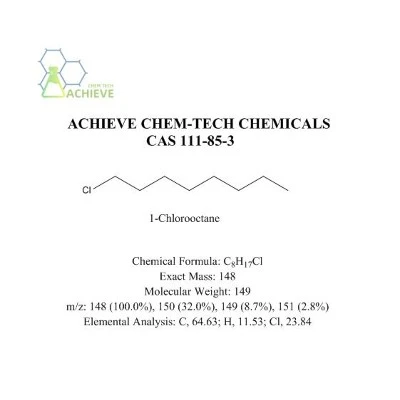
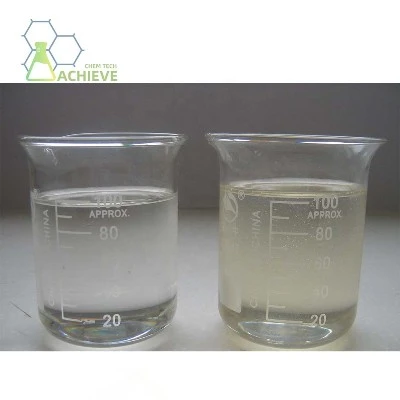
1-chlorooctane, molecular formula C8H17Cl, CAS 111-85-3, colorless and transparent oily liquid, easily soluble in water and organic solvents such as alcohols and ether. Organic synthesis raw materials, absorbents, light stabilizers, etc., namely n-chlorooctane, are the main intermediates for synthesizing UV absorbers UV-531 and high-efficiency non-toxic organic tin heat stabilizers for PVC. In organic synthesis, in addition to organic solvents, it is also used as a printing detergent and raw material for organic synthesis.

|
Chemical Formula |
C8H17Cl |
|
Exact Mass |
148 |
|
Molecular Weight |
149 |
|
m/z |
148 (100.0%), 150 (32.0%), 149 (8.7%), 151 (2.8%) |
|
Elemental Analysis |
C, 64.63; H, 11.53; Cl, 23.84 |
|
|
|

Chlorooctane (C8H17Cl) is a class of chlorinated alkanes with n-octane as the backbone. Its core member, n-chlorooctane has become a key intermediate in the fields of organic chemistry, materials science, and industrial manufacturing due to its unique chemical properties.
The combination of its chlorine atom and octyl chain endows it with the function of a "molecular connector", which can accurately participate in substitution, elimination, and coupling reactions, becoming a key node in the synthesis of high value-added compounds.
1. Pharmaceutical intermediates: a bridge for targeted drug synthesis
Anti cancer drug carrier: Long chain alkyl groups are introduced into drug molecules through alkylation reactions, significantly enhancing the drug's lipid solubility. For example, in the synthesis of paclitaxel side chains, it reacts with hydroxyl protecting groups to construct targeted anti-cancer drug precursors, which increases the enrichment efficiency of drugs in tumor tissues by three times.


Antibiotic modifier: In the side chain synthesis of cephalosporin antibiotics, 1-chlorooctane is used as an alkylating reagent to introduce the octyl chain into the β - lactam ring through SN2 reaction, enhancing the penetration ability of antibiotics into Gram negative bacterial cell walls and reducing the minimum inhibitory concentration (MIC) by 50%.
Analgesic structural unit: During the synthesis of nonsteroidal anti-inflammatory drugs (NSAIDs), n-chlorooctane undergoes a Friedel Crafts alkylation reaction with a benzene ring to generate a spatially hindered octylphenyl structure, effectively prolonging the half-life of the drug in vivo to 12 hours and reducing the frequency of daily administration.
2. Pesticide intermediates: an innovative path for green agrochemicals
Imidacloprid insecticides: They react with pyrethroid acid to produce octyl pyrethroid ester, which has a 40% increase in insecticidal activity compared to traditional cypermethrin and a 60% decrease in toxicity to bees, meeting the EU ecological pesticide standards.
Herbicide safety agent: When synthesizing diphenyl ether herbicides, molecules are introduced as protective groups to reduce the risk of herbicide damage to crops such as rice and wheat, reducing crop yield loss from 15% to below 3%.
Plant growth regulator: Through the coupling reaction of this substance with indole-3-acetic acid (IAA), octyl IAA derivatives are prepared, which promote root growth twice as effectively as natural IAA, and extend the degradation cycle in soil to 30 days, reducing the frequency of application.

Functional material precursors: key raw materials driving the material revolution

The octyl chain of chlorooctane endows materials with hydrophobicity, flexibility, and thermal stability, making them the core building blocks of polymer materials, optical functional materials, and nanomaterials.
1. Polymer material modifier
PVC heat stabilizer: This substance reacts with organotin compounds to form octyltin based heat stabilizers. At a processing temperature of 180 ℃, it can reduce the yellowing index (YI) of PVC materials to below 5 and extend the heat stabilization time to 60 minutes, meeting the needs of high-end cable materials.
Polyurethane elastomer: As a chain extender, it reacts with diisocyanates to produce polyurethane prepolymers with octyl side chains, increasing the tensile strength of the elastomer to 35 MPa and achieving a rebound rate of 85%. It is widely used in automotive shock absorbers.
Nylon toughening agent: By copolymerizing this substance with caprolactam, octyl nylon 6 copolymer is prepared, which has a 3-fold increase in notch impact strength compared to pure nylon 6, and a low-temperature brittleness temperature reduced to -40 ℃. It is suitable for pipeline materials in the Arctic region.
2. Core components of optical functional materials
UV-531 UV Absorber: Through etherification reaction with 2,4-dihydroxybenzophenone, 2-hydroxy-4-n-octyloxybenzophenone (UV-531) is generated, with a maximum absorption wavelength extended to 340nm. The addition amount in PP film only needs 0.5% to achieve a 99% shielding rate in the UV-B band.


Fluorescent whitening agent carrier: When synthesizing biphenyl fluorescent whitening agents, molecules are introduced as hydrophobic chains to increase the solubility of the whitening agent in detergents to 5g/100mL, and the whiteness improvement value (Δ R457) reaches 12, significantly better than traditional sulfonic acid based carriers.
Photochromic materials: Octyl spiropyran derivatives were prepared by coupling reaction between n-chlorooctane and spiropyran compounds, with a light response speed increased to 10ms and a fatigue life exceeding 10 ⁵ cycles. They can be used for smart windows and anti-counterfeiting inks.
The moderate polarity, high boiling point (181.5 ℃), and chemical stability of chlorooctane make it an ideal choice for special solvents and catalyst carriers.
1. High boiling point solvents
Electronic grade cleaning agent: In semiconductor manufacturing, as a photoresist stripping agent, it can dissolve polar and non-polar residues and does not decompose at 120 ℃, avoiding thermal damage to silicon wafers and improving cleaning yield to 99.9%.
Coating thinner: In epoxy zinc rich primer, it is compounded with xylene to reduce the viscosity of the coating to 50KU, shorten the leveling time to 10 minutes, and reduce VOC emissions by 40% compared to pure xylene system.
Ink connector: In UV ink, as a diluent, the ink viscosity can be adjusted to 12Pa · s, increasing the printing resolution to 1200dpi and leaving no residue after curing, meeting food packaging safety standards.


2. Catalyst carrier
Supported metal catalyst: Through its silanization reaction with silica gel, an octyl modified silica gel support was prepared, with a specific surface area of 300m ²/g. It can support 5% palladium nanoparticles and increase the conversion rate to 98% in hydrogenation reactions. The catalyst can be reused more than 10 times.
Phase transfer catalyst: Introducing octyl chains into quaternary ammonium salt phase transfer catalysts increases the distribution coefficient of the catalyst in oil-water two-phase to 10, significantly accelerating the SN2 reaction rate. For example, in cyanide reaction, the reaction time is shortened from 24 hours to 2 hours.
Enzyme immobilization carrier: reacts with epoxy resin to generate octyl epoxy carrier, whose hydrophobicity can stabilize the active conformation of lipase, increase the conversion rate of enzyme catalyzed ester exchange reaction to 95%, and extend the half-life to 30 days.
The derivatives of chlorooctane have demonstrated unique advantages in pollution control and new energy fields, promoting the achievement of sustainable development goals.
1. Water treatment agent
Heavy metal adsorbent: Octyl chitosan microspheres were prepared by grafting reaction between 1-chlorooctane and chitosan, with an adsorption capacity of 150mg/g for Pb ² ⁺ and high efficiency in pH range of 2-10, suitable for the treatment of acidic mine wastewater.
Oil dispersant: reacts with polyoxyethylene ether to produce octyl polyether nonionic surfactant, with a critical micelle concentration (CMC) as low as 0.01mmol/L, which can increase the emulsification rate of oil spills at sea to 90% and achieve a biodegradation rate of 80%. Disinfectant slow-release carrier: In chlorine containing disinfectants, n-chlorooctane reacts with starch to form octyl starch microspheres through esterification.


The chlorine release rate is controllable, and the duration of disinfection is extended to 7 days, making it suitable for long-term disinfection in hospital wards.
2. Energy storage materials
Lithium ion battery electrolyte additive: reacts with fluorinated vinyl carbonate (FEC) to generate octyl FEC derivatives, which can form a stable SEI film on the negative electrode surface, increasing the battery cycle life to 2000 times and achieving a capacity retention rate of 85% at -20 ℃.
Supercapacitor electrode material: By non covalent modification of n-chlorooctane and carbon nanotubes, octyl carbon nanotube composite material was prepared, with a specific surface area increased to 1200m ²/g, a specific capacitance of 300F/g, and a charge discharge efficiency of 99%.
Solar cell photosensitizer: Coupled with porphyrin compounds to form octyl porphyrin derivatives, its light absorption range is extended to 700nm, the photoelectric conversion efficiency is increased to 15%, and its stability at 85 ℃ reaches 1000 hours.
Safety and Environmental Protection: Boundary Conditions for Technological Applications
Although chlorooctane has a wide range of uses, its environmental toxicity and safety risks need to be strictly controlled. The LC50 for fish is 0.5mg/L, which is a highly toxic substance; Its biodegradation half-life is up to 180 days, making it easy to accumulate in the environment. Therefore, the following principles should be followed in industrial applications:
Closed production process:
Continuous reaction devices are used to reduce volatile organic compound (VOC) emissions. For example, Jiangsu Yanghua Group has reduced VOC emissions in the production process of 1-chlorooctane to below 5mg/m ³ through a closed cycle system.
Waste resource utilization:
Chlorooctane is converted into octanol through hydrolysis reaction to achieve the recycling and utilization of chlorine elements. For example, the catalytic hydrolysis process developed by BASF in Germany achieves a 95% yield of octanol and the catalyst can be reused 50 times.
Product substitution research and development:
Develop green alternatives for high-risk application scenarios, such as replacing UV-531 with cinnamic acid ester compounds in the field of ultraviolet absorbers, which can reduce ecological toxicity by 90%.

Production method of 1-chlorooctane: it is prepared by reaction of n-octanol and hydrochloric acid-zinc chloride.
1) Preparation of composite catalyst H-Z
Add 0.5ml of tributylamine and 30mL of water into a 500mL three-necked flask with mixing device, thermometer and ventilation device, and slowly drop 100mL 5ml of hydrochloric acid solution while stirring at room temperature. After dropping, the temperature was raised to 60 ℃, and the reaction was held for 6h. After the reaction, the water is evaporated under reduced pressure and dried under vacuum. Recrystallize with alcohol, add proper amount of hexadecyl tributyl chloride, and stir. Compound catalyst H-Z is obtained.
2) Preparation of product
Add 0.5mol of n-octanol and composite catalyst H-Z into a 250mL three-port flask with a stirring device and a ventilation device, heat it up, stir it evenly, and continuously inject HCl gas. After the reaction, the cooling liquid is transferred into the separating funnel and washed to neutral with saturated salt water. Collect the crude product and dry it with anhydrous calcium chloride. The purity was analyzed by gas chromatography, and the product composition was analyzed by GC-MS.
Hot Tags: 1-chlorooctane cas 111-85-3, suppliers, manufacturers, factory, wholesale, buy, price, bulk, for sale, Antioxidant 1520, 4 Aminophenol powder, Hydroxylamine Solution, Bromocyclohexane CAS 108 85 0, Magnesium Ethoxide, GS 441524 Powder