




Shaanxi BLOOM Tech Co., Ltd. is one of the most experienced manufacturers and suppliers of 2,3-difluorophenol cas 6418-38-8 in China. Welcome to wholesale bulk high quality 2,3-difluorophenol cas 6418-38-8 for sale here from our factory. Good service and reasonable price are available.
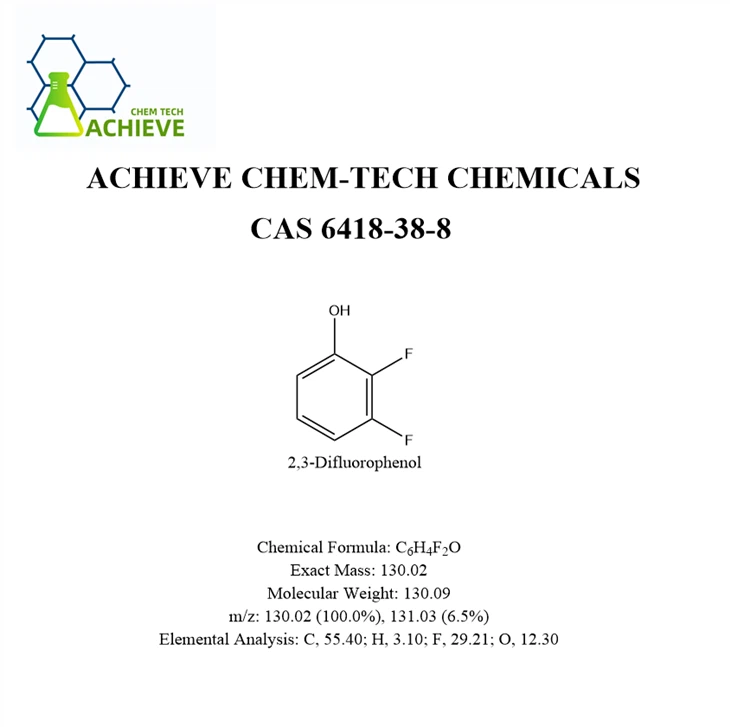
2,3-Difluorophenol is an organic compound with the chemical formula C6H4F2O. It belongs to the category of aromatic compounds, specifically phenols substituted with two fluorine atoms. The introduction of fluorine atoms into the phenol structure alters its chemical and physical properties significantly. Fluorine is the most electronegative element, which enhances the polarity of the molecule and affects its intermolecular interactions. Consequently, it displays altered solubility, melting point, and boiling point compared to unsubstituted phenol.
|
|
|

|
Chemical Formula |
C6H4F2O |
|
Exact Mass |
130.02 |
|
Molecular Weight |
130.09 |
|
m/z |
130.02 (100.0%), 131.03 (6.5%) |
|
Elemental Analysis |
C, 55.40; H, 3.10; F, 29.21; O, 12.30 |
This compound finds applications in various fields due to its specific chemical characteristics. In the pharmaceutical industry, it serves as an intermediate in the synthesis of drugs, where the fluorine substitution can modify the biological activity and pharmacokinetic properties of the final products. Additionally, it is utilized in the production of agrochemicals, polymers, and dyes, benefiting from its enhanced reactivity and stability.
Moreover, researchers often employ it as a building block in organic synthesis, taking advantage of the versatile transformations possible with fluorinated aromatic rings. Its role in the development of new materials and functional molecules underscores its importance in scientific research.
Pharmaceutical Intermediates
In medicinal chemistry, 2,3-Difluorophenol is highly valued as it serves as a crucial intermediate in the synthesis of numerous pharmaceuticals. The introduction of fluorine atoms into aromatic rings, such as in phenol derivatives, can profoundly influence the physical, chemical, and biological properties of the resulting compounds.
The incorporation of fluorine atoms can affect the lipophilicity, metabolic stability, and biological activity of compounds, making it an important building block in medicinal chemistry.

Fluorine atoms can stabilize the aromatic ring against metabolic degradation. This can result in compounds with longer half-lives in vivo, which is desirable for therapeutic agents that need to maintain effective concentrations in the body for extended periods.
The presence of fluorine can also alter the biological activity of a compound. Fluorinated derivatives often exhibit enhanced binding affinity towards biological targets such as enzymes, receptors, and ion channels. This can lead to more potent and selective drugs with reduced off-target effects.
Fluorine substitution can introduce steric hindrance, which can restrict the conformational flexibility of a molecule. This conformational restraint can be beneficial in stabilizing specific bioactive conformations, thereby enhancing the efficacy and selectivity of a drug.
Fluorine can act as a bioisostere for hydrogen, hydroxyl, or other functional groups. This means that fluorinated compounds can mimic the biological activity of non-fluorinated counterparts while offering improved pharmacokinetic profiles.

In summary, the fluorine-substituted phenol structure provides a versatile scaffold for the synthesis of drugs with tailored properties. Its ability to modulate lipophilicity, metabolic stability, and biological activity makes it an indispensable building block in medicinal chemistry. Researchers leverage these unique properties to design and develop innovative therapeutic agents targeting specific biological pathways, ultimately contributing to advancements in healthcare.
Pesticide Formulation
This compound finds application in the formulation of pesticides due to its fluorine substitution, which often enhances the biological activity and environmental stability of pesticide molecules. It can be used to synthesize pesticides with improved efficacy and reduced environmental impact.

1. Enhanced Biological Activity
Fluorine substitution can modify the electronic and steric properties of a molecule, which can lead to improved binding affinity towards biological targets in pests. This can result in pesticides with higher potency and selectivity, meaning they are more effective at controlling the target pest while causing minimal harm to non-target organisms.
2. Environmental Stability
The introduction of fluorine atoms can stabilize pesticide molecules against degradation by environmental factors such as sunlight, moisture, and microbial activity. This increased stability can translate into longer persistence in the environment, allowing for more sustained pest control with reduced application frequencies.


3. Improved Efficacy
Pesticides synthesized using it can exhibit enhanced efficacy due to their optimized physical and chemical properties. This can lead to more effective pest management strategies, reducing the overall quantity of pesticide needed and thus minimizing environmental contamination.
4. Reduced Environmental Impact
Despite their enhanced stability, fluorinated pesticides designed using it can still be designed to degrade more readily under specific environmental conditions. This balance between stability and degradability is crucial for developing pesticides with reduced environmental impact. Additionally, the higher potency of these pesticides can mean lower application rates, further minimizing their ecological footprint.

In summary, it serves as a valuable intermediate in the synthesis of pesticides with improved efficacy and reduced environmental impact. Its fluorine substitution offers unique advantages in terms of biological activity enhancement and environmental stability, making it an important tool in the development of more sustainable pest management solutions. By leveraging these properties, researchers can design pesticides that are both highly effective and environmentally friendly, contributing to more sustainable agricultural practices.
Liquid Crystal Materials
As a component in liquid crystal materials, it contributes to the development of advanced display technologies. Its unique chemical structure and properties make it suitable for use in liquid crystal displays, where it helps to enhance display performance and stability.

1. Unique Chemical Structure
The fluorine atoms alter the molecule's electronic and physical properties, providing specific advantages in liquid crystal formulations. These fluorine substitutions can influence the molecular packing, orientation, and interaction within the liquid crystal phase, leading to optimized performance.
2. Enhanced Display Performance
By incorporating it into liquid crystal materials, manufacturers can achieve improved display performance. This includes:
Higher Contrast Ratios: The fluorine atoms may enhance the optical properties of the liquid crystals, leading to higher contrast ratios and more vivid colors.
Faster Response Times: The modified molecular structure can result in faster switching speeds, which are crucial for reducing motion blur and improving the overall responsiveness of the display.
Improved Viewing Angles: The incorporation can help to broaden the viewing angles, making the display more viewable from different perspectives.
Liquid crystal displays that incorporate it can exhibit greater stability under various environmental conditions. The fluorine atoms contribute to the molecule's resistance to degradation, ensuring that the liquid crystal material maintains its properties over a longer period. This stability is essential for maintaining consistent display performance over the lifetime of the device.


I. Early Synthetic Exploration (Mid-20th Century)
In the 1950s and 1960s, organofluorine chemistry emerged, and researchers focused on the synthesis of aromatic fluorinated compounds. As a phenol with ortho-difluoro substitution, 2,3-difluorophenol was first prepared via multi-step nucleophilic substitution reactions, using 2,3-difluorobenzene derivatives as starting materials, followed by hydrolysis, deprotection and other steps to obtain the crude product. During this period, the synthetic route was cumbersome, with a low yield (less than 40%), and there was a lack of precise structural characterization. It was only a niche laboratory compound and did not enter industrial or applied research.
II. Optimization of Synthetic Methods and Structural Identification (1970s–1990s)
After 1970, with breakthroughs in the synthesis technology of fluorinated aromatic compounds, the preparation route of it was gradually simplified. From 1980 to 1990, methods such as direct hydroxylation using ortho-difluorobenzene as raw material and oxidation of 2,3-difluorophenylboronic acid were developed, raising the yield to 60%–70%. Meanwhile, the popularization of modern analytical techniques including IR, NMR and mass spectrometry enabled the accurate confirmation of its molecular structure (fluorine atoms at the 2- and 3-positions of the benzene ring, and a hydroxyl group at the 1-position). Its CAS Registry Number 6418-38-8 was officially registered, making it a standardized chemical reagent.
III. Application-Driven Large-Scale Development (21st Century to Present)
In the early 21st century, demand for fluorinated aromatic intermediates surged in the fields of pharmaceuticals and liquid crystal materials. Due to the unique electronic effects and liposolubility of fluorine atoms, the product became a key synthetic building block. After 2005, mature processes such as high-efficiency catalytic oxidation and diazotization-hydrolysis pushed the yield above 90%, realizing industrial production. Today, it is widely used in the synthesis of pharmaceutical molecules, antifungal agents and liquid crystal monomers. Having evolved from a niche laboratory compound, it has become an important basic raw material in the organofluorine chemical industry, with continuously expanding application value.

Grignard-Boration Oxidation Method (Main Industrial Route)
This process adopts 2,3-difluorobromobenzene as the starting material and realizes synthesis through three key steps: Grignard reaction, boration, and oxidative hydrolysis. Featuring easily available raw materials, high reaction selectivity and stable yield (85%–92%), it is highly suitable for large-scale industrial production.
Grignard reagent preparation: Under inert gas protection, magnesium turnings are initiated with iodine, and anhydrous THF serves as the reaction solvent. 2,3-difluorobromobenzene is added dropwise under reflux to prepare 2,3-difluorophenylmagnesium bromide. The reaction temperature is strictly controlled to avoid coupling side reactions.
Low-temperature boration reaction: At −78 °C, the prepared Grignard reagent is slowly added dropwise into trimethyl borate/THF mixed solution. The system is gradually warmed to room temperature and stirred for 12–16 hours to generate difluorophenyl borate. Low-temperature conditions effectively inhibit rearrangement by-products.
Oxidative hydrolysis and purification: Oxidation is carried out by dropwise adding 30% hydrogen peroxide under alkaline conditions, followed by hydrolysis with dilute hydrochloric acid to obtain crude products. The mixture is extracted with dichloromethane, washed with saturated brine, and dried over anhydrous magnesium sulfate. High-purity 2,3-difluorophenol with purity ≥ 99% is finally obtained via vacuum rectification.
Frequently Asked Questions
Q1: What are the psychochemical characteristics of 3-difluorophenol nuclei?
+
-
A: Molecular formula \ (\ boldsymbol {C6H4F2O} \), molecular weight 130.09, white low melting point crystal, melting point 39-42 ° C, close to liquefaction at room temperature; pKa≈7.71, Due to the electron withdrawing effect of two adjacent fluorides, the acidity is significantly stronger than that of ordinary phenol. Slightly soluble in water, easily soluble in organic solvents such as ethanol and ether; Phenolic hydroxyl groups are easily oxidized and volatile when heated, and belong to the class of phenolic fluorinated intermediates with flammable risks.
Q2: What are the main application scenarios of 3-difluorophenol?
+
-
A: Belonging to fine chemical intermediates, mainly used for the synthesis of pharmaceuticals, pesticides, and liquid crystal materials. Used in drug development to construct central nervous system drugs, antibacterial and antiviral molecules; Used in the field of pesticides for synthesizing fluorine-containing active molecules; It is also used as a structural block for liquid crystal monomers, regulating the lipid solubility and conformation of molecules through 2,3-difluoride substitution. It is not directly used as a finished drug or pesticide.
Q3: What are the main hazards of laboratory operation of 2,3-difluorophenol?
+
-
A: The GHS signal word is' warning '; Swallowing, inhalation, and skin contact are all harmful and can cause skin irritation, severe eye irritation, and respiratory mucosal irritation. Steam is irritating, do not smell it directly; Immediately rinse the skin/eyes with plenty of water after contact, do not induce vomiting if ingested, seek medical attention promptly. This substance is flammable and should be kept away from heat sources, open flames, and strong oxidants.
Hot Tags: 2,3-difluorophenol cas 6418-38-8, suppliers, manufacturers, factory, wholesale, buy, price, bulk, for sale, 5 Ethylthio 1H Tetrazole CAS 89797 68 2, 2 Furoic Acid CAS 88 14 2, Sodium P toluenesulfonate CAS 657 84 1, Uridine Powder, Hydroxylamine Solution, Cyclohexene oxide