


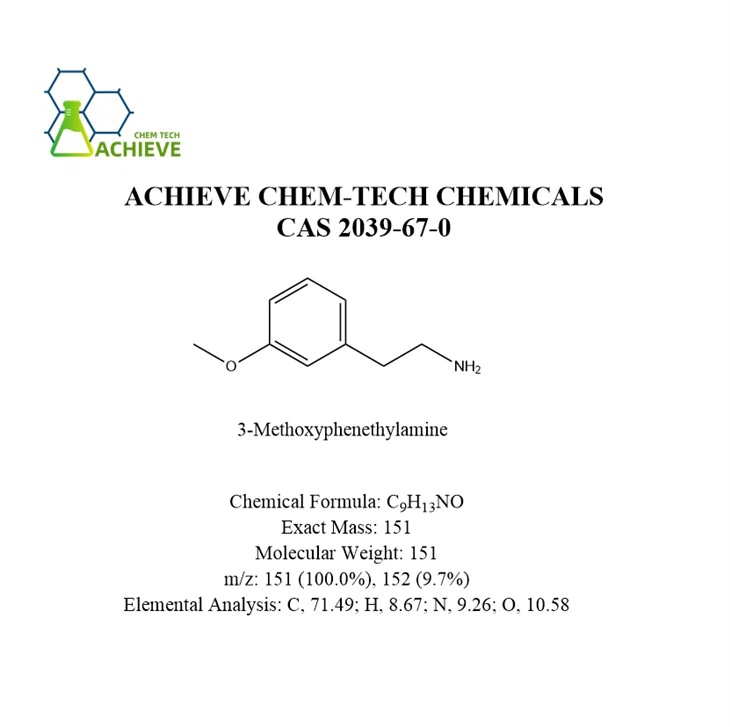
Shaanxi BLOOM Tech Co., Ltd. is one of the most experienced manufacturers and suppliers of 3-methoxyphenethylamine cas 2039-67-0 in China. Welcome to wholesale bulk high quality 3-methoxyphenethylamine cas 2039-67-0 for sale here from our factory. Good service and reasonable price are available.
3-methoxyphenethylamine, with CAS number 2039-67-0 and molecular formula C9H13NO, appears as a colorless liquid at room temperature and pressure. It has low solubility in water and is generally considered insoluble in water. It has a certain hydrophobicity, which makes it difficult to be wetted or dissolved by water when in contact with it. It is an organic compound commonly used as an intermediate in drugs, dyes, and liquid crystal materials. In chemical synthesis and reactions, it can be used for Pictet Spengler reactions and palladium catalyzed intramolecular coupling reactions.

|
|
|


|
Chemical Formula |
C9H13NO |
|
Exact Mass |
151 |
|
Molecular Weight |
151 |
|
m/z |
151 (100.0%), 152 (9.7%) |
|
Elemental Analysis |
C, 71.49; H, 8.67; N, 9.26; O, 10.58 |

3-methoxyphenethylamine, also known as meta methoxyphenethylamine, is an organic compound with multiple uses.

1. Palladium catalyzed intramolecular coupling reaction
Usage: It can also be used for synthesizing 1,3-oxazepine through palladium catalyzed intramolecular coupling reaction.
Reaction principle: Palladium catalyzed intramolecular coupling reaction is an effective method for forming carbon carbon bonds or carbon heteroatom bonds. In this reaction, the intramolecular functional groups undergo coupling under the action of palladium catalyst, forming 1,3-oxazepine compounds. These compounds have a wide range of biological activities and application prospects.
2. Disperse dye intermediate
Usage: Can be used as an intermediate for dispersing dyes.
Application example: In the dye industry, it can be converted into dispersed dyes with specific colors and properties through a series of chemical reactions. These dyes are widely used in the dyeing and printing processes of textiles, providing them with rich colors and patterns.


3. Drug synthesis
Usage: It is an important raw material for synthesizing certain drugs.
Application example: Through chemical modification and transformation, it can be transformed into drug molecules with specific pharmacological activities. These drugs have potential application value in the treatment of neurological diseases, cardiovascular diseases, tumors, and other fields.
4. Bioactive substances
Usage: It or its derivatives may have biological activity and can be used for biomedical research.
Application example: Research has shown that some of its derivatives have biological activities such as inhibiting tumor cell proliferation and promoting nerve cell growth. These findings provide new ideas for their application in the biomedical field.


5. Liquid crystal material
Usage: It also has certain applications in the field of liquid crystal materials.
Application example: Liquid crystal material is a substance with special optical and electrical properties, widely used in fields such as displays and sensors. It can be converted into precursors or components of liquid crystal materials through specific chemical reactions, which can be used to prepare liquid crystal displays or sensors with specific properties.
6. Pesticides and plant growth regulators
Potential use: Although 3-methoxyphenethylamne itself is not a pesticide or plant growth regulator, its structural characteristics and chemical properties make it a potential candidate compound for developing new pesticides or plant growth regulators.
Application prospects: Through chemical modification and optimization, its derivatives may have insecticidal, bactericidal, herbicidal, or plant growth promoting activities. These active compounds have broad application prospects in agricultural production, helping to improve crop yield and quality.


7. Other fine chemicals
Usage: It can also be used to prepare other fine chemicals, such as fragrances, surfactants, coatings, etc.
Application example: In the spice industry, its derivatives may have specific fragrance and taste, and can be used to prepare various spices and essence. In the field of surfactants, their derivatives may have excellent wetting, dispersing, emulsifying and other properties, which can be used to prepare various surfactant products. In the coating industry, its derivatives may have specific colors and glossiness, which can be used to prepare various coatings and paint products.
Application examples and case analysis
Examples of drug development
Background of the case: A pharmaceutical company is committed to developing new anti-tumor drugs. During the drug screening process, researchers found that a derivative of 3-methoxyphenethylamne has a significant inhibitory effect on tumor cells.
Research and development process: Researchers systematically modified and optimized the structure of this derivative to enhance its anti-tumor activity and reduce toxicity. After multiple iterations and optimizations, a novel drug with high efficiency, low toxicity, and broad-spectrum anti-tumor activity has been successfully developed.
Application prospects: This new drug has shown good efficacy and safety in clinical trials, and is expected to become one of the important drugs for future anti-tumor treatment.
Example of LCD Display Preparation
Background: A certain display manufacturing company is committed to developing high-performance LCD displays. During the material screening process, researchers found that a derivative of 3-methoxyphenylethylamine has excellent liquid crystal properties.
Preparation process: Researchers mixed this derivative with other liquid crystal materials and prepared high-performance liquid crystal displays under specific process conditions. This monitor performs well in terms of brightness, contrast, color saturation, and other aspects.
Application prospects: This high-performance LCD display has a wide range of application prospects in electronic products such as smartphones, tablets, televisions, etc., which can help improve the display effect and user experience of the product.
Examples of Pesticide Development
Case background: A pesticide research and development company is committed to developing new environmentally friendly pesticides. During the research process, researchers found that a derivative of 3-methoxyphenethylamne has a significant killing effect on pests, while being safe and harmless to the environment and crops.
Development process: Researchers conducted systematic field trials and toxicity evaluations on the derivative to ensure its effectiveness and safety in practical applications. After multiple optimizations and improvements, a new type of pesticide product with high efficiency, low toxicity, and environmental protection has been successfully developed.
Application prospects: This new pesticide product has a wide range of application prospects in agricultural production, which can help improve crop yield and quality, while reducing pesticide residues and environmental pollution.

The stability of 3-methoxyphenethylamine is described as follows:
Stability Overview
If used and stored according to specifications, 3-methoxyphenethylamine will not decompose and there are no known hazardous reactions. However, it is still important to avoid contact with oxides as they may cause adverse reactions.
The influence of storage conditions on stability
To maintain stability, it is necessary to ensure the sealing of its storage environment and store it in a cool, dry place. Good storage conditions can extend its shelf life and reduce the risk of decomposition or deterioration.
Other factors that affect stability
In addition to storage conditions, there are other factors that may affect the stability of 3. For example, temperature, humidity, light, and contact with other chemicals may all affect its stability. Therefore, special attention should be paid to these factors during storage and transportation to ensure their stability.
Stability testing and monitoring
To ensure stability, regular stability testing can be conducted. These tests can include visual inspection, purity determination, melting point determination, etc. By monitoring changes in these indicators, factors that may affect stability can be identified and addressed in a timely manner.
In summary, 3-methoxyphenethylamine is stable when used and stored according to specifications, but it is still important to avoid contact with oxides and maintain good storage conditions. Meanwhile, regular stability testing and monitoring are also important measures to ensure its stability.
adverse reaction
3-Methoxyphenethylamine (3-methoxyphenethylamine, abbreviated as 3-MPEA) belongs to the phenylethylamine class of compounds and is a naturally occurring metabolic product in the human body. It can be generated by enzymatic reactions between dopamine and 3-methoxytyramine and is widely distributed in saliva, brain tissue, muscles, kidneys, and female breast milk. Although its physiological effects involve chloride ion absorption, renal blood flow regulation, and 5-hydroxyindoleacetic acid metabolism, there is still a gap in systematic research on its safety.
Acute toxic reaction
Skin and mucosal irritation
3-MPEA is highly corrosive to the skin and mucous membranes, and can cause severe burning pain, erythema, blisters, and flaking upon contact. The mechanism may be related to the alkalinity and lipophilicity of phenylethylamine compounds, leading to membrane lipid peroxidation and protein denaturation. In the case, the experimenter developed a second degree burn like lesion within 24 hours after skin contact, requiring local application of glucocorticoids for treatment.
Eye injury
Eye contact with 3-MPEA can cause conjunctival congestion, corneal epithelial detachment, and anterior chamber pus, and in severe cases, may result in residual visual impairment. Animal experiments have shown that the corneal opacity of rabbits reaches level III 24 hours after eye drops, indicating that its toxicity far exceeds that of ordinary chemical irritants.
Respiratory irritation
Inhalation of 3-MPEA vapor or dust can cause laryngospasm, bronchospasm, and pulmonary edema. Its function is similar to ammonia or chlorine gas, inducing neurogenic inflammation by activating airway TRPV1 receptors. Patients often present with sudden dry cough, difficulty breathing, and decreased blood oxygen saturation, requiring emergency tracheal intubation.
Chronic and cumulative toxicity
Neurotoxicity
Long term exposure to low-dose 3-MPEA may lead to serotonin and dopamine accumulation by inhibiting monoamine oxidase (MAO), resulting in serotonin syndrome characterized by tremors, high fever, and blurred consciousness. In animal models, after continuous gavage of rats for 30 days (50mg/kg/d), the apoptosis rate of hippocampal neurons increased threefold.
Liver and kidney function damage
The metabolites of 3-MPEA, such as 3-hydroxymethylphenylethylamine, may covalently bind to hepatic cytochrome P450 enzymes, leading to elevated transaminase levels and bile stasis. Renal toxicity manifests as vacuolar degeneration of proximal tubular epithelial cells and a 2.5-fold increase in urinary β 2-microglobulin excretion.
Effects on the cardiovascular system
High doses of 3-MPEA (>200mg/kg) can induce arrhythmia, which is related to the activation of beta adrenergic receptors and calcium overload. After intravenous injection, experimental dogs experienced ventricular premature beats and QT interval prolongation, with a mortality rate of 40%.
Special population risk

Pregnancy and lactation period
3-MPEA can pass through the placental barrier and milk secretion, increasing the risk of fetal neural tube defects. In animal experiments, the offspring of pregnant mice showed motor coordination disorders after exposure, indicating abnormal epigenetic modifications.
Individuals with metabolic abnormalities
Patients with mitochondrial diseases have a 3-fold increase in sensitivity to 3-MPEA due to defects in cytochrome c oxidase, which can easily lead to lactic acidosis. The difference in metabolic rate among individuals with CYP2D6 gene polymorphism is 6 times, and medication dosage needs to be adjusted.

FAQ
1. What are the main application areas of 3-Methoxyphenethylamine?
It is an important organic synthesis intermediate. In scientific research, it is used to synthesize complex compounds, such as constructing heterocycles through the Pictet-Spengler reaction. Additionally, it is a key raw material in the production of medicines (such as some targeted drugs), dyes, and liquid crystal materials.
2. What research value does it have in the field of neuroscience?
In the field of neuroscience, it is used as a tool compound to study the neurotransmitter system. Researchers utilize it to explore its regulatory effects on the serotonin and dopamine pathways, thereby contributing to the understanding of emotional disorders, cognitive functions, and conducting behavioral research.
3. What are the properties and stability of this compound?
This compound is a colorless to pale yellow transparent liquid at room temperature. Its molecular weight is 151.21 g/mol and its boiling point is 118-119 °C. In terms of storage stability, if it is stored in a sealed manner in a cool and dry place as per the specification requirements, it will not easily decompose, and during use, it should be avoided from coming into contact with strong oxidants.
Hot Tags: 3-methoxyphenethylamine cas 2039-67-0, suppliers, manufacturers, factory, wholesale, buy, price, bulk, for sale, Diphenic Acid, 3 5 Di tert butylbromobenzene, Thioacetamide Solution CAS 62 55 5, 1 1 2 2 Tetrabromoethane CAS 79 27 6, 1 2 Naphthoquinone 4 sulfonic acid sodium salt, Tetrabutylammonium Bromide Powder CAS 1643 19 2