




Shaanxi BLOOM Tech Co., Ltd. is one of the most experienced manufacturers and suppliers of 4-methylcinnamic acid cas 1866-39-3 in China. Welcome to wholesale bulk high quality 4-methylcinnamic acid cas 1866-39-3 for sale here from our factory. Good service and reasonable price are available.
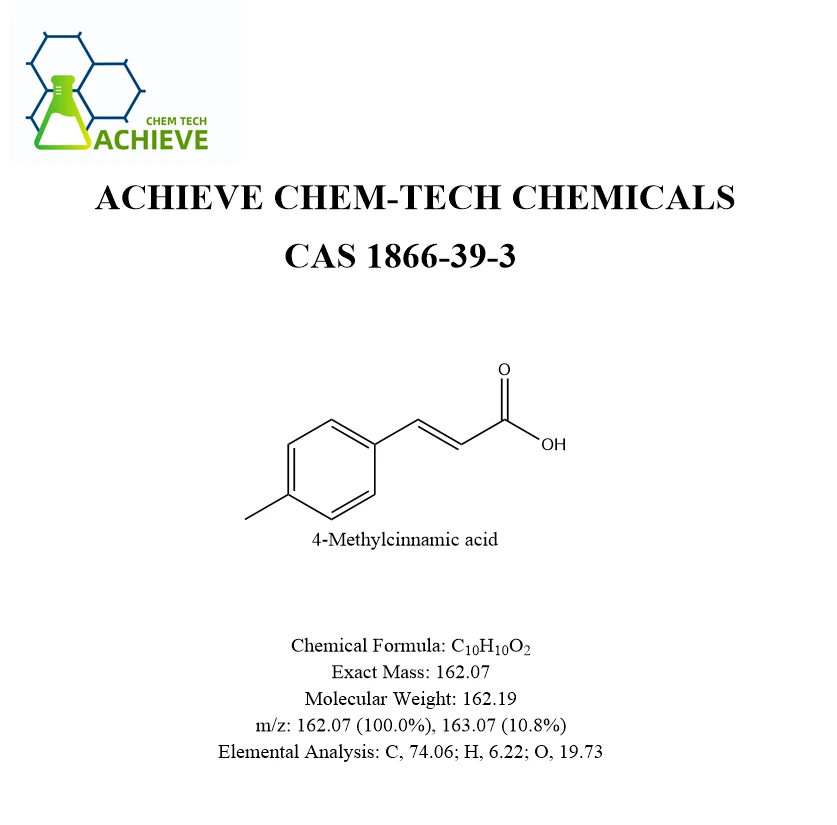
4-Methylcinnamic acid, also known as p-methylcinnamic acid, is an organic compound belonging to the family of cinnamic acids. Structurally, it features a vinyl group (C=C-COOH) attached directly to the aromatic ring, conferring upon it properties typical of alkenes and aromatic compounds. The methyl substituent at the 4-position of the phenyl ring influences its reactivity and spectral characteristics, such as UV-Vis absorption, which is useful for analytical purposes.

|
|
|

|
Chemical Formula |
C10H10O2 |
|
Exact Mass |
162.07 |
|
Molecular Weight |
162.19 |
|
m/z |
162.07 (100.0%), 163.07 (10.8%) |
|
Elemental Analysis |
C, 74.06; H, 6.22; O, 19.73 |

Pharmaceutical Industry
Anti-Inflammatory Properties
- Derivatives can exhibit anti-inflammatory activities, which are essential for treating conditions like arthritis, asthma, and other inflammatory diseases.
- These compounds may work by inhibiting the production or action of inflammatory mediators, such as cytokines and prostaglandins.


Antibacterial Properties
- Some the derivatives have shown antibacterial activity against a range of bacterial strains, including those resistant to conventional antibiotics.
- These compounds can disrupt bacterial cell membranes or inhibit essential bacterial enzymes, making them potential candidates for new antibacterial agents.
Other Therapeutic Properties
- Beyond anti-inflammatory and antibacterial activities, the derivatives may also exhibit antitumor, antioxidant, neuroprotective, or other therapeutic properties.
- These diverse activities can contribute to the development of new treatments for cancer, neurodegenerative diseases, and other medical conditions.

Perfume and Fragrance Industry
The role as a precursor for synthesizing complex and nuanced aromatic compounds underscores its importance in the fragrance industry. By enabling the creation of unique and long-lasting fragrances, this compound contributes to the innovation, customization, and market differentiation of perfumes, colognes, and other personal care products. Its potential for sustainable production further aligns with emerging trends in the industry, making it a valuable asset for fragrance manufacturers.

Creation of Unique Fragrances
- The aromatic compounds derived from it can exhibit a variety of scent characteristics, such as floral, fruity, woody, or spicy notes.
- These distinct notes and nuances allow fragrance creators to blend and layer different compounds to achieve a desired scent profile that aligns with specific consumer preferences.
Long-Lasting Perfumes and Colognes
- Some derivatives exhibit improved volatility and fixative properties, which can contribute to the longevity of fragrances.
- By incorporating these compounds into perfume and cologne formulations, manufacturers can ensure that the fragrances remain detectable on the skin for extended periods.

Improved Volatility
Controlled Release
- The volatility of a compound determines its rate of evaporation. The derivatives with improved volatility can be formulated to evaporate at a slower rate, ensuring a more gradual release of the fragrance over time.
- This controlled release helps maintain a consistent scent throughout the day, providing a pleasant and long-lasting experience for the user.
Balance of Notes
- Different notes in a fragrance evaporate at different rates. By incorporating the derivatives with tailored volatility, manufacturers can balance the evaporation rates of various notes.
- This balance ensures that the top, middle, and base notes in a fragrance blend seamlessly, creating a harmonious and enduring scent profile.
Enhanced Fixative Properties

Longevity
Fixative compounds are crucial for anchoring fragrances to the skin, preventing them from dissipating too quickly. Derivatives with improved fixative properties can significantly extend the longevity of fragrances.
These compounds help bind the volatile components of the fragrance to the skin, ensuring that the scent remains detectable for extended periods.
Subtlety and Persistence
Fixatives not only prolong the lifespan of fragrances but also influence their subtlety and persistence. Derivatives can be designed to provide a soft, lingering scent that is neither overwhelming nor fleeting.
This balance ensures that the fragrance remains pleasant and noticeable throughout the day without becoming too intense or disappearing entirely.

Polymer Industry
4-Methylcinnamic acid is a valuable compound in the polymer industry, offering the ability to synthesize polymers with enhanced thermal stability, mechanical properties, and optical transparency. By incorporating this acid into polymers through various strategies, manufacturers can tailor the material properties to meet the specific needs of diverse applications. This capability is crucial for developing high-performance polymers that meet the rigorous demands of modern technology and industry.
Enhancing Thermal Stability
Increased Decomposition Temperature
- Incorporating it into polymer chains can raise the decomposition temperature of the resulting material. This increase in thermal stability is beneficial for applications that require polymers to withstand high temperatures without degrading.
- The aromatic nature and its ability to form stable cross-links within the polymer matrix contribute to this enhanced thermal stability.
Improved Resistance to Thermal Cycling
- Polymers that incorporate it often exhibit improved resistance to thermal cycling, which involves repeated exposure to high and low temperatures. This resistance helps maintain the structural integrity and performance of the polymer over time.
Enhancing Mechanical Properties
Increased Tensile Strength
- The incorporation into polymers can lead to an increase in tensile strength, which is a measure of the material's ability to withstand tensile forces without breaking.
- This enhancement is attributed to the cross-linking capabilities, which strengthen the polymer matrix and improve its overall mechanical robustness.
Improved Impact Resistance
- Polymers containing it often exhibit improved impact resistance, allowing them to withstand sudden and severe forces without cracking or breaking.
- This improved resilience is crucial for applications that require polymers to endure high-impact conditions, such as automotive parts and protective gear.
Enhancing Optical Transparency

Reduced Haze and Clarity Improvement
It can be used to synthesize polymers with reduced haze and improved clarity. This is particularly beneficial for optical applications, such as lenses, windows, and displays, where high transparency is essential.
The aromatic structure contributes to the formation of polymers with fewer defects and a more uniform molecular arrangement, leading to enhanced optical properties.
UV Resistance and Light Stabilization
In addition to improving transparency, polymers containing it can exhibit enhanced UV resistance and light stabilization. This is because it can absorb UV radiation, converting it into heat and preventing it from causing degradation of the polymer.
This UV-absorbing capability helps maintain the optical clarity and mechanical integrity of the polymer over extended exposure to sunlight and other UV sources.


I. Main Synthetic Process: Knoevenagel Condensation (Preferred Industrial Route)
This method uses p-methylbenzaldehyde and malonic acid as raw materials, which undergo condensation reaction catalyzed by the organic base DBU (1,8-diazabicyclo[5.4.0]undec-7-ene). It is currently the mainstream route for the industrial production of 4-Methylcinnamic acid. The process features mild reaction conditions, few by-products, high yield (up to 70%–85%), and simple post-treatment.
1. Reaction Raw Materials and Ratio
The core raw materials are p-methylbenzaldehyde and malonic acid, with DBU as the catalyst. The molar ratio is controlled as p-methylbenzaldehyde : malonic acid = 1: 1.1–2, and DBU : p-methylbenzaldehyde = 0.1–0.5: 1 to ensure complete reaction.
2. Reaction Process
Mix p-methylbenzaldehyde with malonic acid, add DBU, and stir at room temperature for 2–3 hours. No high-temperature heating is required, resulting in low energy consumption. The reaction mechanism involves condensation between the aldehyde group and the active methylene group of malonic acid with the elimination of one molecule of water, accompanied by decarboxylation of malonic acid to form the target product it.
3. Post-Treatment and Purification
After the reaction, 10%–30% hydrochloric acid is added dropwise to adjust the pH to 2. The mixture is stirred and cooled to crystallize the product, and the crude filter cake is obtained by suction filtration under cold conditions. The filtrate is alkalized with sodium hydroxide, and the DBU catalyst is recovered by vacuum distillation to reduce costs. The crude product is washed with water, filtered, and dried, then recrystallized with ethanol, and vacuum-dried at ≤70 °C under a vacuum of −0.09 to −0.1 MPa to obtain high-purity the product (purity ≥98%).
II. Traditional Synthetic Process: Perkin Reaction (Commonly Used in Laboratories)
The Perkin reaction is a classic method for synthesizing cinnamic acid derivatives. It uses p-methylbenzaldehyde and acetic anhydride as raw materials with anhydrous sodium acetate as the catalyst, suitable for small-scale laboratory preparation.
1. Reaction Conditions
Mix p-methylbenzaldehyde, acetic anhydride, and anhydrous sodium acetate at a molar ratio of 1: 1.5: 0.6, heat to 160–180 °C in an oil bath, and reflux for 4–5 hours. This reaction requires high temperature, leading to high energy consumption, more by-products, and complicated post-treatment.
2. Post-Treatment Steps
After cooling the reaction mixture, water is added and steam distillation is performed to remove unreacted p-methylbenzaldehyde. The residual solution is neutralized with saturated sodium carbonate to pH 8–10, then acidified with hydrochloric acid to pH 2 to precipitate the crude product. The crude product is purified by water washing and recrystallization to obtain the final product.
III. Process Comparison and Advantages
Compared with the Perkin reaction, the Knoevenagel condensation has the advantages of room-temperature reaction, short reaction time, recyclable catalyst, high yield, and environmental friendliness, making it more suitable for large-scale industrial production. Although the Perkin reaction uses readily available raw materials, its high-temperature conditions limit industrial application, and it is only used for laboratory research or small-scale trial preparation.
Skin adverse reactions: mechanism and clinical manifestations

Irritable contact dermatitis (ICD)
4-methylcinnamic acid may trigger inflammatory reactions by disrupting skin barrier function (such as dissolving intercellular lipids) or directly stimulating keratinocytes. Its acrylic group can covalently bind with skin proteins to form antigen complexes, activate the complement system and degranulate mast cells, and release inflammatory mediators such as histamine. Within hours to days after contact, redness, edema, papules, accompanied by a burning sensation or itching may appear. Severe cases may present with blisters or exudation, with clear boundaries consistent with the contact area.
Allergic contact dermatitis (ACD)
The product, as a hapten, needs to be metabolized by the skin and converted into a complete antigen. It then binds to T cell receptors, activates CD4 ⁺ T cells, and triggers delayed type hypersensitivity reactions. After the first contact, it takes several days to weeks to become sensitized. Within 24-72 hours after further contact, severe itching, erythema, and blisters may appear, which can spread to non-contact areas. The use of cinnamic acid derivatives in cosmetics is associated with an increase in the incidence rate of ACD. For example, the cross reaction between hydroxybenzoic acid ester preservatives and cinnamic acid ester fragrances may lead to multi site dermatitis.


Phototoxic reactions
It may absorb ultraviolet (UV) radiation and convert into phototoxic metabolites, directly damaging skin cell DNA or inducing oxidative stress through the production of reactive oxygen species (ROS). Within a few hours after sun exposure, there may be sunburn like erythema, edema, accompanied by pain or burning sensation, which can develop into pigmentation or scars. The analog 4-methoxycinnamic acid can induce apoptosis of human keratinocytes under UVA irradiation, and its phototoxicity is related to the methoxy substituent on the benzene ring.
Frequently Asked Questions
What is 4 formyl cinnamic acid?
+
-
4-Formylcinnamic acid is a molecule that is produced by the condensation of benzaldehyde and formic acid. The nmr spectra of 4-formylcinnamic acid show that it has a structure with two aromatic rings. It has been shown to activate Toll-like receptor 4 (TLR4) in human liver cells.
What is cinnamic acid used for?
+
-
Cinnamic acid is a fragrance ingredient used in many fragrance compounds. It may be found in fragrances used in decorative cosmetics, fine fragrances, shampoos, toilet soaps and other toiletries as well as in non-cosmetic products such as household cleaners and detergents.
What are the advantages of methyl cinnamic acid compared to regular cinnamic acid?
+
-
After introducing a methyl group into the para position of the benzene ring, the electron donating effect is enhanced, and the overall conjugated system is more stable
Thermal stability and antioxidant activity are superior to ordinary cinnamic acid;
Stronger UV absorption performance, better sun protection and light stability effects;
Esterification products have a purer aroma and less impurities;
Improved molecular lipid solubility and better dispersibility in daily chemical and resin systems.
What are the structural characteristics and core reaction sites of methyl cinnamic acid?
+
-
Has three major reactive functional structures: carboxyl (- COOH): can be esterified, acylated, salted, reduced, and amidated; Conjugated carbon carbon double bond: can be added, hydrogenated, epoxidized, polymerized; Para methyl: can be modified by oxidation, halogenation, and dehydrogenation. The overall system is highly conjugated, with excellent optical and thermal properties and strong derivatization ability.
Hot Tags: 4-methylcinnamic acid cas 1866-39-3, suppliers, manufacturers, factory, wholesale, buy, price, bulk, for sale, Cysteamine powder, 2-Chloro-3-methylpyridine, tert Butyldimethylsilyl chloride, 3 5 Dichloropyridine, 4,4'-Dimethylbiphenyl CAS 613-33-2, Tetramethyl orthosilicate