


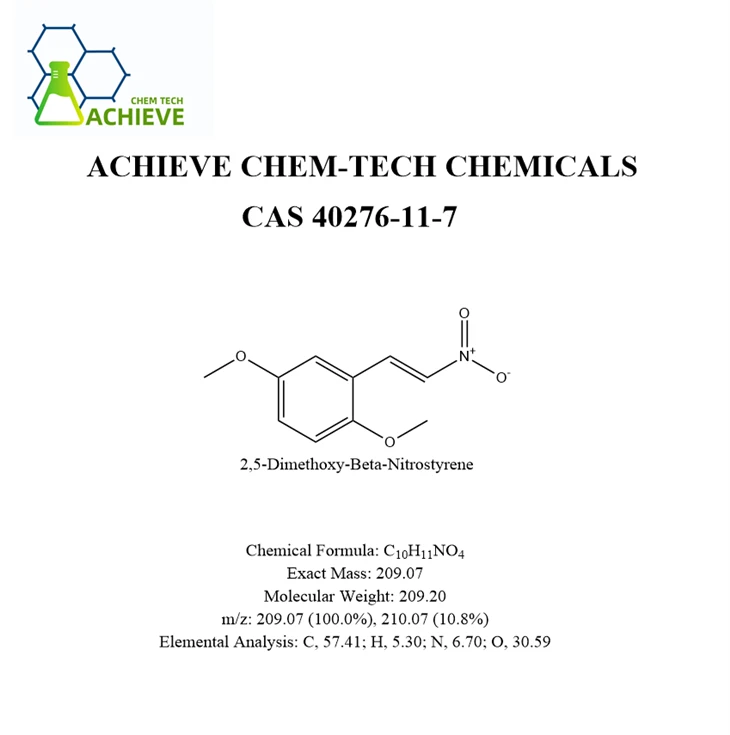


Shaanxi BLOOM Tech Co., Ltd. is one of the most experienced manufacturers and suppliers of 2,5-dimethoxy-beta-nitrostyrene cas 40276-11-7 in China. Welcome to wholesale bulk high quality 2,5-dimethoxy-beta-nitrostyrene cas 40276-11-7 for sale here from our factory. Good service and reasonable price are available.
2,5-Dimethoxy-Beta-Nitrostyrene is an aromatic nitroalkene compound with significant chemical reactivity and unique physical properties. Its molecular structure is centered around a benzene ring, with two methoxy groups (-OCH₃) substituting at the para and meta positions, giving the molecule a strong electron-donating effect and electron-rich nature; simultaneously, the nitro group (-NO₂) on the side chain is conjugated with the vinyl group, forming a strongly electron-withdrawing electrophilic functional group.
This "push-pull" electron structure makes it an important class of Michael acceptors in organic synthesis, capable of undergoing efficient conjugated addition reactions with various nucleophilic reagents (such as amines, thiools, carbon anions), and is a key intermediate for constructing complex nitrogen-containing molecules (such as indoles, tetrahydroquinolines, etc.) and functionalized phenethylamine derivatives.
This compound is usually presented as yellow to orange crystals or powder solids, and its color is due to the strong visible light absorption caused by the intramolecular charge transfer (ICT) transition in the molecule. In addition to its core role in synthetic chemistry, it is also used as a molecular tool in the field of drug chemistry and neuropharmacology research to explore the structure-activity relationships of hallucinogenic amine substances, but it also has potential biological activity and needs to be handled with caution during operation.

|
|
|


|
Chemical Formula |
C10H11NO4 |
|
Exact Mass |
209.07 |
|
Molecular Weight |
209.20 |
|
m/z |
209.07 (100.0%), 210.07 (10.8%) |
|
Elemental Analysis |
C, 57.41; H, 5.30; N, 6.70; O, 30.59 |

Triazole Synthesis
The compound has been reported to be used in the synthesis of triazole-based bioactive molecules. These molecules often exhibit biological activities such as antimicrobial, antifungal, or anticancer properties.
Triazoles are a class of five-membered heterocyclic compounds characterized by the presence of three nitrogen atoms within their ring structure. These compounds have gained significant attention in various fields due to their diverse chemical and biological properties.
Chemically, triazoles are known for their stability and reactivity, which make them valuable in organic synthesis. They can be synthesized through cycloaddition reactions, such as the Huisgen 1,3-dipolar cycloaddition (commonly known as "click chemistry"), involving azides and alkynes. This method is highly efficient and regioselective, allowing for the incorporation of triazole moieties into complex molecules.
Biologically, triazoles exhibit a wide range of activities, including antimicrobial, antifungal, and anticancer properties. Many triazole-based compounds have been developed as pharmaceuticals to treat infections and diseases. For instance, some triazoles are used as antifungal agents in both human and veterinary medicine, while others show promise as anticancer drugs by targeting specific cellular pathways.
In addition to their biological applications, triazoles are also utilized in materials science and agrochemicals. Their ability to form hydrogen bonds and interact with various substrates makes them useful in the design of new materials and pesticides. Overall, triazoles represent a versatile class of compounds with significant potential in multiple areas of research and development.
Triazoles can be synthesized through a variety of methods, with cycloaddition reactions being one of the most common and efficient approaches. These reactions often involve the use of azides and alkynes or nitriles, leading to the formation of 1,2,3-triazole rings.
|
|
|


Cycloaddition Reactions
Click Chemistry
The Huisgen 1,3-dipolar cycloaddition, commonly known as "click chemistry," is a powerful method for synthesizing triazoles. This reaction involves the cycloaddition of an azide and an alkyne, typically catalyzed by copper(I) salts, to form a 1,2,3-triazole.
Reaction Mechanism
The reaction proceeds through a concerted [3+2] cycloaddition mechanism, where the azide (a 1,3-dipole) reacts with the alkyne (a dipolarophile) to form a five-membered triazole ring.
The copper(I) catalyst plays a crucial role in accelerating the reaction and enhancing its regioselectivity, leading to the formation of the 1,4-disubstituted 1,2,3-triazole as the major product.
Efficiency and Selectivity
Click chemistry is characterized by its high efficiency, often proceeding to completion under mild conditions with minimal side reactions.
The reaction is highly regioselective, ensuring that the triazole product is formed with a specific regiochemistry, which is crucial for predicting and controlling the properties of the resulting molecule.
Versatility
The Huisgen 1,3-dipolar cycloaddition can be applied to a wide range of azides and alkynes, allowing for the synthesis of diverse triazole-containing molecules.
This versatility makes it a valuable tool in organic synthesis, enabling the incorporation of triazole moieties into complex molecular architectures.
Applications
Triazoles synthesized via click chemistry find applications in various fields, including pharmaceuticals, agrochemicals, and materials science.
They are used as bioactive molecules, drug carriers, and functional materials due to their stability, reactivity, and ability to form hydrogen bonds.
Azide-Alkyne Cycloaddition (CuAAC)
The CuAAC reaction is highly efficient and regioselective, making it a preferred method for triazole synthesis. It proceeds under mild conditions and tolerates a wide range of functional groups, allowing for the incorporation of triazole moieties into complex molecules.
High Efficiency
The CuAAC reaction typically proceeds rapidly and to completion, even at low concentrations of reactants. This high efficiency is attributed to the catalytic role of copper(I) salts, which facilitate the cycloaddition of azides and alkynes to form 1,2,3-triazoles.
Regioselectivity
The reaction is highly regioselective, predominantly yielding the 1,4-disubstituted 1,2,3-triazole isomer. This regioselectivity is crucial for predicting and controlling the properties of the resulting triazole-containing molecules, ensuring consistency and reproducibility in synthetic outcomes.
Mild Reaction Conditions
The CuAAC reaction can be carried out under mild conditions, often at room temperature and in the presence of aqueous solvents or organic solvents with low toxicity. These mild conditions minimize the risk of side reactions and degradation of sensitive functional groups, making the reaction suitable for a wide range of substrates.
Functional Group Tolerance
One of the most significant advantages of the CuAAC reaction is its tolerance to a diverse array of functional groups. This tolerance allows for the incorporation of triazole moieties into complex molecules without the need for extensive protecting group strategies, streamlining the synthetic process and increasing its versatility.
2,5-Dimethoxy-Beta-Nitrostyrene, with its reactive double bond, can participate in cycloaddition reactions to form triazole-containing molecules. The electron-withdrawing nitro group attached to the double bond enhances its reactivity, making it a suitable partner in these reactions.
Incorporation
Functionalization
The double bond in 2,5-Dimethoxy-Beta-Nitrostyrene can be functionalized through cycloaddition reactions with azides, leading to the formation of triazole rings. This allows for the introduction of triazole moieties into the molecule, potentially altering its physical and chemical properties.
Diversity in Triazole Synthesis
By varying the azide or alkyne partner in the cycloaddition reaction, a diverse range of triazole-containing molecules can be synthesized. This diversity is crucial for exploring the structure-activity relationships of triazole-based compounds and identifying new leads for pharmaceutical or agrochemical development.
The synthesis of triazoles through cycloaddition reactions, involving azides and alkynes or nitriles, is a powerful and versatile method in organic chemistry. 2,5-Dimethoxy-Beta-Nitrostyrene, with its reactive double bond, can play a crucial role in this synthesis, allowing for the incorporation of triazole moieties into complex molecules. The resulting triazole-containing compounds have a wide range of applications in pharmaceuticals, agrochemicals, and materials science, making them an important area of research and development.
 |
 |
Analytical Reagent
The unique chemical properties make it a valuable analytical reagent in chemical analysis. Its reactivity, UV-Vis absorption, and solubility characteristics allow it to be used in a range of analytical techniques, enhancing the selectivity and sensitivity of these methods. As such, it plays an important role in the accurate identification and quantification of compounds in various research and industrial applications.
Chemical Properties Relevant to Analytical Use
Reactivity
The compound's double bond, influenced by the electron-withdrawing nitro group, exhibits high reactivity. This reactivity allows it to participate in a range of chemical reactions that can be exploited for analytical purposes.
UV-Vis Absorption
It may have characteristic UV-Vis absorption properties, making it suitable for spectrophotometric analysis.
Solubility
Its solubility in various solvents can be advantageous for different analytical methods, allowing for easy preparation of solutions and handling in the laboratory.
Analytical Techniques
Spectrophotometry
The compound's UV-Vis absorption characteristics can be used to quantify it or other compounds that react with it, leading to a change in absorbance.
01
Chromatography
In column chromatography or thin-layer chromatography, it can be used as a mobile phase additive or as a derivatizing agent to enhance the separation and detection of analytes.
02
Reaction-Based Analysis
Due to its reactivity, it can be used in reaction-based analytical methods. For example, it may be used in colorimetric or fluorimetric assays where a change in color or fluorescence indicates the presence or concentration of a specific compound.
03
Instrumental Analysis
The compound can be combined with other analytical techniques such as fluorescence spectroscopy, electroanalysis, or atomic absorption spectroscopy to provide additional selectivity and sensitivity in the analysis of complex samples.
04
Advantages in Analytical Chemistry
Selectivity
The specific chemical properties can enhance the selectivity of analytical methods, allowing for the accurate identification and quantification of target compounds in the presence of other interferents.
Sensitivity
The compound's reactivity and UV-Vis absorption properties can contribute to increased sensitivity in analytical assays, enabling the detection of low concentrations of analytes.
Versatility
Its use in a variety of analytical techniques makes it a versatile reagent in the chemical analysis laboratory.

Organic pigments are insoluble in the application medium and dispersed in the form of tiny crystal particles in coatings, inks, and plastics. The color is determined by the molecular aggregation state of the crystal state. The 2,5-Dimethoxy-Beta-Nitrostyrene matrix itself is an orange crystal, but its photostability is insufficient and it cannot be directly used as a commercial pigment; Mainly used as a synthetic intermediate to construct organic pigment molecules.
Synthesize insoluble azo pigments (azo yellow, azo orange pigments) through reduction diazotization coupling. Compared to water-soluble dyes, pigment molecules need to increase their molecular weight, reduce solubility, and promote crystallization. Using the aromatic amine diazonium salt derived from this intermediate, coupled with a large volume coupling component, a large molecule insoluble azo orange pigment is generated, which is applied in printing inks and coatings.


2,5-dimethoxy substitution can adjust the crystal form, color tone, and coverage of pigments. However, the drawbacks are that the light resistance and solvent migration resistance of some derivatives need to be improved, and pigment processing (salt grinding, solvent treatment) is needed to optimize the crystal particle size and crystal form.
β - Nitrostyrene derivatives are a popular research subject in stimulus responsive organic solid materials. 2,5-dimethoxy substituted derivative crystals are assembled through intermolecular hydrogen bonding, π - π stacking, and weak C-H... O interactions. Under external forces (grinding, pressure), crystals transform from crystalline to amorphous form, causing changes in molecular planarity and conjugation, resulting in visible color changes to the naked eye, known as piezochromism pigments.
Traditional pigments pursue color stability and invariance; And stimulus responsive pigments pursue reversible color change under external stimuli, used in anti-counterfeiting inks, intelligent coatings, and pressure sensing display materials. Using 2,5-dimethoxy - β - nitrostyrene as the parent nucleus for chemical modification, introducing long alkyl chains and large steric hindrance groups to regulate molecular stacking, reversible pressure induced color changing organic pigment powders can be developed. This direction belongs to the forefront of scientific research and is still far from industrialized pigment products.
The nitroalkene alkyl group has photochemical reactivity, and under UV irradiation, the molecule undergoes cis trans isomerization and photodecomposition. Based on the derived pigments synthesized from this intermediate, photoresponsive coatings can be constructed: color changes under light conditions, or pigment molecules undergo photodegradation and fading, which can be applied to disappearing anti-counterfeiting inks and disposable temporary marking coatings.

The influence of synthesis process on downstream properties of dyes/pigments
The mainstream process for industrial preparation of 2,5-dimethoxy - β - nitrostyrene is Knoevenagel Henry condensation: 2,5-dimethoxybenzaldehyde and nitromethane are refluxed and condensed in an alkaline catalyst (methylamine, ammonium acetate acetic acid system) for dehydration, resulting in the precipitation of trans nitrostyrene crystals.

Impurities and cis isomer content in the synthesis process can significantly affect the quality of downstream dyes and pigments
Impurities of cis (Z) isomers: The optical properties of cis and trans isomers are different. If the content of Z configuration in the product is too high, the downstream color products will shift in color and the color purity will decrease. Relying on recrystallization purification and enrichment of trans (E) configuration in industry is a key quality control point for dye grade intermediates.
Residual aldehyde raw materials and nitromethane residues: can be carried into downstream coloring products, causing pigments and dyes to turn gray and reduce their sun resistance.
Metal ion impurities: Catalyst metal residues can catalyze dye photocatalytic oxidation, reducing weather resistance. Functional dyes require strict control of heavy metal content.
Dye pigment grade intermediate, purity generally required to be ≥ 98.5% -99.0%, requires multiple recrystallization; The purity of ordinary chemical grade is not sufficient for direct use in the synthesis of high-quality coloring materials.
Hot Tags: 2,5-dimethoxy-beta-nitrostyrene cas 40276-11-7, suppliers, manufacturers, factory, wholesale, buy, price, bulk, for sale, 2 Bromo 9 9 spirobifluorene, squaric acid treatment, 1 Hydroxy cyclobutanecarboxylic acid, 1 Chlorooctane CAS 111 85 3, 3 Nitrobenzaldehyde 99 , atropine sulfate powder