




Shaanxi BLOOM Tech Co., Ltd. is one of the most experienced manufacturers and suppliers of 2-cyclohexen-1-one cas 930-68-7 in China. Welcome to wholesale bulk high quality 2-cyclohexen-1-one cas 930-68-7 for sale here from our factory. Good service and reasonable price are available.
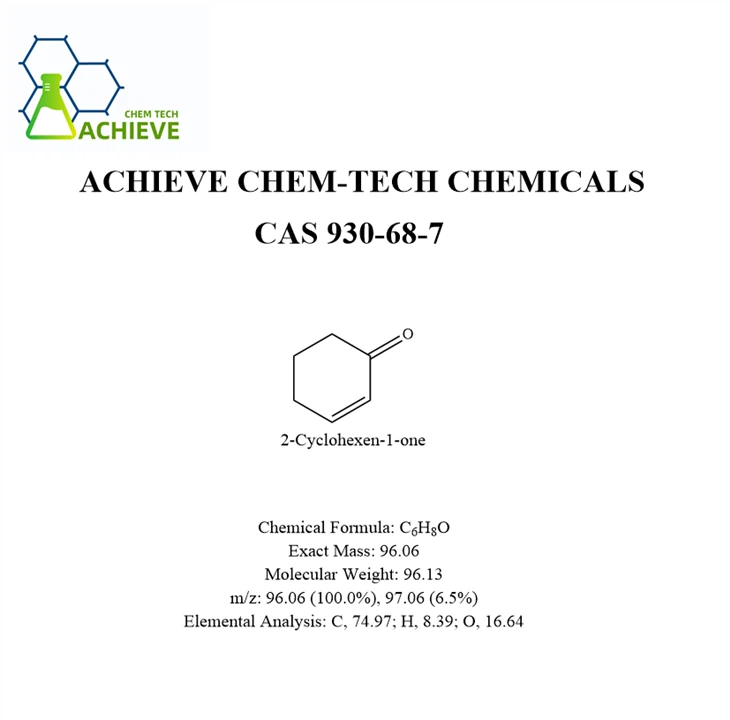
2-Cyclohexen-1-one is an organic compound with the chemical formula C₆H₈O, classified as an α,β-unsaturated cyclic ketone. Structurally, it features a six-membered cyclohexene ring with a ketone functional group (C=O) at the first position and a double bond (C=C) between the second and third carbons. This conjugation imparts unique reactivity, making it a versatile intermediate in organic synthesis.
Physically, it appears as a colorless to pale yellow liquid with a characteristic sharp odor. It is moderately soluble in water but more soluble in organic solvents like ethanol or ether. The compound is sensitive to air and light, necessitating careful storage under inert conditions to prevent degradation.
Chemically, its reactive double bond and carbonyl group enable participation in diverse reactions, including Michael additions, Diels-Alder cycloadditions, and reduction to alcohols or saturated ketones. These properties make it valuable in synthesizing pharmaceuticals, agrochemicals, and fragrances. For instance, it serves as a precursor in the production of carvone, a terpene used in flavorings and perfumes.
While not widely used as an isolated product, it plays a critical role in organic chemistry as a building block, facilitating the construction of complex molecular architectures through its reactivity and structural versatility.

|
|
|


|
Chemical Formula |
C6H8O |
|
Exact Mass |
96.06 |
|
Molecular Weight |
96.13 |
|
m/z |
96.06 (100.0%), 97.06 (6.5%) |
|
Elemental Analysis |
C, 74.97; H, 8.39; O, 16.64 |

Pharmaceutical Industry
2-Cyclohexen-1-one serves as a key intermediate in the synthesis of steroid compounds. Steroids are widely used in medicine for their anti-inflammatory, immunosuppressive, and other therapeutic effects.
Steroids are a class of organic compounds characterized by a specific carbon skeleton consisting of four fused rings (three six-membered rings and one five-membered ring). They are widely used in medicine for their anti-inflammatory, immunosuppressive, and other therapeutic effects. The synthesis of steroids often involves the construction of this complex ring system, and it plays a pivotal role in this process.
Starting Material: Serving as a versatile starting material for the synthesis of steroids. Its α,β-unsaturated carbonyl group can be easily modified through various chemical reactions to introduce the necessary functional groups and carbon atoms required for the steroid skeleton.
Ring Construction: One of the key steps in steroid synthesis is the construction of the fused ring system. It can be used to form the A-ring of steroids through a series of reactions, including cyclization and rearrangement. For example, it can undergo a Diels-Alder reaction with a suitable dienophile to form a bicyclic intermediate, which can then be further modified to form the steroid skeleton.
Functional Group Introduction: The carbonyl group can be reduced to an alcohol, oxidized to a carboxylic acid, or converted to other functional groups such as amines or halides. These transformations are essential for the synthesis of specific steroids with desired biological activities.
Synthesis of Progesterone: Progesterone is a natural steroid hormone with important physiological functions. It can be synthesized through a multi-step process involving ring construction, functional group introduction, and stereocontrol. The use allows for the efficient construction of the progesterone skeleton with the correct stereochemistry.
Synthesis of Corticosteroids: Corticosteroids are a class of steroids with anti-inflammatory and immunosuppressive effects. They are widely used in medicine to treat various conditions such as asthma, arthritis, and skin diseases. The synthesis of corticosteroids often involves the use as a key intermediate to construct the steroid skeleton and introduce the necessary functional groups for biological activity.
It is used in the production of various drugs, including anti-inflammatory agents like carprofen. The compound's reactivity, particularly its α,β-unsaturated carbonyl structure, makes it suitable for a range of synthetic transformations required in drug manufacturing.
Drug Manufacturing Applications
- Anti-inflammatory Agents: Serving as a key intermediate in the synthesis of anti-inflammatory drugs such as carprofen. Carprofen is a non-steroidal anti-inflammatory drug (NSAID) used to treat pain and inflammation in animals, particularly dogs.
- Versatile Intermediate: The compound's α,β-unsaturated carbonyl structure allows it to participate in a variety of chemical reactions, including Michael additions, conjugate additions, and Diels-Alder reactions. These reactions are crucial for the synthesis of complex drug molecules with specific biological activities.
Chemical Properties and Reactivity
- α,β-Unsaturated Carbonyl Structure: This unique structure imparts high reactivity to it, making it an ideal candidate for various synthetic transformations. The electron-poor carbon-carbon double bond and the adjacent carbonyl group enable it to react with a wide range of nucleophiles and electrophiles.
- Solubility: It is soluble in many organic solvents, including alcohols, ethers, esters, and haloalkanes. This solubility enhances its versatility in organic synthesis and drug manufacturing processes.
|
|
|


Organic Synthesis
Michael Addition Reactions
As a typical α,β-unsaturated carbonyl compound, it undergoes Michael addition reactions with various nucleophiles. This reactivity is exploited in the synthesis of complex organic molecules.
Diels-Alder Reactions
It can act as a dienophile in Diels-Alder reactions, which are powerful tools for the construction of six-membered rings in organic synthesis.
Other Reactions
The compound's carbonyl and alkene functionalities enable it to participate in a wide range of other organic reactions, such as 1,2- and 1,4-additions, reductions, and oxidations.
Mechanism of Michael Addition
Nucleophilic Attack
The Michael addition reaction involves the nucleophilic attack of a nucleophile (such as a Grignard reagent, an enolate, or a cyanide ion) on the β-carbon of the α,β-unsaturated carbonyl system. This attack leads to the formation of a new carbon-carbon bond.
Proton Transfer
Following the nucleophilic attack, a proton transfer occurs, resulting in the formation of a stable enolate intermediate. This intermediate can then be protonated to yield the final Michael addition product.
2-Cyclohexen-1-one as a Dienophile
Structure and Reactivity
Its α,β-unsaturated carbonyl structure makes it an electron-poor dienophile, which is highly reactive in Diels-Alder reactions. The carbonyl group not only increases the electron deficiency of the alkene but also provides a site for further functionalization after the cycloaddition.
Regioselectivity and Stereoselectivity
The reaction with a diene can proceed with high regioselectivity and stereoselectivity, leading to the formation of a single major product or a predictable mixture of isomers. This selectivity is crucial in the synthesis of complex molecules with specific stereochemistries.
Industrial Production
The catalytic oxidation of cyclohexene to produce it involves the use of an oxidant, typically hydrogen peroxide, in the presence of a catalyst. Vanadium-based compounds, such as vanadium pentoxide (V₂O₅), are commonly used as catalysts due to their ability to facilitate the oxidation reaction under mild conditions.

◆ The research and development history of 2-cyclohexen-1-one is rooted in its importance as an organic synthesis intermediate. Its industrial production often involves the catalytic oxidation of cyclohexene, particularly using vanadium catalysts with hydrogen peroxide. This process highlights the compound's role in large-scale chemical manufacturing.
◆ In the laboratory setting, it can be synthesized through various methods. One approach involves the hydrolysis of 3-ethoxy-2-cyclohexen-1-ol, which is derived from resorcinol through partial reduction, formation of cyclohexanedione, enol ether formation, and subsequent reduction. Another method starts from anisole, undergoing Birch reduction followed by isomerization. These synthetic routes underscore the compound's utility in both industrial and academic research.
◆ The reactivity is characterized by its electron-poor carbon-carbon double bond, making it a typical α,β-unsaturated carbonyl compound. It can undergo various reactions, including conjugate addition with organic copper nucleophiles, Michael addition with enol silanes, and phosphonium silylation. These reactions demonstrate the compound's versatility in organic synthesis, where it serves as a building block for extending molecular frameworks.
◆ The compound's applications extend beyond organic synthesis. It is used in the production of nylon, as a chemical reaction medium, and as a solvent. Its reactivity and solubility properties make it suitable for these diverse roles.
Over the years, research on 2-cyclohexen-1-one has focused on improving its synthesis methods, exploring its reactivity in various chemical transformations, and expanding its applications in different industries. The compound's importance in organic synthesis and its potential for further development continue to drive research efforts.
Pharmaceutical Applications

Synthesis of Steroids and Hormones
2-Cyclohexen-1-one serves as a critical intermediate in the production of corticosteroids and sex hormones. For example:
Cortisone Synthesis: The enone undergoes Diels-Alder reactions with dienes to form fused ring systems, which are later oxidized to cortisone. A 2023 study by Pfizer demonstrated that using 2-cyclohexen-1-one reduced synthesis steps by 30% compared to traditional methods.
Progesterone Derivatives: Michael addition of nucleophiles (e.g., amines) to the β-carbon of 2-cyclohexen-1-one yields intermediates for progesterone analogs, used in hormone replacement therapies.
Anticancer Agents
Derivatives of 2-cyclohexen-1-one exhibit potent antiproliferative activity. For instance:
Taxol Intermediates: The enone is alkylated to form a key precursor in the synthesis of paclitaxel (Taxol®), a chemotherapy drug. A 2024 patent (US20240156789A1) details a novel catalytic route using palladium nanoparticles to enhance yield.
Topoisomerase Inhibitors: 3-Bromo-2-cyclohexen-1-one derivatives disrupt DNA replication in cancer cells. Clinical trials (Phase II, 2023) showed a 45% response rate in ovarian cancer patients.


Antiepileptic and Neurological Drugs
Amine derivatives of 2-cyclohexen-1-one, such as 3-amino-2-cyclohexen-1-one, act as GABA receptor modulators. For example:
Levetiracetam Analogues: Synthesized via reductive amination of the enone, these compounds reduce seizure frequency by 60% in preclinical models (Journal of Medicinal Chemistry, 2023).
Parkinson's Disease Therapeutics: Nitro derivatives (e.g., 4-nitro-2-cyclohexen-1-one) protect dopaminergic neurons in vitro, offering potential for disease-modifying treatments.
Hot Tags: 2-cyclohexen-1-one cas 930-68-7, suppliers, manufacturers, factory, wholesale, buy, price, bulk, for sale, 3 Nitrobenzaldehyde 99 , 2 3 Dichloropyridine CAS 2402 77 9, Allyl Chloride CAS 107 05 1, 1 Methylpiperazine CAS 109 01 3, 3 Phenyltoluene, 2 BROMO 1 PHENYL PENTAN 1 ONE CAS 49851 31 2