




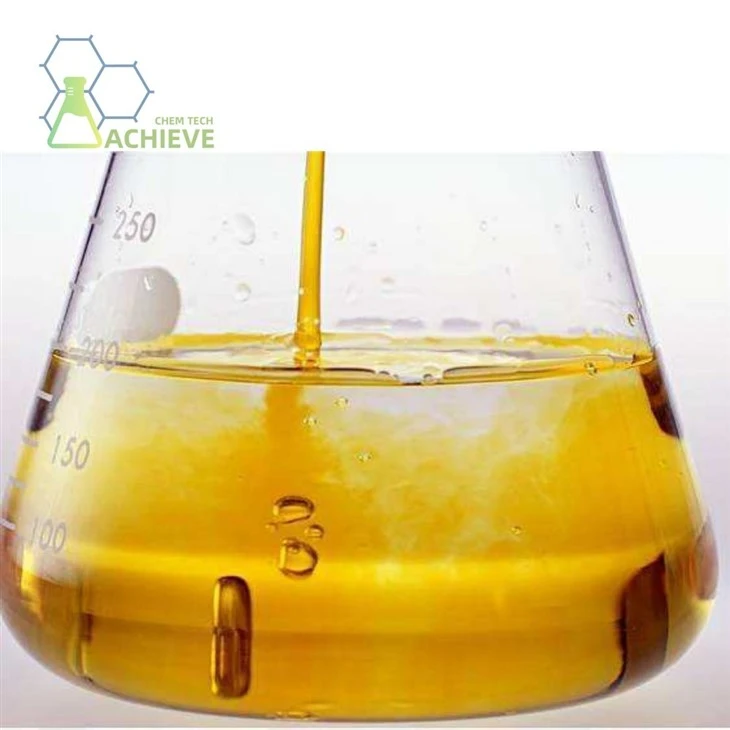
2,6-diethylaniline, CAS 579-66-8, Molecular formula C10H15N. This product is a light yellow to red transparent oily liquid. Melting point 3-4 ℃, boiling point 243 ℃, relative density 0.906 g/mL at 25 ° C (lit.), relative molecular weight 149.23. Insoluble in water, but easily soluble in organic solvents such as ethanol, ether, benzene, and toluene, it is a weakly alkaline compound that can react with strong acids to form corresponding salts, or be oxidized by oxidants to form corresponding oxidation products.
It is one of the most important amine substances. This product is an important organic synthetic intermediate used in the manufacture of dyes, pharmaceuticals, fragrances, and pesticides. It can replace tetraethyl lead as a gasoline anti knock agent. It is also an important pesticide, dye, and pharmaceutical intermediate, and is a raw material for the amide herbicides metoclopramide and butachlor. This compound can also replace tetraethyl lead as a gasoline anti knock agent, widely used in rubber additives and petrochemical fields. However, it is important to handle 2,6-diethylaniline with care due to its potential health and environmental hazards, and to implement proper safety and waste management practices to minimize its impact on human health and the environment
|
Chemical Formula |
C10H15N |
|
Exact Mass |
149 |
|
Molecular Weight |
149 |
|
m/z |
149 (100.0%), 150 (10.8%) |
|
Elemental Analysis |
C, 80.48; H, 10.13; N, 9.39 |
|
|
|


2,6-diethylaniline (DEA), as an important organic synthesis intermediate, has shown wide application value in the fields of pesticides, dyes, pharmaceuticals, rubber additives, petrochemicals, and fine chemicals due to its unique molecular structure and reactivity.

Pesticide field: Core raw materials for amide herbicides
1. Application background
DEA is a key intermediate for the synthesis of chloroacetanilide herbicides, particularly Alachlor, Butachlor, and Pretilahlor. This type of herbicide effectively controls weeds by inhibiting the protease activity of weed seedlings, hindering protein synthesis.
2. Specific examples
Alachlor
Use: Mainly used for dry land crops such as corn, soybeans, peanuts, etc., soil treatment before emergence, to control annual gramineous weeds and some broad-leaved weeds.
Dosage: 1-4 kg per hectare, effective for 4-6 weeks.
Synthesis pathway: DEA and chloroacetyl chloride are used as raw materials to produce the active ingredient metoclopramide through acylation reaction.
Advantages: High selectivity, crop safety, short soil degradation half-life (30-45 days), in line with environmental requirements.


Butachlor
Usage: Used before transplanting rice or before sowing in live fields, to prevent and control barnyard grass, irregular sedge, etc.
Mechanism of action: After contact with weed sprouts, it interferes with lipid metabolism, leading to cellular structural damage.
Market position: The global annual demand exceeds 50000 tons, accounting for 12% of the market share of herbicides for rice fields.
Pretilachlor
Innovation point: Contains acetyl structure, enhances the safety of rice and can be used for transplanting rice fields.
Technical parameters: purity ≥ 95%, melting point 38-40 ℃, registered dosage 600-900 g/ha.
3. Technical advantages
The introduction of ethyl by DEA enhances the hydrophobicity of the molecule, improves the penetration of herbicides into the plant wax layer, and reduces water solubility to reduce the risk of pesticide damage to crops.


Dyes and pigments industry: key intermediates for high-performance color materials
1. Mechanism of action
DEA, as an intermediate of azo dyes and phthalocyanine pigments, has an amino group (- NH ₂) on its benzene ring that can react with diazotizing reagents to form diazonium salts, which then interact with coupling components such as phenols and naphthols to form stable insoluble azo dyes.
2. Application examples
Synthesis of azo dyes
Example reaction: DEA is diazotized with sodium nitrite at low temperature to form 2,6-diethylbenzene diazonium salt, which is then coupled with N-phenyl-1,8-naphthalimide to produce a red dispersed dye with high light fastness.
Performance indicators: Color fastness level 4-5, suitable for dyeing polyester microfiber.
Phthalocyanine pigment modification
Process innovation: Introducing 2,6-Diethylaniline as a peripheral substituent for phthalocyanine molecules to improve the dispersibility of pigments in coatings.


Product application: Used for automotive coatings (blue phase copper phthalocyanine) and plastic coloring (green phase phthalocyanine), with a temperature resistance of up to 300 ℃.
3. Market value
In the global dye market, azo dyes account for over 60%, and the annual demand for DEA related dyes is about 80000 tons. The main suppliers include BASF, Huntsman, etc.
Pharmaceutical field: an important cornerstone of drug molecular structure modification
1. Introduction of pharmacological activity
The aniline structure of DEA can be converted into various nitrogen-containing heterocycles (such as quinoline and indole), and its ethyl substituent can regulate the lipophilicity of drug molecules, affecting drug absorption and metabolism.


2. Synthesis examples
Bromide prodrug
Reaction conditions: DEA reacted with 40% HBr aqueous solution at 0 ℃ for 7 days to produce 2,6-diethyl-4-bromoaniline (yield 82%).
Usage: As an antibiotic intermediate, introducing bromine atoms to enhance antibacterial spectrum.
Amide anti-inflammatory drugs
Synthesis pathway: DEA and methyl acrylate undergo Michael addition, followed by acetylation with acetyl chloride to produce N - (2,6-diethylphenyl) acetamide, which has antipyretic and analgesic activity.
3. Clinical value
A certain antiepileptic drug containing DEA structure has entered phase II clinical trials, and its low water soluble derivatives can prolong the efficacy for up to 12 hours.


Rubber and Petrochemical Industry: Molecular Design of Multi functional Additives
1. Rubber additives
Sulfurization accelerator: DEA reacts with carbon disulfide to produce N-cyclohexyl-2-benzothiazole sulfonamide (CZ), which is used for crosslinking tire rubber and improving wear resistance.
Antioxidant intermediate: Condensed with phenol to produce highly hindered phenolic antioxidants, which delay rubber aging.
2. Epoxy resin curing agent
Reaction characteristics: DEA undergoes ring opening polymerization with epichlorohydrin to generate a curing agent containing aniline structure, which increases the glass transition temperature (Tg) of the resin to above 120 ℃.
Application case: Used for coating wind turbine blades, with a 40% improvement in weather resistance.
3. Lubricating oil additives
Extreme pressure agent: DEA derivatives are used in photoresist to improve resolution in semiconductor manufacturing to below 0.1 μ m.


Expanding applications in the field of refinement
1. Spice industry
Synthesis of fragrance fixative: DEA is condensed with α - pentylcinnamaldehyde to produce aniline based fragrances with oriental flavor, extending the fragrance retention time by three times.
2. Special coatings
Corrosion resistant coating: DEA is involved in the preparation of modified polyaniline, and the coating remains rust free even after soaking in a 3% NaCl solution for 1000 hours.
3. Electronic materials
Photosensitizer: DEA derivatives are used in photoresist to improve resolution in semiconductor manufacturing to below 0.1 μ m.


2,6-diethylaniline (2,6-DEA) is a highly reactive ortho diethylsubstituted aromatic amine. The strong nucleophilicity of the amino group (- NH ₂) in its molecular structure and the high electron cloud density at the 4-position of the benzene ring endow it with multiple core reaction activities such as acylation, alkylation, diazotization, cyclization, and nitration. The steric hindrance of ortho diethylene can precisely regulate reaction selectivity and avoid multi substitution side reactions. It is a key active intermediate in the synthesis of fragrances, pharmaceuticals, pesticides, and dyes.
Alkylation reaction (synthesis of N-substituted amines, intermediate of fragrances/pesticides)
Reactivity: Amino nitrogen atom lone pair electron nucleophilic attack halogenated hydrocarbons/olefins to generate N-alkyl-2,6-diethylaniline, ortho steric hindrance inhibits dealkylation, and high selectivity generates mono substituted products; N-alkylation (amino reaction) and C-alkylation (benzene ring reaction) are divided, and the synthesis of fragrances is mainly based on N-alkylation.
Reaction equation: 2,6-Diethylaniline+R-X → N-R-2,6-diethylaniline+HX (R=alkyl, X=Cl/Br/I)
Raw materials and equipment
- Raw materials: 2,6-diethylaniline (99.5%, 1.0mol, 149.2g), haloalkanes (such as chloroethylpropyl ether, 99%, 1.0mol, 122.5g), sodium hydride (60% dispersed in mineral oil, 1.0mol, 40.0g, strong base catalyst), anhydrous toluene (solvent, 500mL), ice water, saturated saline solution, anhydrous sodium sulfate, ethyl acetate (extraction solvent).
- Equipment: 2L three necked flask, mechanical stirrer, constant pressure dropping funnel, nitrogen protection device, oil bath pot, separating funnel, rotary evaporator.
Detailed operation steps
- Anhydrous and anaerobic preparation: Dry a three necked flask and replace it with nitrogen three times to ensure that the system is free of water and oxygen (sodium hydride reacts violently with water, releasing hydrogen gas).
- Substrate dissolution and alkalization: Add 149.2g of 2,6-diethylaniline and 500mL of anhydrous toluene, stir and dissolve; Add 40.0g of sodium hydride in batches (5g each time, with a 5-minute interval), control the reaction temperature to ≤ 30 ℃, and avoid local overheating; After adding, stir at room temperature for 30 minutes to generate 2,6-diethylaniline sodium (a strong alkaline intermediate that enhances amino nucleophilicity).
- Haloalkane dropwise addition: 122.5g of chloroethylpropyl ether is added to a constant pressure dropping funnel, slowly dropped (1 drop/second), and dropped at room temperature for 1 hour. After the dropwise addition is complete, the oil bath is heated to 80 ℃ and stirred for 1 hour to promote complete reaction (TLC monitoring: petroleum ether/ethyl acetate=10:1, and the raw material point disappears).
- Quenching and extraction: The reaction solution is cooled to room temperature, and 500mL of ice water is slowly added dropwise to quench excess sodium hydride (control the dripping rate to avoid hydrogen gas boiling); Separate the liquid, extract the aqueous phase with ethyl acetate (3 × 200mL), and combine the organic phases.
- Drying and concentration: Wash the organic phase with * * saturated saline solution (2 × 200mL) * *, dry with anhydrous sodium sulfate (20g, let it stand for 4 hours); Filter and concentrate under reduced pressure using a rotary evaporator (40 ℃, -0.09MPa), remove the solvent, and obtain the pale yellow oily product N - (2-propoxyethyl) -2,6-diethylaniline.
Key parameters and yield
- Molar ratio: 2,6-diethylaniline: haloalkane: NaH=1:1:1 (NaH equimolar generates sodium salt to avoid excessive side reactions).
- Temperature control: Add dropwise at room temperature of 25 ℃, react at 80 ℃ (too low temperature results in slow reaction, too high temperature leads to dehalogenation).
- Reaction time: Add dropwise for 1 hour, heat and react for 1 hour.
- Yield and purity: Yield ≥ 88%, purity ≥ 98.5% (GC detection).
Reference information source:
- BenchChem. 2025. A Comparative Guide to 2,6-Diethylaniline Derivatives
- X technology two thousand and twenty-four 2,6-diethylaniline Alkylation Catalyst and Process
- ChemicalBook. 2026. 2, Application of 6-diethylaniline N-alkylation reaction
Frequently Asked Questions
What is 2,6-dimethylaniline?
+
-
2,6-dimethylaniline is a primary arylamine that is aniline in which the hydrogens at the 2- and 6-positions are replaced by methyl groups. It is used in the production of some anasthetics and other chemicals. It is a drug metabolite of lidocaine (local anasthetic).
What is the flash point of 2 6-dimethylaniline?
+
-
Flash Point: 196°F C.C.
What is another name for 2 3 dimethylaniline?
+
-
Synonyms: 2,3-Xylidine. vic-o-Xylidine.
What is the main purpose of aniline?
+
-
Description. Aniline is used in rubber accelerators and anti-oxidants, dyes and intermediates, photographic chemicals, as isocyanates for urethane foams, in pharmaceuticals, explosives, petroleum refining; and in production of diphenylamine, phenolics, herbicides and fungicides.
Why does aniline turn brown?
+
-
Due to strong electron-donating effect (+R-effect) of the NH2 group, the electron density ono the benzene ring increases. As a result, aniline is easily oxidised on standing in air for a long time to form coloured blackish brown products.
Hot Tags: 2,6-diethylaniline cas 579-66-8, suppliers, manufacturers, factory, wholesale, buy, price, bulk, for sale, 4 Diphenylamino phenylboronic Acid CAS 201802 67 7, 3 Phenyltoluene, 2-Chloro-4-pyridinecarboxylic acid, 3-Phenyltoluene, Dodecylamine, 1 1 Thiocarbonyldiimidazole CAS 6160 65 2