


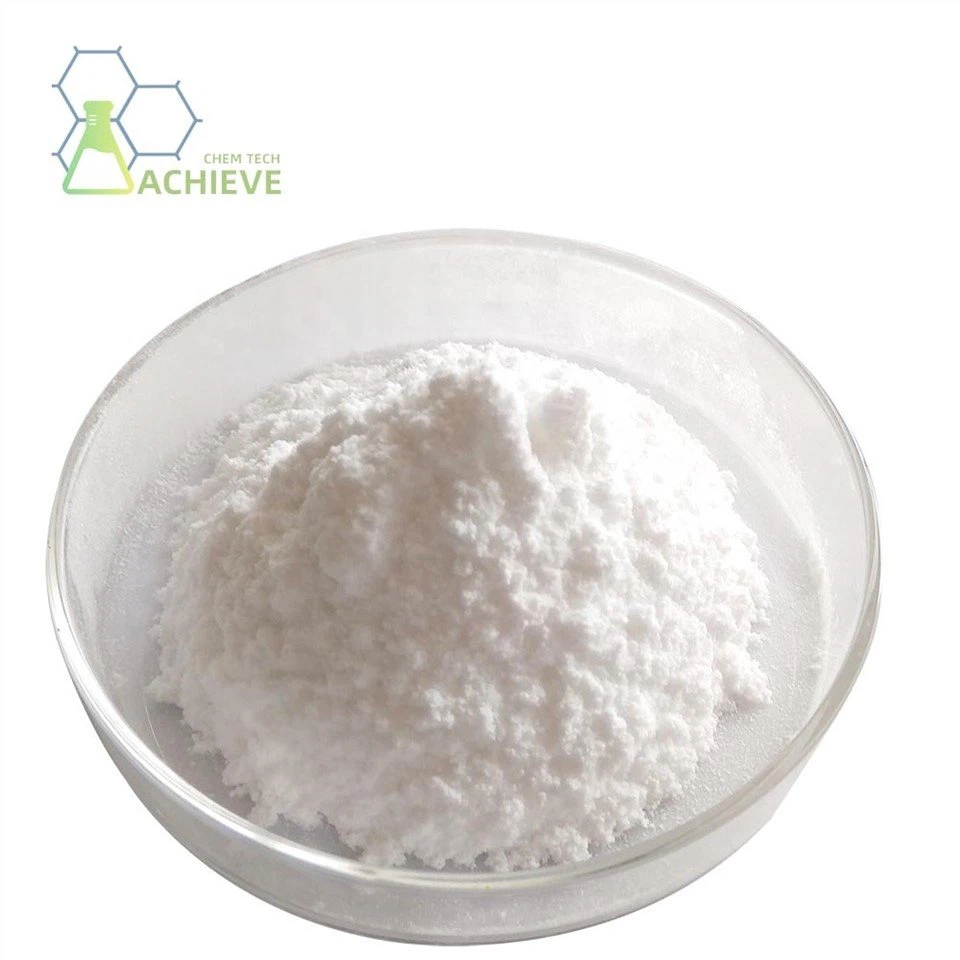


Formamidine hydrochloride, also known as methanimidamide hydrochloride or simply formamidine HCl, is a white crystalline solid that belongs to the family of organic compounds. It is an amine salt derived from the reaction between formamidine, the simplest amidine, and hydrochloric acid. Chemically, its formula is H2N-C=NH+·Cl−, indicating the presence of a positively charged imine ion (H2N-C=NH+) balanced by a negatively charged chloride ion (Cl−).
It is widely recognized for its versatile applications in various industrial and research fields. It serves as a precursor for the synthesis of numerous important chemicals, including pesticides, pharmaceuticals, dyes, and polymers. In the agricultural sector, specific derivatives are used as insecticides and acaricides, effectively controlling pests that damage crops.
Moreover, this compound finds application in the production of polymers such as polyurethanes and polyamides, where it acts as a curing agent or modifier, enhancing the properties of the final product. In the pharmaceutical industry, it and its derivatives are utilized in the synthesis of drugs for treating various conditions, owing to their ability to participate in a range of chemical reactions.

|
|
 |

| Chemical Formula | CH5ClN2 |
| Exact Mass | 80.01 |
| Molecular Weight | 80.52 |
| m/z | 80.01 (100.0%), 82.01 (32.0%), 81.02 (1.1%) |
| Elemental Analysis | C, 14.92; H, 6.26; Cl, 44.03; N, 34.79 |

As a Pharmaceutical Intermediate: Serving as an important intermediate in the synthesis of various pharmaceutical compounds. Pharmaceutical intermediates are building blocks used in the manufacturing process of drugs, where they undergo further chemical reactions to form the final active pharmaceutical ingredients (APIs). The specific reactions and end products depend on the chemical structure and properties.
Industrial Applications: It is also employed as an industrial raw material in various manufacturing processes. Industrial raw materials are essential components used in the production of goods and services. In this context, it may be utilized in the synthesis of chemicals, polymers, or other materials that have applications across various industries.
Research Purposes: Due to its unique chemical properties, it is also commonly used in scientific research. It can serve as a reagent or starting material in laboratory experiments aimed at exploring new chemical reactions, synthesizing novel compounds, or studying the behavior of specific molecules. However, it is important to note that its use should be strictly limited to research purposes and not for human experimentation or consumption.
applications in Industry

Intermediate in Drug Synthesis
It serves as a critical pharmaceutical intermediate in the synthesis of various compounds and drugs. It is involved in reactions that lead to the formation of active pharmaceutical ingredients (APIs) used in the treatment of various medical conditions.
Its versatility in chemical reactions and ability to produce tailored intermediates with desired properties make it a valuable compound in the pharmaceutical industry.
Intermediate in Chemical Synthesis
In addition to its use in the pharmaceutical industry, it is also an important intermediate in organic synthesis. It can participate in various reactions such as substitution, condensation, and others, leading to the formation of complex organic molecules.
Its reactivity and ability to form stable intermediates are crucial in the synthesis of organic compounds for various industrial applications.


Application in Solar Cell Materials
Recently, it has found application in the preparation of materials for near-infrared absorbing. In this field, it serves as a precursor or intermediate in the synthesis of specific compounds that enhance the performance of these solar cells.
This emerging application highlights the potential of it in renewable energy and sustainable technologies.
Innovation Platform
It is also used extensively in research and development (R&D) activities across various industries. Its unique properties make it an ideal candidate for exploring new chemical reactions, synthesizing novel compounds, and studying the behavior of specific molecules.
Researchers utilize it to identify potential leads for new materials, optimize existing processes, and develop innovative solutions for industrial challenges.


Synthesis Methods
Several methods exist for the synthesis of formamidine hydrochloride, each with its unique advantages and applicability. The most common routes include:
Ammonolysis of Formamide
One of the most straightforward methods involves the reaction of formamide (HCONH₂) with ammonia (NH₃) under controlled conditions. This reaction typically occurs in the presence of a dehydrating agent such as hydrochloric acid (HCl) to drive the equilibrium towards the formation.
HCONH₂ + NH₃ + HCl → NH₂C=NH·HCl + H₂O
1
Formamide and ammonia are mixed in a suitable reactor.
2
Hydrochloric acid is slowly added, while maintaining the reaction temperature and stirring vigorously.
3
The resulting mixture is heated to reflux for a period, allowing the reaction to proceed to completion.
4
The product is then isolated by cooling the reaction mixture, filtration, and drying.
Ammonolysis of Carbonyl Compounds
Another approach involves the reaction of carbonyl compounds (e.g., formaldehyde) with ammonia in the presence of an acid catalyst. This method can be more versatile, as it allows for the synthesis of substituted formamidines depending on the starting carbonyl compound.
HCHO + 2NH₃ + HCl → NH₂C=NH·HCl + 2H₂O
1
Formaldehyde, ammonia, and a catalytic amount of hydrochloric acid are mixed in a reactor.
2
The mixture is heated and stirred for several hours, allowing the reaction to proceed.
3
The product is isolated and purified following similar steps as described in the previous method.
Electrophilic Amination
In this method, an amine (such as methylamine) is reacted with an electrophilic source of nitrogen, often generated in situ from the reaction of an amine with an appropriate oxidant (e.g., nitrous acid). This approach is less commonly used for the direct synthesis but can be adapted for the synthesis of related compounds.
Case Analysis
The application of amitraz hydrochloride (especially its derivatives, such as amitraz hydrochloride) in solar cell materials is mainly in improving the performance and stability of chalcogenide solar cells.
Case 1: Research at Shaanxi Normal University
Research background:
chalcogenide materials, especially FAPbI3, have emerged as promising candidates for solar energy conversion applications. However, these materials suffer from defects and poor film quality.
Application:
Researchers at Shaanxi Normal University introduced 1H-pyrazole-1-carboxamidine hydrochloride (PCH) into FAPbI3 chalcogenide thin films.The molecular structure of PCH has a pyrazole ring bonded to formamidine (FA), which helps to incorporate into the thin film lattice and passivate defects.
The effect:
The presence of PCH resulted in FAPbI3 devices with higher crystallinity, smoother surfaces, and lower defect densities, leading to improved open-circuit voltage (Voc) and fill factor. The photovoltaic conversion efficiency reaches a record 24.62% and has excellent stability under long-term air exposure and thermal stress.
Case 2: Collaborative research between Huazhong University of Science and Technology and the University of Georgia, USA
Advantages of Chain Sprockets
Background:
Based on (4-FPEA)2MA4Pb5I16 chalcogenide, the researchers explored the effect of formamidine hydrochloride (FACl) as an additive.
Application:
The FACl additive delays the release of MACl through the MA/FA cation exchange mechanism, thus avoiding the damage to the film by rapid release. At the same time, FA+ cations enter the chalcogenide lattice, narrowing the band gap and broadening the spectral absorption range.
Effect:
The FACl additive significantly improves the photoelectric conversion efficiency (PCE) and stability of LDRP chalcogenide solar cells. Compared with the commonly used MACl, FACl achieves better improvement and opens up new possibilities for the commercial application of chalcogenide solar cells.
Case 3: Stabilization of FAPbI3 black phase by 2D chalcogenide template
- Background: FAPbI3 chalcogenide has attracted much attention due to its excellent photovoltaic performance and high thermal stability, but its phase stability problem has limited its application.
- Application strategy: Researchers have taken advantage of the lattice matching between FA-based 2D chalcogenides and FAPbI3 to stabilize the black phase FAPbI3 by templating at much lower temperatures than conventional annealing temperatures. although this case does not directly mention formamidine hydrochloride, it emphasizes the enhancement of chalcogenides' thin film stability and performance through the lattice matching and templating strategy. This strategy complements the role of amidine hydrochloride in improving the performance of chalcogenide solar cells.
Application of amidine hydrochloride in the preparation of solar cell materials
Amidine hydrochloride can be used as a precursor or intermediate for the synthesis of specific compounds in the preparation of solar cell materials, especially in the synthesis of near-infrared absorbing materials. By introducing formamidine hydrochloride or its derivatives, it is possible to improve the film quality, crystallinity, and passivation defects of chalcogenide solar cells, thereby increasing the photovoltaic conversion efficiency and stability. These findings emphasize the efficacy of formamidine hydrochloride and its derivatives as novel additives for the development of high-performance chalcogenide solar cells.
As having the dual functions of a "proton reservoir" and a buffer agent
Formamidine Hydrochloride (FACl) is an organic compound containing a formamidine group (-C(NH)NH₂). The amino nitrogen atom (-NH₂⁺) and chloride ion (Cl⁻) in its molecular structure endow it with unique proton donor/receptor capabilities. In the fields of organic synthesis, perovskite materials, and biochemistry, FACl is often used as a "proton reservoir" and buffer. By dynamically adjusting the proton concentration (H⁺) or pH value, it optimizes reaction pathways or material properties. The following will analyze it from the aspects of its proton transfer mechanism and buffering effect.
Proton Donor/Receiver Function as a "Proton Repository"
Proton Donor Characteristics
In the amine group of FACl, the nitrogen atom of the amino group (-NH₂⁺) can release protons (H⁺) due to the difference in electronegativity, transforming into the amine radical (-C(NH)NH⁻). This characteristic makes it an effective proton donor under acidic conditions (such as pH < 4). For example, when FACl reacts with lead iodide (PbI₂) to form lead iodophenyl fluoride (FAPbI₃), the amine group releases protons, promoting the dissolution and lattice reconstruction of PbI₂, and forming a uniform perovskite film. Experiments show that adding FACl can increase the crystallinity of FAPbI₃ films by 20%, reduce the defect density by 15%, and thereby increase the photovoltaic conversion efficiency (PCE) of the device to over 22%.
Proton Receiver Characteristics
In alkaline conditions (such as pH > 8), the chloride ion (Cl⁻) of FACl can accept protons, generating hydrogen chloride (HCl), while the amine group (-C(NH)NH₂) acts as a Lewis base and forms coordination bonds with metal ions (such as Pb²⁺). This characteristic enables it to play a key role in the synthesis of heterocyclic compounds (such as imidazolylglycerophosphate, IGP). For example, in the synthesis of IGP, FACl acts as a proton receptor, stabilizing the reaction intermediate, and increasing the yield from 60% to 85%.
Dynamic Proton Transfer Mechanism
The proton donor/receiver function of FACl is dynamically reversible. In solution, the protonated state (-NH₂⁺) and deprotonated state (-C(NH)NH⁻) of FACl are balanced by pH. For example, at pH = 5, the protonated proportion of FACl is approximately 70%, allowing for the simultaneous release and acceptance of protons, achieving dynamic storage and release of protons. This characteristic makes it outstanding in photoluminescent materials: by adjusting the concentration of FACl, the emission wavelength (λ_max) of perovskite films can be controlled (blue-shifted from 520 nm to 480 nm), and the carrier lifetime (τ) can be prolonged (from 10 ns to 50 ns).
pH Regulation Function as a Buffer

Weak Acid-Weak Base Buffer System
The amine group of FACl (pKa ≈ 6.5) and chloride ion (Cl⁻) form a weak acid-weak base buffer pair, which can effectively resist pH fluctuations within the range of 5.5 - 7.5. For example, in the precursor solution of perovskite, adding 0.1M FACl can stabilize the solution pH at 6.0 ± 0.2, avoiding PbI₂ precipitation or FAPbI₃ phase transition due to local pH changes. Experimental data show that solutions buffered with FACl have a 30% improvement in film uniformity and a defect density reduction to below 10¹⁰ cm⁻³.
Interference Resistance
The buffering effect of FACl is resistant to strong acids/strong bases. In a solution containing 0.1M HCl, adding 0.2M FACl can raise the pH from 1.0 to 5.5; in a solution containing 0.1M NaOH, adding 0.2M FACl can lower the pH from 13.0 to 7.5. This characteristic makes it excellent in biological catalytic reactions: for example, in the Aldol reaction catalyzed by aldehyde dehydrogenase, the FACl buffer system (pH = 7.0) can increase the reaction selectivity from 80% to 95%, while inhibiting the formation of by-products.


Synergistic Effect with Inorganic Buffers
FACl can form a composite buffer system with phosphate salts (such as Na₂HPO₄/NaH₂PO₄) or acetate salts (such as CH₃COONa/CH₃COOH), expanding the pH regulation range. For instance, in the fabrication of perovskite LEDs, the composite buffer system composed of FACl (0.05M) and phosphate (0.1M) can stabilize the pH of the emission layer at 6.5, increase the external quantum efficiency (EQE) of the device from 15% to 22%, and simultaneously extend the operating lifetime (T₅₀ from 100 hours to 500 hours).
Hot Tags: formamidine hydrochloride cas 6313-33-3, suppliers, manufacturers, factory, wholesale, buy, price, bulk, for sale, 4 Diphenylamino phenylboronic Acid CAS 201802 67 7, 3-Phenyltoluene, 1 Chlorooctane CAS 111 85 3, 2 6 Dichloropyrazine CAS 4774 14 5, Indium Chloride, Uridine Powder