


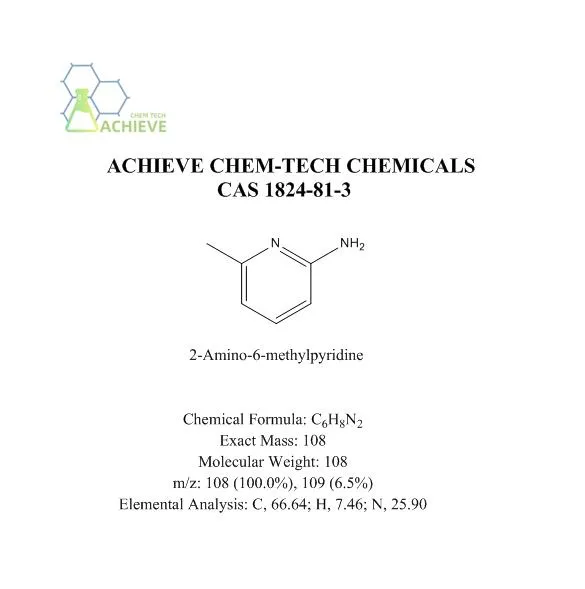

Shaanxi BLOOM Tech Co., Ltd. is one of the most experienced manufacturers and suppliers of 2-amino-6-methylpyridine cas 1824-81-3 in China. Welcome to wholesale bulk high quality 2-amino-6-methylpyridine cas 1824-81-3 for sale here from our factory. Good service and reasonable price are available.
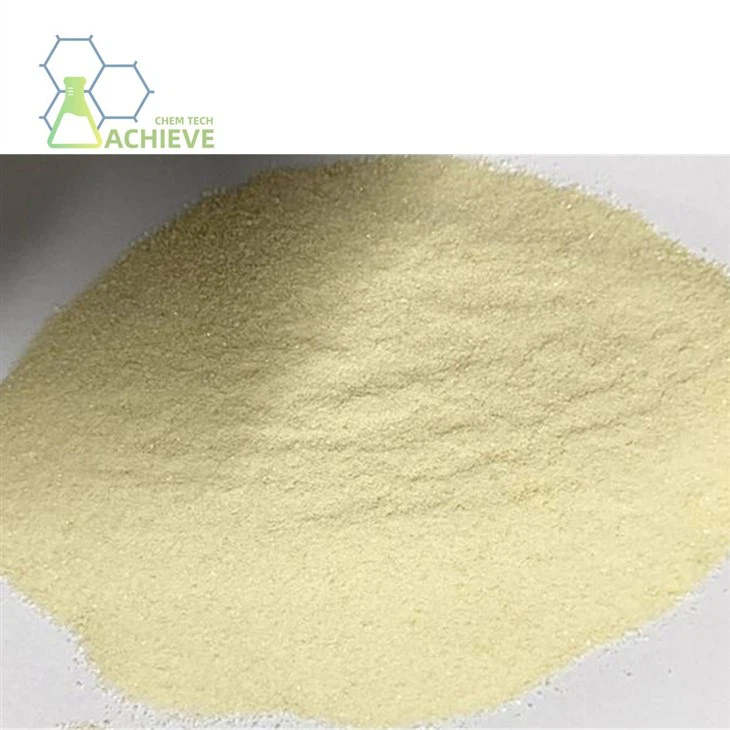
2-amino-6-methylpyridine is an important nitrogen-containing heterocyclic organic compound. Its appearance is a white to off-white crystalline powder. The molecular structure ingeniously integrates an amino group with alkaline properties and the ability to act as a hydrogen bond donor/receptor, as well as a neighboring methyl group that regulates reactivity through electronic effects and steric hindrance. Together, these features confer unique reaction properties to the molecule.
This "bifunctional" structure makes it an indispensable high-value building block in drug chemistry and materials science: it can serve as a ligand to coordinate with metal ions to form functional complexes, and is also a key starting material for synthesizing complex nitrogen heterocyclic drugs such as pyridazine imidazole and triazole, widely used in the preparation of anticancer agents, antibacterial drugs, and intermediate materials for liquid crystal materials. Thanks to its excellent molecular modifiability and structure-oriented ability, this compound continues to play a core role in promoting the innovative research and development of high-end fine chemicals and functional materials.

|
|
|

|
Chemical Formula |
C6H8N2 |
|
Exact Mass |
108 |
|
Molecular Weight |
108 |
|
m/z |
108 (100.0%), 109 (6.5%) |
|
Elemental Analysis |
C, 66.64; H, 7.46; N, 25.90 |

The following is an overview of some possible uses of 2-Amino-6-methylpyridine:
It can be used as an important intermediate in drug research and development. Its diversity and reactivity in organic synthesis make it one of the interesting starting materials for developing new drug candidates.
This compound can be used for various transformations in organic synthesis reactions. It can serve as a substitute reagent and participate in nucleophilic substitution, phosphorylation reactions, etc. In addition, it can also carry out Carbon–carbon bond formation reactions, such as series reaction, Coupling reaction, etc.

Pesticides and insecticides&Coordination chemistry

The structure and properties of it can make it an important component of pesticides and insecticides. It may be used to synthesize the active part of pesticides to improve selectivity and effectiveness against specific pests or pathogens.
This compound can form stable coordination complexes and be used for coordination chemistry research and applications. By changing its functional groups, stable complexes can be formed with metal ions, which can be applied in fields such as catalysis, sensing, and materials science.
Due to the characteristics of its molecular structure, it may exhibit photosensitive properties and can be used in photochemical reactions or as a photosensitive fluorescent probe.
This compound has good electron transfer properties and conductivity, therefore it has potential in the field of organic electronic devices. It can be used to prepare Organic solar cell, Organic field-effect transistor, organic light-emitting diodes (OLEDs) and other devices.

C (8) Chain like zygote: the extended logic of one-dimensional chains
2-Amino-6-methylpyridine, as an important organic compound, has a wide range of applications in various fields such as medicine, pesticides, and materials science. Its unique chemical structure, which includes an amino group, a methyl group, and a pyridine ring, endows it with good stability and reactivity, making it an ideal starting material for many chemical reactions. In the field of organic synthesis, constructing chain like molecules with specific lengths and structures is a challenging yet crucial task. The C (8) chain like zygote, as one of the specific length chain like structures, has important implications for the synthesis of molecules with specific functions due to its extension logic on one-dimensional chains.
Construction goals and challenges of C (8) chain like zygote
The goal of constructing the C (8) chain like zygote is to synthesize a chain like molecule with 8 carbon atoms, which extends one-dimensional from the starting point of the substance. This specific length of chain like molecule has important potential applications in drug design, material synthesis, and other fields. In drug design, chain like molecules with specific lengths may have better binding ability with targets in the body, thereby improving the efficacy and selectivity of drugs; In material synthesis, C (8) chain like subunits can serve as building blocks for synthesizing polymers or functional materials with specific properties.

challenges faced

In the process of constructing the C (8) chain like zygote, there are many challenges faced. Firstly, how to achieve precise extension of the chain is a key issue. In organic synthesis, reactions are often complex and side reactions may occur, leading to unexpected chain elongation. For example, during the carbon carbon bond formation reaction, there may be over reaction or incomplete reaction, which can affect the length and structure of the chain. Secondly, the selectivity of the reaction is also an important challenge.
There are multiple reaction sites in this molecule, and it is necessary to choose appropriate reaction conditions and reagents to enable the reaction to occur at specific sites and achieve directional chain extension. In addition, the yield and purity of the reaction are also factors that need to be considered. High yield and high purity products are crucial for subsequent applications and research. Low yield or low purity products may increase the cost of subsequent separation and purification, and even affect the accuracy of experimental results.

The chemical reaction principle of one-dimensional chain extension
Carbon Carbon Bond Formation Reaction

The formation of carbon carbon bonds is a crucial step in achieving chain extension. In the process of constructing C (8) chain like zygotes, commonly used carbon carbon bond formation reactions include coupling reactions, addition reactions, etc. For example, palladium catalyzed coupling reactions are a commonly used method for constructing carbon carbon bonds.
Taking the reaction of coupling organic zinc compounds and thioesters to obtain ketones under palladium catalyst as an example, this reaction is a classic palladium catalyzed coupling reaction discovered by Tohru Fukuyama in 1998. This reaction has high chemical selectivity, mild reaction conditions, and low toxicity of the reagents used. Due to the low reactivity of organic zinc reagents, this reaction has good functional group tolerance, and ketones, esters, sulfides, aryl bromides, aryl chlorides, aldehydes, etc. can all exist stably under these reaction conditions.


When constructing the C (8) chain like zygote, suitable organic zinc compounds and thioesters can be selected, and new carbon carbon bonds can be introduced on the molecule through palladium catalyzed coupling reactions to achieve chain extension. Another commonly used carbon carbon bond formation reaction is addition reaction. For example, a one pot reaction between ketones and p-toluenesulfonylmethyl isonitrile (TosmiC) can yield nitriles with an additional carbon. Using cuprous cyanide as a substrate, arylnitriles can be directly prepared. In the process of constructing the C (8) chain like zygote, a similar addition reaction can be used to introduce new carbon atoms at specific positions of the molecule, gradually extending the length of the chain.
In addition to carbon carbon bond formation reactions, functional group conversion reactions also play an important role in one-dimensional chain extension. By transforming the existing functional groups in the molecule, the reactivity of the molecule can be altered, creating conditions for subsequent chain extension reactions. For example, the amino group in the molecule can undergo acylation reaction to generate amide groups.


The amide group has certain stability and reactivity, and can participate in other reactions such as nucleophilic substitution reactions in subsequent reactions, thereby achieving further chain extension. In addition, methyl can also be converted into functional groups such as aldehyde or carboxyl through oxidation reactions, which have different reaction characteristics and can provide more possibilities for chain extension.
Synthesis strategy for extending one-dimensional chains
The gradual extension strategy is a commonly used method for synthesizing C (8) chain like zygotes. This strategy starts from 2-Amino-6-methylpyridine and gradually introduces new carbon atoms into the molecule through a series of chemical reactions to achieve chain extension. For example, by first utilizing the nucleophilic substitution reaction between the amino group in the molecule and halogenated hydrocarbons, a carbon atom is introduced to obtain an intermediate containing two carbon atoms.


Then, further reactions are carried out on the intermediate, such as carbon carbon bond formation reaction or functional group conversion reaction, introducing a third carbon atom, and so on, until the C (8) chain like zygote is obtained. In each step of the reaction, it is necessary to strictly control the reaction conditions and select appropriate reagents to ensure the selectivity and yield of the reaction. At the same time, it is necessary to separate and purify the products of each step to ensure the smooth progress of subsequent reactions.
The modular synthesis strategy is another effective synthesis method. This strategy decomposes the synthesis process of the C (8) chain like zygote into multiple modules, each responsible for synthesizing specific fragments, and then connects these fragments through appropriate chemical reactions to obtain the final product. For example, the C (8) chain like zygote can be divided into two four carbon fragments, synthesized separately, and then connected together through a coupling reaction.


The advantage of modular synthesis strategy is that it can improve the efficiency and selectivity of synthesis. By optimizing the synthesis conditions of each module separately, the occurrence of side reactions can be reduced and the purity of the product can be improved. In addition, the modular synthesis strategy also facilitates the modification and alteration of molecular structures. By replacing different modules, chain like molecules with different structures and functions can be synthesized.
The strategy of catalytic asymmetric synthesis is of great significance in constructing chiral C (8) chain like zygotes. Chiral molecules have unique application value in fields such as drug design and materials science. Through catalytic asymmetric synthesis strategy, chiral centers can be introduced during the synthesis process to obtain chain like molecules with specific chirality.


For example, using chiral catalysts to catalyze carbon carbon bond formation reactions or functional group conversion reactions can give the reaction a certain degree of stereoselectivity, thereby synthesizing chiral intermediates and ultimately obtaining chiral C (8) chain like zygotes. The key to catalytic asymmetric synthesis strategy lies in selecting appropriate chiral catalysts and controlling reaction conditions to achieve high enantioselectivity in synthesis.
Frequently Asked Questions
Why does its logP value have three "versions"? Which one is correct?
+
-
Both are correct, it's just that the measurement method is different. PubChem provides 0.4 (calculated value), Springer provides 0.666 (calculated value), and Activate Scientific provides 1.31 (experimental value?). This difference is due to differences in calculation methods (XLogP3 vs fragment method) and measurement conditions. Its true lipophilicity ranges from "slightly hydrophilic" to "moderately lipophilic", which happens to be within the drug like window.
Why is its pKa value "7.41 (+1)"? What does the+1 in this bracket mean?
+
-
It refers to the pKa of the conjugate acid of a monobasic. At 25 ° C, the equilibrium constant for protonation of the pyridine ring nitrogen atom to form a cation is 7.41. This value is very clever - close to physiological pH (7.4), meaning it is in a dynamic balance of protonation and deprotonation in body fluids, able to penetrate membranes and bind to targets, which is the "golden pKa" in the eyes of medicinal chemists.
Why are there three different storage temperatures for it: "-20 ° C frozen", "0-8 ° C refrigerated", and "room temperature"?
+
-
This is a continuous spectrum from "extreme conservatism" to "conventional stability". Activate Scientific label -20 ° C freezing (strictest); Chem Impex indicates refrigeration at 0-8 ° C; ChemicalBook indicates room temperature, cool and dark. Compromise suggestion: Store at 2-8 ° C for long-term storage, and store in a dry and cool place for short-term use. The key is moisture resistance.
Why is it a founding father in the history of antibiotics? Is it still useful now?
+
-
It is a key starting material for the first generation quinolone antibiotic nalidixic acid. Synthesis route: First, it is condensed with diethyl ethoxymethylene malonate, heated for cyclization, hydrolyzed, and then alkylated with iodoethane to obtain nalidixic acid. Although nalidixic acid has now been replaced by safer fluoroquinolones, its historical position is indelible.
Hot Tags: 2-amino-6-methylpyridine cas 1824-81-3, suppliers, manufacturers, factory, wholesale, buy, price, bulk, for sale, 4-Fluorophenylacetone CAS 459-03-0, 4 METHYL 2 METHYLSULFANYL PYRIMIDINE CAS 14001 63 9, 4 Propylphenylboronic Acid CAS 134150 01 9, 3 4 Dimethoxythiophene, 1 1 2 2 Tetrabromoethane CAS 79 27 6, Trimethyl Phosphate CAS 512 56 1