




Shaanxi BLOOM Tech Co., Ltd. is one of the most experienced manufacturers and suppliers of cyclohexene oxide cas 286-20-4 in China. Welcome to wholesale bulk high quality cyclohexene oxide cas 286-20-4 for sale here from our factory. Good service and reasonable price are available.
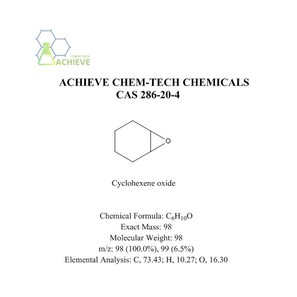
Cyclohexene oxide is an organic compound with a chemical formula of C6H10O and CAS 286-20-4. It is a product of introducing an oxygen heterocycle on cyclohexene through an epoxidation reaction. It is a colorless to pale yellow liquid that is transparent at room temperature. It is volatile and can emit a characteristic odor. The solubility in water is relatively low, about 2.4 g/100 mL. But it can be miscible with many organic solvents (such as ethanol, ether, acetone, etc.). It is a polar solvent, mainly due to the polarity brought by the oxygen atoms in it. This makes it a good catalyst and reagent in certain chemical reactions.

|
|
|

|
Chemical Formula |
C6H10O |
|
Exact Mass |
98 |
|
Molecular Weight |
98 |
|
m/z |
98 (100.0%), 99 (6.5%) |
|
Elemental Analysis |
C, 73.43; H, 10.27; O, 16.30 |

Cyclohexene oxide is an organic compound with many uses and applications. The following will give you a detailed description of the main uses of product and its application in different fields.

Pharmaceutical field
It has many applications in the field of medicine:
Drug synthesis: it is used as an intermediate to participate in the synthesis of various drugs, such as antibiotics, anticancer drugs, antiviral drugs, etc.
Reagents and ligands: it can be used as catalysts, reducing agents, ligands or activating reagents in organic synthesis to promote certain organic reactions.
Chemical modification: it can be used as a chemical modification group in drug molecules to improve the activity, selectivity and solubility of drugs by changing their structure and properties.
Cosmetics and personal care products:
it has several uses in cosmetics and personal care products:
3.1 Fragrances and fragrances: it can be used as fragrance ingredients in synthetic perfumes, fragrances and other cosmetic products.
3.2 Synthesis of alcohols and ketones: By reacting with alcohols or ketones, it can be synthesized as flavoring agents, thickeners or solvents used in cosmetics and personal care products.


Coating preparation and modification
Mechanism of action:
It is mainly used as a crosslinking agent or modifier in coatings. Its epoxy group can react with functional groups such as hydroxyl and carboxylic acids in the coating to form a stable network structure, thereby improving the performance of the coating.
Coating type:
Waterborne coatings: can be used for the preparation of water-based coatings, improving the water resistance and adhesion of coatings through their reaction with water-based resins.
UV curable coatings: In UV curable coatings, epoxy groups can participate in UV curing reactions, improving the curing speed and performance of the coating.
Powder coating: It can also be used for modifying powder coatings by reacting with powder resins to improve the melt flowability and adhesion of the coating.
Performance improvement:
Water resistance: Modified coatings have better water resistance and can maintain stable performance in humid environments.
Chemical resistance: The modified coating has enhanced resistance to chemical reagents and is suitable for use in special chemical environments.
Adhesion: Introducing can improve the adhesion between the coating and the substrate, making the coating more firm.


Mechanical properties: Modified coatings have better mechanical properties, such as hardness, wear resistance, etc.
Practical application case:
Architectural coatings: Modified architectural coatings have excellent weather resistance and adhesion, and are suitable for coating on exterior walls, roofs, and other parts of buildings.
Automotive Coatings: Modified coatings can provide better glossiness and scratch resistance in both original and repair paints for automobiles.
Industrial coatings: Modified coatings can provide stable protective performance in industrial fields such as mechanical equipment and instruments.
Adhesive preparation and modification
Mechanism of action:
In adhesives, epoxy groups can react with functional groups such as amines and hydroxyl groups to increase adhesion and improve flexibility.
Adhesive type:
Epoxy resin adhesive: can be used for the modification of epoxy resin adhesive, by reacting with epoxy resin, to improve the adhesive strength and temperature resistance of the adhesive.


Polyurethane adhesive: Introducing polyurethane adhesive can improve its flexibility and water resistance.
Acrylic adhesive: It can also be used for modifying acrylic adhesive to improve its adhesion and weather resistance.
Performance improvement:
Adhesive strength: Modified adhesives have higher adhesive strength and can firmly bond various substrates.
Temperature resistance: The modified adhesive can maintain stable performance over a wider temperature range.
Flexibility: The introduction of it gives the adhesive better flexibility, making it suitable for bonding materials with different coefficients of thermal expansion.
Practical application case:
Automotive adhesive: In the automotive manufacturing process, oxidized cyclohexene modified adhesive can be used for processes such as body welding and interior parts bonding to improve the strength and sealing of the body structure.
Electronic adhesive: In the packaging and bonding of electronic components, epoxy modified adhesive can provide stable bonding performance and temperature resistance.
Building adhesive: In building decoration, epoxy modified adhesive can be used for bonding materials such as tiles and wood, improving decoration quality and durability.


It is an important organic compound with a wide range of applications. The following are several common methods for the synthesis of product:
The most common method of synthesizing cyclohexene oxide is through epoxidation. This is obtained by reacting cyclohexene with hydrogen peroxide (H2O2) or peracetic acid. In this reaction, hydrogen peroxide is the most commonly used oxidizing agent.
The reaction equation is as follows: C6H10 + H2O2 → C6H10O
This reaction requires the use of appropriate solvents and catalysts, and commonly used solvents include ethanol, dimethyl sulfoxide, and the like. The catalyst can be a transition metal ion catalyst, such as acid-base salts, molybdate, tungstate, etc.

Another common method is to react propylene oxide with cyclohexene to generate It.
The reaction equation is as follows: C3H6O + C6H10 → C6H10O
The synthesis steps of this method are relatively simple, only need to mix and react propylene oxide and cyclohexene under appropriate conditions. The presence of a catalyst is usually also required during the reaction to increase the reaction rate and yield.
In addition to the above methods, cyclohexene chloride can also be reacted with tert-Butyl hydroperoxide to generate it. This is a lesser used synthesis method.
The reaction equation is as follows: C6H11Cl + (CH3)3COOH → C6H10O + (CH3)3COCl + H2O
This reaction requires high temperature and the presence of a catalyst, usually zinc is chosen as the catalyst. Although the conditions of this method are relatively strict, it still has its application value in specific cases.
In addition to the above-mentioned methods, some other less common synthetic methods can also be used to prepare product, such as the reaction of cyclohexene with nitrous acid, and the reaction of cyclohexene with hydrogen under the catalysis of potassium hydroxide (KOH). Peroxide (hydrogen peroxide) reaction, etc. These methods are rarely used in practical applications, but may have certain applicability under certain conditions.
It should be noted that when synthesizing product, factors such as reaction conditions, raw material purity, and catalyst selection need to be considered to improve the yield and purity and ensure safe operation. In addition, the choice of synthesis method should also be weighed according to specific needs and actual conditions.

In the early 19th century, the field of organic chemistry was experiencing rapid development. Chemists gained a better understanding of the structure and properties of various organic compounds and began to try to synthesize new compounds. It was discovered in this context.
The earliest report on It can be traced back to 1863. At that time, the British chemist Augustus Hoffman (August Wilhelm von Hofmann) first synthesized and identified It through the oxidation experiment of Cyclohexene.
Hofmann used hydrogen peroxide (H2O2) as an oxidizing agent to react cyclohexene with hydrogen peroxide under appropriate conditions. He observed a new compound in the product and successfully identified its chemical structure. He named this new compound "product", indicating that it is an epoxide of cyclohexene.
The discovery of It aroused the interest of other chemists, and it was further studied and applied in the following decades. With the advancement of technology, people have a deeper understanding of the properties and synthesis methods of product.
In the 20th century, the synthesis method of it was further improved and optimized. Chemists discovered more synthetic routes and explored new catalysts and reaction conditions. This makes the synthesis of product more efficient and feasible.
At the same time, It is also widely used in applications in various fields. It can be used as an intermediate in organic synthesis for the synthesis of other complex compounds. These compounds have important industrial and scientific value, such as certain drugs, chemicals and polymer materials, etc.
In addition, it can also be used as a solvent and reaction medium, playing an important role in organic synthesis and catalytic reactions. It has good stability and reactivity, which makes it have broad application prospects in many chemical reactions.
To sum up, the discovery history of it can be traced back to the 19th century. It was discovered in the context of early organic chemistry research and has been further developed through years of research and application. Today, Cyclohexene oxide has an important position and broad application prospects in the field of organic chemistry.
FAQ
What is cyclohexene oxide?
Cyclohexene oxide is a compound that is produced as one of the products when cyclohexene is oxidized, along with cyclohexanone, 2-cyclohexen-1-ol, and 1,2-cyclohexanediol. It has a yield of 4.9% based on the total yield of products and the reaction takes place over a period of 3 hours.
What are the products of the oxidation of cyclohexene?
The products are cyclohexene oxide, 2-cyclohexene-1-ol, 2-cyclohexene-1-one and 2-cyclohexene-1-hydroperoxide.
Hot Tags: cyclohexene oxide cas 286-20-4, suppliers, manufacturers, factory, wholesale, buy, price, bulk, for sale, METHYL 5 TERT BUTYL 2 HYDROXYBENZOATE, 2,5-Dihydroxybenzaldehyde, 2-Chloro-3-methylpyridine, Tetrabutylammonium Bromide Powder CAS 1643 19 2, 4 Phenoxyphenylboronic Acid CAS 51067 38 0, 4,4'-Dimethylbiphenyl CAS 613-33-2