


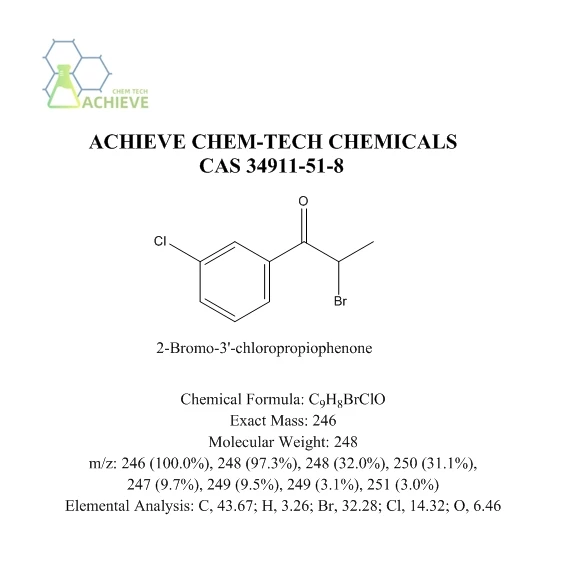
Shaanxi BLOOM Tech Co., Ltd. is one of the most experienced manufacturers and suppliers of 2-bromo-3'-chloropropiophenone cas 34911-51-8 in China. Welcome to wholesale bulk high quality 2-bromo-3'-chloropropiophenone cas 34911-51-8 for sale here from our factory. Good service and reasonable price are available.
2-Bromo-3'-chloropropiophenone is a compound in modern biochemical research and pharmaceutical synthesis. Its unique molecular structure endows it with high application potential, playing a significant role in areas such as the preparation of pharmaceutical intermediates and the development of biochemical reagents. Under standard room temperature and pressure conditions, the physical properties of this compound are closely related to its product purity and storage environment. High-purity products often exist as colorless or pale yellow crystals, while samples with certain purity gradients may appear as yellow-brown liquids. Additionally, the substance itself is irritating, requiring careful handling during experimental and production operations.
The solubility of this compound provides a solid foundation for its industrial applications. It dissolves efficiently in various common organic solvents such as ethanol, ether, chloroform, acetonitrile, dichloroethane, and ethyl acetate, while exhibiting only slight solubility in water. This differentiated solubility enables it to adapt to multiple organic synthesis protest systems. Whether in fine laboratory-scale synthesis or large-scale industrial production, it can effectively complete a series of processes such as protest, extraction, and purification, thereby expanding its application scenarios significantly.
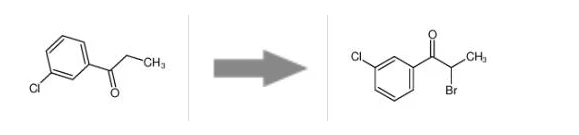
To further explore the application value of this compound, an improved and optimized synthesis process has been developed. This process uses liquid bromine and m-chloropropiophenone as core reactants and employs metal halides as specialized catalysts, which demonstrate excellent catalytic activity. During the actual protest process, this synthetic route not only exhibits fast protest rates, significantly shortening the protest cycle, but also shows strong protest selectivity, effectively suppressing side reactions. The resulting target product not only achieves a considerable yield but also maintains high purity, perfectly meeting the stringent requirements of pharmaceutical synthesis and biochemical research for high-quality and highly stable raw materials. This synthesis process holds great promise for industrial-scale implementation.

|
|
|


As a pharmaceutical intermediate
Within the pharmaceutical industry, the compound functions as a pivotal pharmaceutical intermediate, playing an indispensable part in the synthetic routes of numerous medicinal products. As a core structural unit for constructing drug molecules, it can participate in diverse chemical transformations to incorporate designated functional groups and structural segments. These tailored structural alterations are capable of endowing finished drug molecules with distinct biological activities and targeted pharmacological effects.

As a typical example, this compound ranks among the key starting materials for synthesizing rimonabant, a clinical medication employed in the treatment of obesity. Moreover, it also presents considerable development potential in the preparation of other compounds with promising pharmaceutical prospects, such as novel anticancer drugs and antiviral therapeutic candidates.

Important role in organic synthesis
In the field of organic synthetic chemistry, it also holds a pivotal position. Due to its unique molecular structure and reactivity, it can serve as a starting point or intermediate for synthesizing complex organic molecules. Organic compounds with specific structures and functions can be prepared through chemical protest such as substitution, addition, and elimination. These compounds have broad application prospects in fields such as materials science, life sciences, and pesticide chemistry. For example, they can be used as monomers for polymeric materials, synthetic raw materials for surfactants, and intermediates for dyes and pigments.
The environmental protection implications of this substance are predominantly reflected in the degradation and disposal of environmental pollutants. While direct utilization of this compound in the environmental protection sector remains relatively scarce, it is feasible to develop specialized functional catalysts and environmentally benign materials by utilizing the derivatives and intermediates formed throughout its synthetic and conversion processes.
Protection field
These as-prepared materials and catalytic agents possess considerable potential application value across multiple critical environmental remediation fields, such as industrial wastewater treatment, atmospheric pollutant purification, and contaminated soil restoration.


This drug is an important organic synthesis intermediate, has broad application prospects in the fields of medicine, pesticides, dyes, and functional materials. There are various synthesis methods, but the route based on Grignard reagent is highly favored due to its high efficiency and selectivity. This article provides a detailed description of the complete synthesis process of 2-bromo-3 '- chlorophenoacetone prepared using Grignard reagent and further converted to 2-bromo-3' - chlorophenoacetone, including raw material provision, protest condition control, product purification, and quality evaluation.
1. Pre treatment of magnesium powder: Magnesium powder is one of the key raw materials for preparing Grignard reagents, and its surface often contains impurities such as oxides and moisture, which can affect the progress of the protest. Therefore, magnesium powder needs to be pre treated before use. A common method is to wash with dilute hydrochloric acid or acetone to remove surface impurities. After washing, place the magnesium powder in a dryer to dry thoroughly and set aside for later use.

2. The mixture of bromoethane and tetrahydrofuran (THF): Bromoethane, as the alkylating reagent of Grignard reagent, has a significant impact on the protest results in terms of its purity. Mix bromoethane with an appropriate amount of THF to ensure good solubility of bromoethane in THF. THF, as a solvent, not only dissolves the reactants but also stabilizes Grignard reagents.
3. Preparation of m-chlorobenzonitrile: m-chlorobenzonitrile is a substrate for subsequent protest, and its purity also affects the quality and yield of the product. Before use, it should be checked for moisture or other impurities and dried as needed.
1. Reaction Apparatus Setup: Place pre-treated magnesium powder and an appropriate amount of THF into a dry three-neck flask equipped with a reflux condenser, a dropping funnel, and a thermometer. Since magnesium powder reacts vigorously with oxygen and moisture in the air, the entire operation must be conducted under nitrogen protection to prevent accidents.
2. Addition of Bromoethane: While stirring, slowly add a mixture of bromoethane and THF from the dropping funnel. The droplet acceleration should be controlled within a certain range to avoid excessive reaction and potential hazards. Simultaneously, close attention should be paid to temperature changes in the reaction mixture. Adjust the heating source or dropping rate to maintain the temperature of the protest mixture between 50–60°C.
3. Reaction process control: With the dropwise addition of bromoethane, it can be observed that the protest solution begins to bubble and release heat, which is a sign of Grignard reagent generation. After the dropwise addition is complete, continue heating and refluxing for 1.0-1.5 hours to ensure complete reaction of magnesium powder. During this process, the temperature and color changes of the protest solution should be continuously stirred and monitored.
4. Judgment of reaction completion: When the color of the protest solution turns dark brown or black and no more bubbles are released, it can be considered that the reaction is basically completed. At this point, heating can be stopped and stirring can be continued until the reaction mixture cools to room temperature.
1. Dropwise addition of m-chlorobenzonitrile: Transfer the prepared Grignard reagent into another dry three necked bottle through a catheter, and install an electric stirrer, reflux condenser, and thermometer. Then, slowly add m-chlorobenzonitrile dropwise while stirring. Due to the intense reaction between m-chlorobenzonitrile and Grignard reagent, the dripping rate should be slower, and the temperature and stirring of the reaction solution should be closely monitored.
2. Optimization of reaction conditions: In order to achieve higher yields and purity, it is necessary to optimize the reaction conditions. For example, by adjusting parameters such as reaction temperature, stirring speed, and reaction time, the optimal combination of reaction conditions can be found. In addition, it is also possible to try adding an appropriate amount of catalyst or ligand to promote the progress of the reaction.
3. Monitoring of the reaction process: During the reaction process, regular samples should be taken for TLC (thin layer chromatography) or GC-MS (gas chromatography-mass spectrometry) analysis to monitor the progress of the reaction and the generation of products. By comparing the sample spectra at different time points, it is possible to determine whether the reaction is complete and whether further reaction is necessary.

1. Generation of hydrolysis intermediates: After the reaction is complete, slowly add 3mol/L hydrochloric acid solution dropwise to the reaction solution to hydrolyze Grignard reagent and release the intermediates. During the dropwise addition process, attention should be paid to controlling the droplet acceleration and temperature changes of the reaction solution to avoid local overheating or violent reactions that may cause product decomposition or deterioration.
2. Separation and purification of products: After the hydrolysis reaction is completed, the inorganic phase (mainly magnesium bromide and other salts) is separated from the organic phase (containing intermediates) through a separatory funnel. Then, the organic phase is subjected to atmospheric distillation to remove low boiling point solvents such as THF. Then, vacuum distillation is carried out to collect a fraction of the target product 3-chlorophenylacetone. During the distillation process, temperature and pressure conditions should be strictly controlled to ensure the purity and yield of the product.
3. Quality assessment of the product: The purified product is evaluated for quality through melting point determination, infrared spectroscopy, nuclear magnetic resonance hydrogen spectroscopy, and other methods. Melting point determination can preliminarily determine the purity of the product; Infrared spectroscopy and nuclear magnetic resonance hydrogen spectroscopy can further confirm whether the structure of the product meets expectations.
1. Preparation for bromination reaction: Add a certain amount of 3-chlorophenylacetone, liquid bromine, solvent, and catalyst in sequence into a four necked reaction flask equipped with an electric stirrer, reflux condenser, and thermometer. The selection of solvents should take into account their solubility in reactants and products, as well as the convenience of subsequent processing; The amount of catalyst added is adjusted according to experimental needs to optimize the reaction effect.
2. Control of bromination reaction: Start heating the reaction system to the set temperature (such as 15 ℃) while stirring, and start timing. During the reaction process, close attention should be paid to the color change and stirring of the reaction solution to ensure smooth reaction. At the same time, regular samples should be taken for TLC or GC-MS analysis to monitor the progress of the reaction and the generation of products.

3. Post treatment and purification of the product: After the reaction is complete, the solvent is first removed by distillation to obtain the crude product; Then wash the crude product with water to remove residual bromides and other impurities; Then dissolve the crude product in a refined solvent (such as ethanol or acetone) and perform recrystallization treatment to obtain the pure product; Finally, refined 2-bromo-3 '- chlorophenoacetone product was obtained through filtration, drying, and other steps.
The synthesis method of it prepared by Grignard reagent and further converted has the advantages of easy operation, high yield, and good purity. However, in practical applications, attention still needs to be paid to the purity control of raw materials, optimization of reaction conditions, and post-treatment of products to ensure the quality and yield of the final product. In the future, other more environmentally friendly and efficient synthesis methods can be further explored to meet the demand for 2-bromo-3 '- chlorophenoacetone in different fields. With the continuous advancement of science and technology and the increasing awareness of environmental protection among people, it is believed that more green and sustainable synthesis methods will be developed and applied in practical production.
Frequently Asked Questions
- What is the difference between TSH and TRH?
Thyrotropin-Releasing Hormone and Thyroid-Stimulating Hormone are crucial hormones in the brain-thyroid axis, with TRH released by the hypothalamus to stimulate the pituitary to release TSH, which then prompts the thyroid gland to produce thyroid hormones (T3/T4). The key difference is their origin and role in the chain: TRH starts the process from the hypothalamus, while TSH acts as the messenger from the pituitary to the thyroid gland, forming a regulatory feedback loop where T3/T4 levels control TRH and TSH release.
- What triggers the release of TRH?
Thyrotropin-Releasing Hormone (TRH) release is primarily stimulated by low levels of thyroid hormones (T3/T4), triggering a negative feedback loop, but also by factors like cold, stress, and exercise, and various neurotransmitters (like norepinephrine) and hormones (like leptin), while being inhibited by others (like dopamine). Essentially, when the body needs more thyroid hormones, the hypothalamus releases TRH to start the chain reaction.
- What are the side effects of thyrotropin-releasing hormone?
You may experience some side effects following the TRH injection including flushing, dizziness, nausea, increased heart rate, a strange taste in your mouth and the need to pass urine. Very rarely some people experience wheeziness.
Hot Tags: 2-bromo-3'-chloropropiophenone cas 34911-51-8, suppliers, manufacturers, factory, wholesale, buy, price, bulk, for sale, 4 METHYL 2 METHYLSULFANYL PYRIMIDINE CAS 14001 63 9, d erythrose, quinone dioxime, 1 Methylpiperazine CAS 109 01 3, Bromocyclohexane CAS 108 85 0, 3 4 Pyridinedicarboxylic acid