


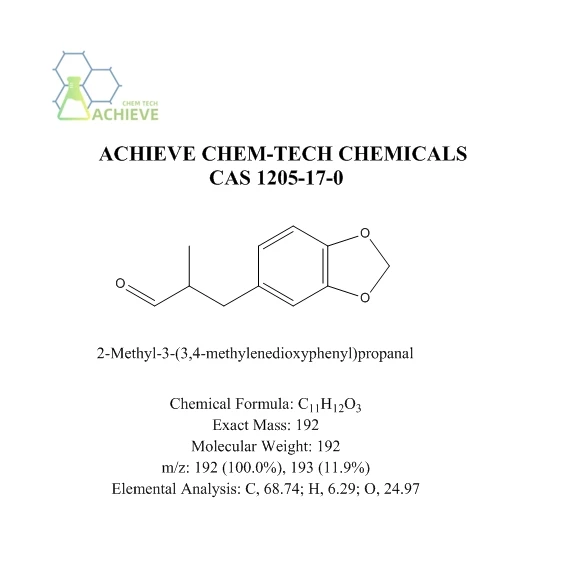


Shaanxi BLOOM Tech Co., Ltd. is one of the most experienced manufacturers and suppliers of 2-methyl-3-(3,4-methylenedioxyphenyl)propanal cas 1205-17-0 in China. Welcome to wholesale bulk high quality 2-methyl-3-(3,4-methylenedioxyphenyl)propanal cas 1205-17-0 for sale here from our factory. Good service and reasonable price are available.
2-Methyl-3-(3,4-methylenedioxyphenyl)propanal is an organic compound with a specific chemical structure. Its chemical name clearly indicates the positions and connection patterns of the methyl, methylene dioxophenyl and prouronic groups in the molecule. This compound has multiple alternative names, such as pepper propionaldehyde, new jasmine aldehyde, jasmine propionaldehyde, melon aldehyde, etc. These alternative names reflect its applications in different fields or the common names it has obtained due to its structural characteristics. The density of this compound is 1.162 g/mL at 25° C. This data is of great significance for the packaging design and the formulation of safety measures during its storage and transportation. Its boiling point is 282°C (lit.).

|
|
|


|
Chemical Formula |
C8H11Cl2NO2 |
|
Exact Mass |
223 |
|
Molecular Weight |
224 |
|
m/z |
223 (100.0%), 225 (63.9%), 227 (10.2%), 224 (8.7%), 226 (5.5%) |
|
Elemental Analysis |
C, 42.88; H, 4.95; Cl, 31.64; N, 6.25; O, 14.28 |
A higher boiling point indicates that the compound has good thermal stability, but it may still decompose or volatilize at high temperatures. Therefore, it needs to be stored and used within an appropriate temperature range. This compound is insoluble in water but soluble in organic solvents such as alcohol, chloroform and ethyl acetate. This solubility characteristic enables it to be conveniently mixed and used with other organic compounds in spice blending and organic synthesis. During storage and use, this compound should be kept away from strong oxidants to prevent chemical reactions that could lead to deterioration or danger. At the same time, it should be stored in a sealed container in a cool, dry and well-ventilated place, avoiding direct sunlight and high-temperature environments to ensure its stability and safety.

2-Methyl-3-(3,4-methylenedioxyphenyl)propanal is an aromatic organic compound that does not exist in nature and is synthesized purely by artificial means. It has both the sweetness of jasmine and the freshness of the sea. The fragrance lasts for more than 12 hours. It is known as the "gold raw material" of the global perfume industry. The appearance is a colorless to light yellow liquid with a boiling point of 134-135 ℃ (399.97Pa), a relative density of 1.162, a flash point of 126 ℃, insoluble in water but soluble in alcohol, and stable within the pH range of 3-9.

Perfume and cosmetics:
This is the most core and largest application map, accounting for over 60% of its total consumption, and it is also the fundamental reason why it is called a "precious spice".
1. The soul of high-end perfume
It is an indispensable core raw material for building "Aquatic Tone" and "Fuqi Tone" perfume. It can be used to blend the fragrance of almost all flowers, such as cyclamen, jasmine, lily of the valley, lilac, rose, etc. It is also the fixative of international famous brand perfume. Dior "Wilderness", Chanel "Blue" and other classic perfume all have their own figures, accounting for 5%~10%.
Its unique "three tone balance" characteristics - top note vitality, middle note delicacy, and long tail tone - are reshaping people's cognition of fragrance. The aroma characteristics of Xinyang Jasmine Aldehyde are accurately described as a complex of floral, green, aldehyde, and ozone like aromas, with both a gentle rabbit ear grass like floral scent and a fresh oceanic aroma.
Under the IFRA certification system, the product is non allergenic and safe for direct skin contact. IFRA has no restrictions on its use, and the dosage can be flexibly adjusted within 20%. This is extremely rare in the spice industry - most spices have strict usage limits, while New Oriental Jasmine Aldehyde can almost be used freely.


2. Comprehensive penetration of cosmetics and personal care
From morning shower gel to night fragrant candle, from face cream to body milk, it has penetrated into all aspects of daily skin care. In the cosmetics essence formula, the amount can be up to 20%, the amount of use is large and the price is high, so it is truly a "precious spice".
Blenders use it more in the preparation of "sea brand" ("ocean", "coast", "sea breeze", etc.) essence and other "modern" fantasy essence. The famous brand perfume that have emerged in the past ten years all have more or less the flavor of this substance. When used in combination with methyl dihydrojasmonate, the effect is even better, significantly enhancing the layering and persistence of the aroma.
3. The "all-in-one oil" of daily chemical essence
It can be used to mix almost all floral essence such as jasmine, rose, cyclamen, etc. in daily chemical essence, and also can be used in essence such as rabdosia, lily of the valley, lilac, neroli, magnolia, hyacinth, violet, peony, etc., to enhance the floral efficacy. Has good aroma coordination with violet ketones and rose fragrances. Sometimes it is also used as a substitute for citral - it is more stable, has a stronger aroma, and is highly resistant to alkalinity and non irritating to the skin, so it can be widely used in soap.


Home cleaning and daily washing:
The market penetration rate of Xinyang jasmonic aldehyde in the household cleaning field is growing at an average annual rate of 15%, and it is an "invisible hero" among laundry detergent, softener, soap and essence.
1. Laundry detergent and fabric softener
Added to liquid detergents and softeners, it can give clothes a long-lasting fresh floral scent. It can be used in the preparation of various liquid detergents, soap and essence, and the maximum dosage can reach 10%.
Due to its extremely long fragrance retention time, consumers can still feel a faint jasmine fragrance even after wearing clothes for several days - this is the core advantage that distinguishes New Oriental Jasmine Aldehyde from ordinary spices.
2. Deodorizers and home fragrances
In deodorant products, 2-methyl-3-(3,4-methylenedioxyphenyl)propanal has become the preferred fragrance for high-end deodorant products due to its strong ability to cover off odors and elegant floral fragrance. At the same time, it is also widely used in home scented candles, indoor spray and other products to create a warm and lasting home atmosphere.


In the field of medicine:
This is one of its most valuable application directions and also the track with the highest profit margin.
1. Synthesis of antiepileptic drugs
It is a key intermediate for the synthesis of the antiepileptic drug carbamazepine. Carbamazepine is a widely used antiepileptic drug in clinical practice, and is also used to treat diseases such as trigeminal neuralgia. Its phenylpropanoid structure gives it extremely high reactivity in drug synthesis, making it an ideal raw material for constructing drug molecular frameworks.
2. Other drug intermediates
In addition to carbamazepine, it can also be used to synthesize antidepressants, antihypertensive drugs, etc. Its antibacterial and antioxidant properties have also received attention in pharmaceutical research and development, providing rich chemical transformation pathways for new drug development.
From the perspective of profit, the theoretical profit rate can reach 30% or more, far higher than 19% of essence products, according to the calculation of pharmaceutical grade new jasmonate products. According to the latest environmental impact assessment data in 2026, the theoretical profit rate of Chinese jasmonaldehyde is 19% (essence level), while the pharmaceutical level can reach more than 30%. It is a product with extremely high visibility in the fine chemical industry.


Industry and New Materials:
Its application is far beyond the consumer goods field, and it also plays an irreplaceable role in multiple industrial scenarios.
1. Electroplating brightener
It can be used as a brightener in electroplating processes to improve the glossiness and uniformity of metal coatings, and has certain applications in electronic component manufacturing.
2. Tobacco industry
In tobacco processing, it is used to modulate special aromas and enhance the sensory quality of tobacco products.
3. Pesticide adjuvants
Its unique chemical structure allows it to be used as an adjuvant in pesticide formulations, enhancing the dispersibility and adhesion of pesticides.
4. Polymer material modifier
In the field of new materials, it can be used as a modifier of polymer materials to improve the weather resistance and aging resistance of materials.


Although the usage of this application is not large, its added value is extremely high, representing an important direction for the extension of fine chemicals to high-end manufacturing.
In addition, it is also listed as UN1993 hazardous material, belonging to category 3 of flammable liquids. Transportation requires the use of fire-fighting equipment and avoidance of mixing with oxidants. Long term toxic hazards to aquatic organisms (H411), leakage treatment and disposal should be carried out in accordance with regulations.
It is used in at least nine fields, including perfume, cosmetics, washing, food, medicine, electroplating, tobacco, pesticides, and new materials. It is truly the "king of cross-border". 2-Methyl-3-(3,4-methylenedioxyphenyl)propanal starts from a synthetic flower that does not exist in nature, and finally penetrates into almost every corner of human life - from the perfume you spray in the morning, to the pajamas you wear at night, to the vanilla ice cream after dinner, new jasmonate is everywhere, but it is silent.

Method 1:
The detailed synthesis route for 2-chloromethyl-3,4-dimethoxypyridine hydrochloride is as follows, starting from 3-hydroxy-2-methylpyridine and undergoing a series of chemical reactions
Reaction description:
Firstly, 3-hydroxy-2-methylpyridine (starting material) undergoes an oxidation reaction, usually using an oxidant such as potassium dichromate (K2Cr2O7) under acidic conditions, to oxidize the hydroxyl group to an aldehyde group, producing 3-formyl-2-methylpyridine (also known as 2-methyl-3-pyridinecarboxaldehyde).
3-hydroxy-2-methylpyridine+K2Cr2O7 → 3-formyl-2-methylpyridine
Reaction description:
Next, 3-formyl-2-methylpyridine undergoes nitration reaction under nitration conditions (usually using a mixture of concentrated nitric acid and concentrated sulfuric acid as the nitration agent), where the nitro group replaces the adjacent hydrogen atom of the methyl group to generate 3-formyl-4-nitro-2-methylpyridine.
Chemical equation: 3-formyl-2-methylpyridine+H2SO4 → 3-formyl-4-nitro-2-methylpyridine
Reaction description:
In the etherification step, the formyl (aldehyde) group and hydrogen atom on the methyl group of 3-formyl-4-nitro-2-methylpyridine are respectively replaced by methoxy groups. This is usually achieved through methoxylation reagents (such as a combination of methylation reagents and reducing agents) to generate 3,4-dimethoxy-2-methylpyridine. However, it should be noted that the direct conversion from aldehyde to two methoxy groups in one step may require multiple reactions or special reaction conditions. Here it is simplified as a one-step reaction to illustrate the overall pathway.
3-formyl-4-nitro-2-methylpyridine+methoxylation → 3,4-dimethoxy-2-methylpyridine
Reaction description:
In the acetylation step, the methyl hydrogen atom of 3,4-dimethoxy-2-methylpyridine is replaced by an acetyl group, producing 2-acetyl-3,4-dimethoxypyridine. This is usually carried out under alkaline conditions using acetylation reagents such as acetyl chloride, acetic anhydride, etc.
3,4-dimethoxy-2-methylpyridine+acetylation → 2-acetyl-3,4-dimethoxypyridine
Reaction description:
Subsequently, the acetyl group in 2-acetyl-3,4-dimethoxypyridine is hydrolyzed to hydroxyl under hydrolysis conditions (such as acid or base catalysis), producing 2-hydroxy-3,4-dimethoxypyridine.
2-Acetyl-3,4-dimethoxypyridine → 2-hydroxy-3,4-dimethoxypyridine
Reaction description:
Finally, the hydroxyl group of 2-hydroxy-3,4-dimethoxypyridine is replaced by a chlorine atom to form 2-chloromethyl-3,4-dimethoxypyridine. This step usually requires the use of chlorination reagents (such as thionyl chloride, phosphorus oxychloride, etc.) under appropriate conditions. The generated product usually exists in the form of hydrochloride salt, as the chlorination reaction may be accompanied by the generation of hydrogen ions.
2-Hydroxy-3,4-dimethoxypyridine+chlorinating reagent+2-chloromethyl-3,4-dimethoxypyridine → 2-chloromethyl-3,4-dimethoxypyridine hydrochloride
The above is a detailed synthesis route for 2-Methyl-3-(3,4-methylenedioxyphenyl)propanal, which is prepared from 3-hydroxy-2-methylpyridine through oxidation, nitration, etherification (methoxylation), acetylation, hydrolysis, and chlorination steps. It should be noted that in the actual synthesis process, the reaction conditions may need to be optimized according to specific conditions, and some steps may require multi-step reactions or special catalysts/reagents to achieve.
Method 2:
Starting from 3-methoxy-2-methyl-4-pyridone (3), a series of reactions including chlorination, oxidation, and etherification were carried out to obtain 2-chloromethyl-3,4-dimethoxypyridine hydrochloride. The detailed synthesis route is as follows:
Reaction description:
Firstly, 3-methoxy-2-methyl-4-pyridone (3) is reacted under chlorination conditions, usually using chlorine gas (Cl2) or chlorination reagents (such as phosphorus chloride, sulfonyl chloride, etc.) in the presence of appropriate solvents and catalysts. The purpose of this step is to introduce chlorine atoms into the pyridine ring, but the specific substitution position may need to be determined based on reaction conditions and raw material structure.
However, due to the potential challenges of directly chlorinating to the desired position, we assume that chlorination occurs at the ortho - or meta position of the methyl group, generating a chlorinated pyridone intermediate. However, for simplicity, we skip directly to the next intermediate, assuming it is already a suitable chlorinated compound, denoted as (4).
Note: In actual reactions, it may be necessary to protect or convert the methyl group first in order to more easily control the chlorination position.
Reaction description:
Next, the chlorinated pyridone intermediate (4) is reacted under oxidative conditions to oxidize the ketone group to a carboxyl group. This is usually carried out using oxidants such as potassium permanganate (KMnO4), potassium dichromate (K2Cr2O7), or hydrogen peroxide (H2O2) under acidic or alkaline conditions. This step generates the chlorinated pyridine carboxylic acid intermediate (5).
Chlorinated pyridone+KMnO4 → Chlorinated pyridine carboxylic acid
Reaction description:
Due to the potential difficulty of direct etherification (i.e. converting carboxyl groups to methoxy groups) on the pyridine ring, esterification reaction is usually required first to generate ester intermediates, followed by methoxylation of the ester. But here, to simplify the pathway, we can assume the existence of an indirect etherification process, in which the chlorinated pyridine carboxylic acid (5) first reacts with methanol to form an ester, which is then subjected to methoxylation (or hydrolysis followed by re methoxylation) to introduce a second methoxy group. However, a more direct approach may be to use esters as leaving groups and carry out nucleophilic substitution reactions under appropriate conditions to introduce methoxy groups.
To simplify the explanation, we will skip directly to the intermediate (6) after etherification, which is already a 3,4-dimethoxy pyridine derivative with a chlorine substituent.
Note: In actual synthesis, this step may require multiple reactions, including esterification, ester conversion (such as hydrolysis, reduction, etc.), and the final etherification reaction.
Reaction description:
After obtaining the 3,4-dimethoxy pyridine derivative (6) with a chlorine substituent, further chlorination methylation of the methyl group is required to generate 2-chloromethyl-3,4-dimethoxypyridine. This step is usually carried out under appropriate conditions using chlorinated methylation reagents (such as chloromethyl ether, a combination of chlorinated methylation reagents such as formaldehyde and hydrogen chloride, etc.).
3,4-dimethoxychloropyridine+chloromethylation → 2-chloromethyl-3,4-dimethoxypyridine
Reaction description:
Finally, 2-chloromethyl-3,4-dimethoxypyridine is reacted with hydrochloric acid (HCl) to produce 2-chloromethyl-3,4-dimethoxypyridine hydrochloride. This step is a simple acid-base reaction used to prepare stable salt forms.
2-chloromethyl-3,4-dimethoxypyridine+HCl → 2-Methyl-3-(3,4-methylenedioxyphenyl)propanal
Hot Tags: 2-methyl-3-(3,4-methylenedioxyphenyl)propanal cas 1205-17-0, suppliers, manufacturers, factory, wholesale, buy, price, bulk, for sale, 5 Methylpyridine 3 boronic Acid CAS 173999 18 3, 1 4 Phenylenebisboronic Acid CAS 4612 26 4, Sodium P toluenesulfonate CAS 657 84 1, 1 3 Propanediol Liquid CAS 504 63 2, N Ethoxycarbonyl 2 ethoxy 1 2 dihydroquinoline, tert Butyldimethylsilyl chloride