




Shaanxi BLOOM Tech Co., Ltd. is one of the most experienced manufacturers and suppliers of 3,5-di-tert-butylbromobenzene cas 22385-77-9 in China. Welcome to wholesale bulk high quality 3,5-di-tert-butylbromobenzene cas 22385-77-9 for sale here from our factory. Good service and reasonable price are available.
3,5-Di-tert-butylbromobenzene is usually white to light yellow crystals or may be in the form of crystalline powder. It has no obvious odor at room temperature. The molecular formula is C14H19Br, CAS 22385-77-9, with a molecular weight of approximately 263.21g/mole. It consists of a benzene ring, two tert butyl groups, and a bromine atom. The melting point range is relatively wide, usually between 60 to 70 degrees Celsius. Its boiling point is approximately 310-320 degrees Celsius. It has a certain solubility in common organic solvents. It can be dissolved in organic solvents such as anhydrous ethanol, toluene, and dichloromethane, while its solubility in water is relatively low. It is a combustible substance that requires attention to fire and explosion prevention measures. It is an important organic compound widely used in fields such as medicine, pesticides, and fine chemicals.

|
Chemical Formula |
C14H21Br |
|
Exact Mass |
268 |
|
Molecular Weight |
269 |
|
m/z |
268 (100.0%), 270 (97.3%), 269 (15.1%), 271 (14.7%), 270 (1.1%), 272 (1.0%) |
|
Elemental Analysis |
C, 62.46; H, 7.86; Br, 29.68 |
|
|
|


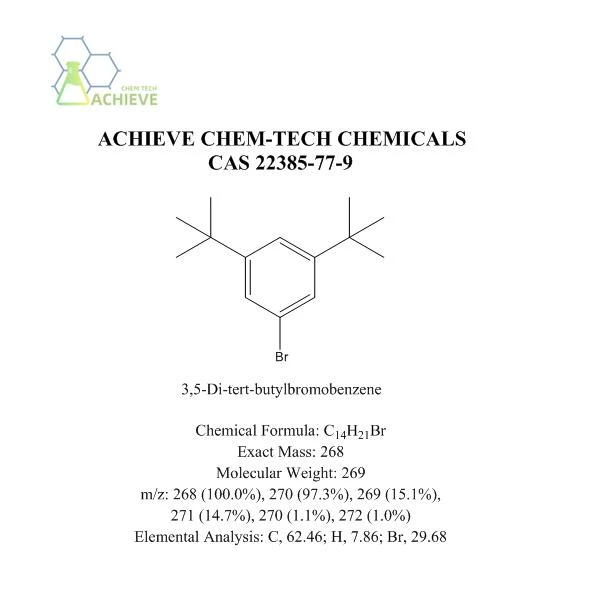
3,5-Di-tert-butylbromobenzene (molecular formula: C14H19Br) is an organic compound with the following molecular structure:
As shown in the figure, it is a benzene ring molecule, where the two hydrogen atoms at positions 3 and 5 are replaced by tert butyl groups, while the hydrogen atom at position 1 is replaced by bromine atoms.
The main feature of this molecule is the substitution of two tert butyl groups at positions 3 and 5 on the benzene ring, which are composed of four butyl carbon atoms. The presence of these tert butyl groups gives molecules a large volume and spatial isolation effect, which affects their physical and reactive properties. In addition, the presence of bromine atoms also brings certain reactivity and chemical properties to the molecules.

1. Functional polymer materials:
 Due to the special structure and the ability to introduce functional groups in 3,5-Di-tert-butylbromobenzene molecules, it can also be used to prepare polymer materials with special functions. Through appropriate synthesis strategies and reaction conditions, functional polymer materials based on 3,5 Di tert butylbromobenzene can be designed and synthesized, such as fluorescent materials, liquid crystal materials, electroactive materials, etc.
For example, by reacting 3,5 Di tert butylbromobenzene with monomers containing specific structures, functional polymer materials with characteristic properties can be obtained. These materials can be applied in fields such as fluorescent probes, display technology, and photovoltaic equipment.
Schematic equation:
C14H21Br +monomers with specific structures → functional polymer materials
2. Polymer Chemistry:
3,5 Di tert butylbromobenzene can be used for polymerization reactions in polymer chemistry. Under suitable conditions, 3,5 Di tert butylbromobenzene can participate in free radical polymerization reactions as an initiator or functional monomer, generating polymers with special structures and properties. These polymers can be applied in fields such as coatings, adhesives, plastics, etc.
3. Initiating agent:
In free radical polymerization reactions, 3,5 Di tert butylbromobenzene can serve as an initiator. The initiator initiates a free radical chain reaction in the polymerization reaction and initiates a reaction between monomers to form a polymer. Under specific conditions, 3,5 Di tert butylbromobenzene can generate free radicals through pyrolysis or photolysis, which can initiate polymerization reactions of monomers.
For example, during the polymerization process, 3,5 Di tert butylbromobenzene can generate bromine radicals through heating or ultraviolet radiation. These free radicals can react with monomer molecules, triggering chain polymerization reactions. This method can achieve efficient polymerization reactions and produce polymers with controllable structures and properties.
Schematic equation:
C14H21Br → 2 n-butyl radical
N-butyl radical+monomer → polymer chain
4. Functional monomer:
3,5 Di tert butylbromobenzene can participate in polymer synthesis as a functional monomer. By introducing specific functional groups such as amino, hydroxyl, or ester groups at the 3,5-position, 3,5 Di tert butylbromobenzene can become functional monomers with special properties. These functional groups can react with other monomers to form polymers with specific functions or properties.
For example, by reacting 3,5 Di tert butylbromobenzene with a monomer containing an amino group, a polymer containing di-tert-butylamino can be obtained. This polymer has good swelling and adsorption properties, and is suitable for fields such as catalyst carriers and separation materials.
Schematic equation:
C14H21Br + monomer (containing functional groups) → functional polymer

5. Modifier:
3,5 Di tert butylbromobenzene can be used as a modifier for polymers. By adding an appropriate amount of 3,5 Di tert butylbromobenzene to the polymer reaction, the molecular structure and properties of the polymer can be changed, and its thermal stability, mechanical properties, or solubility can be improved.
For example, in the process of synthesizing polymers, adding an appropriate amount of 3,5 Di tert butylbromobenzene can undergo a substitution reaction with the forming polymer molecules, introducing tert butyl groups. This modification can improve the thermal stability and antioxidant performance of the polymer, thereby extending the service life of the material.
Schematic equation:
C14H21Br + polymer → brominated modified polymer
6. Flame retardant:
As a brominated aromatic compound, 3,5-Di-tert-butylbromobenzene has certain flame retardancy. It can be added to plastics, rubber, and other combustible materials to improve their flame retardancy and fire resistance. This has important applications in fields such as electronic products and building materials.

3,5-Di-tert-butylbromobenzene is a brominated benzene ring compound containing two tert butyl groups, usually obtained by replacing the hydrogen atom on the benzene ring with bromine. The laboratory synthesis method for this product is as follows:
Chemical equation:
C6H6+Br2 → C6H5Br+HBr
C6H5Br+2CH3CC(CH3)3 → C6(CH3)3C6H4Br+CH3CC(CH3)3
Synthesis method:
Firstly, dissolve benzene in an appropriate solvent, such as dried dichloromethane or tetrahydrofuran. Ensure that the experiment is conducted in an inert atmosphere, such as nitrogen protection.
2. Cool the reaction system to low temperature, usually using an ice bath or low-temperature bath.
3. Add an excess of iron tribromide (FeBr3) as a bromination reagent to a solution of benzene. This reaction is carried out through electron cloud transfer. Due to the strong electrophilicity of bromine, it will remove hydrogen atoms from the benzene ring and form brominated products.
4. Stir the reaction system and maintain it at low temperature. The reaction usually takes a certain amount of time to complete.
After completing the reaction, dilute the reaction mixture with water to remove excess reagents and reaction by-products.
6. Process the organic phase through steps such as extraction, washing, and drying to separate and purify the desired target product.
7. Finally, the obtained 3,5 Di tert butylbromobenzene is subjected to crystallization, recrystallization, or other purification methods to obtain a high-purity product.

The synthesis method of 3,5 Di tert butylbromobenzene mainly includes the following steps.
Step 1: By bromination reaction, tert butyl bromide reacts with benzene to obtain benzyl bromide. This step often uses ferrous bromide as a catalyst, and the reaction takes place at room temperature. Ferrous bromide has high activity, which can accelerate the reaction rate and improve yield.
Step 2: Reduce benzyl bromide to benzylbenzene through hydrogenation reaction. Hydrogenation reaction is a commonly used reduction reaction, often catalyzed by catalysts such as palladium or platinum. The purpose of this step is to convert benzyl bromide into benzylbenzene, preparing for the next step.
Step 3: Under alkaline conditions, benzylbenzene reacts with tert butanol to produce 3,5 Di tert butylbromobenzene. Alkaline conditions can make the reaction more rapid and efficient, while the introduction of tert butanol can improve yield and selectivity. This step usually requires controlling the reaction temperature and time to ensure the integrity and yield of the reaction.
Step 4: Extract 3,5 Di tert butylbromobenzene and remove impurities through precise separation and purification processes. Common purification methods include crystallization, escape, extraction, etc. These methods can be selected based on specific circumstances and combined with molecular characteristics and actual needs to improve purity and yield.

3,5-Di-tert-butylbromobenzene is a bromine-containing aromatic compound. Its molecular structure consists of a benzene ring, two tert-butyl substituents, and a bromine atom. The following analysis is conducted from four aspects: physical properties, chemical properties, reactivity, and application fields:
Physical Properties
3,5-Dibutyl bromobenzene appears as a white to off-white crystalline powder or solid at room temperature, with a melting point range of 62-66℃. This indicates that it is stable at room temperature, but it can be converted into a liquid when heated above its melting point. The boiling point under reduced pressure (26 Torr) is 152-156℃, and it is even higher under standard atmospheric pressure (approximately 251℃), indicating its low volatility and suitability for routine experimental operations. The density of this compound is approximately 1.126 g/cm³, and its solubility is poor. At 25℃, its solubility in water is only 35 μg/L, but it is soluble in organic solvents (such as dichloromethane, ethanol, etc.). This property makes it easy to separate and purify through extraction or recrystallization in organic synthesis. When storing, it should be sealed in a dry and cool place, avoiding heat or contact with moisture to prevent decomposition or moisture absorption and caking.
Chemical Properties
Thermal Stability
The tert-butyl substituents in 3,5-dibutyl bromobenzene exhibit steric hindrance effects, which can protect the benzene ring from oxidation or attack by electrophilic reagents. At the same time, the conjugation between the bromine atom and the benzene ring enhances the overall stability of the molecule. Under normal storage conditions (at room temperature, in the absence of light, and in a dry environment), this compound is not prone to decomposition. However, high temperature or prolonged heating may cause the bromine atom to detach, generating by-products (such as 3,5-dibutylbenzene).
Light Sensitivity
Although the bromine atom itself is sensitive to light, the steric hindrance effect of the tert-butyl group reduces the conjugation degree of the benzene ring, making 3,5-dibutyl bromobenzene relatively stable under ordinary light. However, in the presence of strong ultraviolet light, photolysis reactions may occur, generating free radical intermediates, which further trigger polymerization or degradation reactions.
Acid Base Properties
This compound does not have obvious acidic or basic functional groups. However, under strong acid or strong base conditions, the bromine atom may be substituted (such as generating phenolic compounds), and the tert-butyl group may undergo elimination reactions to form alkenes. Therefore, operations should avoid direct contact with strong oxidants or strong acids and strong bases.
Reactivity

Nucleophilic Substitution Reaction
The bromine atom, as a good leaving group, can undergo substitution reactions with nucleophilic reagents (such as alcohols, amines, thiols, etc.) to form ethers, amines, or thioethers derivatives. For example, reacting with sodium ethoxide can generate 3,5-dibutylbenzyl ether, and reacting with ammonia water can generate 3,5-dibutylbenzylamine. Such reactions are usually carried out in polar aprotic solvents (such as DMF, DMSO) to increase reaction rate and selectivity.
Coupling Reaction
Under the action of palladium or nickel catalysts, 3,5-dibutyl bromobenzene can undergo coupling reactions with terminal alkenes, boronic acids, or alkenes (such as Suzuki, Heck reactions), constructing carbon-carbon bonds, and generating biphenyl or alkenylbenzene compounds. Such reactions have important applications in drug synthesis and materials science, such as preparing organic molecules with fluorescent properties or high-molecular materials.


Reduction Reaction
The bromine atom can be reduced to hydrogen atoms, generating 3,5-dibutylbenzene. Common reducing agents include lithium aluminum hydride (LiAlH₄) or borane (NaBH₄). The reaction needs to be carried out in anhydrous conditions to avoid side reactions. Additionally, the bromine atom can also be reduced by metals (such as zinc, magnesium) to generate organic metal intermediates, which can further participate in other reactions.
Application Areas

Organic Synthesis Intermediate
3,5-Dibutyl bromobenzene is a key intermediate for the preparation of various complex organic molecules, such as through coupling reactions, it can synthesize biphenyl compounds with biological activity, used in drug research (such as anti-cancer, anti-inflammatory drugs); through nucleophilic substitution reactions, functional groups can be introduced, preparing liquid crystal materials or high-molecular monomers.

Materials Science
Its derivatives (such as 3,5-di-tert-butyl styrene) can be used to synthesize polystyrene-based polymer materials. The steric hindrance effect of the tert-butyl group can improve the thermal stability and mechanical properties of the materials. Additionally, this compound can also serve as the framework for fluorescent probes, being used for biological imaging or chemical sensing.

Catalyst ligands
The bromine atoms in 3,5-di-tert-butyl bromobenzene can be replaced by other functional groups to generate ligands containing phosphorus, nitrogen or sulfur, which are used in homogeneous catalytic reactions (such as hydrogenation and oxidation reactions) to enhance the selectivity and activity of the catalyst.
Hot Tags: 3,5-di-tert-butylbromobenzene cas 22385-77-9, suppliers, manufacturers, factory, wholesale, buy, price, bulk, for sale, Triethylsilane CAS 617 86 7, 4 Aminoacetanilide CAS 122 80 5, 2 3 Dichloropyridine CAS 2402 77 9, 4 Iodopyrazole CAS 3469 69 0, 4'-Aminoacetanilide CAS 122-80-5, 2 6 Pyridinedicarboxylic acid