


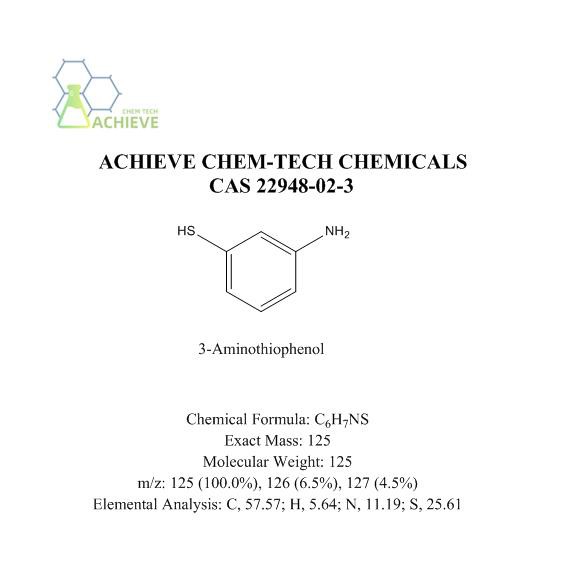


Shaanxi BLOOM Tech Co., Ltd. is one of the most experienced manufacturers and suppliers of 3-aminothiophenol cas 22948-02-3 in China. Welcome to wholesale bulk high quality 3-aminothiophenol cas 22948-02-3 for sale here from our factory. Good service and reasonable price are available.
3-Aminothiophenol is an organic compound with the chemical formula C6H7NOS, CAS 22948-02-3, and a molecular weight of 141.19 g/mol. It is a white or similar white crystalline powder. It is a polar molecule with a region of partial positive and partial negative charges. This polarity characteristic gives it good solubility in some solvents. It is a weak base. It can react with acids to form salt compounds. Having a pair of electrochemical active centers for reversible redox reactions, it can participate in redox reactions and exhibit certain redox capabilities. It can be used as a starting material or intermediate for organic synthesis. It can react with other compounds to form different functional groups, such as ketones, esters, etc. These derivatives have extensive applications in organic synthesis, such as in the preparation of drugs, dyes, and functional materials.

|
C.F |
C6H7NS |
|
E.M |
125 |
|
M.W |
125 |
|
m/z |
125 (100.0%), 126 (6.5%), 127 (4.5%) |
|
E.A |
C, 57.57; H, 5.64; N, 11.19; S, 25.61 |
|
|
|


3-Aminothiophenol has a wide range of applications in the field of electrochemistry.

1. Electrochemical catalyst:
Aminothiophenol can be used as the active component of electrochemical catalysts. Aminothiophenol can participate in electrochemical reactions, catalyze redox processes, and improve reaction rate and efficiency. For example, in fuel cells, It can be used as an anode catalyst to promote fuel oxidation reactions and improve battery performance.
2. Electrochemical sensors:
Due to its sensitivity and selectivity to specific substances, Itcan be used as an active component in electrochemical sensors. By reacting with the target molecule, it can cause changes in the electrochemical signal, thereby achieving detection and analysis of the target molecule. This type of sensor is widely used in fields such as environmental monitoring, biosensing, and chemical analysis.


3. Electrode material:
Aminothiophenol can be used as a component of electrode materials. It can combine with other materials to form composite materials, with improved electrochemical performance. For example, modifying Aminothiophenol on the electrode surface can increase the conductivity, stability, and catalytic activity of the electrode, thereby improving its performance.
4. Capacitors:
Due to its high specific capacitance and good electrochemical stability, Aminothiophenol is used as an electrolyte or electrode material for capacitors. It can provide high energy density and high charge transfer rate for preparing high-performance electrochemical energy storage devices such as supercapacitors or lithium-ion batteries.


5. Electroanalytical Chemistry:
Aminothiophenol can be used as an analytical method in electroanalytical chemistry. For example, it can be used as a reducing or oxidizing agent to participate in reactions and generate specific electrochemical signals in electrochemical analysis. This method is widely used in fields such as drug analysis, environmental monitoring, and food safety testing.
6. Electrodeposition:
Aminothiophenol can be used as an additive in the electrodeposition process. In electrodeposition, it can regulate the morphology, structure, and performance of the sediment. By controlling the concentration and addition method of Aminothiophenol, the morphology and composition of the sediment can be regulated for the preparation of specific shaped nanostructures or metal alloy materials.


7. Conductive polymer:
Aminothiophenol is a commonly used thiophene monomer that can be used to prepare conductive polymers through polymerization reactions. After polymerizing Aminothiophenol into a polymer, due to its conjugated structure, the polymer has good conductivity. This conductive polymer is widely used in fields such as organic electronic devices, flexible electronics, and optoelectronic materials.
8. Preservatives and antioxidants:
Due to its antioxidant properties, Aminothiophenol can be used as a preservative and antioxidant to protect some products from oxidation or spoilage. For example, there are applications in industries such as food, cosmetics, and plastics.


The detailed steps for the laboratory synthesis method of the product are as follows:
Step 1: Thiophene ring opening
Chemical equation:C4H4S+HNO3+H2SO4 → C4H4S2
Add thiophene and nitric acid to the reaction flask, and then add an appropriate amount of concentrated sulfuric acid as a catalyst. At an appropriate temperature (usually room temperature until the solution in the reaction bottle boils), the reaction proceeds for a period of time, causing the thiophene ring to open and react with nitric acid to form 3-mercaptothiophene.

Step 2: Sulfhydryl protection
Chemical equation:C4H4S2+C2H6O2+iodoalkanes → thiol protection products
Add 3-mercaptothiophene with ethylene glycol and iodoalkane to a reaction flask and react under appropriate conditions (usually in a suitable solvent, such as dimethyl sulfoxide) for a period of time. This step will protect the thiol group in 3-mercaptothiophene to obtain the thiol protection product.
Step 3: Amination reaction
Chemical equation:Sulfhydryl protection product+H5NO → C4H5NS
Add the thiol protection product to the reaction flask with amino reagents such as ammonia or sodium hypochlorite, and react under appropriate conditions (usually in a suitable solvent) for a period of time. This step will convert the thiol group in the thiol protection product into an amino group, forming 3-aminothiophene.
Step 4: Deprotection of thiol groups
Chemical equation:C4H5NS+reducing agent → C6H7NS
Add 3-aminothiophene and an appropriate amount of reducing agent (such as hypophosphate) to a reaction flask, and react under appropriate conditions (usually in a suitable solvent) for a period of time. This step will remove the protective group of the thiol group and reduce 3-aminothiophene to 3-Aminothiophenol.

The product (3-Aminobenzenethiol) is an important organic intermediate that has shown broad prospects in fields such as chemical synthesis, medicine, and materials science. Its unique molecular structure (containing both amino and thiol dual active functional groups) makes it a key raw material for constructing complex molecules. The future market growth potential mainly stems from technological innovation, expansion of application fields, and the promotion of green chemistry trends.
Chemical Synthesis Field: Core Raw Materials for Functional Materials and Nanotechnology

Self-assembly of nanomaterials
3-Aminobenzenethiol can be anchored to the gold substrate surface through the thiol group, forming a monolayer or a polyaniline-like structure. It has important applications in nano-electronic devices, sensors, and catalyst carriers. For example, in the self-top-down connected system composed of silver nanowires and nanospheres, it can precisely control the conductivity and optical properties of the nanostructure, promoting the development of flexible electronics and optoelectronic devices.
Polymer material modification
The synergistic effect of amino groups and thiol groups makes it a functional additive for polymer materials. Through covalent bonding, it can impart antibacterial, self-healing or conductive properties to the material, expanding its applications in intelligent packaging, biomedical materials, etc.

Pharmaceutical Field: Breakthroughs in Innovative Drug Development

Antitumor drug development
The derivatives of 3-Aminobenzenethiol show outstanding performance in targeted therapy. For instance, as an intermediate for breast cancer hormone therapy drugs, it selectively activates the androgen receptor, significantly inhibiting tumor cell proliferation while reducing the side effects of traditional hormone therapy (such as bone loss). Clinical trials have shown that this type of drug has a clinical benefit rate of 32%-52% for patients with androgen receptor-positive, estrogen receptor-positive, and HER2-negative metastatic breast cancer. It may become an important option for breast cancer treatment in the future.
Muscle atrophy and metabolic disease treatment
As a raw material for selective androgen receptor modulators (SARMs), 3-Aminobenzenethiol can promote protein synthesis and inhibit muscle breakdown, used for treating cancer cachexia, HIV-related muscle atrophy, and osteoporosis. Its advantage lies in avoiding the side effects of traditional steroids (such as prostate hypertrophy, liver toxicity), and the muscle growth results are easier to retain after discontinuation.


Green synthesis process promoting industrialization
Traditional synthesis methods have problems such as low yield and heavy pollution. The application of new catalytic technologies (such as continuous flow reactors) and biocatalysis can significantly increase yield and reduce harmful by-products. For example, using enzyme catalysis instead of chemical synthesis can not only reduce energy consumption but also improve product purity, meeting the high standards of raw materials required by the pharmaceutical industry.
Materials Science: Surface Functionalization and Innovation in Composite Materials
Metal surface modification
Through the strong binding force of thiol groups with precious metals such as gold and silver, 3-Aminothiophenol can be used to prepare surface-enhanced Raman scattering (SERS) substrates, enhancing detection sensitivity to the single-molecule level. Additionally, the modified metal nanoparticles perform well in catalysis, photothermal therapy, etc.


Conductive polymer synthesis
As the monomer precursor of polyaniline-like conductive polymers, 3-Aminobenzenethiol can regulate the conductivity and electrochemical properties of the polymer, applied in supercapacitors, anti-static coatings, and flexible electrodes, etc.
Market Prospects and Challenges
Demand growth drivers
Pharmaceutical industry: The expansion of the global antitumor drug and muscle atrophy treatment markets will directly drive demand.
Nanotechnology: The demand for functional materials in emerging fields such as flexible electronics and sensors is surging.
Green chemistry: The strictening of environmental regulations prompts enterprises to adopt low-pollution synthesis processes, promoting technological upgrades.

Main challenges
Production technology barriers: The synthesis of high-purity products requires complex process control, and the entry threshold for small and medium-sized enterprises is high.
Safety and regulation: The potential toxicity requires strict management, and some application fields (such as medicine) need to be approved by FDA or NMPA.
Market competition: With the expiration of patents, generic drugs and improved new drugs may trigger price competition, and enterprises need to maintain their advantages through technological innovation.
Future Trends and Suggestions

Technology Direction
Develop efficient catalysts and continuous manufacturing processes to reduce costs and enhance environmental friendliness.

Application Expansion
Explore applications in high-end medical fields such as bio-imaging and drug delivery systems.

Market Strategy
Customize differentiated products for different applications (e.g., pharmaceuticals, nanomaterials).

I. Mid-to-Late 19th Century
In 1887, chemist Hoffmann first synthesized o-aminothiophenol, kicking off research on aminothiophenol isomers. At that time, the dye industry flourished across Europe, and disubstituted benzene compounds bearing both aromatic mercapto and amino groups became key research targets.
Numerous reduction processes for nitro- and sulfonyl-substituted benzene derivatives were developed, laying theoretical and operational foundations for the synthesis of the meta isomer. Early researchers mainly focused on ortho and para products; the meta isomer was difficult to synthesize due to substituent directing effects, and relevant research remained merely theoretical deduction for a long time.
II. Late 19th Century – Early 20th Century
Around 1890, the Journal of Applied Chemistry of Germany first documented the preparation of crude 3-Aminobenzenethiol. Using m-nitrobenzenesulfonyl chloride as the starting material, crude mercaptoaniline mixtures were obtained via acidic reduction with iron/tin powder followed by alkaline desulfonylation hydrolysis.
The meta isomer was separated through sequential acid-base extraction and vacuum distillation. Researchers preliminarily confirmed that amino and mercapto groups were simultaneously attached to the meta positions of the benzene ring, and named the compound m-aminothiophenol. Restricted by purification technologies at that time, products obtained in this stage featured low purity, and only basic qualitative identification was accomplished.
III. Mid-to-Late 20th Century to Present
Catalytic reduction technologies matured in the mid-20th century. Synthetic routes employing zinc powder and catalytic hydrogenation drastically improved product yields.
Scientists accurately calibrated its physicochemical constants, assigned CAS No. 22948-02-3, and fully elucidated its molecular structure. After 1990, researchers in the field of surface-enhanced Raman spectroscopy (SERS) discovered that the compound can self-assemble into monolayers on gold and silver surfaces.
Consequently, 3-Aminobenzenethiol evolved into a classic probe molecule, driving continuous optimization of its synthetic processes. In recent years, novel synthetic routes such as green reduction and iodothiophenol substitution have been successively reported. This compound has grown from a niche laboratory intermediate into a core building block for materials science and pharmaceutical synthesis.
FAQ
What is the density of 3 aminothiophenol?
+
-
1.179 g/mL density. 1.179 g/mL at 25 °C (lit.)
Hot Tags: 3-aminothiophenol cas 22948-02-3, suppliers, manufacturers, factory, wholesale, buy, price, bulk, for sale, 5 Chloro 2 Nitrotoluene CAS 5367 28 2, Ritalinic Acid Powder CAS 19395 41 6, 4 Amino 2 chloropyridine CAS 14432 12 3, 1-Bromohexadecane, 4-Fluorophenylacetone CAS 459-03-0, D-tert-Butylglycine