


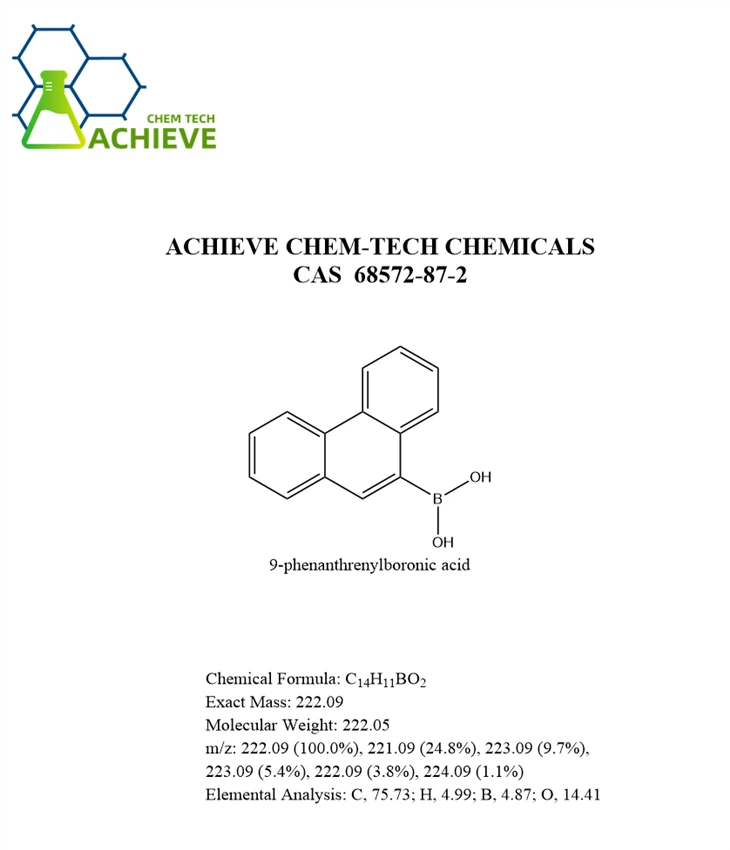



Shaanxi BLOOM Tech Co., Ltd. is one of the most experienced manufacturers and suppliers of 9-phenanthrenylboronic acid cas 68572-87-2 in China. Welcome to wholesale bulk high quality 9-phenanthrenylboronic acid cas 68572-87-2 for sale here from our factory. Good service and reasonable price are available.
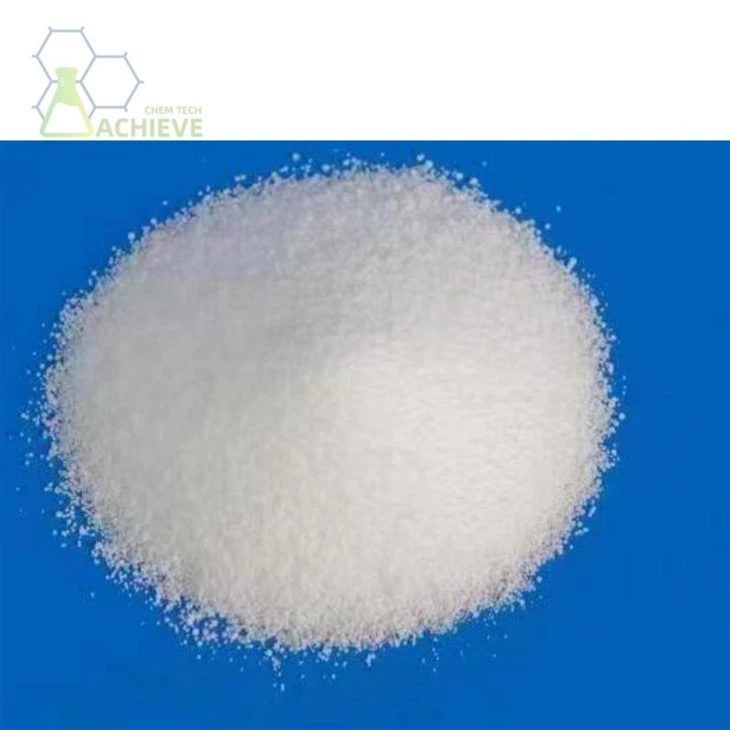
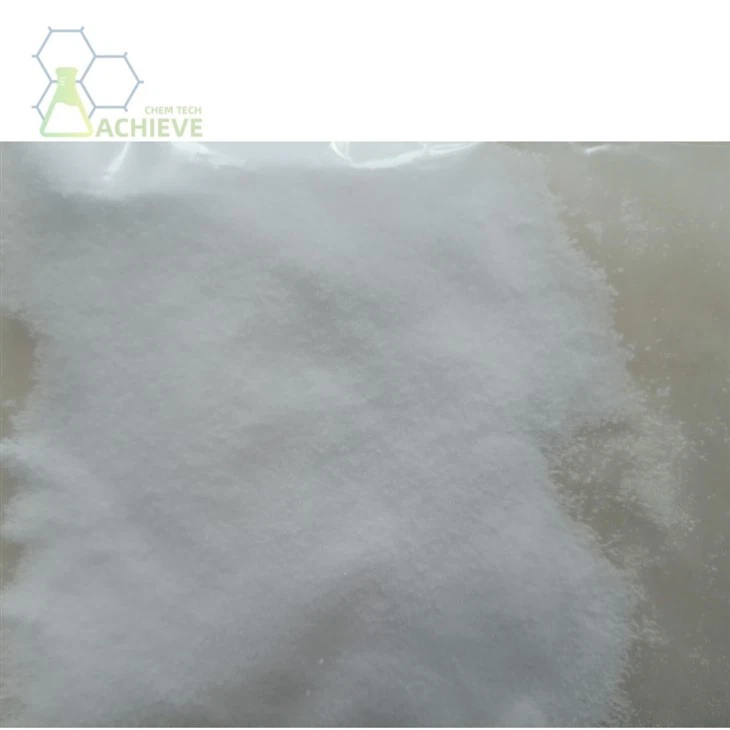
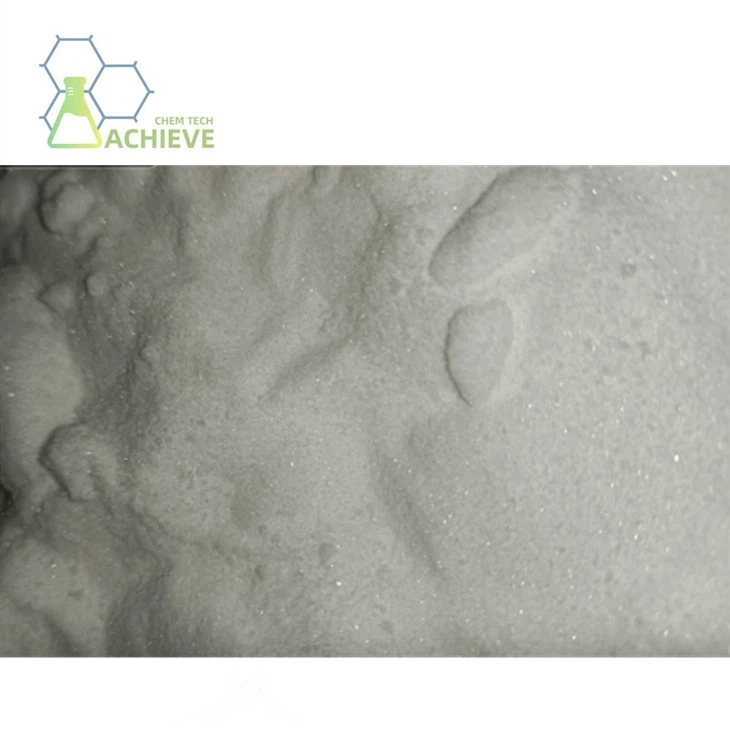
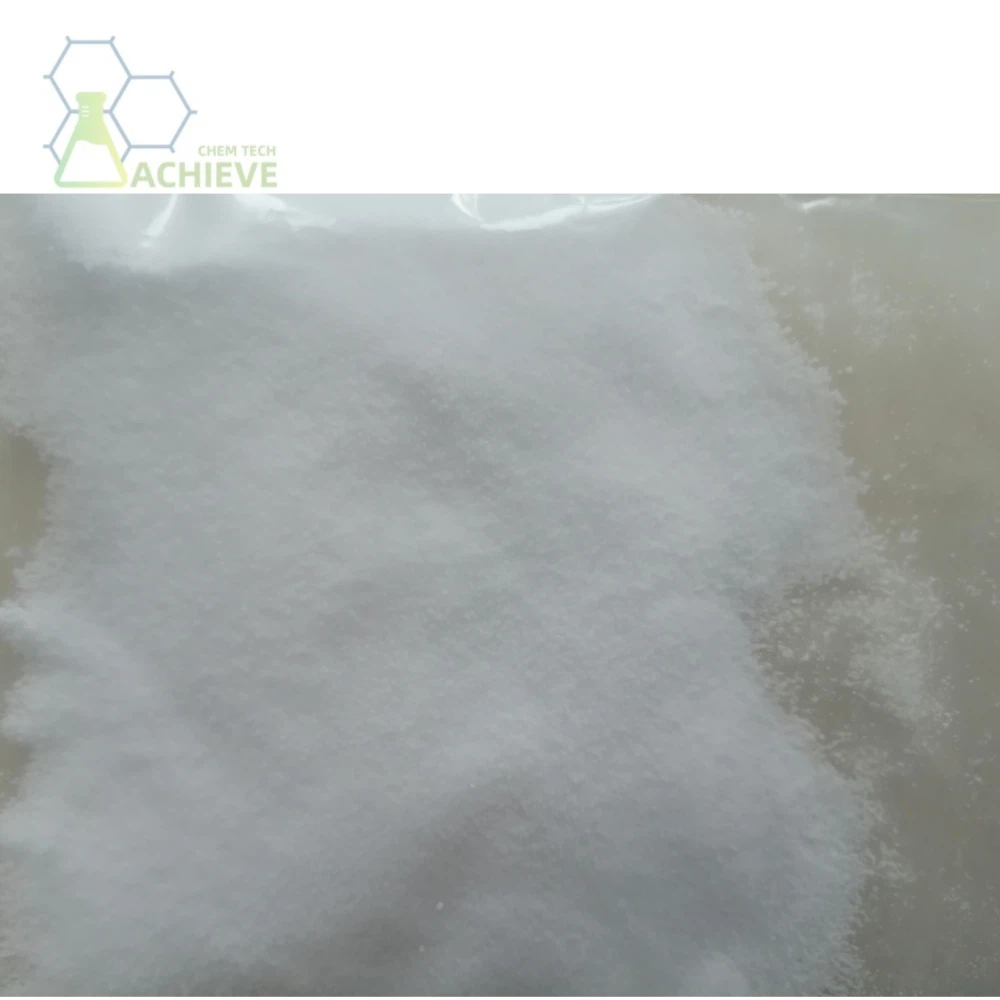
9-phenanthrenylboronic acid is a chemical substance that usually appears as a powder or white crystal. Its industrial grade product purity can reach 98% or 99%, and it is soluble in DMSO (dimethyl sulfoxide). It is mainly used as an intermediate in synthetic materials and has a wide range of applications in the field of organic synthesis. It can participate in various chemical reactions, such as Suzuki coupling reactions, and is used to synthesize organic compounds with specific structures and functions.

Additional information of chemical compound:
|
Chemical Formula |
C14H11BO2 |
|
Exact Mass |
222.09 |
|
Molecular Weight |
222.05 |
|
m/z |
222.09(100.0%),221.09(24.8%), 223.09 (9.7%),223.09 (5.4%), 222.09 (3.8%), 224.09 (1.1%) |
|
Elemental Analysis |
C, 75.73; H, 4.99; B, 4.87; O, 14.41 |
|
Melting point |
165-170℃ |
|
Boiling point |
479.5±28.0℃(Predicted) |
|
Density |
1.26±0.1 g/cm3(Predicted) |
|
|
|


Research Progress and Applications in Ultrafast Spectroscopy
Ultrafast spectroscopy is an experimental technique used to study the response of substances to light excitation within extremely short time intervals. By achieving femtosecond (10⁻¹⁵ seconds) or even attosecond (10⁻¹⁸ seconds) time resolution, it reveals ultrafast dynamic processes such as electron transitions and lattice vibrations in molecules and atoms. 9-Phenanthrenylboronic Acid, due to its unique boronic acid group and conjugated structure with the phenanthrene ring, has become an important model molecule in ultrafast spectroscopy for studying photophysical and photochemical processes.
Principles of Ultrafast Spectroscopy and the Compatibility of 9-phenanthrenylboronic Acid
The core of ultrafast spectroscopy lies in utilizing the pump-probe mechanism. Through two time-delayed femtosecond laser pulses (the pump light excites the sample, and the probe light monitors the changes in the excited state), the dynamic response of the substance within an extremely short period of time can be captured. The phenyl ring structure of 9-phenylboronic acid has a rigid plane, which can form a stable π-conjugated system, while the boronic acid group (-B(OH)₂) endows it with specific recognition ability (such as binding to cis diols).
These structural characteristics give it dual advantages in ultrafast spectroscopy research:
Optical physical properties: The conjugated system of the phthalocyanine ring can support the transition of electrons from the ground state (S₀) to the excited state (S₁/T₁), generating fluorescence or phosphorescence signals. Ultrafast spectroscopy can track the lifetimes, energy transfer pathways, and non-radiative relaxation processes of these excited states.
Chemical dynamic processes: The binding of the boronic acid group to the target molecule (such as glucose) involves dynamic hydrogen bond formation and breakage. Ultrafast spectroscopy can monitor the rate constants and intermediate states of these processes in real time.
Typical Applications of 9-phenanthrenylboronic Acid in Ultrafast Spectroscopy Research

Excited state dynamics research
Through femtosecond transient absorption spectroscopy (fs-TAS), researchers can observe the excited state absorption (ESA), ground state bleaching (GSB), and stimulated emission (SE) signals of 9-phenylboronic acid after optical excitation.
For example, when the pump light matches its absorption peak, the π electrons of the phthalocyanine ring are excited to the S₁ state, and then relax to the ground state through internal conversion (IC) or intersystem crossing (ISC). fs-TAS can precisely measure the relaxation times (such as the S₁ state lifetime in the picosecond to nanosecond range), revealing the mechanisms of intramolecular charge transfer and energy dissipation.


Tracking of photochemical reaction intermediates
In chemical reactions involving the boronic acid group (such as the formation of cyclic esters with glucose), ultrafast spectroscopy can capture the key intermediates in the reaction path. For example, after excitation by the pump light, the empty p orbital of the boronic acid group forms a coordination bond with the hydroxyl oxygen of glucose, and fs-TAS determines the reaction rate and activation energy by monitoring the changes in characteristic absorption peaks, providing a basis for optimizing reaction conditions.
Analysis of nonlinear optical response
9-Phenylboronic acid may exhibit nonlinear optical effects (such as two-photon absorption, third-order nonlinear polarization) under strong femtosecond laser irradiation. Through Z-scan techniques or four-wave mixing experiments, its nonlinear optical coefficients can be quantified, evaluating its potential in applications such as optical limiting and all-optical switching.

Technical Challenges and Solutions
Signal superposition problem
In fs-TAS, excited state absorption and ground state bleaching signals may overlap, making data interpretation difficult. Researchers use global fitting algorithms (such as exponential decay models) or machine learning-assisted analysis to separate the contributions of different signals, improving the accuracy of kinetic parameters.
Sample uniformity control
The aggregation state of 9-phenylboronic acid in solution or film may affect the light absorption behavior. In experiments, quartz cuvettes or vacuum evaporation techniques should be used to ensure uniformity without bubbles and to control the pump light wavelength to match the absorption peak of the sample, avoiding ineffective excitation.
Time zero-point calibration
The time delay between the pump light and the detection light needs to be accurate to the femtosecond level. By measuring known ultrafast processes (such as Rayleigh scattering) or using optical delay lines (with precision up to hundreds of nanometers), the "time zero-point" can be calibrated to ensure data reliability.
Fluorescent Analytical Reagent

9-Phenanthrenylboronic Acid is widely used as a fluorescent analytical reagent in the field of biochemical detection, relying mainly on the strong fluorescence of its phenanthrene ring structure and the specific binding ability of the boronic acid group.Its primary application is the specific detection of glucose. The boronic acid group can specifically bind to the cis-diol structure in the glucose molecule to form a cyclic boronate ester, which in turn triggers a reversible change in its own fluorescence signal.
By monitoring fluctuations in fluorescence intensity, glucose concentration can be accurately quantified, with detection sensitivity reaching the nanomolar level, providing an efficient and convenient detection method for biochemical scenarios such as clinical blood glucose monitoring.In addition, it can be used to construct fluorescent sensing systems. With its excellent fluorescence quantum yield and photostability, it has been extended to the detection of certain biomolecules and environmental pollutants. Meanwhile, its water solubility and sensing performance can be optimized through structural modification to adapt to different detection scenarios, showing promising application potential and development prospects in the fields of biosensing and precision detection.


Future Research Directions

Multidimensional ultrafast spectroscopy combination
Combining femtosecond transient absorption spectroscopy with time-resolved fluorescence spectroscopy (TRFLS) can simultaneously obtain excited state absorption and emission information, comprehensively analyzing the optical physical pathways of 9-phenylboronic acid.
In situ environment simulation
Studying the light response of 9-phenylboronic acid in physiological pH or complex biological media to simulate its actual application scenarios in glucose sensing or cell imaging.

Theoretical calculation assistance
Through quantum chemical calculations (such as TD-DFT), simulating the excited state energy levels and transition dipole moments of 9-phenylboronic acid, providing theoretical support for experimental data and guiding molecular structure optimization.

|
|
|
|
|


9-Phenanthrenylboronic Acid is a boron-containing organic compound. Its chemical properties mainly revolve around the interaction between the boronic acid group (-B(OH)₂) and the conjugated system of the phenanthrene ring, exhibiting unique reactivity, physical properties, and chemical behaviors under specific conditions.
The boronic group of 9-fluorenylboronic acid is the core of its chemical properties. This group has two hydroxyl groups (-OH), making it weakly acidic in solution (pKa ≈ 8.5), and it can react with bases to form borates. More importantly, the boronic group can specifically bind to cis diols (such as glucose, fructose), forming reversible cyclic esters. This reaction is highly efficient under physiological pH conditions (such as pH 7.4) and has high selectivity for the cis diol structure, with strong anti-interference ability. For example, in glucose sensing, 9-fluorenylboronic acid can achieve micro-molar-level detection through fluorescence signal changes, and the cross-reaction rate with other sugars (such as lactose, maltose) is less than 5%.
Furthermore, the boronic group is a key participant in the Suzuki-Miyaura cross-coupling reaction. Under the action of a palladium catalyst, 9-fluorophenylboronic acid can react with halogenated aromatics (such as bromobenzene, iodoanisole) to form carbon-carbon bonds and generate polynuclear aromatic compounds. This reaction is mild (usually carried out at 80-100°C), has a high yield (up to 90% or more), and has good compatibility with functional groups, making it an important method for synthesizing polycyclic aromatic hydrocarbons (PAHs) and drug intermediates.
The phenyl ring structure of 9-phenylboronic acid consists of three fused benzene rings, forming a rigid planar conjugated system. This structure endows it with unique physical properties:
Optical properties: The conjugated system of the phthalocyanine supports π→π* electronic transitions, giving 9-phenoxyboronic acid strong absorption in the ultraviolet-visible light region (250-400 nm). Its fluorescence emission peak is usually located at 450-550 nm (blue-green light), with a quantum yield of up to 0.3-0.5, making it suitable for fluorescence sensing and imaging.
Thermal stability: The melting point of 9-phenoxyboronic acid is 165-170℃, and the predicted boiling point is 479.5℃, indicating that it can maintain structural stability at high temperatures. This property makes it potentially applicable in high-temperature reactions (such as coupling reactions).
Solubility: 9-phenoxyboronic acid has good solubility in polar non-aqueous solvents (such as dimethyl sulfoxide, DMSO), but has low solubility in water (about 0.1 mg/mL). By modifying the structure (such as introducing sulfonic acid groups), its water solubility can be significantly improved.
9-phenoxyboronic acid can be stable for a long time under dry and light-protected conditions. Its boronic acid group is stable in acidic or neutral environments, but it is prone to hydrolyze in strong alkaline conditions (pH > 10), generating borate and phenoxyphenol. Additionally, long-term exposure to the air may lead to partial oxidation, generating phaeonol-type impurities. Therefore, the recommended storage conditions are: sealed in a desiccator, protected from light, and kept at a temperature below room temperature (25℃).
Chemical Dynamics in Ultrafast Spectroscopy
In the study of ultrafast spectroscopy, the chemical dynamic process of 9-phenoxyboronic acid can be tracked using femtosecond laser pulses. After being excited by light, the π electrons of the phenyl ring transition from the ground state (S₀) to the excited state (S₁), and then relax back to the ground state through internal conversion (IC) or intersystem crossing (ISC). The binding process of the boronic acid group with the target molecule (such as glucose) can also be monitored by ultrafast spectroscopy, revealing the dynamic paths of hydrogen bond formation and breakage. For example, the pump-probe experiment shows that the rate constant of the boronic acid-sugar binding can reach 10⁸ - 10⁹ M⁻¹s⁻¹, indicating an extremely fast reaction rate.
The chemical properties of 9-phenoxyboronic acid make it valuable for applications in multiple fields:
Organic Synthesis: As a reagent for the Suzuki coupling reaction, it is used to synthesize polycyclic aromatic hydrocarbons and drug intermediates (such as FLAP protein inhibitors, PARP-2 selective inhibitors).
Bio-Sensing: By utilizing the specific binding of borate and sugar, a glucose fluorescence probe is developed to achieve continuous blood glucose monitoring for diabetic patients.
Materials Science: Participating in the synthesis of conjugated polymers, which are used in organic light-emitting diodes (OLEDs) and organic photovoltaic devices to enhance charge transport efficiency.
FAQ
Is phenanthrene a solid or liquid?
+
-
Phenanthrene is a colorless to white, crystalline (sand-like) solid with a faint odor. It is used in dyestuffs, explosives, research, and in making drugs.
What is naphthalene 2 boronic acid?
+
-
Naphthalene-2-boronic acid, is a synthetic fine chemical useful in the synthesis of pharmaceuticals and fine organic chemicals.
Hot Tags: 9-phenanthrenylboronic acid cas 68572-87-2, suppliers, manufacturers, factory, wholesale, buy, price, bulk, for sale, 4 Aminobenzonitrile CAS 873 74 5, 4 METHYL 2 METHYLSULFANYL PYRIMIDINE CAS 14001 63 9, 2 Chloro 4 6 dimethoxypyrimidine, 2 4 Quinolinediol, 5 Fluoro 2 Nitroaniline CAS 2369 11 1, 2 Bromo 9 9 spirobifluorene