







Shaanxi BLOOM Tech Co., Ltd. is one of the most experienced manufacturers and suppliers of ethyl 3-methyl-1h-pyrazole-5-carboxylate cas 4027-57-0 in China. Welcome to wholesale bulk high quality ethyl 3-methyl-1h-pyrazole-5-carboxylate cas 4027-57-0 for sale here from our factory. Good service and reasonable price are available.
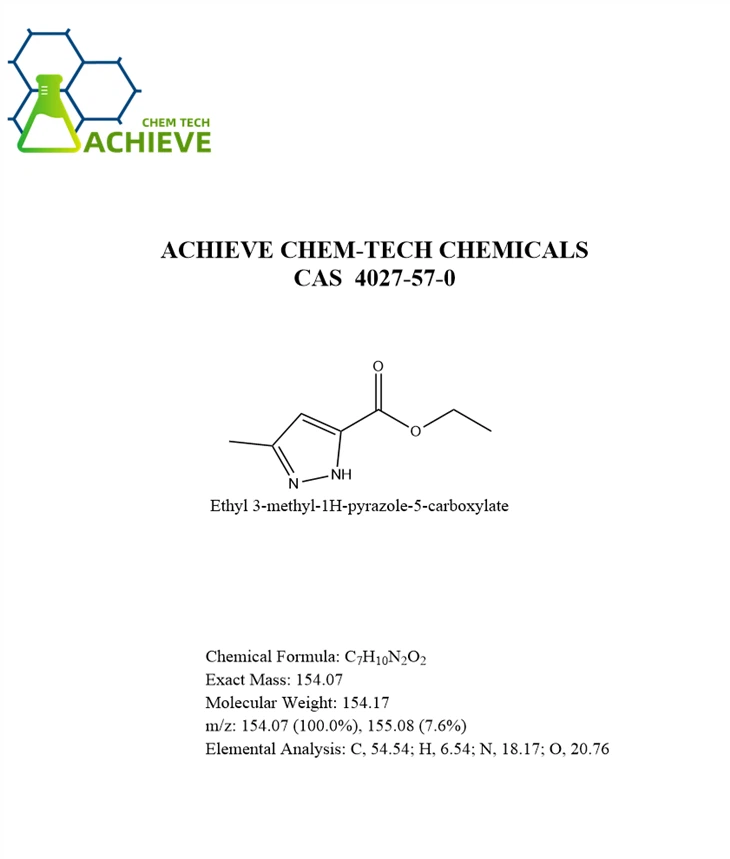
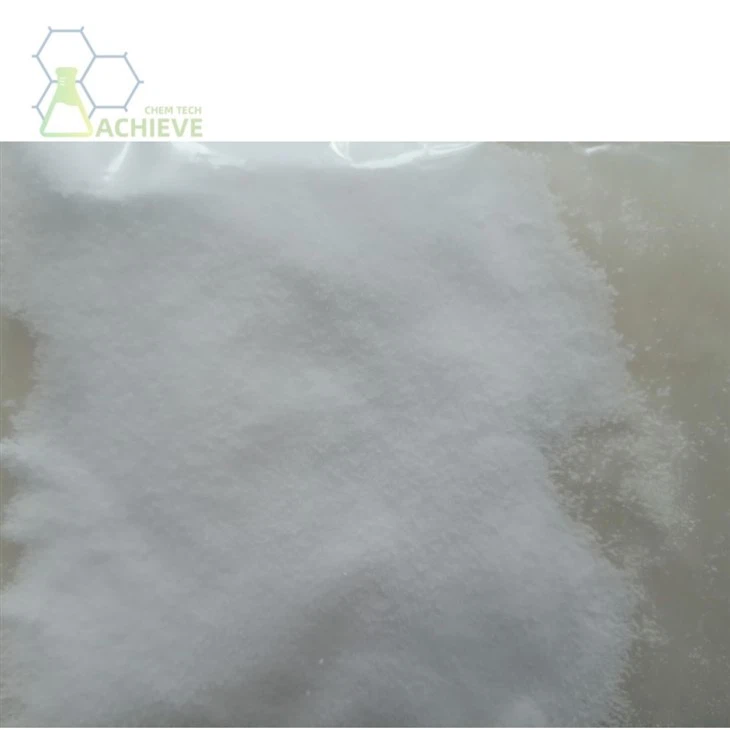
Ethyl 3-methyl-1H-pyrazole-5-carboxylate,The Chinese name is 3-methyl-1H-pyrazole-5-carboxylic acid ethyl ester or 1-ethyl-3-methyl-1H-pyrazole-5-carboxylic acid ethyl ester, which is a chemical substance As a pyrazole compound, it may possess typical chemical properties of pyrazole compounds. The appearance is usually white to light yellow powder or crystal. It can be used as an intermediate in pharmaceutical synthesis to participate in the preparation of biologically active compounds or drugs.
Due to the potential irritant or toxic properties of these compounds, they should be operated in a well ventilated environment and appropriate protective equipment (such as gloves, goggles, etc.) should be worn. In addition, direct contact with skin, eyes, etc. should be avoided, and waste should be properly disposed of after use.

Additional information of chemical compound:
|
Chemical Formula |
C7H10N2O2 |
|
Exact Mass |
154.07 |
|
Molecular Weight |
154.17 |
|
m/z |
154.07 (100.0%), 155.08 (7.6%) |
|
Elemental Analysis |
C, 54.54; H, 6.54; N, 18.17; O, 20.76 |
|
Melting point |
80-84℃(lit.) |
|
Boiling point |
299.1±20.0℃(Predicted) |
|
Density |
1.171±0.06 g/cm3(Predicted) |
|
|
|


Ethyl 3-methyl-1H-pyrazole-5-carboxylate (CAS number: 4027-57-0) is an organic compound containing a pyrazole ring, with the molecular formula C7H10N2O2 and a molecular weight of 154.17 g/mol. As an important member of pyrazole compounds, its unique chemical structure (a five membered heterocyclic ring containing two nitrogen atoms) endows it with rich reactivity and a wide range of applications.
Pharmaceutical field: Key intermediates and core roles in drug development
In the field of medicine, the core intermediates for the synthesis of various drugs, especially in the research and development of anti-cancer, antiviral, antibacterial and other drugs, occupy an important position. Its pyrazole ring structure can specifically interact with biological targets such as enzymes and receptors, thereby exerting pharmacological activity.
Lorlatinib (PF-06463922) is a third-generation ALK inhibitor developed by Pfizer for the treatment of non-small cell lung cancer (NSCLC), particularly for patients resistant to the first generation ALK inhibitor Crizotinib and the second-generation ALK inhibitors Ceritinib and Alectinib.
Mechanism of action: ALK fusion gene is one of the driving genes of non-small cell lung cancer. Loratinib inhibits the activity of ALK tyrosine kinase, blocks the signaling pathways of tumor cells (such as PI3K/AKT, RAS/MAPK), and thus inhibits tumor growth and metastasis.
Synthesis pathway: It is a key intermediate in the synthesis of lorlatinib.


It is transformed into a core structure through the following steps:
Ester hydrolysis: Hydrolyzed to 3-methyl-1H-pyrazole-5-carboxylic acid under alkaline conditions.
Nitrilation reaction: Reacts with ammonia and sodium cyanide to form 1-methyl-3- ((methoxy) methyl) -1H-pyrazole-5-nitrile.
Cyclization and modification: Further cyclization with chloropyridine to form the final structure of lorlatinib.
Clinical significance: Loratinib has a strong inhibitory effect on ALK resistant mutations (such as L1196M, G1269A), significantly prolonging the progression free survival (PFS) of patients and becoming an important choice for the treatment of advanced lung cancer.
It can also be used to synthesize other anti-cancer drugs containing pyrazole rings, such as:
CDK inhibitors: Cyclin dependent kinases (CDKs) are key proteins that regulate the cell cycle. Pyrazole compounds can block tumor cell proliferation by inhibiting the activity of CDK4/6.
PARP inhibitors: Adenosine diphosphate ribose polymerase (PARP) is a key enzyme in DNA damage repair, and pyrazole PARP inhibitors (such as olaparib) kill BRCA mutant tumor cells through a "synthetic lethality" mechanism.

3. Antiviral and antibacterial drug intermediates

Antiviral drugs: Pyrazole ring structures exhibit good activity in antiviral drugs, such as inhibiting HIV integrase or RNA polymerase. New antiviral drugs can be developed through structural modification.
Antibacterial drugs: Antibacterial drugs containing pyrazole rings (such as linezolid) exert antibacterial effects by inhibiting bacterial protein synthesis, and this compound can be used as a precursor for the synthesis of its analogues.
Its nitrogen atom can form complexes with metal ions (such as copper and palladium) and be used as a ligand in metal catalyzed reactions. For example:
Suzuki coupling reaction: Under palladium catalysis, pyrazole ligands can improve the coupling efficiency between aryl halides and boronic acid, which is used to synthesize aromatic compounds (common structures of drug molecules).
Asymmetric catalysis: Chiral pyrazole ligands can be used for asymmetric hydrogenation reactions to synthesize optically pure pharmaceutical intermediates.

Innovative solutions for pest control and crop protection in the field of pesticides
In the field of pesticides, ethyl 3-methyl-1H-pyrazole-5-carboxylate derivatives exhibit excellent biological activity, especially in combating agricultural pests with significant effects. Its mechanism of action usually involves interfering with the nervous system, respiratory system, or metabolic processes of pests.

1. Intermediate of acaricide: the synthesis core of imidacloprid nitrile ester
Cyenopyrafen is a novel acrylonitrile based acaricide developed by Sumitomo Chemical in Japan. It has high efficacy in preventing and controlling harmful mites such as red spider mites and heart mites on crops such as citrus trees, apple trees, and tea trees.
Mechanism of action: Nitrile imidacloprid inhibits the activity of mitochondrial complex II (succinate dehydrogenase, SDH) in harmful mites, blocks energy metabolism (ATP synthesis), and leads to mite death.
Synthesis pathway: 3-methylpyrazole-5-carboxylic acid ethyl ester is converted to nitrile imidacloprid ester through the following steps:


Esterexchange reaction: Reacts with methanol to produce 3-methyl-1H-pyrazole-5-carboxylic acid methyl ester.
Nitrilation reaction: Reacts with sodium cyanide and thionyl chloride to form 3-methyl-1H-pyrazole-5-carbonitrile.
Side chain introduction: Reacts with chloroacrylonitrile to form the core structure of nitrile imidacloprid ester.
Advantages: Compared with traditional acaricides such as avermectin and imidacloprid, imidacloprid has the characteristics of high selectivity, strong activity, long shelf life (4-6 weeks), and low toxicity to non target organisms such as bees and natural enemies, which is in line with the development trend of green pesticides.


2. Other pesticide intermediates
Other pesticides containing pyrazole rings can be developed through structural modification:
Herbicide: Pyrazole herbicides (such as fluazuron) inhibit weed growth by suppressing acetyl lactate synthase (ALS) and blocking the synthesis of branched chain amino acids (valine, leucine).
Fungicides: Pyrazole fungicides (such as fluconazole) inhibit fungal growth by suppressing complex III in the mitochondrial respiratory chain, disrupting energy metabolism.


3. Structural optimization in pesticide research and development
The substituents of pyrazole rings, such as methyl and ethyl esters, can significantly affect the biological activity of pesticides. The following strategies can optimize its performance:
Introducing halogens: Introducing halogen atoms such as fluorine and chlorine into the pyrazole ring can enhance the lipid solubility of drugs and improve their ability to penetrate pest cell membranes.
Introducing heteroatoms: Introducing heteroatoms such as oxygen and sulfur into the side chain can form hydrogen bonds or electrostatic interactions, enhancing the binding ability with the target protein.

Chemical industry: the cornerstone of organic synthesis and functional materials
In the field of chemical engineering, as an important organic intermediate, it is widely used to synthesize organic compounds containing pyrazole rings, which have potential application value in materials science, functional materials and other fields.

1. Synthesis of organic compounds
Pyrazole derivatives: Various pyrazole derivatives can be synthesized through substitution reactions, cyclization reactions, etc., such as:
1,3-dimethyl-1H-pyrazole-5-carboxylic acid ethyl ester: Introducing a second methyl group through methylation reaction to enhance the hydrophobicity of the molecule.
1,5-dimethylpyrazole-3-carboxylic acid methyl ester: synthesized through ester exchange and methylation reactions, used for preparing polymers containing pyrazole rings.
Heterocyclic compounds: Pyrazole rings can fuse with other heterocycles such as thiazoles and imidazoles to form heterocyclic compounds with unique properties, which are used in the development of functional materials.


2. Materials Science
Optoelectronic materials: Compounds containing pyrazole rings exhibit excellent performance in photoelectric conversion materials
Organic Light Emitting Diodes (OLEDs): Pyrazole compounds can be used as electron transport layer or hole blocking layer materials to improve the luminous efficiency and lifespan of OLEDs.
Organic solar cells (OPVs): Pyrazole rings can be introduced into donor or acceptor materials to optimize the light absorption range and charge transfer performance.


Functional polymer: Through polymerization reactions, pyrazole rings can be introduced into polymer chains to prepare polymer materials with special functions
High temperature resistant material: Polyimide containing pyrazole ring has excellent thermal stability (decomposition temperature>500 ℃) and can be used in the aerospace field.
Conductive material: Pyrazole conjugated polymers can achieve conductivity through doping and are used in flexible electronic devices.
3. Catalysis and Coordination Chemistry
Metal organic framework materials (MOFs): Pyrazole ring compounds can serve as ligands to form MOFs with metal ions such as zinc and copper, exhibiting high specific surface area and excellent adsorption properties. They can be used for gas storage (such as hydrogen and carbon dioxide), separation, and catalysis.
Asymmetric catalysis: Chiral pyrazole ligands can be used for asymmetric hydrogenation, epoxidation, and other reactions to synthesize optically pure drug or fragrance intermediates.

Research field: important tools for biochemical research and reagent development
In the field of scientific research, as an important biochemical reagent, ethyl 3-methyl-1H-pyrazole-5-carboxylate is widely used in life science research, organic synthesis experiments, etc.

1. Biochemical research
Enzyme activity research: Pyrazole ring compounds can be used as enzyme inhibitors or activators to study the relationship between enzyme structure and function. For example:
SDH inhibitors: Nitrile imidacloprid analogs can be used to study the catalytic mechanism of mitochondrial complex II.
ALK inhibitors: Loratinib analogs can be used to study the signaling pathways of ALK fusion genes.
Receptor binding assay: By synthesizing ligands containing pyrazole rings and studying their binding properties with receptors, theoretical basis is provided for drug design. For example:
G protein coupled receptors (GPCRs): Pyrazole ligands can mimic natural ligands such as dopamine and adrenaline, and study the interaction between receptors and ligands.


2. Reagent development
Standard and reference substance: This compound can be used as a standard or reference substance for calibration of instruments such as mass spectrometry analysis and nuclear magnetic resonance (NMR).
Organic synthesis reagents: In organic synthesis, 3-methylpyrazole-5-carboxylic acid ethyl ester can be used as a reaction intermediate or reagent to participate in various chemical reactions:
Substitution reaction: The nitrogen atom of the pyrazole ring can undergo alkylation and acylation reactions, introducing different substituents.
Cyclization reaction: Reacts with alpha, beta unsaturated ketones or aldehydes to form new heterocyclic structures.

Other potential application areas
In addition to the aforementioned fields, potential application value has also been demonstrated in the following areas:

1. Spices and essence
Compounds containing pyrazole ring have unique fragrance and can be used to synthesize perfume or essence:
Floral fragrance: Compounds with rose and jasmine aromas can be synthesized by introducing long-chain alkyl or aryl groups.
Fragrant spices: Compounds with apple and strawberry aromas can be synthesized by introducing ester or aldehyde groups.
2. Dyes and pigments
Through chemical modification, dyes or pigments containing pyrazole rings can be developed:
Acid dyes: Pyrazole rings can introduce sulfonic acid groups to improve the water solubility and dyeing performance of dyes, used for dyeing wool and silk.
Organic pigments: Pyrazole pigments have the characteristics of bright colors and good stability, and can be used for coloring plastics and inks.


3. Metal corrosion inhibitors
Pyrazole ring compounds can form a protective film on metal surfaces, inhibiting contact with corrosive media such as water and oxygen, thereby preventing metal corrosion. For example:
Copper corrosion inhibitor: Compounds containing pyrazole rings can form complexes on copper surfaces, preventing copper oxidation.
Steel corrosion inhibitors: Pyrazole compounds can form stable complexes with iron ions, slowing down the corrosion rate of steel.

It is prepared via a two-step process involving Claisen condensation and hydrazine cyclization, using acetone and diethyl oxalate as starting materials, which is the mainstream industrial route.
Synthesis of Ethyl Acetylpyruvate Intermediate
To a 500 mL three-necked flask was added 300 mL of anhydrous ethanol, followed by 5.77 g of sodium metal (0.251 mol). The mixture was stirred at room temperature until sodium was completely dissolved. After cooling to 0 °C, 36.5 g of diethyl oxalate (0.25 mol) was added dropwise slowly, and the mixture was stirred for 30 minutes. Then 14.5 g of acetone (0.25 mol) was added dropwise, and the reaction was carried out at 0–5 °C for 4 hours to afford the sodium salt of ethyl 2-hydroxy-4-oxo-2,3-pentenoate, a key β-dicarbonyl intermediate.
Pyrazole Cyclization and Product Preparation
The above sodium salt solution was warmed to 25 °C, and 12.5 g of 80% hydrazine hydrate (0.2 mol) was added dropwise. The mixture was stirred at room temperature for 6 hours to complete cyclization.Upon completion of the reaction, ethanol was removed under reduced pressure. The residue was dissolved in 100 mL of water, and the pH was adjusted to 5–6 with dilute hydrochloric acid. The mixture was extracted with ethyl acetate three times. The organic phases were combined, dried over anhydrous sodium sulfate, concentrated, and then distilled under reduced pressure to obtain Ethyl 3-methyl-1H-pyrazole-5-carboxylate with a yield of approximately 75% and a purity above 98%.
The product as a multifunctional organic intermediate, plays an irreplaceable role in fields such as medicine, pesticides, chemical engineering, and materials science due to its unique chemical structure and rich reactivity. From the synthesis of anticancer drug lorlatinib to the development of green acaricide nitrile imidacloprid, from optoelectronic materials to metal corrosion inhibitors, its application scope continues to expand. In the future, with the development of green chemistry, computational chemistry and other technologies, research on 3-methylpyrazole-5-carboxylic acid ethyl ester and its derivatives will usher in new opportunities, providing more solutions for human health, agricultural production and material innovation.

FAQ
What is 3 methyl 1 phenyl pyrazol 5 one used for?
+
-
3-Methyl-1-phenyl-5-pyrazolone (PMP) is primarily used as the drug Edaravone, a neuroprotective antioxidant treating amyotrophic lateral sclerosis (ALS) and stroke by reducing oxidative stress. It is also a critical intermediate in manufacturing dyes, pyrazolone-based analgesic medicines, and agrochemicals, and is commonly used in chemical research for the analysis of reducing carbohydrates.
What is ethyl 5 acetyl 1H pyrazole 3 carboxylate?
+
-
Ethyl 5-acetyl-1H-pyrazole-3-carboxylate is a chemical compound characterized by the molecular formula C9H11NO3. It is a derivative of pyrazole and carboxylic acid, known for its unique structure and properties that make it a valuable component in various research and industrial applications.
Hot Tags: ethyl 3-methyl-1h-pyrazole-5-carboxylate cas 4027-57-0, suppliers, manufacturers, factory, wholesale, buy, price, bulk, for sale, 5 Fluoro 2 Nitroaniline CAS 2369 11 1, DOTA CAS 60239 18 1, Cytidine 5 diphosphate disodium salt, 5 Iodocytidine CAS 1147 23 5, 1 Chlorooctane CAS 111 85 3, 1-Bromododecane