


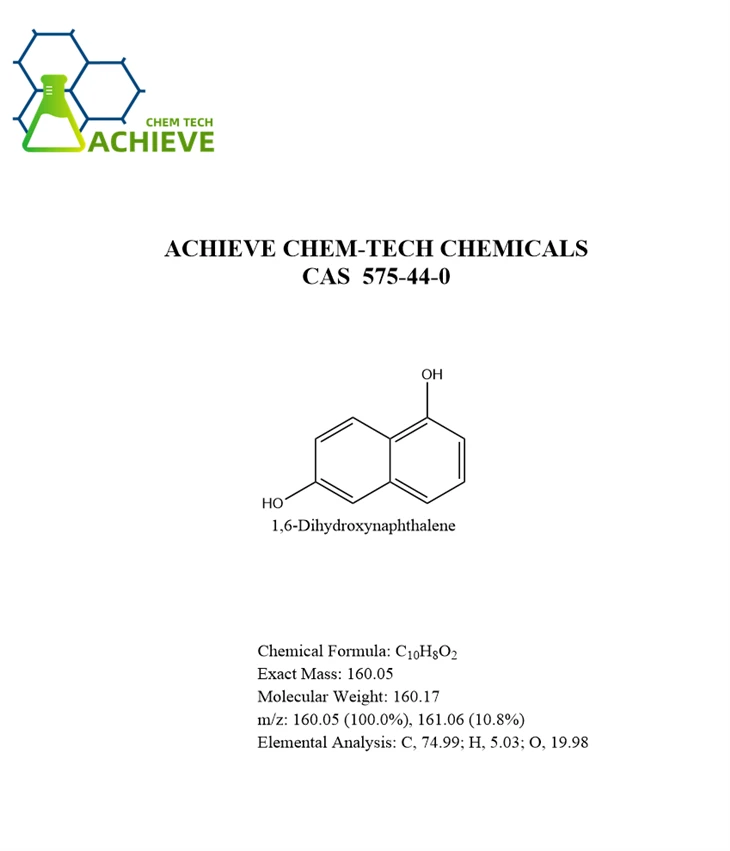


Shaanxi BLOOM Tech Co., Ltd. is one of the most experienced manufacturers and suppliers of 1,6-dihydroxynaphthalene cas 575-44-0 in China. Welcome to wholesale bulk high quality 1,6-dihydroxynaphthalene cas 575-44-0 for sale here from our factory. Good service and reasonable price are available.
1,6-Dihydroxynaphthalene, also known as 2,5-dihydroxynaphthalene, is an important organic compound with a CAS number of 575-44-0. It appears as a white to brown solid at room temperature and pressure, soluble in polar organic solvents such as methanol, but slightly soluble in water. Its structure contains two hydroxyl units and a large naphthalene ring system. This structure gives it significant acidity and a certain degree of nucleophilicity, with good chemical stability and no decomposition under normal circumstances.
It can serve as an important intermediate in organic synthesis. Corresponding derivatives can be generated through acid-base neutralization, substitution, or substitution reactions. In the field of medicine, it is also used as a raw material or intermediate for synthesizing certain drugs. In the field of luminescent materials, this compound and its derivatives have a wide range of applications. By introducing different substituents or modifiers into the molecule, its luminescent properties can be adjusted, achieving control over the luminescent color and fluorescence intensity. These luminescent materials can be used in fields such as organic light-emitting diodes (OLEDs), fluorescent probes, chemical sensors, etc.

Additional information of chemical compound:
|
Chemical Formula |
C10H8O2 |
|
Exact Mass |
160.05 |
|
Molecular Weight |
160.17 |
|
m/z |
160.05 (100.0%), 161.06 (10.8%) |
|
Elemental Analysis |
C, 74.99; H, 5.03; O, 19.98 |
|
Melting point |
130-133℃(lit.) |
|
Boiling point |
246.06℃(rough estimate) |
|
Density |
1.0924 (rough estimate) |
|
|
|


1,6-Dihydroxynaphthalene has multiple uses, mainly reflected in the following aspects:

Organic synthesis intermediates
This compound plays an important role as an organic synthesis intermediate in chemical synthesis processes. The two hydroxyl functional groups and one naphthalene ring system in its structure provide abundant active sites for chemical reactions, enabling the compound to participate in various types of chemical reactions such as acid-base neutralization, substitution, and substitution. By introducing different substituents or modifiers, 2,5-dihydroxynaphthalene derivatives with specific functions can be prepared. These derivatives have broad application prospects in fields such as medicine, pesticides, dyes, etc. It can also serve as a fundamental raw material for constructing complex organic molecules.
pharmaceutical intermediates
The application of this compound in the pharmaceutical field is mainly reflected in drug synthesis. Through chemical modification and transformation, compounds with pharmacological activity can be prepared, which play an important role in drug development and disease treatment. Research has shown that certain derivatives have anti-tumor activity and can inhibit the growth and spread of tumor cells. These compounds provide new ideas for the development of anti-tumor drugs. Some derivatives also have anti-inflammatory effects, which can alleviate inflammatory reactions and pain.


These compounds have potential application value in the development of anti-inflammatory drugs. In the process of drug development, the first step is to screen and evaluate the compound and its derivatives to determine whether they have pharmacological activity. Based on the screening results, optimize the structure of active compounds to enhance their efficacy and reduce side effects. After structural optimization, the compound needs to undergo clinical trials to verify its safety and efficacy.
dye and pigment
This compound has important application value in the dye industry. A series of acidic media dyes can be prepared by coupling with various diazo components. These dyes are mainly used for dyeing and printing textiles such as silk, cashmere, and wool. The dyes synthesized from it have bright and long-lasting colors, which can meet the high color requirements of textiles. These dyes have good washing and sun resistance, and can maintain color stability and brightness during long-term use. In the process of silk dyeing, the use of acid mordant dyes synthesized from it can achieve bright colors and soft hand feel dyeing effects. In the printing process, these dyes can also provide clear and delicate pattern effects, meeting the high requirements of textile printing.


luminescent material
This compound and its derivatives also have certain potential applications in the field of luminescent materials. By introducing different substituents or modifiers into the molecule, its luminescent properties can be adjusted, achieving control over the luminescent color and fluorescence intensity. OLED is a new type of display technology that has advantages such as self emission, bright colors, and wide viewing angles. It and its derivatives can serve as luminescent materials for OLEDs, providing new possibilities for the development of display technology.
Fluorescent probes are compounds used for biological labeling and imaging. 2,5-dihydroxynaphthalene and its derivatives can be used as raw materials for fluorescent probes, and probe molecules with specific fluorescent properties can be prepared through chemical modification and transformation for the detection and imaging of biomolecules. A chemical sensor is an instrument used to detect the concentration of chemical substances.


Molecular Electron Cloud Distribution and Frontline Orbital DFT Quantitative Calculation Results
Density functional theory calculations were performed on gas-phase 1,6-DHN molecules using the B3LYP/6-311G (d, p) functional basis set: 10 sp ² hybridized carbon atoms in the naphthalene ring form a global π - conjugated skeleton, and lone pair electrons of hydroxyl O atoms at positions 1 and 6 transport electrons to the naphthalene ring through p - π conjugation, raising the HOMO energy level and lowering the LUMO energy level.
The spatial arrangement of hydroxyl groups results in a molecular dipole moment of μ=3.87 D, which is much higher than that of symmetric 1,4-DHN (μ=1.12 D). The strong dipole effect causes the molecule to undergo solvation coloration in polar solvents (Solvatochromism): in non-polar n-hexane, the molecular hydrogen bonds tighten, the HOMO-LUMO band gap increases, and the maximum emission is λ ₑₘ=428 nm (blue light); The hydroxyl groups in polar DMSO form intermolecular hydrogen bonds with the solvent, causing further delocalization of the electron cloud and narrowing of the band gap. The wavelength of λ ₑₘ is 517 nm (green light), and the Stokes shift increases from 89 nm to 152 nm. The large Stokes shift effectively avoids excitation light scattering interference and is suitable for the development of fluorescent probes.

Intrinsic fluorescence transition mechanism of single-molecule dilute solution

In a dilute solution (concentration ≤ 1 × 10 ⁻⁵ mol/L), 1,6-DHN exists as an isolated single molecule without intermolecular π - π stacking. After excitation by ultraviolet light (320-350 nm), the ground state S ₀ electrons transition to the S ₁ excited singlet state, and 91% of the excited state electrons return to the ground state through radiative transition, releasing photons. The remaining 9% dissipates energy through vibrational relaxation without radiative dissipation. The fluorescence quantum yield of the dilute solution is Φ _f=0.38.
Transition path: S ₀ → S ₁ (π→π *) is the main transition, with n →π * transition accounting for less than 5%. There is no TICT (intramolecular charge transfer quenching) secondary path, so the fluorescence efficiency of dilute solution is stable and not affected by trace polar impurities.
When the pH of the solution changes, hydroxyl deprotonates to generate phenoxide anions, and O ⁻ has a stronger electron donating ability, further expanding the π electron delocalization. The HOMO rises by 0.42 eV, and the Δ E drops to 2.37 eV, emitting red light shifted to 602 nm, achieving pH triggered blue green red reversible switching. This protonation deprotonation reversible spectral change is the core theoretical basis for the design of ratio type pH probes.


Aggregation state luminescence dual pathway: ACQ and AIE controllable conversion mechanism
The aggregation state luminescence of 1,6-DHN is the core theory of its solid-state luminescent material. As the concentration/solvent water content increases, the molecule evolves from single-molecule to loose aggregation and then to dense stacking, exhibiting bidirectional tunability of aggregation quenching (ACQ) and aggregation induced luminescence (AIE), different from traditional aromatic dyes with single ACQ:
Oligomerization (water content 30%~50%, molecular spacing 0.6~0.8 nm): Intermolecular hydroxyl hydrogen bonds dominate, π - π interactions are weak, intramolecular hydroxyl twisting is limited by hydrogen bonds, non radiative transitions are hindered, the proportion of excited state radiative transitions increases, and the fluorescence quantum yield increases from 0.38 to 0.52, exhibiting AIE characteristics (aggregation luminescence enhancement);


High aggregation (water content>70%, molecular spacing<0.4 nm): Large area π - π stacking of naphthalene rings forms H-aggregates, S ₁ excited state energy level splits, excited state energy is non radiative dissipated through exciton coupling, fluorescence quantum yield drops sharply to 0.07, and classical ACQ aggregation quenching occurs.
The key approach to modifying OLED solid-state light-emitting layers is to precisely lock in oligomeric aggregates and permanently achieve AIE type solid-state luminescence through side chain alkyl modification and cyclodextrin inclusion.
Other Applications
It can also be used for the synthesis of pesticides. Through chemical modification and transformation, pesticide products with insecticidal, bactericidal, or herbicidal activity can be prepared. These pesticide products provide important guarantees for agricultural production. It can also serve as a raw material or intermediate for fine chemicals. By reacting with other compounds, fine chemicals with specific functions and uses can be prepared, such as surfactants, plasticizers, flame retardants, etc. These fine chemicals have a wide range of application value in industrial production. With the continuous development of science and technology, its application fields are also constantly expanding. In the future, this compound may demonstrate new application prospects in fields such as new energy, environmentally friendly materials, and biomedicine.


The discovery of 1,6-dihydroxynaphthalene can be traced back to the late 19th century, when chemists began systematic research on the chemical properties of naphthalene and its derivatives. As an important aromatic hydrocarbon, the study of naphthalene derivatives is of great significance for understanding the reaction mechanism and application potential of aromatic compounds.
In this context, 2,5-dihydroxynaphthalene, as an important naphthalene derivative, has gradually attracted the attention of scientists. Early research mainly focused on the synthesis methods and chemical properties of 2,5-dihydroxynaphthalene.
At the end of the 19th century, German chemist Emil Fischer and his colleagues successfully prepared 2,5-dihydroxynaphthalene for the first time through chemical synthesis methods. They synthesized 2,5-dihydroxynaphthalene from naphthalene through multiple reactions and conducted preliminary research on its chemical properties. This discovery laid the foundation for subsequent research and sparked more scientists' interest in 2,5-dihydroxynaphthalene and its derivatives.
At the beginning of the 20th century, with the continuous development of organic chemistry theory, research on 2,5-dihydroxynaphthalene gradually deepened. Scientists have begun to explore its behavior in different chemical reactions and attempt to prepare 2,5-dihydroxynaphthalene through various synthetic pathways. For example, 1,6-naphthalenedioic acid is generated through the sulfonation reaction of naphthalene, and then 2,5-dihydroxynaphthalene is generated through alkali melting reaction. These early studies not only enriched the synthesis methods of 2,5-dihydroxynaphthalene, but also provided theoretical support for its applications in fields such as dyes and pharmaceuticals.
Architectural design & planning cepteur sint occaecat cupidatat proident, taken possession of my entire soul, like these sweet mornings of spring which I enjoy with my whole...Architectural design & planning cepteur sint occaecat cupidatat proident, taken possession od my entire soul, like these sweet mornings of spring which I enjoy with my whole Lorem ipsum dolor sit ament, consectetur adipisicing elit,sed do eiusmod tempor incididunt labore et dolore magna aliqua. it enim ad minim veniam.
Our Strengths
● Excellent product quality
High purity guarantee: the purity of 1,6-Dihydroxynaphthalene products provided by our company reaches 98% or even more than 99%, which can meet the strict requirements of laboratory research and development and high-end chemical production on the purity of raw materials, and ensure the quality and performance of downstream products.
Reliable stability: the product shows good stability during storage and use, which helps customers to maintain process stability and product consistency in the production process.
● Strong supply capacity
Adequate inventory: our company has large-scale production capacity and sufficient inventory, can ensure timely delivery to meet the customer's large-volume purchasing needs, to avoid out-of-stock and affect the customer's production schedule.
Flexible packaging: provide a variety of packaging specifications (such as 25g, 50g, 100g, 250g, 25kg, etc.), can be customized according to the specific needs of customers, convenient for customers to use and storage.
● Perfect service support
Professional consulting: we have a professional sales and technical team, which can provide customers with detailed product information, use advice and technical support to help customers better understand and apply 2,5-dihydroxynaphthalene.
Customized service: according to the special needs of customers, we provide customized products and services, such as specific purity, packaging specifications or special treatment to meet the individual needs of customers.
Frequently Asked Questions
What is the main purpose of this compound?
+
-
Its most important role is as a dye intermediate and pharmaceutical intermediate. In industry, it can synthesize a series of acidic media dyes for textile dyeing such as silk and cashmere by coupling with diazo components. In the field of medicine, it serves as a precursor for synthesizing bioactive molecules.
What special biological activity does it possess?
+
-
Research has shown that 1,6-dihydroxynaphthalene has the potential for anti-cancer and antioxidant properties. For example, some studies on human breast cancer cells (MCF-7) found that it can induce cancer cell apoptosis in a dose-dependent manner. In materials science, it is also used as an antioxidant additive for plastics and rubber to enhance their thermal stability.
What are its main security risks? What should be noted during operation?
+
-
The GHS hazard statements for 1,6-dihydroxynaphthalene are H315 (causing skin irritation), H319 (causing severe eye irritation), and H335 (possibly causing respiratory irritation). Therefore, appropriate personal protective equipment must be worn during operation, such as protective gloves, goggles, and dust masks. If accidentally touched, immediately rinse with plenty of water for at least 15 minutes and seek medical attention according to the situation.
Hot Tags: 1,6-dihydroxynaphthalene cas 575-44-0, suppliers, manufacturers, factory, wholesale, buy, price, bulk, for sale, Ritalinic Acid Powder CAS 19395 41 6, 2 Phenylacetamide CAS 103 81 1, 4 Aminophenol powder, 1 1 Thiocarbonyldiimidazole CAS 6160 65 2, 3 1 Naphthoyl indole CAS 109555 87 5, 5 Chlorovaleryl Chloride CAS 1575 61 7