


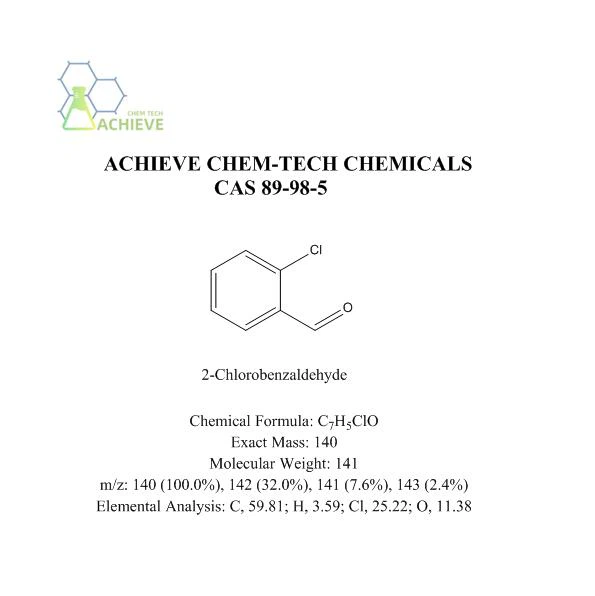


2-Chlorobenzaldehyde, colorless or light yellow oily liquid. Slightly soluble in water, soluble in ethanol, ether, acetone and benzene. It has a strong aldehyde smell. It is used as medicine and dye intermediate. The pesticide Mithijing produced with o-chlorobenzaldehyde can control mites on dry crops and fruit trees. O-chlorobenzoxime can be obtained by oximation of o-chlorobenzaldehyde, and o-chlorobenzoxime can be obtained by further chlorination, both of which are pharmaceutical intermediates. It is mainly used to synthesize oxacillin in medicine.

|
Chemical Formula |
C7H5ClO |
|
Exact Mass |
140 |
|
Molecular Weight |
141 |
|
m/z |
140 (100.0%), 142 (32.0%), 141 (7.6%), 143 (2.4%) |
|
Elemental Analysis |
C, 59.81; H, 3.59; Cl, 25.22; O, 11.38 |


2-Chlorobenzaldehyde,also known as 2-chlorobenzaldehyde, is an important organic synthetic intermediate with wide applications in various fields such as pesticides, pharmaceuticals, dyes, fragrances, functional materials, and analytical chemistry. The following will elaborate on its applications in various fields:
In the field of dyes and pigments
Disperse dyes are one of the most widely used types of dyes in synthetic fiber dyeing, especially suitable for hydrophobic fibers such as polyester and nylon. 2-chlorobenzaldehyde plays a crucial role in the synthesis of dispersed dyes, as it can undergo condensation, coupling, and other reactions with other intermediates to construct dispersed dye molecules with specific molecular structures and color systems. For example, in the synthesis of certain high-performance dispersed dyes, the introduction of 2-chlorobenzaldehyde can improve the dispersibility of the dyes.


Due to the electronic and steric hindrance effects of chlorine atoms and aldehyde groups in 2-chlorobenzaldehyde, the polarity and intermolecular forces of dye molecules can be adjusted, making it easier for the dye to form a uniform dispersion system in water or organic solvents, thereby improving the dye's dye uptake and dyeing uniformity on fibers. In addition, the participation of 2-chlorobenzaldehyde can enhance the wash fastness and light fastness of dispersed dyes. During the dyeing process, dye molecules containing 2-chlorobenzaldehyde structure can form more stable chemical bonds or physical adsorption with fibers, reducing the shedding and fading of dyes under washing and light conditions, and giving the dyed fabric a more durable color.
Reactive dyes have excellent color fastness due to their covalent bonding with fibers, and are widely used for dyeing natural fibers such as cotton, linen, and silk. 2-chlorobenzaldehyde can be used as a key raw material for constructing reactive groups or intermediates in the synthesis of reactive dyes, enhancing the reactivity between dyes and fibers. For example, in the synthesis of certain vinyl sulfone reactive dyes, 2-chlorobenzaldehyde can be converted into an intermediate containing vinyl sulfone groups through a series of reaction steps. Ethylene sulfone groups can undergo nucleophilic addition reactions with hydroxyl groups on fibers under alkaline conditions, forming stable covalent bonds.


The presence of 2-chlorobenzaldehyde helps optimize the formation conditions and reaction activity of vinyl sulfone groups, enabling reactive dyes to bind more efficiently to fibers and improve the dye fixation rate. When synthesizing certain reactive dyes containing sulfonic acid groups, 2-chlorobenzaldehyde can serve as a linking arm to connect the sulfonic acid group with the chromophore. The introduction of sulfonic acid groups increases the water solubility of dyes, while the structural characteristics of 2-chlorobenzaldehyde help maintain the stability of dye molecules, prevent adverse reactions such as hydrolysis and oxidation during storage and use, and extend the service life of dyes.
Acid dyes are mainly used for dyeing protein fibers such as wool and silk. 2-chlorobenzaldehyde can be synthesized as an acidic dye intermediate with specific color and dyeing properties by reacting with aromatic amine compounds. These intermediates further bind with acidic groups to form acidic dye molecules. For example, in the synthesis of certain azo acid dyes, 2-chlorobenzaldehyde undergoes diazotization coupling reaction with aromatic amines, resulting in azo dye intermediates with good chromogenic properties. Then, by introducing acidic groups such as sulfonic acid groups, protein fibers can be stained in acidic media. The presence of 2-chlorobenzaldehyde helps to regulate the color brightness and dyeing affinity of dyes, and improve the dyeing effect of acidic dyes on protein fibers.

Fragrance and essence
2-chlorobenzaldehyde has a special aldehyde aroma, which is usually described as slightly fruity, sweet, and accompanied by a certain degree of irritation. The presence of aldehyde group makes its aroma highly volatile and diffusive, which can rapidly release the aroma in essence formula and bring fresh and bright smell to essence products. Compared with other simple aldehyde fragrances such as benzaldehyde, the chlorine atom in 2-chlorobenzaldehyde introduces additional electronic and steric hindrance effects, making its aroma characteristics more unique and complex. This unique aroma feature enables 2-chlorobenzaldehyde to add personalized aroma elements to the product in essence preparation, and meet the needs of consumers for different flavor types.

In the essence formula, 2-chlorobenzaldehyde can cooperate with other flavor ingredients to build a rich and harmonious aroma system. For example, when it is used together with citrus spices (such as citral and nerolide), it can enhance the freshness and vitality of citrus aroma, making essence products more suitable for summer perfume, air freshener and other products.


When combined with floral fragrances (such as rose alcohol and jasmine ketone), 2-chlorobenzaldehyde can balance the sweetness of floral fragrance, increase the level and three-dimensional sense of fragrance, and provide elegant and lasting fragrance for high-end perfume, cosmetics essence, etc. In addition, its combination with woody spices (such as sandalwood alcohol and cedar alcohol) can also produce a unique effect, giving essence products warm and deep woody fragrance, which is suitable for the deployment of men's perfume, cologne and other products.
In the formulation of fruity essence, 2-chlorobenzaldehyde can simulate the aroma characteristics of some fruits, such as peaches and apricots. Through the synergistic effect with other fruit flavors (such as benzyl acetate, ethyl butyrate), a realistic and attractive fruit flavor essence can be formulated, which is widely used in food essence (such as candy, drinks, ice cream, etc.), daily chemical essence (such as bath gel, shampoo, etc.), and tobacco essence.


Among the food essence, the fruity essence containing 2-chlorobenzaldehyde can enhance the flavor and attractiveness of food, so that consumers can get more pleasant sensory experience when tasting food. Among daily chemical essence, fruity essence can give products fresh and natural fragrance, and satisfy consumers' pursuit of natural and healthy products. In tobacco essence, appropriate amount of 2-chlorobenzaldehyde can improve the taste and aroma of tobacco, reduce the irritation of tobacco, and improve the quality of tobacco products.
When preparing rose essence, adding a small amount of 2-chlorobenzaldehyde can enhance the freshness and modernity of rose fragrance, making essence more in line with the aesthetic needs of contemporary consumers. In the formulation of jasmine essence, 2-chlorobenzaldehyde can complement jasmine and other major floral components, making the aroma of essence more lasting and elegant. In addition, 2-chlorobenzaldehyde can also be used as an important auxiliary flavor to add unique flavor characteristics to some flower essence with unique style (such as narcissus essence, violet essence).

Custom Notebook Solutions

In addition to fruity and floral essence, 2-chlorobenzaldehyde can also be used to prepare some characteristic essence. For example, in the marine flavor type essence, it can be combined with marine spices (such as ambergris, sea breeze aldehyde) to create a fresh and cool marine flavor, which is suitable for perfume, air freshener and other products. Among oriental flavor essence, 2-chlorobenzaldehyde can be matched with herbs, amber and other spices to add warm and mysterious oriental flavor to essence, which is often used in the deployment of high-end perfume, incense candles and other products.

2-Chlorobenzaldehyde has the following synthetic methods.
1. Chlorination and hydrolysis of o-chlorotoluene:
It is obtained by chlorination and hydrolysis of o-chlorotoluene.
① Chlorination: heat o-chlorotoluene, phosphorus trichloride and sulfoxide chloride to 150 ℃, and pass chlorine gas to theoretical amount under ultraviolet irradiation to obtain o-chlorobenzylidene dichloride.
② Hydrolysis: heat the mixture of o-chlorobenzylidene dichloride and zinc chloride at 120~130 ℃, stir and add 1% ferric chloride aqueous solution. After the addition, heat the mixture and return with water. The oil layer is refined o-chlorobenzaldehyde.
In addition, hydrolysis can also be carried out in the presence of sulfuric acid. Stir o-chlorobenzylidene dichloride and industrial concentrated sulfuric acid together until the temperature automatically decreases and the hydrogen chloride escape slows down, and then slowly heat for 12h to keep the temperature at 30-40 ℃; After the reaction, the finished product is obtained by layering with cold water, separating the oily substance, washing and steam distillation.

2. Chlorination and oxidation of o-chlorotoluene:
The methyl in o-chlorotoluene is chlorinated and then oxidized with nitric acid.
Add 380g (3.0mol) of o-chlorotoluene into the 600mL photoreactor with thermometer, stirrer, chlorine blowing tube, reflux condenser and high-pressure mercury lighting device, heat it to 130 ℃, blow 106g/h (1.5mol/h) of chlorine under light, and the injection time is 3.6h. A total of 5.4mol of chlorine gas is introduced. After the reaction, dry nitrogen was added to the reaction liquid to drive out the hydrogen chloride and chlorine gas. A total of 558g of reaction liquid was obtained, including 0.5% (mol) of o-chlorotoluene, 28% of o-chlorobenzyl chloride, 67% of o-chlorodichlorotoluene, 3% of o-chlorotrichlorotoluene, and the average chlorination degree of o-chlorochlorotoluene was 1.8.
Add 64.7g (0.343mol) of the chlorinated mixture of o-chlorotoluene, 1440g of 3% (mass fraction) nitric acid and 2.0g of vanadium pentoxide into a 2L three-port flask with a thermometer, stirrer and reflux condenser, and heat and reflux for 6h under stirring. After the reaction is completed, cool it, add 200mL toluene, separate the oil phase, and add 100mL toluene to the aqueous solution layer for extraction twice. Combine the oil phase and extraction liquid, evaporate toluene, distill the residue, collect the fraction at 107~110 ℃ (4.0kPa), and obtain 36g of product o-chlorobenzaldehyde, with the yield of 73.5% based on o-chlorotoluene.

Compared with traditional zinc brightener, water-soluble 2-chlorobenzaldehyde has the following advantages:
Water-soluble o-chlorobenzaldehyde dissolved in water can give full play to the polarizing effect of brightener, and the added amount is small. The reference amount is 0.3~1.0 g/L.
The traditional carrier brightener is a softener. In order to ensure the complete dissolution of o-chlorobenzaldehyde and benzidine acetone, a certain high cloud point is required, and its demand is generally large. After the water solubility of water-soluble o-chlorobenzaldehyde is improved, the required carrier brightness dose will be reduced, that is, the cost of brightener will also be reduced, and COD will be reduced, which is more environmentally friendly. If the carrier brightener after sulfonation is added, the effect will be better.
3. Foam volume decreases
After the amount of carrier brightener is reduced, the amount of foam will be reduced, which will be more convenient and environmentally friendly in actual electroplating production.
Hot Tags: 2-chlorobenzaldehyde cas 89-98-5, suppliers, manufacturers, factory, wholesale, buy, price, bulk, for sale, gs 441524 remdesivir, BENZENE D6, DIMETHYLPHOSPHINE OXIDE, Additive, N N N Trimethylethylenediamine, 3 Phenyltoluene