


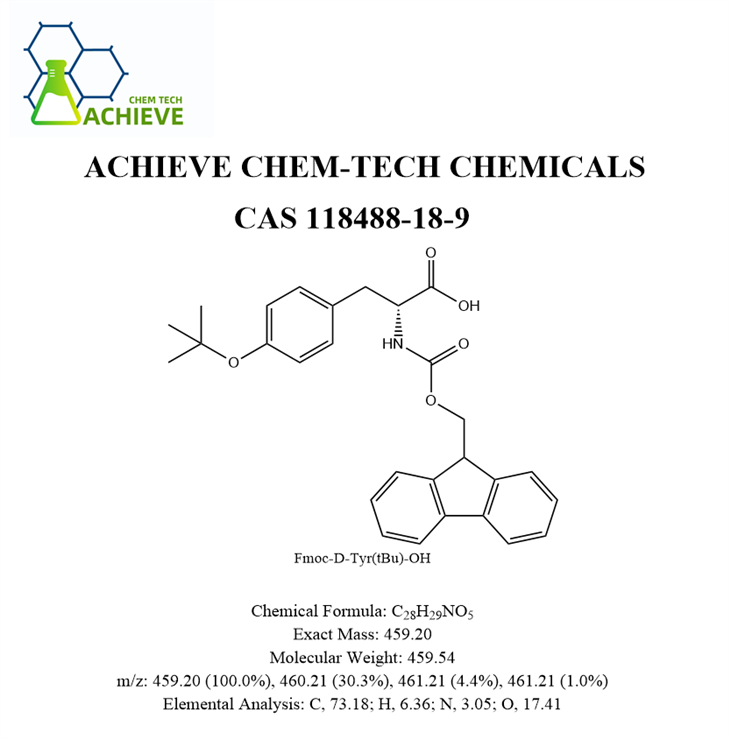



Fmoc-D-Tyr(tBu)-OH, also known as Fmoc-O-tert-butyl-D-tyrosine, is a chemical compound with a specific structure and numerous applications in the field of chemistry and biochemistry. It is a tyrosine derivative with an Fmoc (fluorenylmethoxycarbonyl) protecting group attached to the amino group and a tert-butyl (tBu) group protecting the phenolic hydroxyl group. The Fmoc group is commonly used in solid-phase peptide synthesis due to its ease of removal under mild alkaline conditions. The tert-butyl group, on the other hand, protects the phenolic hydroxyl group from unwanted reactions, enhancing the stability and reactivity of the molecule.

 |
 |
|
Chemical Formula |
C28H29NO5 |
|
Exact Mass |
459.20 |
|
Molecular Weight |
459.54 |
|
m/z |
459.20 (100.0%), 460.21 (30.3%), 461.21 (4.4%), 461.21 (1.0%) |
|
Elemental Analysis |
C, 73.18; H, 6.36; N, 3.05; O, 17.41 |


Peptide Synthesis
- Solid-Phase Peptide Synthesis (SPPS): Serves as a crucial building block in SPPS due to its Fmoc protecting group. The Fmoc group enables efficient coupling reactions and can be readily removed under mild alkaline conditions, making it ideal for the synthesis of complex peptides and proteins. This application is widely used in academic research and industrial settings for the production of bioactive peptides and proteins.
Biomedical Research
- Precursor in Hormone and Neurotransmitter Synthesis: It is a critical intermediate in the synthesis of various hormones and neurotransmitters, such as thyroxine, dopamine, and adrenaline. These hormones and neurotransmitters play essential roles in regulating metabolic processes, mood, cognitive function, and physical performance. By participating in their synthesis, it indirectly contributes to maintaining homeostasis and proper functioning of various biological systems.
- Proteomics Studies: Its unique structure and reactivity make it a valuable tool for studying protein structure, function, and interactions. Researchers can utilize it to introduce specific modifications or tags into proteins, enabling the investigation of protein-protein interactions, post-translational modifications, and other biological processes.


Pharmaceutical Industry
- Drug Discovery and Development: The ability to participate in the synthesis of hormones and neurotransmitters makes it an attractive starting point for the development of novel therapeutic agents. Pharmaceutical companies may explore its potential in the development of drugs targeting specific neurological or endocrine disorders.
Scientific Research
- Biochemical Assays and Experiments: It is used in various biochemical assays and experiments to study the mechanisms underlying hormone and neurotransmitter production, regulation, and function. These studies can provide valuable insights into the underlying causes of diseases and disorders related to hormone and neurotransmitter imbalances.

key considerations & usage notes
Personal Protective Equipment (PPE)
- Wear Chemical-Resistant Gloves: Protect your hands from direct contact with the chemical. Nitrile or neoprene gloves are typically recommended.
- Eye Protection: Use chemical splash goggles or a full face shield to prevent accidental eye exposure.
- Clothing: Wear protective clothing that covers your arms and legs to minimize skin contact.
- Respiratory Protection: If working with high concentrations or generating dust, consider wearing a respirator approved for the specific hazard. However, note that routine use may not necessarily require respiratory protection unless specific conditions warrant it.
Storage Conditions
- Temperature Control: Store in a cool, dry place, preferably at 2-8°C. Avoid exposure to extreme temperatures or direct sunlight.
- Container Integrity: Keep the container tightly closed to prevent moisture ingress and contamination.
- Shelf Life: Check the product's expiration date and follow recommended storage conditions to ensure optimal shelf life.
Handling Precautions
- Minimize Exposure: Handle in a well-ventilated area to minimize the risk of inhalation.
- Avoid Dust Generation: Avoid actions that may generate dust, such as grinding or crushing the solid. Use appropriate techniques to minimize dust formation.
- Compatibility: Be aware of the chemical's compatibility with other substances. Avoid mixing with incompatible chemicals or materials.
Emergency Procedures
- Inhalation: If inhaled, move the person to fresh air immediately and seek medical attention if necessary.
- Skin Contact: Immediately remove any contaminated clothing and wash the affected area thoroughly with soap and water. Seek medical attention if irritation persists.
- Eye Contact: Rinse eyes immediately with copious amounts of water for at least 15 minutes. Remove any contact lenses, if easily done, and continue rinsing. Seek medical attention if irritation occurs.
- Ingestion: Do not induce vomiting. Rinse mouth with water and seek medical attention.
Waste Disposal
- Proper Disposal: Dispose and its waste products according to local regulations and guidelines. Consult with your local waste management authority for specific instructions.
- Environmental Considerations: Avoid discharging the chemical or its waste products into the environment, including waterways and sewage systems.
Additional Information
- MSDS/SDS Review: Before using, review the Material Safety Data Sheet (MSDS) or Safety Data Sheet (SDS) provided by the manufacturer. This document contains detailed information on hazards, handling precautions, emergency procedures, and disposal methods.
- Training: Ensure that all personnel handling it have received proper training on its safe handling and use.

Fmoc-D-Tyr(tBu)-OH in drug discovery and development
As a drug precursor:
It has potential biological activity and can be used as a precursor compound for new drugs. By chemically modifying or transforming it, new compounds with enhanced biological activity or superior drug properties can be obtained.
Participation in drug molecular design:
In drug molecule design, It can be used as a key structural unit to combine with other compounds or moieties to form new drug molecules with specific functions and activities.
Improved drug selectivity and targeting:
By introducing Fmoc-D-Tyr(tBu)-OH into drug molecules, drug selectivity and targeting can be improved so that they can act more accurately on specific biological targets, thereby increasing therapeutic efficacy and reducing side effects.
Synthesis of new drug A:
Using it as a starting material or key intermediate, the researchers synthesized a new drug A with a novel chemical structure and biological activity through a series of chemical reactions (e.g., esterification, amidation, substitution, etc.).
Further studies showed that the mechanism of action of the new drug A is to inhibit the signaling and metabolic processes of tumor cells by binding to specific receptors on the surface of tumor cells, thus achieving the anti-tumor effect.

Structural studies:
Labeled proteins can be used in X-ray crystallography, nuclear magnetic resonance (NMR) or other structural biology techniques to resolve their three-dimensional structures. These techniques can reveal the interactions and arrangement of atoms within the protein, thus providing important information about the structure and function of the protein.
Functional studies:
By observing the behavior of tagged proteins within a cell or organism, researchers can understand the mechanism of their action in biological processes. For example, they can use fluorescence microscopy to observe the localization and dynamic changes of labeled proteins within cells, or determine their interactions with other molecules and enzyme activities through biochemical experiments.
Case Applications
Assuming that researchers are interested in the structure and function of a signaling protein, they can utilize Fmoc-D-Tyr(tBu)-OH as a marker to be incorporated into a specific location on the protein.
They then used X-ray crystallography to resolve the three-dimensional structure of the labeled protein and found that the protein has a unique active site.
distribution channel
Fmoc-D-Tyr(tBu)-OH,The Chinese name is Fmoc-O-tert-butyl-D-tyrosine, which is an important biochemical reagent with wide applications in peptide synthesis, drug development, and other fields. Its sales channels are extensive, covering multiple professional chemical reagent suppliers, biopharmaceutical technology companies, and research institutions both domestically and internationally. The following is a detailed analysis of its sales channel scope:
Characteristics and advantages of sales channels
Diversity
Its sales channels are diverse, including official websites, e-commerce platforms, customer partnerships, exhibitions, and other ways. This diversity allows customers to choose the most suitable purchasing method based on their own needs and preferences.
Convenience
With the development of the Internet, more and more suppliers begin to sell through official websites and e-commerce platforms. Customers can browse product information, place orders, and track order status online anytime and anywhere, greatly improving purchasing efficiency.
Professionalism
Many suppliers provide professional technical support and after-sales service while selling. They can provide customized solutions according to the needs of customers, helping them solve problems encountered during use.
Internationalization
Some internationally renowned brands such as SCRSTANDARD sell their products globally through agents and distributors. This international sales channel makes it easier for customers to obtain high-quality products and technical support.
The development trend of sales channels
The growth of online sales
With the continuous progress and popularization of Internet technology, online sales will become the main trend of future sales. Suppliers can expand their online sales channels, improve sales efficiency and customer satisfaction by establishing official websites and joining e-commerce platforms.
The rise of customized services
With the diversification and personalized development of customer needs, customized services will become an important direction for future sales. Suppliers can provide customized products and technical support according to customer needs to meet their special requirements.
Strengthening international cooperation
With the accelerated development of globalization, international cooperation and exchanges will become increasingly frequent. In the future, more domestic suppliers will actively seek cooperation opportunities with internationally renowned brands to jointly expand the international market and enhance the international competitiveness of their products.
The promotion of technological innovation
Technological innovation is an important driving force for the development of this sales channel. Suppliers can improve the quality and performance of their products by continuously developing new products and optimizing production processes, thereby attracting more customers and enhancing market competitiveness.
The 'Rebellion' of Fmoc-D-Tyr (tBu) - OH Function: From Metabolic Inert to Stable Kernel
In the microscopic world of peptide synthesis and drug development, Fmoc-D-Tyr (tBu) - OH is like a unique "chemical pearl", and its functional properties are constantly redefined in scientific exploration. From being initially believed to have metabolic inertness, to now being revealed to have a key role in stabilizing the core, this transformation not only overturns traditional cognition, but also opens up a new path for the design, synthesis, and application of peptide drugs.
Background formation
In the early research on Fmoc-D-Tyr (tBu) - OH, researchers mainly focused on its application in peptide synthesis. Due to the presence of Fmoc and tBu groups, this compound is considered difficult to be recognized and metabolized by enzymes in vivo. Enzymes typically have specific active centers and substrate binding sites. For compounds with complex protective groups, their spatial structure and chemical properties differ significantly from natural substrates, making it difficult to effectively interact with enzymes. Based on this understanding, researchers hypothesize that Fmoc-D-Tyr (tBu) - OH has metabolic inertness, meaning it is not rapidly broken down or transformed in living organisms and can maintain a relatively stable structure.


Research Basis
Some experimental observations at that time provided some basis for this hypothesis. For example, in an in vitro cell experiment, Fmoc-D-Tyr (tBu) - OH was added to the cell culture medium, and after a period of cultivation, it was detected by analysis methods such as high performance liquid chromatography (HPLC) that the concentration of the compound in cells changed little and no significant degradation products were generated. In addition, in animal experiments, the distribution and metabolism of Fmoc-D-Tyr (tBu) - OH in vivo were detected after injection or oral administration. It was also found that the compound has a longer half-life and slower metabolism rate in vivo. These experimental results further support the view that Fmoc-D-Tyr (tBu) - OH has metabolic inertness.
The impact on peptide synthesis
Based on the assumption of metabolic inertness, Fmoc-D-Tyr (tBu) - OH is widely used in peptide synthesis. In solid-phase peptide synthesis, it serves as an important protective amino acid, ensuring that tyrosine residues are not prematurely modified or degraded during the synthesis process. For example, when synthesizing peptides containing multiple tyrosine residues, the use of Fmoc-D-Tyr (tBu) - OH can avoid the reaction between the phenolic hydroxyl group of tyrosine and other reagents during the synthesis process, thereby ensuring the quality and yield of peptide synthesis. In addition, due to its metabolic inertness, the synthesized peptides are more stable during subsequent purification and storage processes, reducing losses caused by compound degradation

Hot Tags: fmoc-d-tyr(tbu)-oh cas 118488-18-9, suppliers, manufacturers, factory, wholesale, buy, price, bulk, for sale, pontocaine, Consumable, CAS 1762 84 1, 4 4 5 5 tetramethyl 2 triphenylen 2 yl 1 3 2 dioxaborolane, N 1 1 biphenyl 4 yl 1 1 3 1 terphenyl 4 Amine, 14H benzo c benzo 4 5 thieno 2 3 a carbazole