


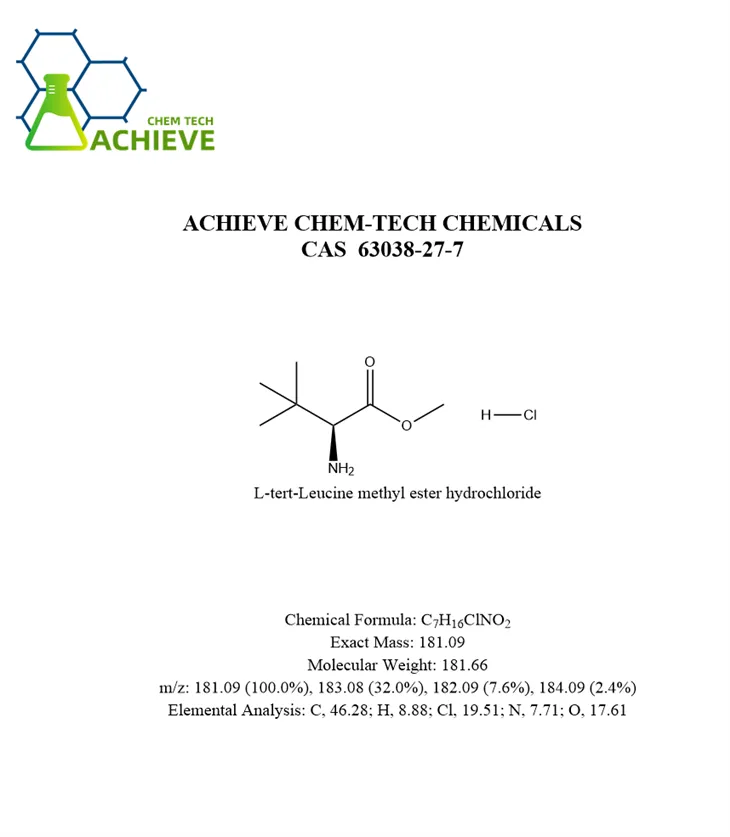


L-tert-Leucine methyl ester hydrochloride is an important organic synthesis intermediate and pharmaceutical intermediate. It appears as a white crystalline powder and is soluble in organic solvents such as methanol. Stable at room temperature and pressure, but should be stored in a cool, dry place, away from oxidants and heat sources. As a pharmaceutical intermediate, this substance can be used to synthesize various bioactive compounds, such as peptidase inhibitors. These compounds play an important role in pharmaceutical research and development, and can be used to treat various diseases such as cancer, inflammation, etc. It also has broad application prospects in the fields of chemistry and biotechnology. It still needs to be kept away from oxidants and heat sources during use and storage to ensure its safety.

Additional information of chemical compound:
|
Chemical Formula |
C7H16ClNO2 |
|
Exact Mass |
181.09 |
|
Molecular Weight |
181.66 |
|
m/z |
181.09(100.0%),183.08(32.0%),182.09(7.6%),184.09(2.4%) |
|
Elemental Analysis |
C, 46.28; H, 8.88; Cl, 19.51; N, 7.71; O, 17.61 |
|
Melting point |
183-186℃ |
|
Storage conditions |
2-8℃ |
 |
 |

L-tert-Leucine methyl ester hydrochloride, As an important pharmaceutical intermediate, it has demonstrated its unique application value in the pharmaceutical field. The following is a detailed explanation of its purpose:
Application in pharmaceutical intermediates
Synthesis of peptidase inhibitors: It can be used to synthesize peptidase inhibitors, which have broad application prospects in the pharmaceutical field. Protease inhibitors can inhibit the activity of proteases, thereby regulating the protein degradation process in organisms. Peptide like protease inhibitors, as a class of compounds that mimic the structure of natural peptides, have higher stability and bioavailability, so they have become important candidate drugs for the treatment of many diseases, such as cancer, inflammation and infectious diseases.

Application as a chiral source

The synthesis of chiral drugs: Through the chiral induction effect of this substance, drug molecules with specific chiral structures can be synthesized. These chiral drugs have higher selectivity and activity in the body, and can more effectively target their targets. In addition, its chiral structure can provide stable conformation and bioavailability for drug molecules, thereby improving the efficacy and safety of drugs.
Preparation of chiral catalysts: It can also be used to prepare chiral catalysts. These catalysts exhibit high selectivity and catalytic activity in asymmetric synthesis reactions, capable of catalyzing the formation of compounds with specific chiral structures.
The foundation of new drug design: As a compound with clear biological activity, it can serve as the basis for new drug design. By studying its structure, activity, and mechanism of action, the interaction relationship between drug molecules and biological targets can be revealed, providing theoretical basis for the design and optimization of new drugs.Pharmacodynamic and pharmacokinetic studies: In the process of new drug development, pharmacodynamic and pharmacokinetic studies are essential links.

Application in chemical synthesis

As a catalyst and ligand
The functional groups such as amino and ester groups in this substance can form coordination bonds with metal ions, thereby participating in chemical reactions as catalysts or ligands. For example, in asymmetric catalytic reactions, chiral catalysts can be formed by combining with metal catalysts to catalyze asymmetric addition, asymmetric cyclization, and other reactions. This chiral catalyst has high selectivity and catalytic activity, and can efficiently generate target compounds with specific chirality. In addition, it can also serve as a ligand to form complexes with transition metal ions for catalyzing reactions such as oxidation, reduction, and addition.
What are the sales channels for this compound?
International market sales-Diversified market demand: There are differences in market demand among different countries and regions, which need to be adjusted and customized according to local market conditions and customer needs.
Intense competition: The competition in the international market is usually more intense, requiring manufacturers and distributors to have stronger market competitiveness and brand influence.Trade barriers and risks: There are various trade barriers and risks in international trade, such as tariffs, exchange rate fluctuations, and changes in trade policies, which require manufacturers and distributors to have the ability to respond and manage risks.


In order to expand into international markets, manufacturers and distributors usually take the following measures:Participate in international exhibitions:
By participating in international exhibitions, showcase product and technological strength, attract potential customers and partners.Establish overseas sales network: By collaborating with local distributors or agents, establish an overseas sales network to enhance the product's visibility and competitiveness in the international market.
Provide customized services: Provide customized services according to customer needs, such as special specifications, purity requirements, etc., to meet customers' personalized needs.
Paradigm shift from this substance to rigid tertiary leucine derivatives
Design concept of rigid tert leucine derivatives
The design of rigid tert leucine derivatives aims to enhance the stability and conformational rigidity of molecules by introducing rigid structural units, thereby improving their performance in specific application scenarios. For example, in drug design, rigid structures can reduce the flexibility of molecules and improve their binding affinity with targets; In the preparation of biomaterials, rigid structures can enhance the mechanical properties and stability of materials.


Key reactions and optimization of conditions
In the synthesis process, key reactions include hydrolysis of ester groups, protection and removal of amino groups, and introduction of rigid structures. To improve reaction efficiency and product purity, it is necessary to optimize the reaction conditions. For example, in hydrolysis reactions, it is necessary to control the concentration of alkali and reaction temperature to avoid the occurrence of side reactions; In the introduction of rigid structures, appropriate reaction reagents and catalysts need to be selected to improve the selectivity and yield of the reaction.
Synthesis route
Starting from L-tert Leucine methyl ester hydrochloride, the route for L-tert-Leucine Methyl Ester Hydrochloride derivatives mainly includes the following steps:
Hydrolysis of ester groups
Firstly, L-tert Leucine methyl ester hydrochloride is hydrolyzed under alkaline conditions to produce L-threonine.
Protection of amino groups
To avoid interference of amino groups in subsequent reactions, it is necessary to protect the amino group of L-thre-leucine. Common protective groups include Boc (tert butoxycarbonyl), Fmoc (9-fluorenylmethoxycarbonyl), etc.
Introduction of rigid structure
By chemical reaction, rigid structural units are introduced on the side chain or carboxyl group of L-thre-leucine. For example, cyclic structures can be formed through cyclization reactions, or rigid molecular fragments can be connected through covalent bonds.
Removal of protective groups
After introducing the rigid structure, the protective groups of the amino group need to be removed to obtain the target rigid tertiary leucine derivative.
The Relationship between Structure and Properties of Rigid Tertiary Leucine Derivatives
The impact of structure on performance
The properties of rigid tert leucine derivatives are closely related to their structure. The introduction of rigid structures can enhance the stability and conformational rigidity of molecules, thereby improving their performance in specific application scenarios. For example, in drug design, rigid structures can reduce the flexibility of molecules and improve their binding affinity with targets; In the preparation of biomaterials, rigid structures can enhance the mechanical properties and stability of materials.


Performance characterization methods
To evaluate the performance of rigid tert leucine derivatives, multiple characterization methods are required. For example, using methods such as nuclear magnetic resonance (NMR) and infrared spectroscopy (IR) to determine its chemical structure; Using circular dichroism (CD), X-ray crystallography and other methods to study its conformation and stereochemistry; Evaluate its thermal stability using techniques such as thermogravimetric analysis (TGA) and differential scanning calorimetry (DSC); Evaluate its potential application in biomaterials through mechanical performance testing, cell toxicity experiments, and other methods.
Expansion of pesticide application in the field
Constructing a highly active chiral pesticide skeleton
Relying on its stable chiral configuration, as a core synthetic block, it constructs pesticide molecular structures such as insecticides, fungicides, and plant growth regulators, accurately shaping the three-dimensional structure of drug efficacy advantages, and greatly improving the efficiency of drugs against target pests and bacteria.
Optimize low toxicity and environmentally friendly products
L-tert-Leucine Methyl Ester Hydrochloride can selectively synthesize a single effective chiral isomer, eliminate racemic components that are inactive or even have toxic side effects.


While ensuring insecticidal and antibacterial effects, reducing pesticide residue toxicity, and minimizing ecological harm to soil, water bodies, and crops, in line with green agricultural production standards.
Adapt to the mass production process of refined pesticides
The chemical reaction activity is moderate, the synthesis route is simple and easy to control, and it can adapt to industrial continuous production processes, helping to achieve large-scale preparation of highly efficient and low toxicity chiral pesticides, and controlling the purity and production cost of finished products.
Expansion of high-end daily chemical applications
Synthetic skincare and conditioning active ingredients
Participate in the preparation of high-end skincare ingredients such as anti-aging repair, soothing and stabilizing, oil control and conditioning. By utilizing chiral molecules to specifically bind to skin targets, enhance ingredient penetration and skin affinity, and improve the efficiency of skincare efficacy.
Mixing mild washing and care functional raw materials
Used for the synthesis of exclusive active ingredients for washing and care products, optimizing the physicochemical properties of raw material molecules.


Reducing the irritation of daily chemical products, balancing the use of skin sensation and actual conditioning effects.And adapting to the research and production of high-end daily chemical products suitable for sensitive skin.
Meet the quality control standards for high-purity daily chemical raw materials
Due to its high purity and minimal impurities, the daily chemical active substances derived from it have a high purity compliance rate, which can easily meet the strict requirements of raw material testing and safety production in the beauty and daily chemical industry, and adapt to the full process production needs of high-end fine daily chemical products.
FAQ
With active ester group and amino functional structure, it can participate in condensation, acylation and other classic organic reactions efficiently. Its tert-butyl branched structure can also adjust molecular steric hindrance, helping researchers optimize reaction route and shorten the overall synthetic process of fine chemical products.
It shall be preserved in sealed, dry and cool environment away from direct light and humid air to prevent deliquescence and structural deterioration. Long-term exposure to high temperature will affect its chemical stability, so constant low-temperature storage is recommended to retain original reaction activity.
This substance possesses stable spatial stereoconfiguration and excellent chemical reactivity. It can effectively control the chiral selectivity in synthetic reactions, lower the generation of racemic impurities, and greatly elevate the optical purity and synthetic yield of final chiral products, which fits high-standard pharmaceutical synthesis demands.
It is a chiral amino acid ester hydrochloride derivative with high stereopurity, mainly served as crucial chiral building block and pharmaceutical intermediate. It is widely adopted in asymmetric synthesis and the preparation of targeted therapeutic drugs, laying stable structural foundation for the construction of complex chiral molecular frameworks.
Hot Tags: l-tert-leucine methyl ester hydrochloride cas 63038-27-7, suppliers, manufacturers, factory, wholesale, buy, price, bulk, for sale, 2-Bromo-5-nitrobenzotrifluoride, Cysteamine powder, 3 5 Di tert butylbromobenzene, Thiophosgene, Cinnamamide, N Ethoxycarbonyl 2 ethoxy 1 2 dihydroquinoline