




Shaanxi BLOOM Tech Co., Ltd. is one of the most experienced manufacturers and suppliers of tributylphosphine oxide cas 814-29-9 in China. Welcome to wholesale bulk high quality tributylphosphine oxide cas 814-29-9 for sale here from our factory. Good service and reasonable price are available.
Tributylphosphine oxide, also known as tri-n-butylphosphine oxide or tributylphosphane oxide, is a chemical compound, which exists as a white crystalline powder, and it is known for its specific physical properties. It has a melting point range of 64°C to 69°C, and its boiling point is 150°C at 1.5 mmHg. Which is hygroscopic, meaning it readily absorbs moisture from the air, therefore, it should be stored in a sealed container to prevent this.
In terms of its applications, it serves as an important intermediate in the pharmaceutical industry. It is also utilized in various chemical reactions and processes, thanks to its unique chemical properties. However, it's crucial to note that this compound should only be used for industrial applications or scientific research and should not be consumed or used for clinical diagnosis or treatment on humans or animals.
In conclusion, tributylphosphine oxide is a versatile compound with distinct physical properties and multiple applications in the chemical and pharmaceutical industries. Its specific characteristics make it a valuable intermediate in various processes, while its storage and handling requirements ensure its safe use.

|
|
|
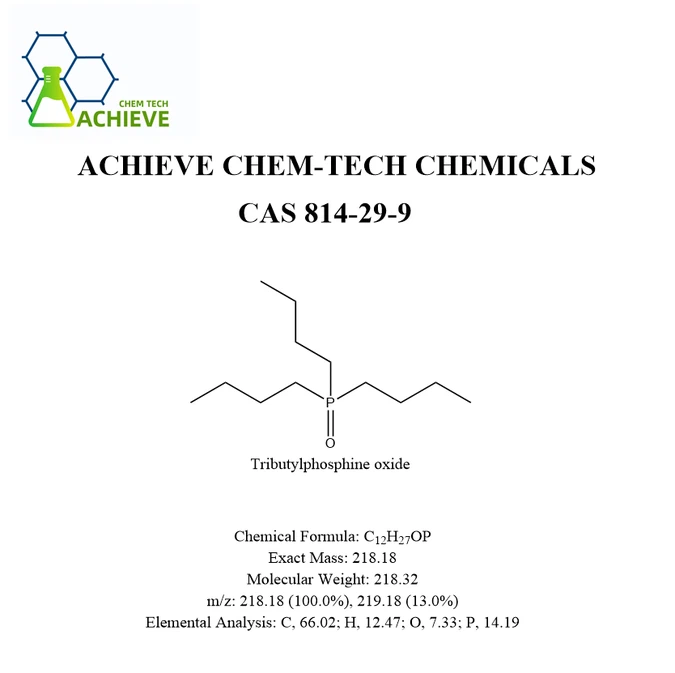

|
Chemical Formula |
C12H27OP |
|
Exact Mass |
218.18 |
|
Molecular Weight |
218.32 |
|
m/z |
218.18 (100.0%), 219.18 (13.0%) |
|
Elemental Analysis |
C, 66.02; H, 12.47; O, 7.33; P, 14.19 |

As an Intermediate in Chemical Synthesis
Phosphorus Esters and Amides
- TBPO can be used to prepare phosphorus esters and amides, which are important in various applications such as flame retardants, surfactants, and plasticizers.
- The reaction typically involves treating TBPO with an alcohol or amine, followed by elimination of butane to form the desired phosphorus compound.
01
Phosphorus Oxides and Acids
- TBPO can also be converted into other phosphorus oxides and acids by oxidation reactions.
- These compounds have applications in catalysis, materials science, and as intermediates in the synthesis of pharmaceuticals and agrochemicals.
02
Ligands for Transition Metal Complexes
- TBPO and its derivatives can serve as ligands in the formation of transition metal complexes.
- These complexes are often used in catalysis, where they can catalyze a wide range of reactions, including olefin polymerization, hydrogenation, and oxidation reactions.
03
Phosphorus-Containing Polymers
- TBPO can be incorporated into polymers to impart unique properties such as flame retardancy, antioxidant activity, and improved thermal stability.
- This is often achieved by copolymerizing TBPO-derived monomers with other monomers to form the desired polymer.
04
Modification of Polymers
Flame Retardancy
- TBPO and its derivatives can be incorporated into polymers to enhance their flame retardancy.
- The phosphorus content in TBPO acts as a flame retardant, absorbing heat and generating non-flammable gases during combustion, which helps to slow down the spread of fire.
Thermal Stability
- The introduction of TBPO into polymers can improve their thermal stability.
- This is particularly useful in applications where polymers are exposed to high temperatures, such as in aerospace, automotive, and electronic industries.
Mechanical Properties
- TBPO can also modify the mechanical properties of polymers, such as tensile strength, elasticity, and wear resistance.
- This can be achieved by controlling the degree of cross-linking or by introducing specific functional groups that interact with the polymer chains.
|
|
|


Creation of Functional Materials
Catalytic Materials
- TBPO and its derivatives can be used to prepare catalytic materials with specific activities and selectivities.
- These catalysts can be used in a wide range of reactions, including hydrogenation, oxidation, and polymerization.
01
Optical Materials
- TBPO-based compounds may exhibit unique optical properties, such as luminescence or photoconductivity.
- These properties can be harnessed to create new optical materials for applications in displays, sensors, and solar cells.
02
Biocompatible Materials
- TBPO and its derivatives can be designed to be biocompatible, making them suitable for use in medical applications.
- For example, they can be incorporated into biomaterials such as hydrogels, scaffolds, and coatings to improve their mechanical properties, cell adhesion, and biodegradability.
03
Electronic Materials
- TBPO-based compounds may have applications in the development of new electronic materials, such as semiconductors, conductors, and dielectrics.
- Their unique electronic properties can be tuned to meet specific requirements for electronic devices.
04
In the industrial sector
TBPO could potentially be used in the formulation of high-performance lubricants. Its unique chemical properties may contribute to enhanced lubrication, wear resistance, and thermal stability of the lubricants. This could be particularly beneficial in industries where machinery operates under extreme conditions, such as high temperatures or heavy loads.
Surfactants are compounds that lower the surface tension of a liquid, making it easier to spread or wet a surface. TBPO, with its phosphorus-containing structure, may offer unique surfactant properties. It could potentially be used in the production of surfactants for various applications, such as detergents, emulsifiers, and foam stabilizers. The phosphorus moiety may also contribute to enhanced biodegradability and environmental compatibility of the surfactants.
TBPO's versatility and unique chemical properties make it a potential candidate for use in the production of specialty chemicals. These chemicals may have specific applications in various industries, such as electronics, pharmaceuticals, and cosmetics. For example, TBPO could be used as a raw material or intermediate in the synthesis of phosphorus-containing polymers, which are often used in advanced materials and coatings.
In addition to the above-mentioned applications, TBPO may also have potential uses in other industrial processes. For instance, it could be employed as a catalyst or reagent in various chemical reactions, promoting the formation of desired products with high yields and selectivity. Its ability to form stable complexes with transition metals also makes it a valuable tool in the development of new catalytic systems for industrial processes.

Tributylphosphine oxide (TBPO), a versatile compound derived from the oxidation of tributylphosphine, finds extensive applications across various industrial sectors due to its unique properties. This chemical entity possesses excellent thermal stability, chemical inertness, and a distinct ability to act as a ligand in coordination chemistry.
In the field of catalysis, TBPO serves as a crucial ligand for the preparation of metal catalysts. It enhances the activity and selectivity of these catalysts in various chemical transformations, such as hydrogenation, isomerization, and oligomerization reactions. This makes it indispensable in the synthesis of pharmaceuticals, fine chemicals, and polymers.
Moreover, TBPO is employed as an antioxidant and stabilizer in polymers and plastics. It protects these materials from oxidative degradation, thereby extending their shelf life and improving their overall performance. This application is particularly significant in the automotive, electronics, and packaging industries where durability and reliability are paramount.
TBPO also plays a pivotal role in the extraction and separation of metals from ores and waste streams. Its affinity for certain metal ions allows for efficient and selective extraction processes, contributing to more sustainable and environmentally friendly mining practices.
Additionally, in the realm of materials science, TBPO is utilized in the synthesis of functional materials with unique optical, electrical, and magnetic properties. These materials are crucial for advancements in optoelectronics, information technology, and energy storage systems.
Furthermore, TBPO has found applications in analytical chemistry as a reagent for the spectrophotometric determination of certain metal ions. Its ability to form colored complexes with these ions facilitates accurate and sensitive analytical methods.
In summary, tributylphosphine oxide, with its diverse functionalities and broad applicability, continues to be a cornerstone in the advancement of various industrial processes. From catalysis and polymer stabilization to metal extraction and materials science, TBPO demonstrates its versatility and importance in contemporary chemical technology.
Adverse reactions
Tributylphosphine oxide (TBPO) is an important organic phosphorus compound with the chemical formula C ₁ ₂ H ₂ ₇ OP. It is typically a white crystalline solid with specific physical and chemical properties such as melting point, boiling point, solubility, etc. TBPO plays a key role in organic synthesis, often used as a catalyst, ligand, or intermediate, and participates in various chemical reactions such as Stille coupling reaction, Suzuki coupling reaction, etc. It can improve the selectivity and yield of reactions and has a wide range of applications in pharmaceuticals, materials science, and other fields.
Acute toxic reaction
Skin contact
When human skin comes into direct contact with TBPO, it may cause an irritant reaction. The initial symptoms include redness and itching of the skin. With prolonged exposure time or increased concentration, more severe skin damage such as rash and blisters may occur. This is because TBPO can disrupt the barrier function of the skin, causing damage to skin cells and triggering inflammatory reactions. In animal experiments, high concentrations of TBPO applied to animal skin resulted in significant skin corrosion.
Eye contact
TBPO has a more significant irritant effect on the eyes. Once it enters the eyes, it can quickly cause symptoms such as eye pain, tearing, and photophobia. In severe cases, it can lead to conjunctivitis, keratitis, and even damage to corneal epithelial cells, affecting vision. This is because the mucosal tissue of the eyes is very sensitive, and the chemical stimulation of TBPO can directly act on mucosal cells, causing inflammation and damage.
Inhalation
In the workplace, if TBPO is inhaled in the form of aerosols or vapors, it can cause damage to the respiratory system. Inhalation can cause symptoms such as coughing, wheezing, and difficulty breathing. In severe cases, it can lead to chemical pneumonia or pulmonary edema. This is because TBPO can stimulate the respiratory mucosa, causing mucosal congestion, edema, and increased secretion, hindering gas exchange.
Ingestion
Ingestion of TBPO is very dangerous. After ingestion, TBPO will have a strong stimulating effect on the digestive system, causing symptoms such as nausea, vomiting, abdominal pain, and diarrhea. At the same time, it may also be absorbed into the bloodstream, causing damage to important organs such as the liver and kidneys, leading to serious consequences such as liver dysfunction and kidney failure.
Chronic toxic reactions
Neurological effects
Long term exposure to low-dose TBPO may have chronic toxic effects on the nervous system. Patients may experience symptoms such as headache, dizziness, fatigue, insomnia, and memory loss. Animal experiments have shown that long-term exposure to TBPO environment can cause changes in the neurobehavior of animals, such as decreased motor coordination and impaired learning and memory abilities. This may be due to TBPO affecting the synthesis, release, and metabolism of neurotransmitters, interfering with the normal function of the nervous system.
Immune system effects
TBPO may also have inhibitory effects on the immune system. Long term exposure to TBPO may lead to a decrease in the body's immune function, manifested as susceptibility to diseases and slow wound healing. Research has found that TBPO can affect the activity of immune cells, such as inhibiting lymphocyte proliferation and differentiation, reducing antibody production, and thus weakening the body's immune defense ability.
Effects on the reproductive system
Studies have shown that TBPO may have adverse effects on the reproductive system. For men, long-term exposure to TBPO may affect the quality and quantity of sperm, leading to a decrease in fertility. For women, it may interfere with the menstrual cycle, affecting ovarian function and embryonic development. In animal experiments, feeding female animals with food containing TBPO can observe pathological changes in their reproductive organs and a decrease in fertility.
Hot Tags: tributylphosphine oxide cas 814-29-9, suppliers, manufacturers, factory, wholesale, buy, price, bulk, for sale, 2 4 Quinolinediol, 2-Chloro-3-methylpyridine, GS 441524 Powder, 1 Chlorooctane CAS 111 85 3, 4 6 Dichloro 2 methylpyrimidine CAS 1780 26 3, 3 Nitrobenzonitrile