


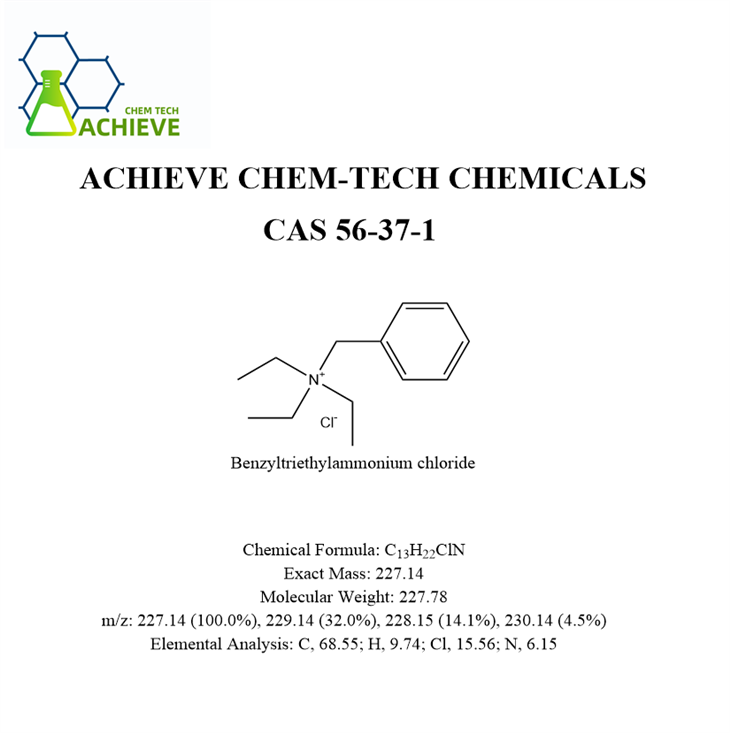
Benzyltriethylammonium chloride, also known as triethylbenzylammonium chloride (TEBAC), is a quaternary ammonium salt commonly used in various industrial and research applications. It is characterized by its cationic nature, featuring a positively charged nitrogen atom surrounded by three ethyl groups and a benzyl moiety. This unique structure imparts TEBAC with excellent solubility in both water and organic solvents, making it a versatile reagent.
In the chemical industry, TEBAC serves as a phase transfer catalyst, facilitating reactions between compounds that are normally insoluble in each other's solvents. This property has found widespread use in the synthesis of pharmaceuticals, agrochemicals, and other fine chemicals, where it enhances reaction efficiency and product yields.
Furthermore, TEBAC exhibits strong surface-active properties, making it a valuable component in detergents, emulsifiers, and surfactants. Its ability to lower the surface tension of water allows for better wetting, penetration, and dispersion of various substances.
In the field of biology, TEBAC has been employed as a preservative and antiseptic due to its bactericidal and fungicidal effects. However, its use in such applications is limited due to potential toxicity concerns.

|
|
|


|
Chemical Formula |
C13H22ClN |
|
Exact Mass |
227.14 |
|
Molecular Weight |
227.78 |
|
m/z |
227.14 (100.0%), 229.14 (32.0%), 228.15 (14.1%), 230.14 (4.5%) |
|
Elemental Analysis |
C, 68.55; H, 9.74; Cl, 15.56; N, 6.15 |

Benzyltriethylammonium chloride (TEBAC, CAS number 56-37-1) is a quaternary ammonium salt compound with the molecular formula C ₁ ∝ H ₂ ClN. Its unique hydrophilic oleophilic amphiphilic structure makes it widely applicable in organic synthesis, materials science, environmental governance, and industrial production.

Core function: The "bridging effect" of phase transfer catalysis
Its core function lies in its ability to serve as a Phase Transfer Catalyst (PTC). In liquid-liquid or solid-liquid two-phase reactions, anions (such as CN ⁻, OH ⁻) are usually confined to the aqueous phase, while organic reactants exist in the organic phase, resulting in extremely low reaction rates. Through the benzyl (lipophilic group) and triethylammonium (hydrophilic group) in its quaternary ammonium salt structure, it can "carry" anions from the aqueous phase to the organic phase, significantly improving reaction efficiency.
Typical case:
Williamson ether synthesis: In the etherification reaction between benzyl ether and halogenated hydrocarbons, the reaction rate can be increased by more than 10 times, and the product yield can reach over 95%.
Intermediate preparation of antibiotics: In the N-alkylation reaction of penicillin derivatives, its catalytic effect reduces the reaction temperature from 120 ℃ to 80 ℃, shortens the reaction time by 50%, and avoids the generation of by-products.


Industry application: Full chain coverage from laboratory to production line
1. Organic synthesis: the "master key" of catalytic reactions
Widely used in organic synthesis, covering key reaction types such as alkylation, nucleophilic substitution, oxidation-reduction, and condensation:
Alkylation reactions: including C-alkylation (such as alkylation of alcohols with halogenated hydrocarbons), O-alkylation (etherification), N-alkylation (alkylation of amines), and S-alkylation (alkylation of thiols). For example, in spice synthesis, it catalyzes the etherification reaction of benzyl ether and bromoethane, resulting in a product purity of 99%.
Nucleophilic substitution reactions, such as - CN and - F substitution reactions, reduce the activation energy of the reaction by stabilizing the transition state. For example, in the synthesis of fluorobenzoic acid, the reaction yield increased from 60% to 92%.
Redox reaction: As a latent catalyst, it activates the crosslinking reaction of epoxy/anhydride system at 60-80 ℃, suitable for low-temperature curing of electronic packaging materials.
Condensation reaction: In Darzen condensation (preparation of epoxy propane derivatives) and Wittig Hormar synthesis (construction of carbon carbon double bonds), its catalytic effect makes the reaction conditions milder and the product selectivity higher.


2. Materials Science: Functional Additives for High Performance Materials
The application in the field of materials focuses on functional modification:
Polymer polymerization: As a curing accelerator, it can regulate the crosslinking density of epoxy resin, improve the heat resistance and mechanical strength of the material. For example, in electronic packaging materials, it increases the glass transition temperature (Tg) of the material by 15 ℃ and achieves a compressive strength of 0.2 MPa.
Ionic liquid synthesis: High temperature stable ionic liquids (>300 ℃) were prepared by reacting with lithium bis (trifluoromethanesulfonyl) imide (LiTFSI) for use as electrolytes in energy storage devices, significantly improving battery cycling stability.
Thermal insulation material: as a foaming agent in polyurethane foam, the thermal conductivity of the material is reduced to 0.02 W/(m · K) by controlling the pore size distribution (average pore size 50 μ m), while maintaining lightweight characteristics (density 0.03 g/cm ³).


3. Environmental governance: a "green solution" for pollution control
The application in the field of environment is reflected in water treatment and soil remediation:
Water treatment: As a flocculant, benzyltriethylammonium chloride removes suspended solids (such as heavy metal ions and organic pollutants) in water through charge neutralization. In the treatment of printing and dyeing wastewater, the COD removal rate reaches 85%.
Soil remediation: As a clay stabilizer, it can inhibit the hydration expansion of shale formations. In the shale gas extraction test of Sinopec, it reduced the filtration loss of drilling fluid by 40% and significantly improved the wellbore stability.
Corrosion inhibitor: Compound with thiourea in acidic cleaning solution to inhibit hydrogen embrittlement during steel pickling, reducing the corrosion rate to 0.01 mm/year.


4. Industrial production: an "efficiency booster" for process optimization
Optimizing process flow in industrial production to achieve cost reduction and efficiency improvement:
Electroplating process: As an additive to improve coating quality, the uniformity of the coating is increased by 30% and the porosity is reduced to 0.5% in zinc nickel alloy electroplating.
Paper industry: As a sizing agent, it enhances the water resistance of paper, reducing its water absorption rate from 15% to 5%, while improving its printability.
Textile industry: As a descaling agent, it removes surface impurities from fabrics, increases whiteness by 10%, and makes the hand feel softer in cotton fabric pretreatment.


Frontier research: breakthrough applications in emerging fields
1. Energy sector: "Innovation catalyst" for battery technology
As an electrolyte additive, it can regulate the surface structure of zinc metal negative electrode and inhibit dendrite growth. Research has shown that in zinc symmetric batteries, it enables the electrolyte to achieve stable cycling for 9000 hours and a capacity retention rate of 90%, providing key technical support for the development of high safety zinc based batteries.
2. Biopharmaceuticals: "Stereoselective regulators" for enzyme catalyzed reactions
In non-aqueous enzymatic reactions, by changing the enzyme microenvironment, the enantioselectivity of lipase is improved (ee value increased to 99%). For example, in the synthesis of chiral drugs, it achieves an optical purity of 99.5%, meeting pharmaceutical grade standards.


3. Green chemistry: the "research and development benchmark" for low toxicity alternatives
Although benzyl triethylammonium chloride is toxic to aquatic organisms (EC50=5 mg/L), its catalytic activity remains the industry benchmark. The current research focuses on developing low toxicity choline quaternary ammonium salts (such as choline chloride) as alternatives, but the stability of such alternatives in high-temperature reactions still needs to be optimized.
Benzyltriethylammonium chloride (TEBAC), with the chemical formula C13H22ClN, has a rich history of scientific exploration. Initially synthesized in the mid-20th century, TEBAC quickly gained attention for its versatility as an alkylating and phase transfer catalyst. Its unique ability to enhance chemical reactions, particularly in the synthesis of multi-substituted cyclopropanes through Michael addition, has made it an invaluable tool in organic chemistry.
Research on TEBAC has progressed significantly, focusing on optimizing synthesis conditions and exploring new applications. Early studies concentrated on maximizing yields through variations in reactant ratios, solvents, and reaction temperatures. Recent advancements have led to the development of cost-effective and environmentally friendly production methods, ensuring TEBAC's accessibility and sustainability.
Looking ahead, the research on TEBAC is poised to expand into several exciting directions. Firstly, there is a growing interest in understanding its mechanism of action at a molecular level, which could lead to the design of even more efficient catalysts. Secondly, TEBAC's potential as a catalyst in green chemistry processes, such as those using renewable feedstocks or under mild conditions, is being actively investigated. Lastly, the exploration of TEBAC's antimicrobial and biocidal properties opens up avenues for its application in healthcare and environmental disinfection.
Hot Tags: benzyltriethylammonium chloride cas 56-37-1, suppliers, manufacturers, factory, wholesale, buy, price, bulk, for sale, 1 4 Cyclohexanedicarboxylic Acid CAS 1076 97 7, 1 Nonanol CAS 143 08 8, Dodecyltrimethylammonium chloride, polyquaternium 7 powder, Chrysene powder, 1 10 Phenanthroline hydrate