




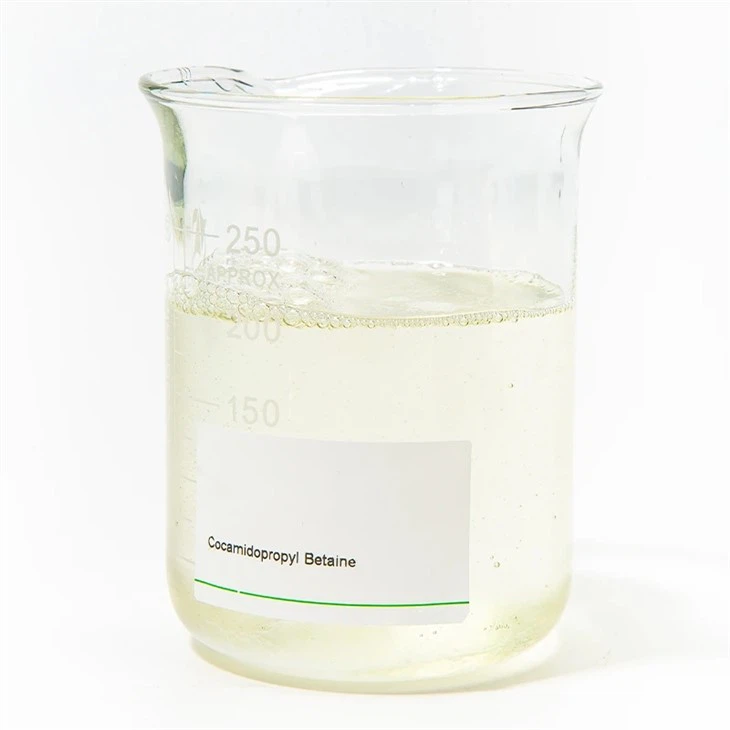
Shaanxi BLOOM Tech Co., Ltd. is one of the most experienced manufacturers and suppliers of cocamidopropyl betaine liquid cas 61789-40-0 in China. Welcome to wholesale bulk high quality cocamidopropyl betaine liquid cas 61789-40-0 for sale here from our factory. Good service and reasonable price are available.
Cocamidopropyl betaine, also commonly known as CAPB, is a versatile and widely used amphoteric surfactant in the personal care and cosmetics industry. Derived from coconut oil, this ingredient combines the properties of both cationic and anionic surfactants, offering a balance of cleansing and conditioning benefits. Its chemical structure features a hydrophilic (water-loving) betaine moiety and a hydrophobic (oil-loving) cocamide group, allowing it to effectively interact with both water and oil-based impurities on the skin and hair. This unique characteristic makes it an excellent choice for formulating gentle yet effective cleansers that maintain the skin's natural moisture barrier.
CAPB is renowned for its mildness and low irritation potential, making it suitable for a broad range of skin types, including sensitive skin. It produces a rich, creamy lather that enhances the user experience, while its excellent foam stability ensures consistent performance across various products like shampoos, body washes, facial cleansers, and even bubble baths. Moreover, it is biodegradable and eco-friendly, aligning with the growing consumer demand for sustainable personal care options. It also enhances the solubility and stability of other ingredients in formulations, acting as a stabilizing agent and helping to maintain the overall quality and consistency of cosmetic products.
In summary, it is a highly valued ingredient in the cosmetics industry due to its balanced surfactant properties, mildness, foaming ability, and environmental compatibility, making it a cornerstone in the creation of many popular personal care products.

|
|
|


| Chemical Formula | C19H38N2O3 |
| Exact Mass | 342.29 |
| Molecular Weight | 342.52 |
| m/z | 342.29 (100.0%), 343.29 (20.5%), 344.29 (2.0%) |
| Elemental Analysis | C, 66.63; H, 11.18; N, 8.18; O, 14.01 |

Coconut amidopropyl betaine is a mild and efficient multifunctional surfactant. Coconut amidopropyl betaine is a colorless to yellowish transparent liquid. Little irritation, mild performance Foam is rich and stable. It has the functions of adjusting viscosity and sterilization, enhancing the softness to hair and skin. It can be used as detergent, conditioner, wetting agent, bactericide, thickener, antistatic agent, etc. Coconut amidopropyl betaine is a popular shampoo in the world. Basic ingredients widely used in hair care products. At present, it is mainly used to prepare shampoo, bath agent, facial cleanser, baby care products and other detergents. Coconut amidopropyl betaine is an amphoteric surfactant, which has developed rapidly in recent years. Coconut amidopropyl betaine has mild properties superior to other amphoteric surfactants, and can achieve very ideal results in shampoo products. Coconut amidopropyl betaine is famous for its unique multi-function. It not only has good decontamination, emulsification, dispersion, wetting and other functions, but also has the bactericidal, antistatic, softening and other functions of cationic surfactants.
Cocamidopropyl betaine, a highly effective surfactant, plays a crucial role in personal care products by facilitating the mixing of water with oil and dirt, thus enabling their easy rinsing away. This property makes it indispensable in formulations such as shampoos, soaps, body washes, and other skin cleansing products.
Moreover, it functions as a foam booster, contributing to the creation of a rich, creamy lather. This not only enhances the sensory experience of using these products but also amplifies their cleansing capabilities. The foam acts as a carrier for the surfactant, ensuring that the cleaning agent reaches all areas of the hair or skin, thereby improving the overall effectiveness of the product.

Gentle on Skin

Derived from coconut oil, is renowned for its mildness and minimal irritation potential. This gentle nature makes it an ideal choice for inclusion in products designed for sensitive skin and baby care.
For individuals with sensitive skin, the use of harsh chemicals can lead to discomfort, redness, or even more severe reactions. However, it is well-tolerated by most skin types, making it a safe and effective ingredient in skin care products that cater to sensitive skin.
Similarly, in baby care products, it is crucial to use ingredients that are gentle and non-irritating. It meets this criterion, making it a popular choice for baby shampoos, body washes, and other cleansing products. Its mildness ensures that it is safe for use on baby's delicate skin, providing effective cleansing without causing any discomfort.
By enhancing the viscosity of personal care products such as shampoos, lotions, and creams,it contributes to a more pleasant texture. This improvement in viscosity can make the product feel smoother, creamier, and more luxurious upon application.
Furthermore, its conditioning properties make it particularly beneficial for hair and skin care products. It helps to deposit conditioning agents onto hair strands, smoothing the cuticle and reducing friction, which can lead to less breakage and a shinier appearance. Similarly, on the skin, it can help to improve moisture retention and barrier function, resulting in softer, smoother skin.
Household Cleaning Products

In household cleaning products, it plays a crucial role in removing dirt, grease, and other stubborn stains from various surfaces. Its amphoteric nature allows it to effectively clean a wide range of soils, making it a popular choice for laundry detergents, hand dishwashing liquids, and hard surface cleaners.
Static electricity can be a nuisance in many applications, causing problems such as dust attraction, shock hazards, and interference with electronic equipment. Being an amphoteric surfactant, helps to neutralize static charges on surfaces, thereby reducing the incidence of these issues.
In the context of fabrics, it can be incorporated into fabric softeners and finishing agents to help reduce static cling and improve the overall feel of the fabric. Similarly, in plastics and other materials prone to static build-up, it can be used as an antistatic agent to prevent the accumulation of static charges.

Biodegradable and Environmentally Friendly

Biodegradability refers to a substance's ability to be broken down by microorganisms into harmless components, such as carbon dioxide, water, and biomass, under natural conditions. It meets this criterion, as it readily degrades in aerobic aquatic environments, meaning it can be broken down by bacteria in the presence of oxygen.
This biodegradability is an important consideration in the formulation of eco-friendly products. It does not accumulate in the environment, and its breakdown products are not toxic or persistent, making it a sustainable choice for various applications.

Raw material source: Coconut oil and its derivatives
The core raw material of CAB/CAPB is coconut oil, which is a natural vegetable oil extracted from coconut meat and rich in medium chain fatty acids such as lauric acid and myristic acid. The preparation process starts with coconut oil or its derivatives (such as coconut oil, cocoyl halides, methyl cocoate) and is converted into the target product through chemical synthesis.
Extraction method: two-step chemical synthesis process
The preparation of cocoamidopropyl betaine requires two key processes: condensation reaction and quaternization reaction. The specific process is as follows:
Raw materials: Coconut oil or its derivatives (such as methyl cocooleate) and N, N-dimethyl-1,3-propanediamine (DMAPA).
Reaction conditions:
Reaction process:
Methyl cocoate undergoes amidation condensation reaction with DMAPA at high temperature, removing methanol (CH3 OH) and generating intermediate product cocoamidopropyl dimethylamine (PKO, i.e. tertiary amine). The reaction equation is as follows:
RCOOCH3+H2N(CH2)3N(CH3)2→RCONH(CH2)3N(CH3)2+CH3OH
(Where R represents cocoyl, C11H23CO-)
Raw materials: Intermediate tertiary amine (PKO) and sodium chloroacetate (NaClCH ₂ COO ⁻).
Reaction conditions:
Reaction process:
Quaternary ammonium reaction occurs between tertiary amine and sodium chloroacetate, resulting in the formation of zwitterionic cocoamidopropyl betaine. The reaction equation is as follows:
RCONH(CH2)3N(CH3)2+ClCH2COONa→RCONH(CH2)3N + (CH3)2CH2COO−+NaCl
The final product is a colorless to pale yellow transparent liquid with an active ingredient content of approximately 30% -35%.
Process optimization and key parameters
Temperature optimization:
The condensation reaction temperature needs to be precisely controlled. For example, when n (DMAPA): n (methyl cocoate)=1.15:1 and the catalyst dosage is 3%, the conversion rate of methyl cocoate can reach 99.7% after 25 minutes of reaction at 210 ℃.
Catalyst selection:
Potassium hydroxide (KOH) is a commonly used catalyst, but sodium methoxide (CH3 ONa) can also be used for specific processes.
Purity control:
By adjusting the pH value (such as using citric acid or sodium hydroxide) and vacuum removing by-products (such as methanol, unreacted DMAPA), the purity of the product is ensured.
Everything You Need to Know
Is Cocamidopropyl Betaine safe to use?
Yes, Cocamidopropyl Betaine is widely recognized as safe for use in personal care products.
What are the side effects of Cocamidopropyl Betaine?
Prolonged exposure may cause irritation. Symptoms/Injuries After Skin Contact: Redness, pain, swelling, itching, burning, dryness, and dermatitis. Symptoms/Injuries After Eye Contact: Contact causes severe irritation with redness and swelling of the conjunctiva.
Is Cocamidopropyl Betaine good for the skin?
Cocamidopropyl Betaine is very well tolerated by the skin and is so mild that it is internationally recommended for use in foaming products designed for use by babies and infants. It is also suitable for those who may be prone to eczema and sensitive skin.
Is Cocamidopropyl Betaine safe for babies?
Cocamidopropyl Betaine (CAPB) is a commonly used ingredient in baby care products due to its mildness, low irritation potential, and foaming properties.
Hot Tags: cocamidopropyl betaine liquid cas 61789-40-0, suppliers, manufacturers, factory, wholesale, buy, price, bulk, for sale, Stearic Acid Powder CAS 57 11 4, P Terphenyl CAS 92 94 4, Chrysene powder, Monostearin, ferrocene powder, 3-Chloropropyltrimethoxysilane