




Shaanxi BLOOM Tech Co., Ltd. is one of the most experienced manufacturers and suppliers of calcium stearate powder cas 1592-23-0 in China. Welcome to wholesale bulk high quality calcium stearate powder cas 1592-23-0 for sale here from our factory. Good service and reasonable price are available.
Calcium stearate powder, chemical composition calcium stearate, is an organic compound with molecular formula C36H70CaO4, CAS 1592-23-0. White powder, non-toxic, soluble in hot pyridine, slightly soluble in hot ethanol, hot vegetable oil, and mineral oil, insoluble in water, ether, chloroform, acetone, and cold alcohol. It absorbs moisture from the air. Has resistance to fat degrading microorganisms. High temperature decomposition produces stearones and hydrocarbons. Stable at room temperature and pressure, avoiding contact with strong oxidants. When encountering strong acids, it decomposes into stearic acid and corresponding calcium salts.

|
Chemical Formula |
C36H70CaO4 |
|
Exact Mass |
606 |
|
Molecular Weight |
607 |
|
m/z |
606 (100.0%), 607 (38.9%), 608 (7.4%), 610 (2.2%) |
|
Elemental Analysis |
C, 71.23; H, 11.62; Ca, 6.60; O, 10.54 |
|
|
|

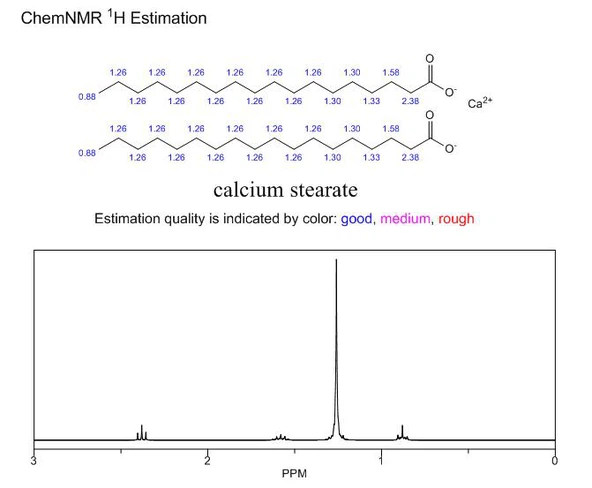
Melting point 147-149 ° C, Density 1.08g/cm3, Storage condition store at +5 ° C to +30 ° C, Solubility in hot pyridine, slightly soluble in oil, but insoluble in alcohol and ether, Form powder, Color white, Odo, PH value 7-9 (2.2 mg/l, H2O, 20 ° C), Water soluble H2O, ether, chloroform; slightly soluble hot mineral oils [MER06], BRN 3919698, InChIKeyCJZGTCYPCWQAJB-UHFFFAOYSA-L, security information, Dangerous goods sign xn, Hazard category code 20/21/22-36/37/38, Safety instructions 22-24/25-36-26, WGK Germany -, RTECS No. wi3000000, Autoignition temperature 460 ° C DIN 51794,TSCA Yes.

Calcium stearate powder, as an important organic compound, plays a crucial role in multiple industrial fields due to its unique physicochemical properties.
It is an indispensable non-toxic stabilizer in the processing of polyvinyl chloride (PVC), which significantly improves the weather resistance and service life of products by inhibiting high-temperature degradation reactions. Experiments have shown that the addition of 2% calciu stearate to PVC film increases the retention rate of fracture elongation from 65% to 82% in xenon lamp aging tests. Its mechanism of action includes:
Thermal stabilization effect: When used in combination with zinc soap and epoxy compounds, a synergistic stabilization system can be formed, effectively absorbing HCl produced by PVC decomposition and preventing self catalytic degradation. This system is widely used in fields with extremely high safety requirements, such as food packaging films and medical devices.


Lubrication demolding: As an internal lubricant, it can reduce the friction coefficient between plastic melt and equipment metal surface, reducing processing energy consumption by 15% -20%. At the same time, its external lubrication characteristics increase the surface glossiness of the product by more than 30%, reducing the frequency of mold cleaning.
Halogen absorption: In the processing of polyethylene (PE) and polypropylene (PP), it can eliminate the influence of residual catalysts (such as TiCl ₄) on the color and stability of the product. Experiments have shown that adding 0.5% calciu stearate can reduce the yellowing index (YI) of PE films from 12 to below 5.
It has multiple functions in rubber processing, and its mechanism of action involves chemical promotion and physical modification:
Sulfurization activator: As an activation carrier for metal oxides (such as ZnO), it can accelerate the sulfurization reaction rate and shorten the positive sulfurization time by 20% -30%. Adding 1.5% calciu stearate to the tire tread rubber formula can increase the crosslink density by 18% and significantly improve wear resistance.


Softening dispersion: Its long-chain fatty acid structure can penetrate between rubber molecular chains, weaken the interaction force, and reduce the Mooney viscosity of the mixed rubber by 25% -35%. This is particularly important for the processing of high filling systems, such as carbon black N660 with a dosage of up to 60 phr.
Isolation and anti sticking: During the storage process of rubber products, a protective film can be formed on the surface to prevent semi-finished products from sticking to each other. Experiments have shown that adding 0.8% calciu stearate can reduce the peeling force of rubber sheets from 12N to below 3N.
As a key additive in the paper industry, calcium stearate powder functions through a dual mechanism of physical adsorption and chemical modification:
Coating lubrication: As a lubricant for coating processed paper, it can reduce the friction coefficient between the coating and the calendering roller, reducing the surface roughness (Ra value) of the coating from 0.8 μ m to 0.3 μ m, significantly improving the printing suitability.
Waterproof enhancement: By reacting with hydroxyl groups on the fiber surface, a hydrophobic film layer can be formed, reducing the Cobb value (water absorption) of the paper from 45g/m ² to below 15g/m ². This feature has important application value in fields such as packaging paper and oil paper.
Stable thickening: As a stabilizer for coatings, it can prevent pigment particles from settling. Experiments have shown that adding 0.3% calciu stearate can reduce the 24-hour sedimentation rate of the coating from 18% to below 3%, maintaining the uniformity of the system.

Food industry: Anti caking and texture improvement

Food grade meets FAO/WHO standards and plays an irreplaceable role in the processing of powdered foods
Anti caking agent: By reducing the surface energy between particles, it can effectively prevent sugar powder, salt, seasonings, etc. from clumping during storage. According to FAO/WHO regulations, the maximum allowable dosage of glucose powder for coating is 15g/kg, which can increase product flowability by more than 40%.
Emulsification stability: stable O/W lotion can be formed in emulsification systems such as margarine and salad dressing. The experiment shows that adding 0.5% calciu stearate can reduce the centrifugal oil separation rate of lotion from 12% to less than 3%, significantly extending the shelf life.
Texture improvement: As a viscosity regulator for chewing gum, it can control the hardness changes during chewing, making the product taste better. In the production of hard candies, it can prevent crystallization and maintain transparency.
As a multifunctional additive in cosmetic formulations, its functions include physical modification and chemical stability:
Emulsification system: As an oily raw material and emulsifier for creams such as snow cream and cold cream, it can form a stable liquid crystal structure, making the product texture delicate. Experiments have shown that adding 2% calciu stearate can increase the viscosity of the paste from 15000mPa · s to 22000mPa · s while maintaining its spreadability.
Sensory improvement: As a softener and gloss agent, it can enhance the smoothness of the product. In the lipstick formula, it can adjust the melting point from 58 ℃ to 62 ℃, improving the stability under high temperature.
Stabilization effect: By chelating metal ions, it can prevent the loss of antioxidants (such as vitamin E) in the formula and extend the shelf life of the product.

Textile Industry: Printing and Dyeing Auxiliaries and Post finishing

Calcium stearate powder, as a key additive in textile printing and dyeing, plays a role throughout the entire process of pretreatment, dyeing, and finishing
Dispersion softness: As a dispersant, it can evenly disperse dye particles and prevent the formation of color spots. Experiments have shown that adding 1% calciu stearate can increase the dye uptake of reactive dyes by 15% -20%.
Immersion and Wear Reduction: In the immersion rolling process, the friction coefficient between the fabric and the rolling mill can be reduced, resulting in an increase of over 30% in the flatness of the fabric surface and a decrease in fabric damage rate.
Waterproof finishing: As an important component of textile waterproofing agents, it can form a hydrophobic layer by reacting with fibers, increasing the contact angle of the fabric from 120 ° to over 150 °, achieving a water repellent effect.
As an efficient release agent in the casting industry, its mechanism of action involves physical lubrication and chemical isolation:
Demolding performance: During the metal die-casting process, a continuous lubricating film can be formed on the surface of the mold, reducing the demolding force by 50% -70%. Experiments have shown that adding a 2% calcium stearate release agent can reduce the surface roughness (Ra value) of castings from 3.2 μ m to 1.6 μ m.
Surface smoothness: By controlling the cooling rate, defects such as cold shuts and flow marks on the surface of castings can be reduced. In aluminum alloy die-casting, it can increase the product qualification rate from 85% to over 92%.
Mold protection: Calcium stearate can prevent direct contact between molten metal and the mold, extending the service life of the mold. Experiments have shown that continuous use of release agents containing calcium stearate can extend the lifespan of molds by 1.5-2 times.


The synthetic method of calcium stearate powder is as follows:
Calcium stearate is an important organic metal salt widely used in industrial fields such as rubber, plastics, coatings, paints, etc., as a plasticizer, stabilizer, lubricant, etc. Direct method is a commonly used method for synthesizing calcium stearate, which has the advantages of simple process, easy availability of raw materials, and low cost. Our laboratory adopts the direct method to synthesize calcium stearate, and the detailed steps are as follows:
The direct synthesis of calcium stearate mainly requires two raw materials: stearic acid and calcium oxide. Stearic acid is generally selected from industrial products with higher purity, while calcium oxide can be obtained by calcining natural minerals such as limestone or shells. Before synthesis, the raw materials should be thoroughly dried to remove any moisture.
Add stearic acid and calcium oxide in a certain ratio (usually 1:1) to the reaction vessel. Turn on the stirring device and gradually heat it to a molten state. During the melting process, stearic acid and calcium oxide undergo a neutralization reaction, producing calcium stearate and water.
The melting reaction needs to be carried out at a certain temperature and pressure. Usually, the reaction temperature is controlled between 140-150 ℃ and the pressure is maintained at a slightly positive pressure. Within this temperature range, the production rate of calcium stearate is faster and can avoid the occurrence of side reactions. At the same time, by vacuuming, the water generated by the reaction is continuously removed to push the reaction forward.
When the water in the reactor is basically drained and the production of calcium stearate no longer increases, the reaction is considered complete. At this point, turn off the heating and stirring devices and discharge the molten calcium stearate material. By cooling, crushing and other steps, calcium stearate products are obtained.
The chemical equation for the direct synthesis of calcium stearate is as follows:
2CaO+C17H35COOH → Ca(C17H35COO)2+H2O
In this reaction, calcium oxide (CaO) undergoes a neutralization reaction with stearic acid (C17H35COOH) to produce calcium stearate [Ca (C17H35COO) 2] and water (H2O). Calcium stearate is a white or slightly yellowish amorphous powder that is insoluble in water but soluble in organic solvents such as hot ethanol, benzene, and turpentine.
The direct synthesis of calcium stearate is a simple and effective method. By controlling factors such as raw material purity, reaction temperature and time, stirring speed, and vacuum degree, high-quality calcium stearate products can be obtained. This method has the advantages of simple process, easy availability of raw materials, and low cost, and has broad application prospects in industrial production.

Melting method is a commonly used method for synthesizing calcium stearate powder, which is characterized by a high-temperature melting reaction that causes chemical reactions between raw materials to obtain the target product. This method has the advantages of easy availability of raw materials, simple process, and fast reaction rate, and has been widely used in industrial production.
The chemical equation for the synthesis of calcium stearate by melting method is as follows:
2MO+C17H35COOH → Ca(C17H35COO)2+2MO
Among them, M represents metallic elements (such as Ca, Zn, etc.), and O represents oxygen element. In this reaction, stearic acid undergoes a neutralization reaction with metal oxides, producing calcium stearate and corresponding metal oxides. Calcium stearate is a white or slightly yellowish amorphous powder that is insoluble in water but soluble in organic solvents such as hot ethanol, benzene, and turpentine.
The main raw materials for the synthesis of calcium stearate by melting method are stearic acid and metal oxides (such as calcium oxide, zinc oxide, etc.). Stearic acid is generally selected from industrial products with higher purity, while metal oxides can be obtained by calcining corresponding natural minerals or chemical synthesis. Before synthesis, the raw materials should be thoroughly dried and screened to remove moisture and impurities.
Add stearic acid and metal oxides in a certain proportion to the reaction vessel. Turn on the heating device and gradually increase the temperature until the raw material melts. During the melting process, stearic acid undergoes a neutralization reaction with metal oxides, generating calcium stearate and corresponding metal oxides.
The melting reaction needs to be carried out at a certain temperature and pressure. Usually, the reaction temperature is controlled between 180-220 ℃ and the pressure is maintained at a slightly positive pressure. Within this temperature range, the production rate of calcium stearate is faster and can avoid the occurrence of side reactions. Meanwhile, by controlling reaction time and stirring speed, product quality and yield can be further affected.
When the material in the reaction kettle has a uniform color and no more bubbles are generated, the reaction is considered complete. At this point, turn off the heating device and let the material cool naturally. After the material cools to room temperature, remove it and crush it into the required particle size powder. Calcium stearate products are obtained through steps such as screening, washing, and drying.
Hot Tags: calcium stearate powder cas 1592-23-0, suppliers, manufacturers, factory, wholesale, buy, price, bulk, for sale, 1 10 Phenanthroline hydrate, 1 4 Cyclohexanedicarboxylic Acid CAS 1076 97 7, 3-Isocyanatopropyltriethoxysilane, ferrocene powder, Dodecyltrimethylammonium chloride, 3-Chloropropyltrimethoxysilane