




Shaanxi BLOOM Tech Co., Ltd. is one of the most experienced manufacturers and suppliers of diphosphoryl chloride cas 13498-14-1 in China. Welcome to wholesale bulk high quality diphosphoryl chloride cas 13498-14-1 for sale here from our factory. Good service and reasonable price are available.
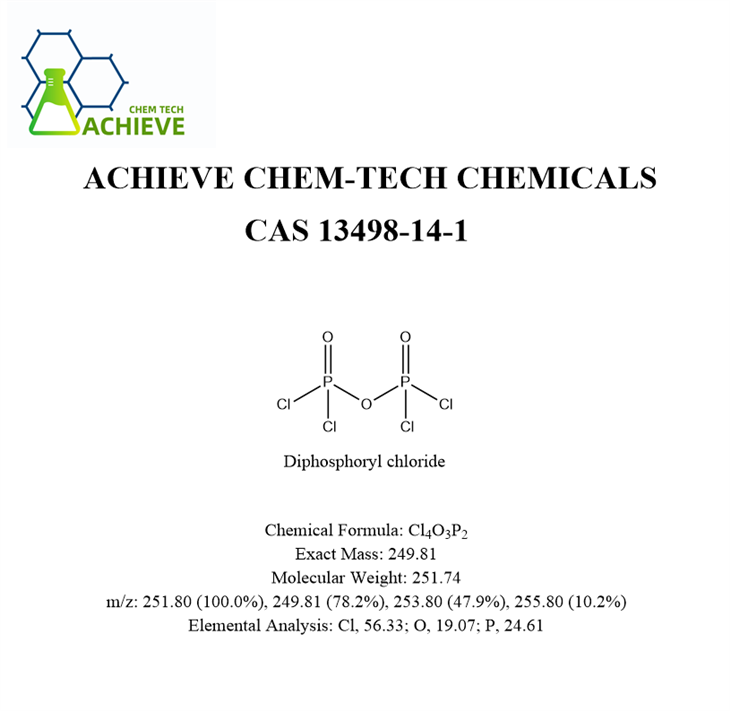
Diphosphoryl chloride, also known as phosphorus oxychloride (POCl3), is a colorless to light yellow, fuming liquid with a pungent odor. This compound is typically encountered as a colorless liquid under standard conditions, making it a versatile intermediate in various chemical reactions. It is a versatile inorganic compound with a crucial role in various industrial applications. Although it is often represented simplistically as POCl3 to highlight its structural similarity to phosphorus trichloride with an additional oxygen atom bonded to phosphorus.
It is known for its reactivity, particularly towards water and other hydrophilic compounds. It reacts vigorously with water, releasing heat and potentially hazardous gases such as hydrogen chloride (HCl). Due to its corrosive and hazardous nature, proper handling and storage procedures are essential.

 |
 |
|
Chemical Formula |
Cl4O3P2 |
|
Exact Mass |
249.81 |
|
Molecular Weight |
251.74 |
|
m/z |
251.80 (100.0%), 249.81 (78.2%), 253.80 (47.9%), 255.80 (10.2%) |
|
Elemental Analysis |
Cl, 56.33; O, 19.07; P, 24.61 |

Pharmaceutical Synthesis: Dual-Functional Phosphorylating and Chlorinating Reagent

Synthesis of Nucleoside and Nucleotide Drugs
Diphosphoryl chloride is a core phosphorylating reagent for the synthesis of nucleosides, nucleotides and nucleic acid derivatives. It enables efficient and selective phosphorylation of nucleoside hydroxyl groups to construct phosphate, pyrophosphate and phosphoramide structures, providing a vital synthetic route for antiviral, antitumor and antimetabolite drugs. In the synthesis of drugs against Hepatitis B (HBV), Hepatitis C (HCV) and Human Immunodeficiency Virus (HIV), it reacts with the 5'-hydroxyl group of nucleosides such as vidarabine and zidovudine to generate nucleoside 5'-diphosphate derivatives.
These compounds mimic viral nucleic acid synthetic substrates, competitively inhibit viral DNA/RNA polymerase, block viral replication, and enhance antiviral activity and cellular permeability.
In the preparation of antitumor nucleoside analogues including fluorouracil and gemcitabine, it modifies nucleoside side chains and introduces phosphoryl groups to strengthen binding affinity with intracellular tumor targets. Meanwhile, it improves drug lipophilicity, facilitates penetration through tumor cell membranes, increases intracellular drug concentration, and reduces systemic toxic and side effects.


Additionally, it is used to synthesize cyclic nucleotide analogues such as cAMP and cGMP, which act as signaling pathway modulators for the research and development of cardiovascular and neurological drugs.
Synthesis of Antibiotics and Anti-Infective Drugs
In the synthesis of β-lactam antibiotics (penicillins, cephalosporins) and quinolone anti-infective agents, it acts as a phosphorylating modifier to improve drug stability, antibacterial activity and ability to overcome drug resistance. When performing phosphorylation modification on the penicillin parent nucleus 6-APA, it reacts with the 3-position hydroxyl group to form phosphate ester derivatives.
Such modification enhances the stability of the β-lactam ring against β-lactamase, prevents hydrolytic degradation by bacteria, restores the susceptibility of drug-resistant strains, and broadens the antibacterial spectrum to cover more Gram-negative bacteria.
In the production of quinolone drugs such as ciprofloxacin and levofloxacin, it catalyzes chlorination and phosphorylation of key heterocyclic intermediates, constructs the fluorinated quinolone parent nucleus, optimizes the binding affinity with bacterial DNA gyrase, boosts antibacterial activity and reduces drug resistance mutation rates.

Industrial Materials: Flame Retardants, Lithium Battery Additives and Electronic Chemicals

Synthesis of High-Efficiency Phosphorus-Based Flame Retardants
Diphosphoryl chloride is an essential raw material for environmentally friendly phosphorus-based flame retardants. It reacts with polyols, phenols and amines to produce phosphate esters, polyphosphate esters and phosphoramide flame retardants, which are widely incorporated into polymer materials such as plastics, rubber, coatings and textiles. They endow materials with outstanding flame retardancy, smoke suppression and anti-dripping performance, while maintaining low toxicity, low corrosion and environmental friendliness.
In the flame retardant modification of PVC and PU foam, it reacts with pentaerythritol to form intumescent flame retardants. Upon heating, a dense carbon layer is formed to isolate oxygen and heat, suppress material combustion and reduce the release of toxic fumes, improving fire safety. In curing systems of epoxy resin and unsaturated polyester resin, it acts as a reactive flame retardant, participating in resin curing and introducing phosphorus into the resin skeleton to achieve permanent flame retardancy without additive migration. It is widely used in high-end fields such as electronic packaging materials and composite materials.


Electronic Chemicals and Laser Materials
It is used to synthesize electronic-grade phosphate esters and phosphoramides, which are applied as electronic component cleaning agents, photoresist additives and dopants for laser materials. In semiconductor manufacturing, it removes metallic impurities and organic contaminants on silicon wafer surfaces, improves surface cleanliness and ensures stable performance of semiconductor devices.
In photoresist formulations, it acts as a photosensitizer auxiliary to optimize sensitivity, resolution and corrosion resistance.
In the field of laser materials, it serves as a dopant precursor for preparing phosphate laser glass and crystal materials. The introduction of phosphorus adjusts the optical performance, thermal stability and laser output efficiency, which is applicable to solid-state lasers and optical communication industries.

Fine Chemicals and Other Applications

Synthesis of Surfactants and Water Treatment Agents
It is employed to prepare phosphorus-containing anionic surfactants. By reacting with fatty alcohols and alkylphenol ethoxylates, it introduces hydrophilic groups such as phosphate and pyrophosphate to produce phosphate and pyrophosphate surfactants. These products possess excellent emulsification, dispersion, wetting, antistatic and chelating properties, and are widely used in detergents, cosmetics, textile printing and dyeing, and petroleum exploitation.
In water treatment, its reaction with polyamines and polyethers generates phosphorus-containing polymer water treatment agents, which function as flocculants, corrosion inhibitors, scale inhibitors and bactericides. They are applied to industrial wastewater, circulating cooling water and boiler water treatment, effectively removing heavy metal ions, organic matter, suspended solids and microorganisms, inhibiting equipment corrosion and scale formation, and improving water treatment efficiency and service life of facilities.


Vilsmeier-Haack Formylation and Organic Synthesis Catalysis
It is a high-efficiency reagent for Vilsmeier-Haack formylation and acetylation reactions. It reacts with aromatic and heterocyclic compounds to selectively introduce formyl (-CHO) or acetyl groups for the synthesis of pharmaceutical, pesticide and dye intermediates as well as fine chemicals. Compared with traditional Vilsmeier reagent (POCl₃/DMF), it delivers higher reactivity, better selectivity and fewer by-products.
It is suitable for formylation of polysubstituted aromatic rings and nitrogen-containing heterocycles such as pyridine and indole, with yields ranging from 80% to 95%.
In addition, it can be used as a Lewis acid catalyst to promote esterification, etherification, cyclization and other organic reactions, shortening reaction time and increasing yield, showing broad application prospects in fine chemical synthesis.


Experimental Research Case
The primary objective of this experimental research was to synthesize diphosphoryl chloride through an optimized process and analyze its purity and yield under different reaction conditions.
Carried out using Pentaerythritol and Phosphorus Oxychloride as the main reactants. The reaction was catalyzed by an activated carbon catalyst containing a fenizn compound. The experimental design employed uniform design principles to select a limited number of experimental points that could represent the main characteristics of the system.
The factors investigated included reaction temperature (X1), molar ratio of Phosphorus Oxychloride to Pentaerythritol (X2), and reaction time (X3). The experimental range for these factors was: reaction temperature from 70 to 100°C, molar ratio from 3.0:1.0 to 5.0:1.0, and reaction time from 2 to 24 hours.
A quantity of 2712g of Pentaerythritol and the required amount of Phosphorus Oxychloride were added to a three-necked flask. The mixture was heated to a specific temperature and stirred for a defined period. After cooling, the reaction mixture was filtered, and the filter cake was washed with dichloromethane and dried to obtain the white solid product.
The results of the experiments were analyzed using statistical software, and a regression equation was obtained that described the relationship between the yield and the reaction conditions. The optimal reaction conditions were determined to be a reaction temperature of 81°C, a molar ratio of Phosphorus Oxychloride to Pentaerythritol of 3.6:1.0, and a reaction time of 20 hours. Under these conditions, the yield was 84.8%, which was close to the predicted value.
This experimental research successfully optimized the synthesis conditions, achieving a high yield with the selected reaction parameters. The optimized conditions provide a reliable basis for the industrial production and its downstream products, such as flame retardants.

biological activities
Toxicity and Irritation
Known for its toxicity and corrosive properties. When it comes into contact with skin or eyes, it can cause severe irritation, burns, and potential long-term damage.
Chemical Reactivity
The compound is highly reactive, especially with water, forming hydrochloric acid and phosphorus oxides. These reaction products can further affect biological systems, causing damage to tissues and organs.
Potential for Biotransformation
Although it is not directly used in biological systems, its breakdown products may undergo biotransformation within organisms, leading to various biological effects that are not fully understood.

The discovery of phosphoryl chloride can be traced back to the late 19th century, when the field of inorganic chemistry was in a rapidly developing stage.
In the 1890s, with the deepening of phosphorus chemistry research, scientists began to systematically study various phosphorus chlorides. In this context, diphosphoyl chloride was synthesized and reported for the first time as a novel phosphate chloride.
Early research mainly focused on exploring its basic chemical properties and reactivity. In the early 1900s, with the introduction of modern analytical techniques, scientists were able to more accurately determine the structure and purity of phosphoryl chloride.The application of these technologies not only accelerated the research on the compound, but also laid the foundation for its application in organic synthesis.
In the mid-20th century, research on phosphoryl chloride further deepened, especially in its applications in organic synthesis and materials science. Scientists have discovered that diphosphoyl chloride can serve as an effective phosphorylating reagent, reacting with nucleophilic reagents such as alcohols and phenols to form phosphate esters.
This discovery greatly promotes its application in organic synthesis, making it a key intermediate in many important reactions. In the 21st century, with the development of green chemistry and sustainable chemistry, the research focus on diphosphoyl chloride has gradually shifted towards its environmentally friendly synthesis methods and applications.
Scientists have developed various efficient and low pollution synthetic routes and explored their potential in asymmetric synthesis and biologically active molecule synthesis. These studies not only enrich the chemical properties and application scope of phosphoryl chloride, but also provide new directions for its future chemical research and industrial applications.
It is a fundamental and versatile reagent in organophosphorus chemistry. Its unique structure and high reactivity enable it to participate in a wide range of reactions, leading to the synthesis of numerous valuable compounds with applications in agriculture, pharmaceuticals, materials science, and other fields.
As research in these areas continues to advance, it is likely that new applications and synthetic methods involving it will be discovered, further expanding its importance in the chemical community. However, due to its hazardous nature, strict safety precautions must be followed during its handling and storage.
Hot Tags: diphosphoryl chloride cas 13498-14-1, suppliers, manufacturers, factory, wholesale, buy, price, bulk, for sale, P Terphenyl CAS 92 94 4, 2 Methyl 2 propene 1 sulfonic Acid Sodium Salt CAS 1561 92 8, ferrocene powder, Tetrabutylammonium Hydrogen Sulfate CAS 32503 27 8, 2,2'-Dithiobis(benzothiazole) CAS 120-78-5, Sodium Isopropyl Xanthate SIPX