






Shaanxi BLOOM Tech Co., Ltd. is one of the most experienced manufacturers and suppliers of larazotide peptide in China. Welcome to wholesale bulk high quality larazotide peptide for sale here from our factory. Good service and reasonable price are available.
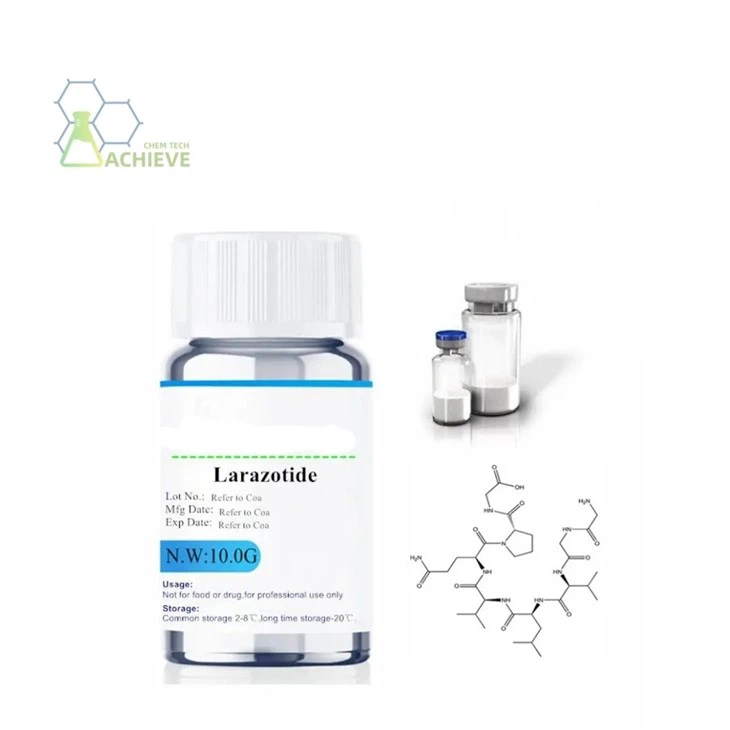
Larazotide peptide is an octapeptide compound with an amino acid sequence of glycyl glycyl valyl leucyl valyl glutamyl prolyl glycine, denoted as GGVLVQPG for single letters and Gly Gly Val Leu Val Gln Pro Gly for three letters. In its molecular structure, the N-terminus starts with two glycine residues connected, followed by valine, leucine, valine, glutamine, and proline in the middle, and the C-terminus is glycine. This specific arrangement of amino acids endows Larezole with a unique spatial conformation and biological activity.
The molecular weight of Larazotide varies depending on its form of existence. The molecular weight of the free base form (Larazotide) is 725.83 g/mol, while the molecular weight of the acetate form (Larazotide acetate) is 785.89 g/mol. Their molecular formulas are C ∝₂ H ₅₅ N ₉ O ₁₀ in the form of free base and C14 H5N9O12 in the form of acetate salt. Larezole usually appears as a white powder with a purity (HPLC) of ≥ 98.0%, acetate content ≤ 12.0%, moisture content ≤ 8.0%, peptide content ≥ 80.0%, endotoxin ≤ 50EU/mg, and amino acid composition analysis ≤ ± 10%.
Our product




Larazotide COA
 |
||
Certificate of Analysis |
||
|
Compound name |
Larazotide | |
|
CAS No. |
258818-34-7 | |
|
Grade |
Pharmaceutical grade | |
|
Quantity |
Customized | |
|
Packaging standard |
Customized | |
| Manufacturer | Shaanxi BLOOM TECH Co., Ltd | |
|
Lot No. |
20250109001 |
|
|
MFG |
Jan 12th 2025 |
|
|
EXP |
Jan 8th 2029 |
|
|
Structure |
|
|
| TEST STANDARD | GB/T24768-2009 Industry. Stnndard | |
|
Item |
Enterprise standard |
Analysis result |
|
Appearance |
White or almost white powder |
Conformed |
|
Water content |
≤4.5% |
0.30% |
| Loss on drying |
≤1.0% |
0.15% |
|
Heavy Metals |
Pb≤0.5ppm |
N.D. |
|
As≤0.5ppm |
N.D. | |
|
Hg≤0.5ppm |
N.D. | |
|
Cd≤0.5ppm |
N.D. | |
|
Purity (HPLC) |
≥99.0% |
99.5% |
|
Single impurity |
<0.8% |
0.48% |
|
Residue on ignition |
<0.20% |
0.064% |
|
Total microbial count |
≤750cfu/g |
80 |
|
E. Coli |
≤2MPN/g |
N.D. |
|
Salmonella |
N.D. | N.D. |
|
Ethanol (by GC) |
≤5000ppm |
400ppm |
|
Storage |
Store in a sealed, dark and dry place at-20 degrees |
|
  |
||


1. Regulation of tight intestinal connections
Larazotide peptide is an orally active zonulin antagonist. Zonulin is a protein that plays a key role in regulating intestinal tight junctions. When Zonulin is activated, it leads to the opening of intestinal tight junctions and increases intestinal permeability. Larezole binds to zonulin receptors to block the zonulin signaling pathway, thereby inhibiting the opening of tight junctions in the intestine, maintaining the integrity of the intestinal barrier, and reducing intestinal permeability. This mechanism of action is of great significance for the treatment of diseases caused by intestinal barrier damage, such as celiac disease.


2. Antiviral activity
The study also found that rabeprazole has antiviral activity against varicella zoster virus (VZV). Its antiviral mechanism may be related to regulating certain signaling pathways in host cells, interfering with processes such as virus adsorption, invasion, replication, or release. Specifically, the EC50 values of Larezole against VZV OKA and 07-1 strains were 44.14 and 59.06 μ M, respectively, indicating that the drug can effectively inhibit virus replication and transmission at lower concentrations, demonstrating good antiviral effects and drug safety.
3. Immune regulation and cardiac protection
Larezole has shown the ability to improve the homeostasis of immune cells in the body and heart in in in vivo experiments. In the model of cardiac toxicity induced by amphotericin B, rabeprazole effectively reduced the toxic side effects of chemotherapy drug amphotericin B by alleviating cell apoptosis in myocardial tissue, alleviating elevated myocardial enzyme spectrum, enhancing left ventricular diastolic capacity and ejection fraction. At the same time, Lirizole also improved the intestinal barrier function damage caused by doxorubicin chemotherapy, which has a dual protective effect and potential application value in clinical chemotherapy adjuvant therapy.


1. Celiac disease model
In research on celiac disease, rabeprazole is used to regulate intestinal barrier function and reduce the immune response caused by gluten entering the body. Multiple clinical trials are evaluating its effectiveness in improving symptoms, repairing intestinal histology, and enhancing quality of life in patients with celiac disease. In a gluten sensitive transgenic mouse model, intraperitoneal injection of liraglutide (250 μ g, twice a week, for 7 weeks) significantly inhibited intestinal permeability, improved barrier function parameters, and reduced the number of intrinsic layer macrophages to control levels.
2. Intestinal inflammation and permeability model
In a mouse colitis model induced by dextran sulfate sodium (DSS), rabeprazole reduces inflammation by regulating immune cell differentiation. During DSS treatment, oral administration of Larenzole (5 mg/kg/d) can reduce Disease Activity Index (DAI) by 50% -55% and colon length shortening rate by 40% -45%. Flow cytometry analysis showed that the proportion of M1 macrophages in colon tissue decreased by 60% -65%, while the proportion of M2 macrophages increased by 55% -60%.


3. Cardiac toxicity protection model
In the doxorubicin induced cardiotoxicity model, rabeprazole reduces the toxic side effects of chemotherapy drugs by improving the homeostasis of cardiac immune cells, alleviating myocardial tissue cell apoptosis, alleviating myocardial enzyme spectrum elevation, enhancing left ventricular diastolic ability and ejection fraction. At the same time, Lirizole also improved the intestinal barrier function damage caused by doxorubicin chemotherapy, which has a dual protective effect and potential application value in clinical chemotherapy adjuvant therapy.

Larazotide peptide is an artificially synthesized octapeptide compound with an amino acid sequence of H-Gly-Gly Val Leu Val Gln Pro Gly-OH, a molecular formula of C32H55N9O10, and a molecular weight of 725.83 g/mol. Larazotide, as a zonulin antagonist, plays an important role in regulating intestinal tight junction and reducing intestinal permeability, and shows potential application value in the fields of celiac disease, viral infectious diseases, and adjuvant chemotherapy. The following will introduce the common synthesis methods of Larazotide.
Solid phase peptide synthesis method (SPPS)
Solid phase peptide synthesis is currently one of the most commonly used methods in peptide synthesis, with advantages such as easy operation, mild reaction conditions, and high product purity. The synthesis of Larazotide is usually achieved through solid-phase peptide synthesis using Fmoc (9-fluorenylmethoxycarbonyl) or Boc (tert butoxycarbonyl) protection strategies.
In solid-phase peptide synthesis, the first step is to select a suitable resin as the solid-phase carrier. Commonly used resins include Wang resin, Rink Amide resin, etc. They have different linking groups and chemical stability, and can be selected according to the properties of the target peptide. Place the resin in a reactor, add an appropriate amount of dichloromethane (DCM) or N, N-dimethylformamide (DMF) for swelling, and then use reagents such as pyridine or hexahydropyridine to remove the Fmoc or Boc protecting groups on the resin, exposing the amino groups on the resin for the next coupling reaction.
Dissolve amino acids with protective groups (such as Fmoc Gly OH, Fmoc Val OH, etc.) in DMF, add coupling reagents (such as HBTU, HATU, DIC, etc.) and activators (such as HOBt), mix thoroughly, and add to a reactor containing activated resin. Under appropriate temperature (usually room temperature) and stirring conditions, amino acids undergo condensation reactions with amino groups on the resin, forming peptide bonds. After the coupling reaction is completed, wash the resin with DMF to remove unreacted amino acids and reagents.
Use pyridine or hexahydropyridine to remove the Fmoc or Boc protecting group on the newly coupled amino acid, allowing the next amino acid to be coupled. Repeat the above coupling and deprotection steps, sequentially connecting amino acids such as glycine, valine, leucine, valine, glutamine, proline, and glycine to the resin until the synthesis of the entire Larazotide peptide chain is completed.
After all amino acids have been coupled, remove the resin from the reactor and stir the reaction at room temperature with a cutting reagent (such as a mixed solution of trifluoroacetic acid, phenol, water, triisopropylsilane, etc.) for several hours to cut the peptide chain from the resin and remove the protective group on the amino acid side chain. After the cutting reaction is completed, filter and remove the resin, and collect the filtrate. The filtrate was precipitated in ice ether and centrifuged to obtain the crude peptide. The crude peptide was purified by high performance liquid chromatography (HPLC) to remove impurities and by-products, resulting in high-purity Larazotide.
Liquid phase peptide synthesis method
Liquid phase peptide synthesis is another commonly used peptide synthesis method, suitable for synthesizing shorter peptide chains or peptide segments that are difficult to synthesize in solid phase. Partial fragments of Larazotide can be synthesized by liquid-phase peptide synthesis, and then coupled with other fragments to obtain the complete Larazotide chain.
Choose an appropriate protective strategy and divide the Larazotide chain into several shorter fragments, which are synthesized separately in the liquid phase. For example, small fragments such as dipeptides and tripeptides can be synthesized first. During the synthesis process, amino acids with protective groups are gradually coupled in appropriate solvents (such as DMF, DCM, etc.) under the action of coupling reagents and activators to form the target fragment. After each fragment is synthesized, it needs to be purified and characterized to ensure its purity and correct structure.
Conjugate the synthesized fragments in liquid phase to obtain the complete Larazotide chain. Fragment coupling usually uses methods such as activated ester method and mixed anhydride method. For example, converting the carboxyl group of one fragment into an activated ester, and then reacting with the amino group of another fragment to form a peptide bond. After the coupling reaction is completed, the product needs to be purified and characterized to remove unreacted fragments and by-products.
Combinatorial chemical synthesis method
Combination chemistry synthesis is a high-throughput synthesis method that can simultaneously synthesize a large number of peptide analogues for screening compounds with specific biological activities. Although combinatorial chemistry synthesis is mainly used for peptide library construction and drug screening, its ideas and methods can also be borrowed for optimization and improvement in the synthesis research of Larazotide.
Divide a large number of resin beads into several equal parts, and attach a different amino acid or fragment to each resin bead. Then, mix these resin beads together and proceed to the next coupling reaction. Through multiple processes of segmentation, synthesis, and mixing, a large number of Larazotide analogs can be synthesized in a short period of time.
After synthesis, screen the peptide library for Larazotide analogs with specific biological activities. The screening methods can use techniques such as biological activity assay and high-throughput screening. Structural identification and further research of the screened active compounds provide a basis for the structural optimization and drug development of Larazotide.
Larazotide peptide as a multifunctional physiological regulatory factor, has shown broad prospects in the fields of intestinal tight junction regulation, antiviral and immune regulation through its unique chemical structure and mechanism of action. Although its clinical transformation still faces challenges such as bioavailability and long-term safety, with the deepening of mechanism research and breakthrough in preparation technology, larazole is expected to become an innovative therapeutic drug for many diseases (such as celiac disease, viral infectious diseases, adjuvant chemotherapy), providing new treatment options for patients. Future research needs to further explore its synergistic effects in combination therapy and establish efficacy prediction biomarkers to promote its clinical translation.
adverse reaction
Larazotide Peptide is a single chain synthetic peptide consisting of 8 amino acids, chemically named Larazotide Acetate (LA). Its core mechanism of action is to restore intestinal barrier function by regulating tight junctions (TJs) between intestinal epithelial cells.
Classification and mechanism of adverse reactions
Gastrointestinal reactions
Common symptoms: bloating, nausea, diarrhea, constipation, abdominal discomfort.
Intestinal motility regulation: LA may indirectly regulate intestinal peristalsis by affecting the distribution of tight junction proteins (such as Claudin-4) in the intestine. Some patients may experience temporary disturbances in intestinal motility, leading to diarrhea or constipation.
Local irritation: After oral administration, LA exerts its effect locally in the intestine and may cause slight irritation to the intestinal mucosa, leading to bloating or abdominal discomfort.
Systemic response
Common symptoms: mild fatigue, headache.
Immune regulation: LA may indirectly affect systemic immune response by regulating intestinal barrier function. Some patients may experience temporary immune system adjustments, leading to fatigue or headaches.
Individual sensitivity: A small number of patients may have differences in the metabolism or excretion of LA, which may lead to drug accumulation in the body and trigger systemic reactions.
Allergic Reaction
Common symptoms: rash, itching.
Immunomediation: Some patients may develop allergic reactions to LA or its excipients (such as lactose), leading to IgE mediated type I hypersensitivity reactions.
Cross reactivity: LA has a similar structure to zonulin and may trigger autoantibody cross reactivity against zonulin.
Dose-dependent response
Phenomenon: The therapeutic effect of high-dose LA (such as 10 μ M) may be lower than that of low-dose LA (such as 1 μ M).
Peptide fragment inhibition: High doses of LA may be degraded into inactive fragments by intestinal brush border enzymes (such as aminopeptidase M), which may inhibit the function of intact LA molecules.
Receptor saturation: The target of LA (such as zonulin receptor) may reach saturation at high doses, and further increasing the dose will not enhance the therapeutic effect.
Hot Tags: larazotide peptide, suppliers, manufacturers, factory, wholesale, buy, price, bulk, for sale, Melanotan ii powder, GLP 1 Peptide CAS 87805 34 3, Tesamorelin CAS 218949 48 5, sermorelin powder, Melanotan 2 Powder, Bremelanotide Powder CAS 189691 06 3