




Shaanxi BLOOM Tech Co., Ltd. is one of the most experienced manufacturers and suppliers of opiorphin cas 864084-88-8 in China. Welcome to wholesale bulk high quality opiorphin cas 864084-88-8 for sale here from our factory. Good service and reasonable price are available.
Opiorphin is a small molecule polypeptide naturally secreted by the human body. It was first discovered in human saliva. It exerts powerful physiological effects by effectively inhibiting the degrading enzymes of enkephalins, and can significantly increase the level of endogenous enkephalins, thereby activating the opioid receptor system in the human body.This mechanism endows it with highly efficient natural analgesic effects. Animal experiments have shown that its antinociceptive efficacy is even superior to that of the same dose of morphine. What is more unique is that it trifluoroacetate, while exerting a powerful antinociceptive effect, does not show the common addictive properties of opioid drugs.
This provides a brand-new possible direction for solving the addiction problem in pain treatment. Moreover, the research also reveals its potential application value in anti-depression and anxiety relief. Therefore, it trifluoroacetate not only brings revolutionary hope for the development of new, safe, and non-addictive antinociceptive drugs, but also opens up a new research window for us to understand the human body's own emotional and pain regulation system.
Our products form
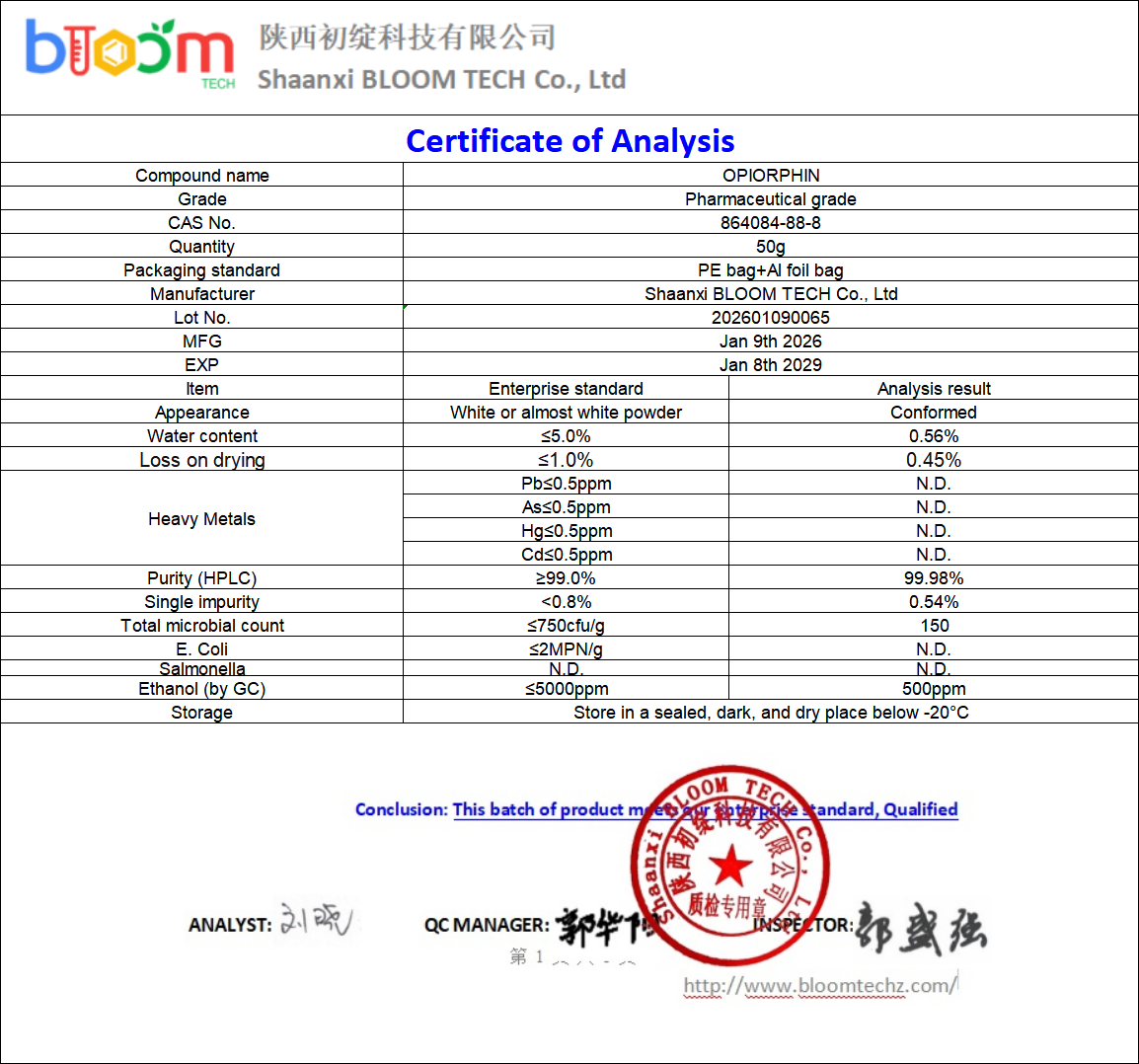
Opiorphin COA

Opiorphin is a neuropeptide composed of Met Gly Phe (methionine glycine phenylalanine), which is produced by the breakdown of proteins in human salivary glands.

1. Analgesic effect:
One of the most well-known functions is its analgesic effect. Research has shown that it can inhibit enkephalinase in the brain, thereby increasing the concentration of endogenous opioid like peptides and producing antinociceptive effects. This effect makes it a potential candidate for antinociceptive drugs and has the potential to be used in the field of pain management.
2. Anti depressive and anti anxiety effects:
Some studies suggest that it may have antidepressant and anti anxiety effects. These effects may be related to their regulation of the endogenous opioid like system, thereby affecting the activity of neurotransmitters related to emotional regulation in the brain.
3. Neuroprotective effects:
Some experimental studies suggest that it may have a protective effect on the nervous system. For example, a study found that neurons can be protected from oxidative stress and other harmful stimuli by reducing cell apoptosis and inhibiting neuroinflammatory responses.
4. Cognitive function improvement:
Although related research is still in its early stages, some experimental results suggest that it may have an improving effect on cognitive function. This may be related to its role in neuroprotection and emotional regulation, which in turn affects the cognitive function of the brain.


5. Anti inflammatory effects:
May have certain anti-inflammatory effects. Some experimental results have shown that it can inhibit the release of inflammatory mediators and reduce the degree of inflammatory response. This anti-inflammatory effect may have potential application value in the treatment of inflammatory diseases.
6. Muscle relaxation effect:
May have a muscle relaxation effect. Some studies have shown that the effect of muscle relaxation can be achieved by inhibiting neurotransmission and reducing muscle contraction. This makes it promising for the treatment of muscle spasms and related muscle tension disorders.
7. Vasodilatory effect:
Some studies suggest that it may have a vasodilating effect. This effect may be related to its impact on vascular smooth muscle contraction and hemodynamics, resulting in vasodilation effects. This makes it have potential application value in the treatment of hypertension and cardiovascular diseases.
8. Antiviral effects:
Recent research suggests that it may have antiviral effects. A study has found that it can inhibit the replication and transmission of certain viruses, such as influenza virus and human immunodeficiency virus, thus possessing the potential for antiviral therapy.


Opiorphin, This endogenous peptide mediator extracted from human saliva by Wisner et al. has attracted widespread attention in the fields of physiological and pharmacological activity research in recent years. As a dual enzyme inhibitor, it not only has significant antinociceptive effects, but also exhibits physiological effects on various aspects such as cardiovascular system, anti panic and anti depression.
Basic characteristics
It is a peptide substance naturally produced by the human body, with a moderate molecular weight and stable chemical structure. As a dual enzyme inhibitor, it can simultaneously inhibit the activity of human neutral endopeptidase endogenous peptidase hNEP (EC 3.4.24.11) and human exogenous aminopeptidase hAP-N (EC 3.4.11.2).
These two enzymes play an important role in breaking down enkephalin in the human body, which is an endogenous antinociceptive substance. Therefore, by inhibiting the activity of these two enzymes, enkephalin can be protected from degradation, thereby exerting its antinociceptive effect.

Its antinociceptive effect is one of its most significant pharmacological activities. Research has shown that it works by activating the endogenous analgesic system in the human body. The system is composed of enkephalin neurons, enkephalin, and opioid receptors. When it binds to these receptors, it can block pain transmission, thereby producing central antinociceptive effects.
In in vivo experiments, scientists observed significant analgesic effects through injection into the lateral ventricle.
This antinociceptive effect is dose-dependent and time-dependent, meaning that as the injection dose increases and time prolongs, the antinociceptive effect gradually strengthens.It is worth noting that the antinociceptive effect is comparable to morphine, and in some cases even stronger than morphine. However, unlike addictive analgesics such as morphine, as a naturally occurring substance in the human body, theoretically it does not have addictive or psychological dependence effects. This characteristic gives it a unique advantage in the field of pain management.


Further research has found that the antinociceptive effect can be completely blocked by naloxone, indicating that its antinociceptive effect is related to opioid receptors.At the same time, the antinociceptive effect was significantly reduced when β - RNA or naltrindole was administered simultaneously with it trifluoroacetate in the lateral ventricle, further confirming the mechanism of antinociceptive action through opioid receptors.
Cardiovascular function
In addition to its antinociceptive effect, it also has a significant impact on the cardiovascular system. Research has shown that intravenous injection can cause an increase in arterial pressure and heart rate in rats. This effect may be related to the upregulation of endogenous circulating angiotensin levels, in which the sympathetic nervous system is also involved.
Specifically, by inhibiting the activity of neutral endopeptidase and aminopeptidase, circulating angiotensin is protected from degradation.


Angiotensin is an important vasoactive substance that can cause vasoconstriction and increase blood pressure. Therefore, by protecting angiotensin, it indirectly triggers a response of elevated blood pressure and tachycardia.
However, it is worth noting that there is no strong contractile effect on the isolated rat thoracic aortic ring. This suggests that the cardiovascular response may mainly depend on protecting circulating angiotensin from degradation by inhibiting enzyme activity, rather than directly acting on vascular smooth muscle cells.
Further research has found that the elevated blood pressure and tachycardia caused by it can be significantly antagonized by the angiotensin-converting enzyme inhibitor Captopril and the angiotensin II type 1 receptor antagonist Valsartan. This indicates that cardiovascular function is closely related to the angiotensin system. Meanwhile, the pre intravenous injection of alpha adrenergic receptor antagonist phentolamine can also block the blood pressure response caused by it, while propranolol can significantly inhibit the tachycardia response caused by opiorphin trifluoroacetate. These results further confirm the cardiovascular mechanism of action.

Anti panic and antidepressant effects

In addition to its antinociceptive and cardiovascular effects, it also exhibits potential for anti panic and anti depression effects. This discovery provides the possibility for its application in the field of mental health.Research has shown that it can regulate the stress response system in the human body, reduce anxiety and fear. In animal experiments, mice showed lower fear responses when faced with fear stimuli.
This effect may be related to the regulation of neurotransmitters and hormone levels in the brain.
In addition, it also has antidepressant effects. In the chronic stress model, mice showed lower depressive like behavior when given treatment. This effect may be related to the regulation of neurotransmitters such as serotonin and norepinephrine in the brain. These neurotransmitters play an important role in the onset of depression.

Research progress and application prospects
At present, research on it is still in its early stages. However, its high efficiency and safety demonstrated in animal experiments provide strong support for its future clinical applications.

In the field of cardiovascular disease, the mechanism of cardiovascular action provides the possibility for its application in the treatment of diseases such as hypertension and heart failure. However, it should be noted that cardiovascular effects may have a double-edged sword effect. On the one hand, it can protect angiotensin, increase blood pressure, and heart rate; On the other hand, this may also increase the risk of cardiovascular disease. Therefore, in future research, it is necessary to further explore the cardiovascular mechanisms and their safety.
In the field of mental health, the anti panic and anti depression effects provide possibilities for their application in the treatment of psychological disorders such as anxiety and depression. However, there is currently relatively little research in the field of mental health. Future research needs to delve deeper into the regulatory mechanisms of neurotransmitters and hormone levels in the brain, as well as their efficacy and safety in treating psychological disorders.


In the field of pain management, it is expected to become a new, non addictive antinociceptive drug. Compared with traditional addictive analgesics, it has lower side effects and higher safety. This makes it trifluoroacetate have broad application prospects in areas such as chronic pain and postoperative pain.
Core Mechanism of Action
Targeting Dual Metallic Exopeptidases to Block Enkephalin Degradation
It does not bind opioid receptors directly. Instead, it acts as a competitive inhibitor targeting two zinc-dependent membrane-bound metalloexopeptidases: neutral endopeptidase (NEP) and aminopeptidase N (APN). Under physiological conditions, methionine enkephalin and leucine enkephalin released by the body are rapidly inactivated within seconds after entering the synaptic cleft-NEP cleaves the middle segment of their peptide chains while APN hydrolyzes N-terminal amino acids.


The arginine and phenylalanine residues of it insert into the zinc-binding pocket within the enzymatic active center, reversibly occluding catalytic sites and drastically reducing the degradation efficiency of enkephalins by both enzymes. This elevates the steady-state concentration of enkephalins at neural synapses and prolongs the duration of endogenous antinociceptive signaling.
Amplification of Endogenous Opioid Pathways Mediating Central and Peripheral Analgesia
Accumulated enkephalins preferentially agonize μ and δ opioid receptors in the spinal cord and periaqueductal gray of the midbrain, triggering downstream inhibitory signaling cascades: they inhibit calcium influx, block the release of pain transmitters including substance P and glutamate, and attenuate the central transmission of nociceptive signals. Meanwhile, potassium channels are activated to lower the excitability of nociceptive neurons, doubly intercepting ascending pain signaling.


Concurrent activation of δ receptors yields additional anxiolytic and antidepressant effects, distinguishing the product from morphine, which predominantly targets μ receptors and carries risks of sedation and addiction. Peripherally, it suppresses peptidase activity at inflammatory lesions to alleviate local hyperalgesia, exerting efficacy in both acute and chronic chemical and mechanical pain models.
Distinct Pharmacological Advantages: Reduced Risks of Tolerance and Addiction
Sustained receptor agonism by conventional opioids readily induces receptor internalization and desensitization, rapidly leading to tolerance, dependence and adverse effects such as respiratory depression. It merely amplifies the body's intrinsic endogenous opioid signals without overstimulating receptors, maintaining opioid pathway activation within physiological ranges.


Animal studies demonstrate that at equivalent analgesic intensity, it elicits no typical opioid adverse reactions including prominent addiction, respiratory depression or constipation. Its only limitation is the short inherent half-life of peptides. As a lead antinociceptive peptide with mild side effects, it also modulates emotion-related opioid circuits, conferring dual bioactivities of pain relief and emotional regulation.

Opiorphin is a neuropeptide containing four amino acids, with a chemical structure of H-Tyr Pro Phe OH. It is composed of tyrosine (Tyr), proline (Pro), and phenylalanine (Phe). In living organisms, it is synthesized through the catalytic action of a series of enzymes.
Biosynthetic steps:
Step one
Gene transcription:
The biosynthesis of Opiorphi begins with gene transcription, which is located on DNA and generates RNA through transcription. This RNA carries its genetic information and will be used for subsequent translation processes.
Step two
Translation:
The transcribed RNA is translated into a precursor protein, which contains its amino acid sequence. This process occurs on the ribosomes of cells, where amino acids are linked into polypeptide chains based on the codons on mRNA.
Step three
Modification of precursor proteins:
Within the cytoplasm, the precursor protein undergoes a series of post-translational modifications, including cleavage, phosphorylation, methylation, etc., to form the final mature precursor peptide.
Step four
Processing of precursor peptides:
Mature precursor peptides are processed in the Golgi apparatus and endoplasmic reticulum, and undergo cleavage through the action of enzymes to generate mature substances.
Step five
Secretion:
The mature substance is packaged into vesicles and released on the cell membrane. This process is completed through the exocytosis pathway, where vesicles fuse with the cell membrane and release their contents outside the cell.
Biosynthetic equation:
Gene transcription:
DNA → RNA
01
Translation:
MRNA+Ribosome → Prepropeptide
02
Modification of precursor proteins:
Prepropeptide+Enzymes → Proposal
03
Processing of precursor peptides:
Proposal+Enzymes → C29H48N12O8
04
Secretion:
C29H48N12O8+Vehicle → Extracellar space
05

In 2006, the research team led by French scholar Rougeot formally reported the product in PNAS. This pentapeptide with the sequence QRFSR was first isolated and extracted from human saliva, encoded by the human PROL1 gene.
The research stemmed from preliminary investigations on sialorphin, its homologous peptide in rats. Researchers discovered that salivary polypeptides markedly potentiate the analgesic activity of endogenous endorphins, and subsequently identified this natural pentapeptide with dual inhibitory activity against NEP and APN.
In vitro enzymatic assays verified its capacity to block enkephalin degradation, and animal pain models confirmed its antinociceptive potency comparable to morphine. Unlike exogenous opioids, it does not directly agonize opioid receptors, making it the first fully characterized human endogenous dual peptidase inhibitory peptide and pioneering a novel target for non-addictive analgesia.
FAQ
Is Opiorphin trifluoroacetate stronger than morphine?
+
-
Human saliva contains a natural painkiller called opiorphin that, when isolated and concentrated, is approximately 6 times more powerful than morphine at equivalent doses in pain-blocking tests on animals.
Can you extract Opiorphin trifluoroacetate from saliva?
+
-
The HFBA-based SUPRAS is, therefore, capable of efficiently extracting opiorphin from saliva samples and shows a high potential for the determination of several amino acids and oligopeptides from biological samples.
What are the three end of life drugs?
+
-
The most commonly prescribed drugs include acetaminophen, haloperidol, lorazepam, morphine, and prochlorperazine, and atropine typically found in an emergency kit when a patient is admitted into a hospice facility.
Hot Tags: opiorphin cas 864084-88-8, suppliers, manufacturers, factory, wholesale, buy, price, bulk, for sale, Epitalon Powder CAS 307297 39 8, Kisspeptin powder, sermorelin powder, Melanotan ii powder, Best Growth Hormone Releasing Peptide CAS 87616 84 0, Bremelanotide Powder CAS 189691 06 3