




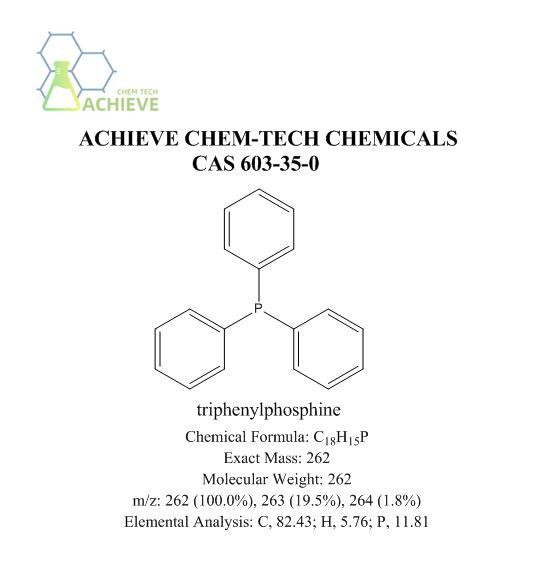

Shaanxi BLOOM Tech Co., Ltd. is one of the most experienced manufacturers and suppliers of triphenylphosphine reagent cas 603-35-0 in China. Welcome to wholesale bulk high quality triphenylphosphine reagent cas 603-35-0 for sale here from our factory. Good service and reasonable price are available.
Triphenylphosphine reagent is an organic compound, CAS 603-35-0, with the molecular formula c18h15p, abbreviated as TPP and pph3. White powder, when above room temperature, is a colorless to light yellow transparent oily liquid with an irritating odor that is irritating to the skin. Easily soluble in ethanol, benzene, and chloroform; Slightly soluble in ester organic solvents and almost insoluble in water. It is the basic raw material for rhodium phosphine complex catalysts and has a wide range of applications in the domestic petrochemical industry. Mainly used in organic synthesis as a polymerization initiator, raw material for antibiotic drug chloramphenicol, and standard sample for organic trace analysis of phosphorus. It is also used in the pharmaceutical industry, analysis and other fields. It can also be used as a brightener in the dyeing process, an antioxidant for polymer polymerization, color film development, a stabilizer for polyepoxidation, and an analytical reagent.

|
Chemical Formula |
C18H15P |
|
Exact Mass |
262 |
|
Molecular Weight |
262 |
|
m/z |
262 (100.0%), 263 (19.5%), 264 (1.8%) |
|
Elemental Analysis |
C, 82.43; H, 5.76; P, 11.81 |
|
|
|


melting point 79 – 81 °C ( lit. ) , boiling point 377 °C ( lit. ), Density 1.132, Vapor density 9 ( vs air ), Vapor pressure 5 mm Hg ( 20 ° C ), Refractive index 1.6358, Flashpoint 181 ° C, Storage conditions Store below + 30 ° C. Solubility water: soluble0.00017 g / L at 22 °C, Crystals, Crystalline Powder or Flakes, Color White, Proportion 1.132, Water solubility insoluble, Hydrolysis sensitivity 8: reactions rapidly with moisture, water, protic solvents.

Triphenylphosphine Reagent is the basic raw material of rhodium phosphine complex catalyst, which has broad applications in the domestic petrochemical industry. It is also used in the pharmaceutical industry, organic synthesis, analysis and other fields. Triphenylphosphine can also be used as a brightener in the dyeing process, polymer polymerization, antioxidant for colour film development, stabilizer for poly epoxidation, and analytical reagent.

1. Chemical synthesis and catalysis
Catalyst: It is the basic raw material for rhodium phosphine complex catalysts and has a wide range of applications in the petrochemical industry. It can serve as a catalyst for various organic reactions, such as Grignard reaction, Michael addition reaction, Wittig reaction, and transverse coupling reaction, effectively promoting reaction progress, improving reaction efficiency and product purity.
Organic synthesis intermediates: Triphenylphosphine can serve as an important intermediate in organic synthesis, participating in various organic synthesis reactions and providing possibilities for the synthesis of complex organic molecules.
2. The pharmaceutical industry
Drug synthesis: Used in the pharmaceutical industry to synthesize various drugs, such as anticancer drugs, antiviral drugs, etc. Its unique chemical properties make it an indispensable raw material in drug synthesis.
Drug analysis: As an analytical reagent, triphenylphosphine can be used in drug analysis to help researchers accurately detect drug components and content, ensuring the quality and safety of drugs.


3. Dyeing process and polymer polymerization
Dyeing process brightener: Used as a brightener in dyeing processes, it can improve the color brightness and stability of dyes, making dyed products more beautiful and durable.
Polymer polymerization stabilizer: Triphenylphosphine can serve as a stabilizer in the polymer polymerization process, preventing the breakage and degradation of polymer chains, and improving the stability and performance of polymers.
4. Optical materials and polymer stabilizers
Optical materials: Triphenylphosphine can be used to prepare optical materials, such as optical glass, optical thin films, etc. Their unique physical and chemical properties endow these materials with excellent optical properties and stability.
Polymer stabilizer: It can also be used as a polymer stabilizer, effectively preventing oxidation, aging, and degradation of polymers during processing and use, and extending the service life of polymers.


5. Other fields
Analytical reagents: They are also widely used in analytical chemistry and can be used as analytical reagents in various chemical analysis experiments, such as elemental analysis, ion analysis, etc.
Metal ion complexing agent: Triphenylphosphine can also be used as a complexing agent for metal ions, forming stable complexes with metal ions, thereby achieving effective separation and enrichment of metal ions.

We are the supplier of Triphenylphosphine Reagent.
Remark: BLOOM TECH(Since 2008), ACHIEVE CHEM-TECH is our subsidiary of us.
Preparation of Flake Triphenylphosphine
(1) Put phenyl magnesium chloride solution into a 1000ml four necked flask as initiator. Input 60g of magnesium chips. Raise the temperature to reflux. Thoroughly mix 300g tetrahydrofuran, 420g toluene and 240g chlorobenzene in advance. Control the dropping under reflux. Drop it in 3 hours. After dripping, continue reflux reaction for 1 hour;
(2) Lower the temperature to 80 ℃, add 96g of the mixture of phosphorus trichloride and 96g of toluene, control the dripping at 80~85 ℃ for 4 hours, and continue to react for 2 hours after dripping;
(3) Cool to room temperature, and drop 600g of 10-15% dilute sulfuric acid. After dripping, continue to stir for 10 minutes. Let stand for 30 minutes. Separate the lower acid water. Then wash with 600g of clean water. Finally, wash with 100g of 30% liquid caustic soda. Fully separate the lower water phase;
(4) Take the upper organic phase and distill it at elevated temperature. Steam to 120 ℃ without distillate, and then distill under reduced pressure until the solvent is completely evaporated;
(5) Cool to below 60 ℃, add 600g methanol and stir for 1h. Cool to room temperature and let stand for 1 hour. Extract the supernatant. Distill at elevated temperature and completely evaporate methanol;
(6) Transfer the remaining feed liquid to the distillation flask for distillation. During distillation, the front distillate is cut off and the main distillate is collected to obtain high-purity triphenylphosphine;
(7) The triphenylphosphine is melted at elevated temperature and put into the slicer to cool the slices; The specific process is: the microtome jacket is filled with chilled water, the power is turned on, and the microtome hub is rotated. Put the melted triphenylphosphine into the feed liquid tank of the slicer, and the hub drives the feed liquid in the tank. The feed liquid is driven by the rotary hub and frozen by the chilled water to form sheet solids, and then scrape the solids off the rotary hub with a scraper to obtain regular sheet triphenylphosphine;
(8) Finally, analysis and packaging.
Experimental results: The appearance of the obtained triphenylphosphine sheet is 10.2mm × 8.0mm × 1.1mm (length × width × Thickness)
The dissolution rate of the obtained sheet triphenylphosphine is 1 minute and 18 seconds, the specific surface area is 70.048 ㎡/g, the purity is 99.8%, there is no residual solvent, and the chromaticity is ≤ 10.

The detailed steps for generating triphenylphosphine by the Friedel Krafts method are as follows:

Step 1: Prepare raw materials
Firstly, the following raw materials need to be prepared: hydrogen chloride gas, triphenyl boron chloride, triphenyl boron bromide, cuprous chloride, nickel chloride, carbon tetrachloride, anhydrous ethanol, sodium hydroxide, concentrated sulfuric acid, etc.
Step 2: Synthesis of Triphenyl Chloroboron
Dissolve triphenyl boron chloride in carbon tetrachloride, then add an appropriate amount of cuprous chloride and concentrated sulfuric acid, and stir evenly. Heat the mixture to a certain temperature, maintain it for a period of time, and then cool it to room temperature. Triphenyl boron chloride was obtained through filtration, washing, drying and other operations.
Step 3: Synthesis of Triphenylboron Bromide
Dissolve triphenylboron bromide in carbon tetrachloride, then add an appropriate amount of cuprous chloride and concentrated sulfuric acid, and stir evenly. Heat the mixture to a certain temperature, maintain it for a period of time, and then cool it to room temperature. Triphenylboron bromide was obtained through filtration, washing, drying and other operations.
Step 4: Synthesize Triphenylphosphine
Dissolve triphenylboron bromide and cuprous chloride in carbon tetrachloride, and then add an appropriate amount of sodium hydroxide solution. Heat the mixture to a certain temperature, maintain it for a period of time, and then cool it to room temperature. Triphenylphosphine was obtained through filtration, washing, drying and other operations.
Chemical equation:
The chemical equations involved in this process are as follows:
Triphenyl boron chloride + ClCu + concentrated sulfuric acid → Triphenyl boron chloride + HCl + CuCl + H2O
Triphenylboron bromide + ClCu + concentrated sulfuric acid → Triphenylboron bromide + HCl + CuBr + H2O
Triphenylboron bromide + NaOH → C18H15P + NaBr + H2O
It should be noted that this process requires professional technology and equipment to operate. At the same time, in order to ensure safety and the accuracy of experimental results, it is necessary to carry out experimental operations under the guidance of professional personnel and follow relevant laboratory safety regulations.
In addition, the Friedel Krafts method may also involve other chemical reactions and intermediate products in the production of triphenylphosphine. Therefore, in practical operation, it is necessary to carefully control the reaction conditions and operating steps to ensure the smooth progress and success of the experiment.
Hot Tags: triphenylphosphine reagent cas 603-35-0, suppliers, manufacturers, factory, wholesale, buy, price, bulk, for sale, 37 formaldehyde, 2 ETHYLHEXYL STEARATE, Tallowamine, Triphenylsilyl Chloride CAS 76 86 8, cmit isothiazolinone, 4'-Hydroxyacetophenone CAS 99-93-4