




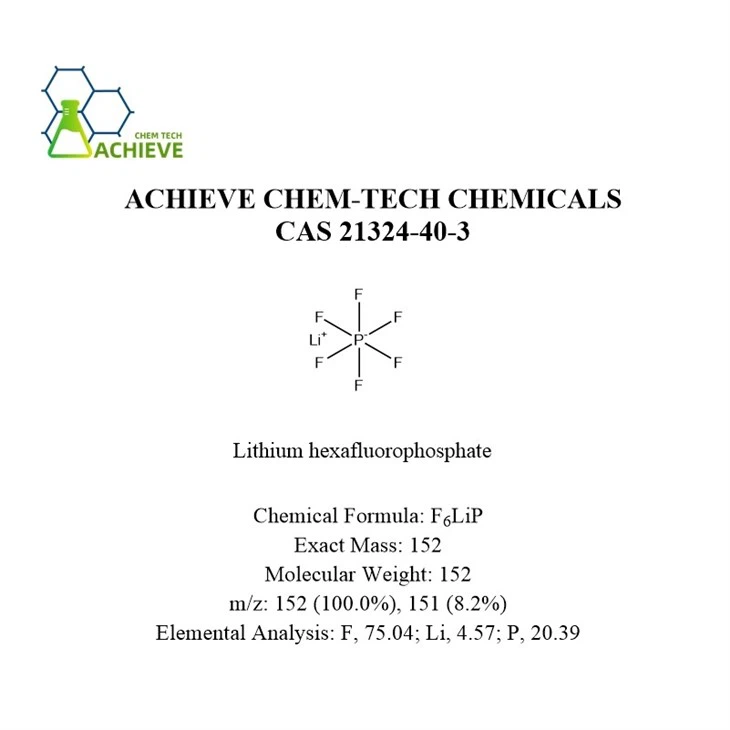

Shaanxi BLOOM Tech Co., Ltd. is one of the most experienced manufacturers and suppliers of lithium hexafluorophosphate cas 21324-40-3 in China. Welcome to wholesale bulk high quality lithium hexafluorophosphate cas 21324-40-3 for sale here from our factory. Good service and reasonable price are available.
Lithium hexafluorophosphate is an inorganic compound with the chemical formula LiPF6, CAS 21324-40-3, It is a white crystalline powder. Easy to dissolve in water, low concentration organic solvents such as methanol, ethanol, acetone, carbonates, etc., mainly used as electrolyte materials for lithium-ion batteries. It is one of the main electrolytes for lithium-ion batteries. Due to its high ion conductivity and chemical stability, it can significantly improve the performance and lifespan of batteries.
In lithium-ion power batteries, lithium-ion energy storage batteries, and other daily batteries, it is an irreplaceable electrolyte material in the near to medium term. Lithium ion power batteries are currently mainly divided into iron phosphate lithium-ion batteries and ternary high nickel lithium-ion batteries. Regardless of the type of battery, electrolyte is required, which in turn uses lithium hexafluorophosphte. It can also be used as a preservative on metal surfaces, effectively inhibiting metal corrosion and oxidation, and has a good anti-corrosion effect.

|
Chemical Formula |
C20H30N2O5 |
|
Exact Mass |
378 |
|
Molecular Weight |
378 |
|
m/z |
378 (100.0%), 379 (21.6%), 380 (2.2%), 380 (1.0%) |
|
Elemental Analysis |
C, 63.47; H, 7.99; N, 7.40; O, 21.14 |
|
|
|


Lithium hexafluorophosphate is an inorganic substance with the chemical formula LiPF6, which appears as white crystals or powder.

Lithium ion battery electrolyte
It is an indispensable electrolyte material in lithium-ion batteries. In lithium-ion batteries, electrolytes play a crucial role in transferring ions and are essential for the normal functioning of the battery. Due to its excellent electrochemical performance and stability, it has become an irreplaceable electrolyte for lithium-ion batteries in the near to medium term.
Especially in lithium-ion power batteries and lithium-ion energy storage batteries, their applications are particularly widespread. These batteries are widely used in fields such as electric vehicles, energy storage systems, and mobile devices, with a huge demand for lithium hexafluorophosphat.
Daily battery electrolyte
In addition to its application in power batteries and energy storage batteries, it is also used as an electrolyte for other daily batteries. These daily batteries include remote control batteries, flashlight batteries, toy batteries, etc. Although their usage is relatively small, they are still one of the important application areas of lithium hexafluorophosphat.


Electric vehicle
With the rapid development of the electric vehicle industry, the demand is also constantly increasing. The core component of electric vehicles is the power battery, and the performance and lifespan of the power battery largely depend on the performance of the electrolyte. As an excellent electrolyte material, it can improve the energy density, cycle life, and safety performance of power batteries, and is therefore widely used in power batteries for electric vehicles.
Energy storage
Energy storage system is one of the important means to solve the problem of energy supply-demand mismatch. As an important electrolyte material for energy storage batteries, it can improve the energy conversion efficiency and cycle stability of energy storage batteries, thereby extending the service life of energy storage systems and improving energy utilization efficiency.


Mobile devices
Mobile devices such as smartphones, tablets, etc. have become an indispensable part of people's daily lives. The battery performance of these devices directly affects the user experience. As an excellent electrolyte material, it can improve the energy density and cycle life of mobile devices' batteries, thereby extending the device's usage time and lifespan.
Other areas
In addition to the above fields, it has also been applied in other areas such as aerospace, military equipment, etc. In these fields, the performance requirements for batteries are extremely high, and they are highly favored due to their excellent performance.

Lithium hexafluorophosphat, with the chemical formula LiPF6, is a white crystalline or powdery inorganic substance. It is one of the most commonly used electrolyte materials in lithium-ion batteries, which has a direct impact on the conductivity, capacity, and output voltage of the battery. Lithium hexafluorophosphat transfers lithium ions between the positive and negative electrodes of a battery, which is a key factor in battery performance.
Electrolyte for lithium-ion batteries
The main component of lithium-ion battery electrolyte provides a transport channel for lithium ions between the positive and negative electrodes, enabling the battery to function properly. As an electrolyte, lithium hexafluorophosphate has the following advantages:
High ion conductivity: It has a high ion conductivity, which helps lithium ions to quickly transfer inside the battery, thereby improving the battery's charging and discharging performance.
Chemical stability: The ability to maintain chemical stability during battery operation, without reacting with other components in the battery, thereby extending the battery's lifespan.
Thermal stability: It has good thermal stability and can maintain the normal operation of the battery at high temperatures.


In the field of power batteries
In the field of power batteries, their applications are particularly widespread. The power battery is the core component of new energy vehicles such as electric vehicles and hybrid vehicles, and its performance directly affects key indicators such as range and acceleration performance of new energy vehicles. As the main component of power battery electrolyte, it has the following functions:
Improving energy density: It can increase the energy density of power batteries, enabling new energy vehicles to carry more electrical energy and extend their range.
Improving charging and discharging performance: High ionic conductivity helps to enhance the charging and discharging performance of power batteries, enabling new energy vehicles to charge and discharge faster.
Enhancing safety: Its chemical and thermal stability helps to enhance the safety of power batteries and reduce the risk of safety accidents such as thermal runaway and explosions during charging and discharging.


Energy storage battery field
In the field of energy storage batteries, it also plays an important role. Energy storage batteries are an important component of energy storage systems, used for storing and releasing electrical energy. As the main component of electrolyte in energy storage batteries, it has the following advantages:
Improving energy storage efficiency: It can enhance the energy storage efficiency of energy storage batteries, enabling the energy storage system to store and release electrical energy more efficiently.
Extend service life: Its chemical and thermal stability helps to extend the service life of energy storage batteries and reduce maintenance costs of energy storage systems.
Strong adaptability: able to adapt to different types of energy storage batteries, such as lithium-ion batteries, sodium ion batteries, etc., providing a wide range of applicability for energy storage systems.


Daily battery field
In addition to power batteries and energy storage batteries, it is also widely used in the field of daily batteries. Daily batteries include small batteries such as remote control batteries, flashlight batteries, toy batteries, etc. Although their usage is relatively small, they are still one of their important application areas. As the main component of electrolytes in daily batteries, six has the following advantages:
Improving battery performance: It can enhance the performance of daily batteries, such as capacity, output voltage, etc., enabling the battery to provide power for a longer period of time.
Cost reduction: The production process of lithium hexafluorophosphat is relatively mature and cost-effective, which helps to reduce the production cost of daily batteries.
Environmental friendliness: It is an inorganic substance that does not contain harmful substances and is environmentally friendly. During the production and use of daily batteries, there will be no pollution to the environment.


The production process of lithium hexafluorophosphate mainly includes steps such as fluorination, phosphorylation, lithiation, and purification. Fluorination and phosphorylation are key steps in the preparation of lithium hexafluorophosphat. By controlling reaction conditions and optimizing process parameters, high-purity and high-performance lithium hexafluorophosphate products can be prepared.
At present, the preparation methods of lithium hexafluorophosphat mainly include chemical synthesis, electrolysis, and pyrolysis. Among them, chemical synthesis is one of the most commonly used preparation methods. This method can prepare lithium hexafluorophosphat products that meet the requirements by controlling the proportion of reactants and reaction conditions. Although electrolysis and pyrolysis can also prepare lithium hexafluorophosphat, they have high production costs and complex processes, so they are rarely used in practical applications.
FAQ
Is lithium hexafluorophosphate toxic?
3 Hazards Summary. Causes burns; Inhalation may cause corrosive injuries to upper respiratory tract and lungs; Harmful by ingestion; Toxic by skin absorption; [Acros Organics MSDS] See FLUORIDES.
What is lithium hexafluorophosphate used for?
Presently lithium hexafluorophosphate is a dominating lithium salt used in commercial rechargeable lithium ion batteries. These rechargeable batteries are in huge demand for various applications like consumer electrical products, automotive, electric vehicles, power plant, household electricity and much more.
Is LiPF6 soluble in water?
Lithium Hexafluorophosphate LiPF6 Electrolyte
Lithium hexafluorophosphate (LiPF6) is an inorganic substance, usually in the appearance of white crystals or powder. It is easily soluble in water, and is also soluble in low-concentration methanol, ethanol, acetone, carbonates and other organic solvents.
Is LFP safer than Li-ion?
Safety: LiFePO4 batteries are generally considered safer than lithium-ion batteries, as they are less prone to overheating and catching fire.
Hot Tags: lithium hexafluorophosphate cas 21324-40-3, suppliers, manufacturers, factory, wholesale, buy, price, bulk, for sale, methyltetrahydrofuran, 2 Methoxy 5 Nitrophenol Sodium Salt, Tetrachloroethylene CAS 127 18 4