


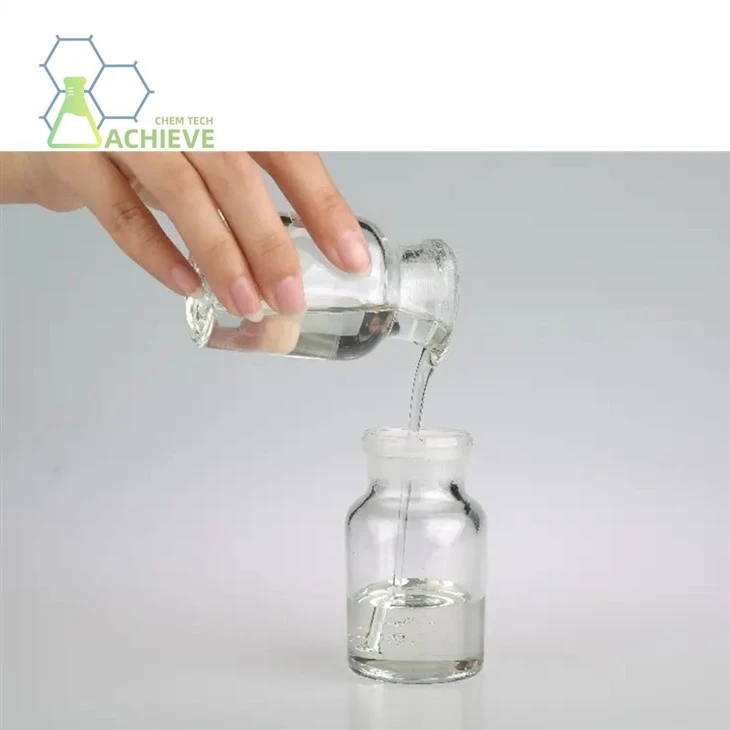


Shaanxi BLOOM Tech Co., Ltd. is one of the most experienced manufacturers and suppliers of triethylene glycol diacetate cas 111-21-7 in China. Welcome to wholesale bulk high quality triethylene glycol diacetate cas 111-21-7 for sale here from our factory. Good service and reasonable price are available.
Triethylene glycol diacetate is an organic compound. The appearance is a colorless to almost colorless transparent liquid that is completely soluble in water at 20 ℃, with a solubility of about 1000g/L. It has low toxicity and flammability.Due to its specific chemical properties, it is often used as an intermediate in pharmaceutical synthesis, and it has good solubility and stability. It is also commonly used as a solvent or extractant. In some industrial processes, it can also be used as a desiccant.
Additional information of chemical compound:
|
Chemical Formula |
C10H18O6 |
|
Exact Mass |
234.11 |
|
Molecular Weight |
234.25 |
|
m/z |
234.11(100.0%), 235.11 (10.8%), 236.11 (1.2%) |
|
Elemental Analysis |
C, 51.27; H, 7.75; O, 40.98 |
|
Melting point |
-50℃ |
|
Boiling point |
286℃ |
|
Density |
1,12 g/cm3 |
|
|
|


Triethylene glycol diacetate (TEGDA, CAS number 111-21-7) is an important organic compound with unique chemical structure and physical properties, which has shown wide application value in multiple fields. The following systematically summarizes the uses and technical details of triethylene glycol diacetate from seven dimensions: solvents, extractants, desiccants, plastic and rubber additives, coatings and paints, adhesives, and other special fields.

Solvent: Dual advantages of solubility and compatibility
The core advantage of being a solvent lies in its high solubility and good compatibility. The acetate groups in its molecular structure endow it with polarity, allowing it to dissolve various polar or non-polar substances, including resins, coatings, inks, dyes, etc. Specific application scenarios include:
Resin processing: TEGDA can be used as a co solvent to reduce melt viscosity and improve processing performance in the processing of polyvinyl chloride (PVC), polyvinyl acetate resin (PVAc), and other materials. For example, in the production of PVC film, adding 5% -10% TEGDA can lower the melt temperature by 10-15 ℃, reduce energy consumption, and extend equipment life; At the same time, the elongation at break of the film increased by 200%, and the impact strength increased by 50%.
Coatings and inks: As a solvent, TEGDA can adjust the viscosity of coatings and inks, improving leveling properties. Adding 0.5% -1% TEGDA to water-based coatings can increase glossiness by 15%; Adding 3% TEGDA to news paper ink can prevent ink from drying and clumping, and increase printing speed by 20%.
Chemical synthesis: TEGDA can be used as a reaction medium to participate in ester exchange, condensation and other reactions. For example, when synthesizing polyurethane foam, TEGDA as a solvent can control the reaction rate and improve the product uniformity.


Extractant: an efficient tool for selective separation
The polarity characteristic makes it a selective extractant that can efficiently separate target components from mixtures. Typical applications include:
Aromatic hydrocarbon extraction: In petroleum refining, TEGDA can separate benzene, toluene, and xylene (BTX) from the reformate through liquid-liquid extraction. The principle is that the polar groups of TEGDA form hydrogen bonds with aromatic hydrocarbons, while non aromatic hydrocarbons (such as alkanes) are excluded due to polarity differences. The separation efficiency of this process can reach over 90%, the purity of aromatic hydrocarbons is close to 100%, and the solvent loss is less than 0.5 kg/ton of raw material.
Metal ion separation: In wet metallurgy, TEGDA can selectively extract metal ions such as copper and nickel through chelation. For example, in copper electrolyte purification, TEGDA can increase the extraction rate of copper ions to 95% while reducing impurity content.
Drug purification: In the pharmaceutical industry, TEGDA can be used to extract antibiotics (such as cephalosporins) or vitamins from fermentation broth. Its low toxicity and high selectivity make it the preferred solvent for biological separation.


Desiccant: Balance between Moisture Absorption and Stability
Its molecular structure contains multiple hydroxyl and ester groups, making it moderately hygroscopic and suitable as a desiccant to prevent items from getting damp. Specific applications include:
Moisture proofing of electronic products: Adding TEGDA desiccant to the packaging of electronic components (such as integrated circuits and capacitors) can absorb environmental moisture, prevent short circuits or oxidation. Its moisture absorption rate can reach 10% -15% of its own weight and remains stable within the range of -20 ℃ to 80 ℃.
Food packaging: TEGDA desiccant can extend the shelf life in the packaging of dry foods such as milk powder and coffee. Its non-toxic and odorless characteristics comply with FDA standards, ensuring food safety.
Textile anti mold: Adding TEGDA in textile finishing can absorb residual moisture in the fabric and prevent mold growth. For example, after being applied in sportswear, the growth rate of mold decreased by 80%.


Plastic and rubber additives: dual effects of plasticization and flexibility
It is an important plasticizer and flexibility agent in the plastic and rubber industry, and its mechanism of action includes:
Lowering the glass transition temperature (Tg): Triethylene glycol diacetate molecules are inserted between resin chains, weakening intermolecular forces and allowing the material to maintain flexibility at low temperatures. For example, after adding TEGDA to PVC, the Tg can be reduced from 80 ℃ to -20 ℃, significantly improving the low-temperature impact resistance.
Improving processing performance: TEGDA can reduce viscosity and improve extrusion and rolling performance during rubber vulcanization. For example, in tire production, adding TEGDA can shorten mixing time by 20% and reduce energy consumption by 15%.
Improving physical properties: TEGDA can enhance the fracture elongation and tear resistance of materials. After adding 5% TEGDA to polyethylene (PE) film, the elongation at break increased by 300% and the tear strength increased by 40%.


Coating and Paint: Collaborative Optimization of Leveling and Adhesion
The application in the field of coatings and paints is mainly based on their leveling and adhesion enhancement effects. Specific applications include:
Architectural coatings: As a leveling agent, TEGDA can eliminate pinholes on the surface of coatings and improve glossiness. Adding 0.5% -1% TEGDA to water-based architectural coatings can increase glossiness by 10% -15% while reducing coating marks.
Industrial anti-corrosion coatings: TEGDA can improve the adhesion of coatings to metal substrates. After adding 2% TEGDA to the epoxy anti-corrosion coating, the adhesion level was increased from level 3 to level 1 (according to GB/T 9286 standard), and the salt spray test life was extended by 50%.
Automotive paint: TEGDA can prevent coating cracking in high-temperature baking paint. For example, adding 3% TEGDA to automotive varnish can reduce the baking temperature from 160 ℃ to 140 ℃, while maintaining the same coating hardness.


Adhesive: Balance between adhesive strength and flexibility
The application in the field of adhesives is mainly based on their plasticizing and adhesive strengthening effects. Typical applications include:
Pressure sensitive adhesive: Adding TEGDA to acrylic pressure-sensitive adhesive can improve initial adhesion and holding strength. For example, after adding 5% TEGDA, the initial adhesion (according to PSTC-6 standard) increased from 1.2 N to 1.8 N, and the holding time was extended from 24 hours to 48 hours.
Epoxy adhesive: TEGDA can be used as a flexible chain segment to introduce epoxy resin and enhance impact resistance. After adding 10% TEGDA to the structural adhesive, the impact strength increased from 5 kJ/m ² to 12 kJ/m ², making it suitable for seismic bonding of electronic components.
Hot melt adhesive: Adding TEGDA to EVA hot melt adhesive can reduce melt viscosity and improve wetting properties. For example, after adding 3% TEGDA, the melt viscosity decreased from 5000 mPa · s to 3000 mPa · s, and the adhesive strength increased by 20%.


Other special fields: Cross border applications from energy to biomedicine
Natural gas dehydration: TEGDA can be used as a substitute for triethylene glycol (TEG) for natural gas dehydration. Its boiling point (285 ℃) is higher than TEG (245 ℃), which can reduce solvent loss during the regeneration process and lower operating costs.
Rocket fuel stabilizer: Adding 0.1% -0.5% TEGDA to liquid oxygen/kerosene engines can suppress the decomposition reaction of fuel at high temperatures and improve combustion efficiency by 5% -10%.
Biomedical materials: TEGDA can be used to synthesize hydrogels or drug carriers. For example, TEGDA hydrogel prepared by photopolymerization can be used for wound dressing, its water absorption can reach 500% of its own weight, and it has antibacterial properties.
With its unique chemical structure and physical properties, it has demonstrated extensive application value in various fields such as solvents, extractants, desiccants, plastic and rubber additives, coatings and paints, adhesives, etc. In the future, with the deepening of green chemistry and circular economy concepts, the industrial application of triethylene glycol diacetate will pay more attention to efficient resource utilization and environmental friendliness. Through technological innovation (such as the development of new catalysts and process optimization) and industry chain collaboration (such as cooperation between upstream and downstream enterprises to develop high value-added products), TEGDA is expected to continue to play a key role in the global chemical market and contribute to sustainable development.
faq
Q:1.What is triethylene glycol diacetate used for?
A:Triethylene glycol diacetate is a versatile chemical compound that finds common application in chemical synthesis processes. Due to its unique properties, triethylene glycol diacetate serves as an effective solvent in various chemical reactions and as a valuable intermediate in the production of numerous compounds.
Q:2.What is ethylene glycol diacetate used for?
A:It is widely used as a softener in silicates for the foundry industry, and it has excellent mechanical properties as well as thermal stability. A crucial component of casting metal processes, in which its thermal stability and low volatility guarantee constant performance in high temperature conditions.
Hot Tags: triethylene glycol diacetate cas 111-21-7, suppliers, manufacturers, factory, wholesale, buy, price, bulk, for sale, methyltetrahydrofuran, 2 Methoxy 5 Nitrophenol Sodium Salt, Tetrachloroethylene CAS 127 18 4