



Shaanxi BLOOM Tech Co., Ltd. is one of the most experienced manufacturers and suppliers of (5-bromo-2-chlorophenyl)(4-fluorophenyl)methanone cas 915095-85-1 in China. Welcome to wholesale bulk high quality (5-bromo-2-chlorophenyl)(4-fluorophenyl)methanone cas 915095-85-1 for sale here from our factory. Good service and reasonable price are available.
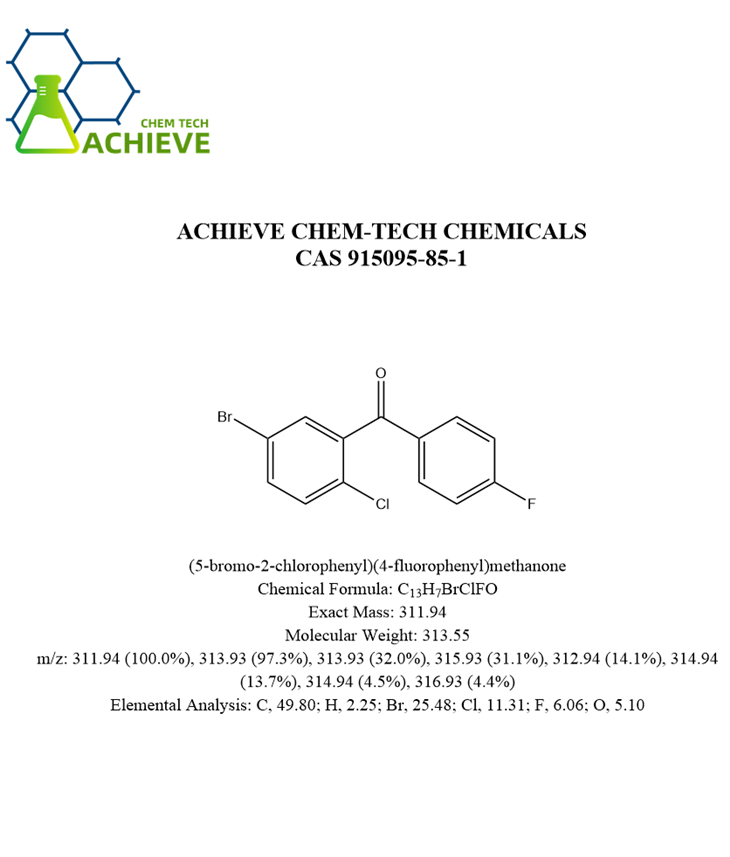
(5-Bromo-2-chlorophenyl)(4-fluorophenyl)methanone is an asymmetric polyhalogenated benzophenone derivative. Its molecular structure features bromine and chlorine substitution sites, along with a para-fluoro-substituted benzene ketone ring. The ketone carbonyl connecting the two aromatic rings gives the molecule strong potential for structural derivatization and drug compatibility. Bloomtechz has built a flexible capacity system linking small-scale R&D, pilot-scale processes, and commercial mass production. With our own standardized fine chemical production base, professional R&D labs, precision testing center, and independent dedicated synthesis lines, we ensure stable year-round production of this high-end intermediate, sufficient raw material reserves, and no risk of supply interruption. We can fully meet customer procurement and custom needs at different stages and scales.

Additional information of chemical compound:
|
Chemical Formula |
C13H7BrClFO |
|
Exact Mass |
311.94 |
|
Molecular Weight |
313.55 |
|
m/z |
311.94 (100.0%), 313.93 (97.3%), 313.93 (32.0%), 315.93 (31.1%), 312.94 (14.1%), 314.94 (13.7%), 314.94 (4.5%), 316.93 (4.4%) |
|
Elemental Analysis |
C, 49.80; H, 2.25; Br, 25.48; Cl, 11.31; F, 6.06; O, 5.10 |
|
Boiling point |
390.6±37.0 °C(Predicted) |
|
Density |
1.568±0.06 g/cm3(Predicted) |
|
Storage conditions |
2-8℃ |


(5-bromo-2-chlorophenyl)(4-fluorophenyl)methanone, also known as 3- (4-fluorophenyl ketone) yl-1-bromo-4-chlorophenyl or empagliflozin intermediate, is mainly used as a pharmaceutical intermediate, especially playing a key role in the synthesis of empagliflozin.
Core Pharmaceutical Intermediates and Pharmacological Research Tools
In the pharmaceutical industry, this substance serves as a core intermediate for the R&D of central nervous system (CNS) medicines, anti-infective agents and kinase inhibitors. Sustained growth in global pharmaceutical R&D investment (exceeding 238 billion US dollars in 2023) has further driven the expansion of its market demand.

Synthesis of Central Nervous System medicines
The halogenated benzophenone skeleton exhibits high affinity for multiple neurotransmitter receptors such as serotonin and dopamine receptors. As a building block, this substance can be used to synthesize antidepressant, anxiolytic and antipsychotic medicines. Its bromine atom enables the introduction of heterocycles (e.g., pyridine, imidazole) via Suzuki-Miyaura coupling; the chlorine atom allows linkage with amino or hydroxyl groups through nucleophilic substitution; the fluorine atom enhances molecular lipophilicity and blood-brain barrier permeability, thereby improving the central targeting efficiency of medicines.
For instance, in the synthesis of selective serotonin reuptake inhibitors (SSRIs), this intermediate can be structurally modified in multiple steps to construct pharmacophores with high receptor matching, significantly boosting medicine potency and selectivity.
R&D of Anti-Infective medicines
The halogenated aromatic ring structure of the substance interferes with bacterial/fungal cell wall synthesis and nucleic acid replication, making it a vital precursor for the development of broad-spectrum antibiotics and antifungal agents.


Its ketone carbonyl group can be reduced to hydroxyl groups or converted into derivatives such as oximes and hydrazones to enhance inhibitory activity against medicine-resistant bacteria including MRSA. Bromine and chlorine substituents bind to the active sites of microbial enzymes through halogen bonding, strengthening antibacterial efficacy. In the synthesis of antifungalmedicines, cyclization of this intermediate constructs the core skeleton of azole antifungals, exerting potent inhibitory effects on fungi such as Candida and Aspergillus.
Research on Kinase Inhibitors and Antitumor medicines
As a key building block for synthesizing multi-target kinase inhibitors, the substance is applicable to the preparation of antitumor medicines targeting epidermal growth factor receptor (EGFR) and vascular endothelial growth factor receptor (VEGFR). Its dihalogen substitution pattern mimics hydrogen bonding and hydrophobic interactions in the ATP-binding domain of kinases. Structural modification optimizes the selective killing effect on tumor cells and reduces toxic and side effects. In antitumor medicine R&D, coupling reactions of this intermediate introduce chemotherapeutic molecules or targeted carriers to construct targeted antitumor prodrugs, increasing medicine enrichment in tumor tissues.


Research on medicine Metabolism and Pharmacological Mechanisms
This substance can be used as a probe molecule to investigate medicine metabolic pathways and action mechanisms. Its isotopically labeled derivatives (e.g., bromine-77Br, fluorine-18F) can trace the absorption, distribution, metabolism and excretion (ADME) processes of medicines in vivo. The halogenated aromatic ring simulates interactions between medicines and metabolic enzymes such as CYP450, providing a basis for optimizing medicine metabolic stability.
Optoelectronic Materials and Polymer Additives
In the field of organic functional materials, benefiting from its conjugated benzophenone structure and polyhalogen substitution characteristics, the substance holds important application value in optoelectronic materials, polymer additives and liquid crystal materials.
Organic Optoelectronic Materials
It is a key building block for synthesizing organic light-emitting diode (OLED) and organic photovoltaic (OPV) materials. Its conjugated structure enables electron delocalization and favorable charge transport performance. The strong electron-withdrawing effect of fluorine atoms modulates material energy level structure, improving electron transport efficiency and photostability.In OLED materials, polymerization or coupling of this intermediate constructs blue/green light-emitting layer materials featuring high luminous efficiency, excellent color purity and long service life.


In OPV materials, it serves as a synthetic precursor for electron acceptor materials to enhance the energy conversion efficiency of photovoltaic devices.
Polymer Material Additives
The substance acts as a light stabilizer, flame retardant and antioxidant for polymer materials, improving weather resistance, flame retardancy and thermal stability. Its halogenated aromatic ring absorbs ultraviolet rays to suppress photodegradation of polymers.
bromine and chlorine substituents exert a synergistic flame-retardant effect by releasing halogen radicals during combustion, interrupting chain combustion reactions and reducing burning rate and smoke density. Incorporation of this substance into plastics, rubber, coatings and other polymers significantly extends service life and improves application safety.
Liquid Crystal Materials
The rod-shaped molecular structure and conjugated system meet the structural requirements of liquid crystal molecules, making it an important intermediate for new liquid crystal material synthesis.


Fluorine atoms adjust the liquid crystal phase temperature range and dielectric anisotropy; bromine and chlorine substituents enhance chemical and thermal stability. In the synthesis of nematic and smectic liquid crystals, etherification and esterification of this intermediate build the core liquid crystal skeleton. The prepared liquid crystal materials feature fast response speed, high contrast ratio and wide operating temperature range, applicable to the manufacture of liquid crystal displays, liquid crystal sensors and other devices.
Reagents, Catalysts and Synthetic Building Blocks
In analytical chemistry and scientific research, the substance functions as a chromatographic derivatization reagent, organic synthesis catalyst ligand and research-grade synthetic building block, widely applied in substance separation, structural analysis and organic synthesis methodology research.
Chromatographic Analytical Reagents
It serves as a derivatization reagent for high-performance liquid chromatography (HPLC) and gas chromatography (GC), derivatizing polar substances such as alcohols, phenols, amines and carboxylic acids to improve chromatographic separation efficiency and detection sensitivity. Its halogenated aromatic ring forms stable derivatives with polar substances, increasing retention on chromatographic columns; fluorine atoms enhance the volatility and thermal stability of derivatives, making it suitable for GC analysis.


In the detection of medicines, environmental pollutants and biological samples, this derivatization reagent enables efficient separation and high-sensitivity detection of trace polar substances.
Ligands for Organic Synthesis Catalysts
The substance acts as a ligand for transition metal catalysts (e.g., palladium, ruthenium, rhodium complexes), catalyzing organic synthesis reactions including Suzuki-Miyaura coupling, Heck reaction and hydrogenation.
Its ketone carbonyl and halogen atoms form stable coordination bonds with transition metal ions, regulating the electronic effect and steric hindrance of catalysts to enhance catalytic activity, selectivity and stability. In the synthesis of complex natural products and medicine molecules, it facilitates efficient and highly selective construction of carbon-carbon and carbon-heteroatom bonds, shortening synthetic routes and reducing production costs.


Research-Grade Synthetic Building Blocks
It is an essential building block for organic synthesis methodology research and substance library construction, widely used in universities, research institutes and CRO companies. Multiple reactive sites (bromine, chlorine, fluorine, ketone carbonyl) participate in diverse organic reactions, enabling rapid construction and diversified modification of molecular skeletons.
Its high purity (≥97%) and commercial availability (supplied by Combi-Blocks, Sigma-Aldrich and other vendors) facilitate scientific research. In combinatorial chemistry and diversity-oriented synthesis, this core building block rapidly constructs structurally diverse substance libraries for medicine screening and bioactivity evaluation, accelerating new medicine discovery.

Competitive Product Comparison
Bloomtechz has been deeply engaged in the R&D and large-scale production of high-end halogenated aromatic ketone intermediates for many years. For (5-bromo-2-chlorophenyl)(4-fluorophenyl)methanone, we have optimized a dedicated synthesis process, multi-stage distillation purification, low-temperature recrystallization refinement, and a full-process system of vacuum drying and quality control, moving away from the rough production methods common in the industry. This allows us to fully upgrade raw material structural purity, impurity control, batch stability, and physicochemical indicators.Our self-developed and produced products strictly control trace impurities such as isomers, residual solvents, heavy metals, and moisture. The HPLC purity is consistently over 99%, well above the industry's standard of 97%-98%. At the same time, we offer flexible industrial-scale production capacity, complete compliance testing reports, and full-cycle technical support, making them ideal for pharmaceutical intermediate synthesis, high-end custom chemical research, and large-scale industrial production. The table below is for reference only:
| Comparison Dimension | Bloomtechz (self-developed high purity grade) | Mainstream peers 98% grade (repackaged and purified) | Low-end peers 97% grade (crude process) |
| Heavy Metal Residue | Lead, cadmium, mercury, arsenic, and other heavy metals are all <10ppm, meeting the compliance standards for pharmaceutical intermediates and high-end fine chemicals. | Heavy metals <20ppm, only meeting the standards for general industrial chemical use. | No strict testing and control, heavy metal residue is uncontrollable, cannot be used for pharmaceutical-related synthesis. |
| Batch Stability and Reproducibility | Full-process parameter solidification ensures that each batch has highly consistent purity, impurities, crystal form, and physicochemical indicators, with 100% reproducibility in mass production, suitable for long-term continuous industrial production. | Affected by upstream crude material supply, there are slight differences between batches, with average stability in mass production and noticeable fluctuations in long-term procurement quality. | Huge differences between batches, with impurities and purity varying each time, making it unsuitable for high-end continuous production. |
| Production Capacity and Delivery Capability | Own large-scale synthesis production lines and purification workshops, flexible capacity covering: gram-level lab samples → kilogram-level pilot → hundreds of kilograms mass production, ample stock on hand, supporting reserved customized capacity, fast delivery both domestically and internationally. | No in-house production lines, rely on outsourcing and repackaging, can only provide regular stock, supply for large orders is unstable, delivery times are unpredictable. | Small workshop-style production, limited capacity, no stock on hand, large orders are very likely to run out of supply. |
| Technical Support Services | Before purchase, we provide sample testing, consultation on physical and chemical parameters, and guidance on application solutions; during purchase, we adjust product specifications to fit customer processes; after purchase, we solve technical issues like dissolution, reaction compatibility, and stability, offering full-cycle technical support. | Only basic supply service is provided, without professional technical support, only answers to basic parameter questions. | No technical service at all, only sell products in stock, no after-sales support. |
| Global Compliance | Meets REACH and TSCA global chemical raw material compliance standards, with complete compliance documentation, supporting global export registration and customs clearance. | Only meets domestic general chemical standards, with missing overseas compliance documents, restricting exports. | No formal compliance registration documents, only suitable for low-end domestic sales. |

Green Chemistry Innovations
Solvent-Free Synthesis: Ball milling enables Friedel-Crafts acylation without DCM, reducing waste.
Biocatalysis: Lipase-catalyzed acylation in water/ionic liquid mixtures offers milder conditions.
High-Value Derivatives
Trifluoromethyl Ketones: Demand for CF₃-substituted analogs is rising in antifungal drug development.
Chiral Ketones: Enantioselective synthesis via asymmetric hydrogenation enables stereospecific drugs.
Market Dynamics
Regional Growth: Asia-Pacific dominates production (55% market share), driven by agrochemical demand in China and India.
Price Trends: Raw material costs (e.g., bromine, fluorine) and regulatory pressures on halogenated substances influence pricing.
(5-Bromo-2-chlorophenyl)(4-fluorophenyl)methanone is a cornerstone of modern organic synthesis, bridging pharmaceuticals, agrochemicals, and advanced materials.
Its reactivity, derived from the strategic placement of halogen atoms, enables the construction of complex molecules with tailored properties. While traditional synthesis methods remain dominant, the shift toward sustainable practices-such as biocatalysis and flow chemistry-promises to reduce environmental impact.
As the global demand for innovative therapeutics and eco-friendly agrochemicals grows, this substance will continue to play a pivotal role in driving chemical innovation.
Frequently Asked Questions
Q1: Is there a hidden risk of customs inspection classification for exporting this halogenated aromatic ketone?
+
-
No hidden risk. This product belongs to stable fine aromatic ketone intermediates and has no hazardous chemical properties. However, because its structure contains halogens, customs might mistakenly classify it as a restricted halide. Bloomtechz provides dedicated export documentation solutions, accurately defines the product's attributes, and supplies classification supporting documents to avoid random inspections, confiscation, or returns during cross-border shipping.
Q2: Will long-term sea transport in high-salt mist environments affect the product's purity?
+
-
No. This chemical has a stable structure and is resistant to salt mist corrosion, but ordinary packaging can allow moisture and impurities to seep in. We use vacuum-sealed, moisture-proof, and corrosion-resistant double-layer export packaging, suitable for distant sea transport in extreme high humidity and high salt mist environments, completely preventing trace impurities from entering and ensuring the delivered product meets the factory standards.
Q3: Are the same cross-border protection standards used for export samples and bulk orders?
+
-
Yes, uniform high-standard protection. Most manufacturers simplify the packaging for samples, which can lead to damage or discoloration during transport. At Bloomtechz, all export orders, regardless of size, use light-proof, moisture-proof, and shock-resistant export-grade packaging, maintaining consistent storage and transport standards to ensure no deviation between sample tests and bulk production data.
Q4: Do you support long-term sealed protection services for delayed cross-border delivery?
+
-
Yes. For special situations like customs clearance delays or logistics issues, we provide dedicated long-term sealing solutions. Using inert sealing, light-proof, and moisture-proof locking processes, we prevent changes in powder properties caused by prolonged delays, minimizing the risk of product damage during cross-border logistics.
Q5: Can export shipments provide transport-level exclusive traceability and filing documents?
+
-
Yes. In addition to standard MSDS and COA, Bloomtechz can provide export transport traceability reports, packaging compliance explanations, and storage and transport risk assessment documents, compatible with customs compliance checks in Europe, the US, and Southeast Asia. This simplifies clients' overseas filing process and greatly enhances the compliance and stability of cross-border deliveries.
Hot Tags: (5-bromo-2-chlorophenyl)(4-fluorophenyl)methanone cas 915095-85-1, suppliers, manufacturers, factory, wholesale, buy, price, bulk, for sale, 2 Bromo 4 trifluoromethyl pyridine, Chlorodiphenylphosphine, 4 4 Nitrobenzyl pyridine CAS 1083 48 3, 2-Bromo-3-nitropyridine, 3-Amino-9-ethylcarbazole, 3 4 Difluorophenylboronic acid