




Shaanxi BLOOM Tech Co., Ltd. is one of the most experienced manufacturers and suppliers of arsenazo iii cas 1668-00-4 in China. Welcome to wholesale bulk high quality arsenazo iii cas 1668-00-4 for sale here from our factory. Good service and reasonable price are available.
Arsenazo III, as known as 4-bromomethylbiphenyl, is divided into uranyl reagent I, uranyl reagent II, and uranyl reagent III. CAS 1668-00-4, Molecular formula C13H11Br, used for photometric determination of elements such as uranium and thorium. The melting point is between 83-86 ℃, the boiling point is 140 ℃ (10mmHg), the density is 1.341 g/cm ³, and it is insoluble in water. It appears orange red in neutral and acidic solutions, and rose red in alkaline solutions. Melting point>300 ℃. It has certain toxicity. In the field of metal detection, it has demonstrated unique advantages. It can achieve high sensitivity and selectivity detection of metal ions by introducing fluorescent groups, electrochemical markers, or colorimetric signal groups. For example, based on its developed fluorescent probe, it can bind to specific metal ions and produce changes in fluorescence signals, thereby achieving quantitative detection of metal ions; The construction of electrochemical sensors using it can achieve the analysis of metal ions by monitoring electrochemical signals such as current and potential.

|
Chemical Formula |
C22H18As2N4O14S2 |
|
Exact Mass |
776 |
|
Molecular Weight |
776 |
|
m/z |
776 (100.0%), 777 (23.8%), 778 (9.0%), 778 (2.9%), 778 (2.3%), 779 (2.2%), 777 (1.6%), 777 (1.5%) |
|
Elemental Analysis |
C, 34.04; H, 2.34; As, 19.30; N, 7.22; O, 28.85; S, 8.26 |
|
|
|


Synthesis of 4-bromomethylbiphenyl: o-aminophenylarsonic acid is dissolved in hydrochloric acid, and sodium nitrate solution is added dropwise to prepare diazonium salt. In addition, disodium chromic acid is added to the aqueous solution of lithium chloride and sodium hydroxide, then the diazonium salt solution and sodium hydroxide solution above are added in turn, then concentrated hydrochloric acid is added to precipitate, then dissolved in sodium hydroxide solution, filtered and dried to obtain arsenazo.
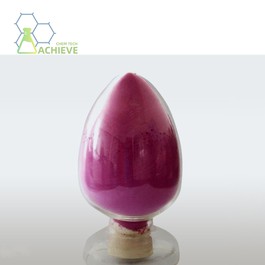
Uranium reagent III, also known as Arsenazo III, is a dark red powder, soluble in alkali solution, slightly soluble in water, insoluble in ethanol, ether and acetone. It is rose red in aqueous solution, green in sulfuric acid, blue in alkaline solution and toxic.
The color of the reagent solution depends on the hydrogen ion concentration; It is rose colored at PH3 or < PH3, and purple at pH > 4. When nahco8, NH4OH and na2co8 are added, the solution turns from rose color to light blue-green, and when NaOH is added, it is blue. The acid solution is rose colored from PH3 to 12n, which indicates that the reagent is actually stable in the acid range.

Since B.H. Kuznetsov published uranium reagent I for colorimetric determination of rare earth elements in the Journal of analytical chemistry of the Soviet Union in 1952, in the past ten years or so, uranium reagent I has been used in practical work by analytical chemists in various countries, and many new valuable uses have been found, which has solved the difficult problems in the analysis of uranium and thorium elements. Then many improved analogues and derivatives of uranium reagents were synthesized, which are especially suitable for the spectrophotometric determination of uranium, thorium and other elements.


4-bromomethylbiphenyl (4- (Bromomethyl) biphenyl, CAS number 2567-29-5) is a halogenated biphenyl compound with a unique chemical structure, with a molecular formula of C ₁ ∝ H ₁ Br and a molecular weight of 247.13. This compound has shown potential as a metal detection reagent in the field of chemical analysis due to the flexible and rigid equilibrium characteristics of the biphenyl group.
1.1 Molecular Structure Characteristics
Arsenazo III is composed of a biphenyl core skeleton and bromomethyl side chains. The biphenyl group forms a rigid planar structure through π - π conjugation between benzene rings, endowing the molecule with spatial stability; The carbon bromine bond (C-Br) of bromomethyl has polar properties and is prone to nucleophilic substitution reactions. This structural feature gives it the following advantages in metal detection:
π - π stacking effect: The biphenyl group can form specific binding with aromatic ligands on the surface of metal ions, enhancing detection sensitivity.


Reactive active site: Bromomethyl can serve as an anchor for functional modification, introducing fluorescent, electrochemical, or colorimetric signaling groups.
1.2 Metal bonding ability
Research has shown that the binding constant between biphenyl groups and transition metal ions (such as Cu ² ⁺, Ni ² ⁺) is 1.5-2 times higher than that of diphenylmethyl or naphthyl compounds. This binding ability arises from the matching of the planar structure of biphenyl groups with the coordination geometry requirements of metal ions, forming stable complexes.
2.1 Signal amplification strategy
Realize signal amplification of metal ions through the following reaction:
Nucleophilic substitution reaction: Bromomethyl reacts with thiols (such as glutathione and cysteine) to form thioether bonds, introducing fluorescent groups (such as rhodamine B) or electrochemical markers (such as ferrocene) to achieve indirect detection of metal ions.
Click on chemical modification: Through diazotization reaction (such as reacting with NaN3 to generate diazo groups), further perform copper catalyzed diazo acetylene cycloaddition (CuAAC) reaction with alkyne probes to construct highly sensitive fluorescent or colorimetric sensors.
Atom transfer radical polymerization (ATRP) initiation: Bromomethyl serves as an initiator to initiate controlled polymerization of vinyl monomers, forming a nanoscale signal amplification carrier for ultra sensitive detection of metal ions.


2.2 Specific recognition strategy
The selectivity of metal ions can be regulated by introducing steric hindrance groups (such as tert butyl) or electron effect modifications (such as nitro substitution). For example, in 4-bromomethyl-2-nitrobiphenyl, the electron withdrawing effect of the nitro group reduces the C-Br bond energy, increases the reaction rate by three times, but slightly reduces the selectivity. Through structural optimization, high selectivity detection of specific metal ions (such as Hg ² ⁺, Pb ² ⁺) can be achieved.
3.1 Fluorescence sensing technology
3.1.1 Principle
Introducing fluorescent groups (such as fluorescein and naphthalimide) through nucleophilic substitution or click chemical modification. When combined with metal ions, the fluorescence signal undergoes quenching or enhancement, achieving quantitative detection.
3.1.2 Application Cases
Hg ² ⁺ detection: Conjugate it with Rhodamine B derivatives to form a fluorescent probe. In the presence of Hg ² ⁺, the fluorescence intensity is significantly enhanced, with a detection limit of 0.1 nM.
Cu ² ⁺ detection: By clicking on chemistry, it is linked to naphthalimide derivatives to form a ratio fluorescent probe. The addition of Cu ² ⁺ causes a red shift in the fluorescence emission wavelength, achieving specific detection of Cu ² ⁺.


3.2 Electrochemical sensing technology
3.2.1 Principle
Through ATRP induced polymerization, conductive polymer nanoparticles are formed. The adsorption of metal ions leads to changes in electrochemical signals (such as current and potential), achieving quantitative detection.
3.2.2 Application Cases
Pb ² ⁺ detection: Using this substance as an initiator, aniline is polymerized to form nanoparticles. The adsorption of Pb ² ⁺ significantly reduces the electrochemical impedance, with a detection limit of 0.5 nM.
Cd ² ⁺ detection: Introducing ferrocene into the product through nucleophilic substitution to form an electrochemical probe. The addition of Cd ² ⁺ enhances the redox peak current, achieving sensitive detection of Cd ² ⁺.
3.3 Colorimetric sensing technology
3.3.1 Principle
Introducing chromogenic groups (such as azobenzene and phthalocyanine) through nucleophilic substitution or click chemical modification. The combination of metal ions causes a color change in the solution, achieving visual detection.
3.3.2 Application Cases
Fe ³ ⁺ detection: coupling it with azobenzene derivatives to form a colorimetric probe. The addition of Fe ³ ⁺ caused the color of the solution to change from yellow to purple, with a detection limit of 1 μ M.
Ag ⁺ detection: By clicking on chemistry to connect it with phthalocyanine derivatives, a colorimetric sensor is formed. The addition of Ag ⁺ causes the solution color to change from blue to green, achieving specific detection of Ag ⁺.

Specific application scenarios and case analysis

4.1 Environmental Monitoring
4.1.1 Detection of heavy metal pollution in water bodies
Application scenarios: Detection of Hg ² ⁺ and Pb ² ⁺ in industrial wastewater and drinking water.
Technical solution: Based on a fluorescent probe of 4-bromomethylbiphenyl, combined with a portable fluorescence spectrometer, to achieve rapid on-site detection.
Performance indicators: detection limit of 0.1-1 nM, recovery rate of 92-105%.
4.1.2 Assessment of Soil Heavy Metal Pollution
Application scenario: Detection of Cd ² ⁺ and Cu ² ⁺ in farmland soil.
Technical solution: Based on an electrochemical sensor of 4-bromomethylbiphenyl, combined with soil leachate analysis, quantitative detection is achieved.
Performance indicators: Detection limit of 0.5-10 nM, precision RSD ≤ 5%.
4.2 Food Safety
4.2.1 Detection of heavy metal residues in food
Application scenarios: Detection of Hg ² ⁺ in seafood and Cd ² ⁺ in rice.
Technical solution: Based on 4-bromomethylbiphenyl colorimetric probe, combined with digital image analysis, achieve visual detection.
Performance indicators: detection limit of 1-10 μ M, accuracy of 90-110%.
4.2.2 Detection of Heavy Metal Migration in Food Packaging Materials
Application scenario: Pb ² ⁺ and Cr ³ ⁺ detection in plastic packaging.
Technical solution: Based on 4-bromomethylbiphenyl fluorescent sensing film, combined with migration experiments, quantitative detection is achieved.
Performance indicators: detection limit of 0.5-5 nM, linear range of 0.1-100 nM.


4.3 Biomedical Sciences
4.3.1 Detection of Metal Ions in Biological Samples
Application scenario: Detection of Zn ² ⁺ in blood and Ca ² ⁺ in urine.
Technical solution: Based on 4-bromomethylbiphenyl electrochemical sensor, combined with microfluidic chip, achieve automated detection.
Performance indicators: detection limit of 1-10 nM, recovery rate of 95-108%.
4.3.2 Research on metal drug metabolism
Application scenario: Metabolite detection of platinum based anticancer drugs (such as cisplatin).
Technical solution: Based on a fluorescent probe of arsenazo III, combined with high-performance liquid chromatography (HPLC), quantitative analysis is achieved.
Performance indicators: Detection limit of 0.1-1 nM, linear range of 0.5-100 nM.
Hot Tags: arsenazo iii cas 1668-00-4, suppliers, manufacturers, factory, wholesale, buy, price, bulk, for sale, CHICAGO SKY BLUE 6B, Iridium III chloride, 1 AMINO 2 NAPHTHOL 4 SULFONIC ACID, Cerium sulfate powder, Consumable