




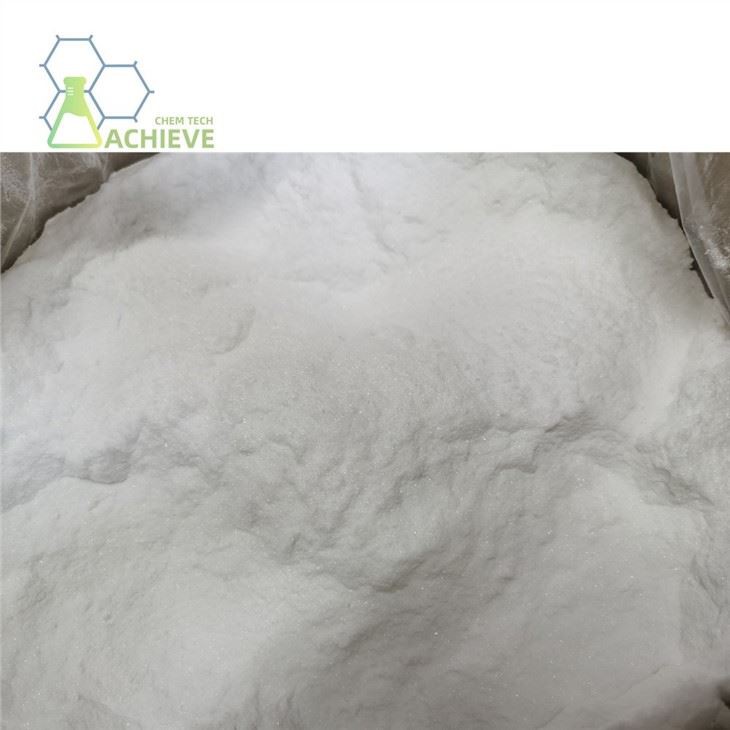
Shaanxi BLOOM Tech Co., Ltd. is one of the most experienced manufacturers and suppliers of bis-tris buffer cas 6976-37-0 in China. Welcome to wholesale bulk high quality bis-tris buffer cas 6976-37-0 for sale here from our factory. Good service and reasonable price are available.
BIS-TRIS buffer, chemical name bis (2-hydroxyethyl) amino (trimethyl) methane, white powder crystals, CAS 6976-37-0, Molecular formula C8H19NO5 is an aminomethane containing two N-hydroxyethyl groups and three N-hydroxymethyl groups. It has high solubility and stability, and can be stored stably at room temperature. In addition, it has low viscosity, is easy to prepare and purify, and has low ionic strength, which is beneficial for the stability and activity of proteins. In addition to its application in biochemical experiments, it can also be used for the preparation of drugs and drug intermediates. Due to its good solubility and stability, it can serve as a carrier for drugs, delivering drugs to target sites and controlling drug release. In addition, it can also be used to synthesize important drug molecules such as peptide compounds and nucleic acid analogues.

|
Chemical Formula |
C8H19NO5 |
|
Exact Mass |
209 |
|
Molecular Weight |
209 |
|
m/z |
209 (100.0%), 210 (8.7%), 211 (1.0%) |
|
Elemental Analysis |
C, 45.92; H, 9.15; N, 6.69; O, 38.23 |
|
|
|


Product properties:
Melting point 104 ° C (lit.), Boiling point 466.2 ± 40.0 ° C (predicted), Density 1.346 ± 0.06 g / cm3 (predicted), Storage conditions insert atmosphere, room temperature, Solubility H2O: 1 m at 20 ° C, clear, colorless, Form: solution, Color: yellow to orange, Odor odorless, PH value: 9.0-10.1 (20-25 ℃, 1m in water), Discoloration of acid-base indicator (pH value range: 5.8 - 7.2), Acidity coefficient (PKA) 6.5 (at 25 ℃), Water solubility, Maximum wavelength( λ max) λ: 280 nm Amax: 0.15, Air sensitive, BRN 2205275, InChIKeyOWMVSZAMULFTJU-UHFFFAOYSA-N
Safety information:
Hazard symbol (GHS), GHS05, Warning words: danger, Hazard description h318, Precautions: p280-p305 + P351 + P338 + P310, Dangerous goods signs Xi, xn, Hazard category code: 36 / 37 / 38-21 / 22-20 / 21 / 22, Safety instructions 26-36-36 / 37 / 39-22, WGK Germany 3, F 10-23, TSCA Yes.

There are usually three methods to synthesize Bis-Tris buffer:
The first one is synthesized by catalytic reaction of trimethylol aminomethane and chloroethanol in dioxane as solvent and sodium hydroxide as dechlorinating agent.
The second method is to use trimethylol aminomethane to react with vinyl carbonate in water as a solvent at a temperature of 100 degrees.
The third kind: trimethylolaminomethane and ethylene oxide can be mildly converted into this product under the conditions of specific bioconversion bacteria.


Bis (2-hydroxyethyl) amino (trihydroxymethyl) methane, with the chemical formula C8H19NO5 and CAS registration number 6976-37-0, abbreviated as BIS-TRIS, is an organic compound with a unique chemical structure and multifunctionality. Its molecular structure contains two N-hydroxyethyl groups and three N-hydroxymethyl groups, which endow it with excellent physical and chemical properties, making it widely applicable in various fields such as biochemistry, medicine, chemical engineering, and biomaterials.
It is an efficient biological buffer with an effective pH buffering range of 5.8-7.2 and a pKa value of 6.5 (25 ℃). In biochemical experiments, many biomolecules such as proteins and nucleic acids are highly sensitive to pH values, and even small changes in pH can affect their structure and function. BIS-TRIS can stabilize the pH value of the solution within this pH range, providing a stable environment for biochemical reactions.
In the process of protein separation and purification, the natural conformation of the protein can be maintained to prevent denaturation or precipitation due to pH changes. For example, in protein purification techniques such as ion exchange chromatography and affinity chromatography, the use of BIS-TRIS buffer can ensure that the interaction between proteins and chromatography media occurs under stable pH conditions, thereby improving purification efficiency and purity.
In enzyme activity assays, enzyme activity often depends on a specific pH environment. The pH value of the reaction system can be precisely controlled to enable the enzyme to exert catalytic activity under optimal pH conditions, thereby accurately measuring the enzyme's activity. This is of great significance for studying the properties, mechanisms of action, and developing enzyme preparations of enzymes.

Coordination with metal ions

BIS-TRIS has the ability to coordinate with various metal ions and form stable complexes, such as Zn ² ⁺ - BIS-TRIS, Mn ² ⁺ - BIS-TRIS, etc. These metal ion complexes play an important role in the study of the structure and function of biomolecules.In the structural analysis of proteins, metal ions often act as cofactors to participate in the formation of active centers in proteins. By coordinating BIS-TRIS with metal ions, the structure of protein metal ion complexes can be stabilized, making it easier to use techniques such as X-ray crystallography and nuclear magnetic resonance (NMR) for structural analysis.
For example, the active centers of certain zinc containing enzymes require zinc ions to maintain their catalytic activity, and BIS-TRIS Zn ² ⁺ complexes can provide a stable structural environment for these enzymes, which helps to accurately analyze their three-dimensional structures.
In nucleic acid research such as DNA sequencing, metal ions may also be involved in the folding and functional regulation of nucleic acids. The coordination between BIS-TRIS and metal ions can regulate the local environment of nucleic acids, affecting the interactions between nucleic acids and proteins, small molecules, etc., providing a powerful tool for in-depth research on the structure and function of nucleic acids.

Protein electrophoresis

BIS-TRIS has important applications in protein electrophoresis experiments. SDS-PAGE (sodium dodecyl sulfate polyacrylamide gel electrophoresis) and Native PAGE (non denaturing polyacrylamide gel electrophoresis) are common protein electrophoresis techniques. BIS-TRIS buffer is often used to prepare electrophoresis buffer to maintain the pH stability of the solution during electrophoresis.
In SDS-PAGE, proteins are denatured and negatively charged in a sample buffer containing SDS and mercaptoethanol, and then separated by molecular size in polyacrylamide gel. It can ensure the stability of the pH value of the electrophoresis buffer, allowing proteins to migrate in the expected way in an electric field, thereby accurately separating proteins of different molecular weights and detecting their relative molecular weights.
In Native PAGE, proteins maintain their natural conformation for electrophoretic separation. Using it can prevent protein denaturation due to pH changes, preserve the natural activity and conformational information of proteins, and help study the natural state and interactions of proteins.
Western blotting is an important experimental technique used to detect the expression level of target proteins. Bis Tris propane buffer is often used as a protein transport buffer in immunoblotting experiments.
During the transfer of protein from gel to the membrane, Bis Tris propane buffer can maintain a stable pH environment, ensuring that the protein is transferred to the membrane with correct conformation and charge state. This is crucial for subsequent antibody binding and signal detection. If proteins undergo denaturation or conformational changes during the transfer process, it may cause antibodies to be unable to accurately recognize the target protein, thereby affecting the accuracy of experimental results. Therefore, Bis Tris propane buffer plays a crucial role in immunoblotting experiments, helping to improve the sensitivity and reliability of the experiments.

Cell culture

Cell culture is an important technology in biomedical research, and the pH value of cell culture medium has a significant impact on cell growth and metabolism. BIS-TRIS propane buffer can be used for the preparation of cell culture media to maintain a stable pH value during the cell culture process.
Different types of cells have varying pH requirements, but generally require growth in an environment close to physiological pH (approximately 7.2-7.4). BIS-TRIS propane buffer can buffer the pH changes of the culture medium during cell culture, prevent pH fluctuations caused by metabolic product accumulation, gas exchange, and other factors, and provide a stable growth environment for cells. This is of great significance for the normal growth, proliferation, and functional expression of cells, helping to improve the success rate of cell culture and the reliability of experimental results.
Nucleic acid electrophoresis is a commonly used method for detecting the length and concentration of target nucleic acids, including DNA and RNA electrophoresis. Suitable for nucleic acid electrophoresis experiments, it can maintain the pH stability of the electrophoresis buffer.
In nucleic acid electrophoresis, nucleic acid molecules migrate under the action of an electric field based on their size and charge properties. It can ensure the stability of the pH value of the solution during electrophoresis, allowing nucleic acid molecules to migrate in the expected way, thereby accurately separating nucleic acid fragments of different lengths and detecting their concentrations. This is of great significance for research such as gene cloning, gene expression analysis, and nucleic acid sequencing.
Detecting creatine kinase

BIS-TRIS can also be used to detect creatine kinase. Creatine kinase is an important enzyme that plays a crucial role in muscle energy metabolism. The determination of its activity is of great significance for diagnosing muscle diseases and evaluating sports injuries.
In the detection experiment of creatine kinase, the pH stability of the reaction system can be maintained to ensure that the enzyme exhibits catalytic activity under optimal pH conditions. By precisely controlling the pH value, the accuracy and reliability of creatine kinase activity measurement can be improved, providing strong support for clinical diagnosis and research.
BIS-TRIS also plays an important role in the research and application of hemoglobin. During the separation process of hemoglobin, its stability and activity can be maintained to prevent denaturation or aggregation due to pH changes. This is of great significance for the purification and structural research of hemoglobin.
BIS-TRIS can effectively protect hemoglobin during the freeze-drying process. Freeze drying is a commonly used method for preserving biological products, but proteins may be damaged during the freezing and drying process. It can provide a stable environment for hemoglobin during the freeze-drying process, reduce protein denaturation and inactivation, and improve the activity and stability of hemoglobin after freeze-drying.

Cathode electrolyte of IEF/2-D gel electrophoresis

IEF (isoelectric focusing electrophoresis) and 2-D gel electrophoresis are common techniques in proteomics research, which are used to separate and analyze complex protein mixtures. BIS-TRIS can be used as cathode electrolyte for IEF/2-D gel electrophoresis.
During the IEF process, proteins migrate and focus in a pH gradient based on their isoelectric point. BIS-TRIS catholyte can maintain the pH stability of the electrophoresis buffer, ensuring that proteins can accurately migrate to their isoelectric point during the isoelectric focusing process. In 2-D gel electrophoresis, the use of BIS-TRIS buffer also helps to improve the separation effect and resolution of proteins, providing high-quality data for proteomics research.
Hot Tags: bis-tris buffer cas 6976-37-0, suppliers, manufacturers, factory, wholesale, buy, price, bulk, for sale, CHICAGO SKY BLUE 6B, 1 AMINO 2 NAPHTHOL 4 SULFONIC ACID, Cerium sulfate powder, Iridium III chloride, Consumable