




Shaanxi BLOOM Tech Co., Ltd. is one of the most experienced manufacturers and suppliers of calcium hydride cas 7789-78-8 in China. Welcome to wholesale bulk high quality calcium hydride cas 7789-78-8 for sale here from our factory. Good service and reasonable price are available.
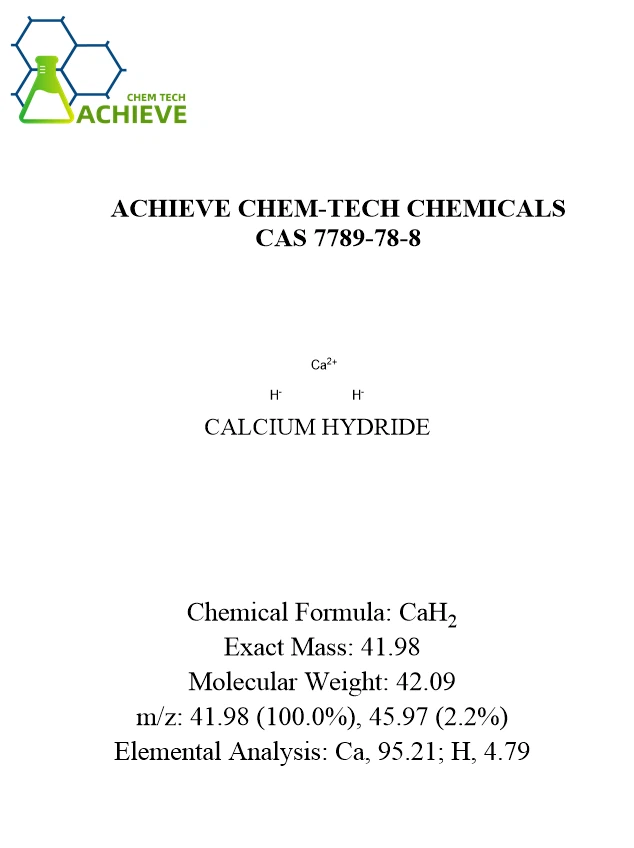
Calcium hydride, also known as CALCIUM HYDRIDE, is an inorganic compound with the chemical formula CaH ₂. It is usually gray white crystalline or blocky, and industrial products are mostly gray, in the form of regular crystals or powder. It is insoluble in carbon disulfide and slightly soluble in concentrated acid. It is extremely sensitive to moisture and easily deliquescent. It has strong reducibility and has a stronger reducing effect on metal oxides than sodium hydride or lithium hydride. When it comes into contact with water, it decomposes and releases hydrogen gas, which reacts violently and may cause combustion or explosion. Therefore, it is marked as a flammable substance when exposed to moisture. At room temperature, it does not react with dry air, nitrogen, or chlorine, but can react with these gases at high temperatures to produce calcium oxide, calcium carbide, and calcium chloride, respectively.

Additional information of chemical compound:
|
Chemical Formula |
CaH2 |
|
Exact Mass |
41.98 |
|
Molecular Weight |
42.09 |
|
m/z |
41.98 (100.0%), 45.97 (2.2%) |
|
Elemental Analysis |
Ca, 95.21; H, 4.79 |
|
Boiling point |
816℃(lit.) |
|
Flash point |
1.9 |
|
Storage conditions |
Store below +30℃. |
|
|
|


In addition, it can also react with ethanol to generate hydrogen gas and calcium ethoxide. It is used as a reducing agent and condensing agent in organic synthesis, and can be used to reduce various organic compounds. Due to its sensitivity to moisture and ability to react with water, this substance can be used as a desiccant to dry certain gases or organic solvents. When working in the field, it can be used to produce hydrogen gas. It reacts with water to release hydrogen gas, which can be used as a lightweight hydrogen generator to provide efficient energy for field operations. In chemical analysis, calcium hydride can be used as a reagent to participate in certain chemical reactions or analysis processes, and can be used to reduce rare metal oxides to prepare rare metals.

Calcium hydride (chemical formula CaH2) is an important inorganic compound with strong reducibility and flammability when exposed to moisture. It has a wide range of applications in organic synthesis, desiccants, hydrogen production materials, chemical analysis reagents, and rare metal preparation. The following will elaborate on its purpose from multiple aspects:

Reducing and condensing agents in organic synthesis
Calcium hydride is an important reducing and condensing agent in organic synthesis, which can participate in various organic chemical reactions and provide convenience for organic synthesis. Has strong reducibility and can reduce various organic compounds. For example, it can reduce carbonyl compounds (such as aldehydes and ketones) to their corresponding alcohols, and reduce functional groups such as carboxylic acids, esters, nitriles, etc. In organic synthesis, calcium hydride is often used to prepare intermediates with specific structures, providing a basis for subsequent reactions.
Its reducing ability is stronger than that of sodium hydride or lithium hydride, and its reducing effect on metal oxides is also more significant. It can also be used as a condensing agent to participate in the condensation reaction of organic compounds. For example, in the preparation of certain complex organic molecules, calcium hydride can promote intermolecular condensation, form new chemical bonds, and thus synthesize the target compound.


Desiccant
Calcium hydride is extremely sensitive to moisture and can react violently with water, releasing hydrogen gas. Therefore, it can be used as a desiccant to dry certain gases or organic solvents. Can be used for drying inert gases such as hydrogen, nitrogen, argon, as well as certain non-polar organic gases. During the gas drying process, calcium hydride can absorb moisture from the gas, preventing it from interfering with subsequent reactions or experiments. It can also be used to dry certain organicsolvents, such as tetrahydrofuran, ether, etc. In organic synthesis, the purity of the solvent has a significant impact on the reaction results. Drying organic solvents with calcium hydride can improve the purity of the solvent and reduce the impact of impurities on the reaction.
Hydrogen producing materials
Calcium hydride can be used as a hydrogen production material in field work, providing efficient energy for field operations. Calcium hydride can react with water to release hydrogen gas, making it suitable for preparing portable hydrogen generators. In field operations, hydrogen generators can provide hydrogen for equipment such as fuel cells and hydrogen lamps to meet energy needs. Calcium hydride can also serve as a storage and transportation medium for hydrogen gas. When hydrogen is needed, it can be released by reacting with water. This method has the advantages of high storage density and convenient transportation, and is suitable for hydrogen supply in certain special occasions.


Chemical analysis reagents
Calcium hydride can be used as a reagent in chemical analysis, participating in certain chemical reactions or analytical processes. Can be used in certain quantitative analysis experiments as a reducing agent or reactant, participating in chemical reactions and determining the content of reactants. For example, when determining the content of certain metal ions, calcium hydride can be used as a reducing agent to reduce the metal ions to elemental metal, and then the metal content can be determined by weighing or other methods.
It can also be used in certain qualitative analysis experiments to identify certain compounds or functional groups. For example, when identifying carbonyl compounds such as aldehydes and ketones, calcium hydride can be used for reduction reactions, and the properties of the reaction products can be observed to determine the type of compound.


Preparation of Rare Metals
Calcium hydride plays an important role in the preparation of rare metals and can be used to reduce rare metal oxides to prepare rare metals. Calcium hydride has strong reducibility and can reduce certain rare metal oxides, such as tantalum oxide and niobium oxide. During the reduction process, calcium hydride reacts with metal oxides to generate corresponding metal elements and hydrogen gas.
This method has the advantages of mild reaction conditions and high product purity, and is suitable for the preparation of certain rare metals. Calcium hydride can also be used to remove impurity elements during the refining process of rare metals. For example, in refining metals such as tantalum and niobium, calcium hydride can be used to react with impurity elements to generate corresponding hydrides, which can then be decomposed by heating or other methods to remove impurity elements and improve the purity of the metal.


Other applications
Can be used to prepare certain electronic materials, such as semiconductor materials, superconducting materials, etc. In the preparation process of electronic materials, calcium hydride can be used as a reducing agent or dopant to participate in the synthesis or modification process of materials, improving their properties. With the continuous development of energy technology, calcium hydride also has potential applications in the field of energy storage and conversion. For example, calcium hydride can be used as a hydrogen storage material in hydrogen energy storage and conversion systems. In addition, calcium hydride can also be used to prepare electrode materials for certain fuel cells, improving the performance of fuel cells.

Calcium hydride (chemical formula CaH ₂) is an important inorganic compound with strong reducibility and flammability when exposed to moisture. It has a wide range of applications in organic synthesis, desiccants, hydrogen production materials, and other fields. The following will provide a detailed introduction to its preparation method:
Direct reaction method between calcium and hydrogen
The direct reaction between calcium and hydrogen is the main method for preparing calcium hydride, and its reaction principle is based on the chemical reaction between calcium and hydrogen at high temperatures.
Principle
Calcium reacts with hydrogen at high temperatures to form calcium hydride, with the chemical equation being:
Ca(s)+H2(g)→CaH2(s)
This reaction is exothermic, but the reaction rate is extremely slow at room temperature and needs to be carried out at high temperature.
Preparation device
The device for preparing calcium hydride usually includes quartz reaction tube, inlet tube, outlet tube, electric furnace, etc. Quartz reaction tubes are used to contain reactants, the inlet tube is used to introduce hydrogen gas, the outlet tube is used to discharge the gas produced by the reaction, and the electric furnace is used to heat the reaction tubes.
Operation steps
Raw material preparation: Place refined calcium with a purity of about 99.5% into an iron plate and place it in the center of a quartz reaction tube. To purify metallic calcium, it is necessary to repeatedly perform vacuum distillation, then scrape off the oxide layer on the surface of calcium in an operating box filled with argon gas, and cut it into small pieces as much as possible. In the absence of air, place the smooth surface small pieces of metallic calcium in an electrolytic iron boat, which is then loaded into a quartz tube.
Device installation: Rubber plugs are used to install the inlet and outlet pipes at both ends of the quartz reaction tube. The outlet pipe is connected to the fume hood through a mineral oil bubbler.
System replacement: Purified hydrogen gas is introduced from the intake pipe, and a large amount of hydrogen gas is initially introduced to replace the air in the reaction system, preventing calcium from reacting with oxygen to produce calcium oxide.
Heating reaction: Heat the reaction tube with an electric furnace, starting from about 200 ℃, and further heating to 250-300 ℃. Introduce hydrogen gas at a flow rate of 0.6 mL/min for reaction. To prevent the quartz tube from being corroded by calcium vapor, the heated part of the quartz tube is covered with a thin-walled tube made of electrolytic iron. The reaction can be completed in about 2 hours, and the generated calcium hydride is a porous gray white crystalline powder.
Product inspection: A petroleum ether bubbler can be used to check if the hydrogenation reaction is complete. Suspend the flow of H ₂ gas. If the liquid level in the bubbler tube does not rise, it indicates that the reaction is complete; If the liquid level inside the conduit rises, it indicates that the hydrogenation reaction still needs to continue.
Cooling collection: After the reaction is complete, cool to room temperature to obtain calcium hydride, which has a purity of about 99%.
FAQ
What is one brand name of calcium hydroxide?
Calcium hydroxide has many names, including builders' lime, caustic lime, slaked lime, cal, and pickling lime. It is used in various applications, including food preparation, where it has been identified as E number E526. Calcium Hydroxide adopts a polymeric structure similar to magnesium hydroxide (brucite structure).
Is calcium hydride explosive?
Calcium Hydride is a FLAMMABLE and REACTIVE chemical and a FIRE and EXPLOSION HAZARD.
What is another name for calcium hydride?
CaH 2 has been used for hydrogen production. In the 1940s, it was available under the trade name "Hydrolith" as a source of hydrogen: The trade name for this compound is "hydrolith"; in cases of emergency, it can be used as a portable source of hydrogen, for filling airships.
What is calcium hydride used for?
Calcium Hydride is a grayish-white crystalline (sand-like) solid. It is used as a drying and reducing agent and as a cleaner for blocked up oil wells. * Calcium Hydride is on the Hazardous Substance List because it is cited by DOT.
Hot Tags: calcium hydride cas 7789-78-8, suppliers, manufacturers, factory, wholesale, buy, price, bulk, for sale, 6 Aminoquinoxaline CAS 6298 37 9, 2-bromo-3-hexylthiophene, 3 4 5 Trimethoxyphenylboronic acid, copper chromite, Indole 3 Acetic Acid IAA CAS 87 51 4, Cobalt tpp