


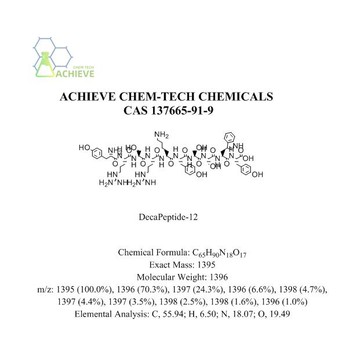
Decapeptide-12 (link:https://www.bloomtechz.com/synthetic-chemical/peptide/decapeptide-12-cas-137665-91-9.html) is a widely used polypeptide molecule, and its synthesis method also presents diversity and complexity due to different application fields. This article mainly introduces ten typical synthetic methods of Decapeptide-12, namely: peptide-based solid-phase synthesis, liquid-phase synthesis, liquid-phase hydrogenation, chemical modification of protective groups, anchoring strategy, isomer surface Recognition method, click chemical reaction method, condensation reaction method, enzyme catalysis method and solid state interaction method.
1. Peptidyl solid-phase synthesis method:
Peptide-based solid-phase synthesis method is a common Decapeptide-12 synthesis method, which is based on the principle of peptide synthesis on polymer materials such as polystyrene resin or porous silica gel. This method requires the Nα-protecting group peptide acid whose C-terminus is connected to the solid-phase scaffold to be connected to the next amino acid through an Nα carboxylating agent (such as DCC), carbonic anhydride or azoyl salt, etc. After each reaction step, the protecting group needs to be removed, and the Nα group should be protected again with a new protecting group. Finally, the polypeptide molecule is released from the scaffold by basic reagents such as hydrofluoric acid or sodium hydroxide to obtain Decapeptide-12.
|
|
|
2. Liquid phase synthesis method:
The liquid-phase synthesis method is a traditional synthesis method of Decapeptide-12, which is based on the principle of synthesis in solution. The method uses Nα-protecting group polypeptide acid or acylated amino acid as a starting material, which is linked with Nα carboxylating agent and amino acid/polypeptide acid. After each reaction step, the protecting group needs to be removed, and the Nα group should be protected again with a new protecting group. Finally, it is synthesized by chemical reagents such as silver nitrate and sodium trimethylsilyl fluoride.
3. Liquid phase hydrogenation method:
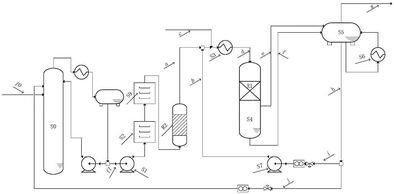
The liquid-phase hydrogenation method is a synthetic method of Decapeptide-12, which is based on the principle of peptide synthesis through the reduction reaction of reactants in a liquid system in the presence of a catalyst. This method requires the use of amino acids or polypeptide acids as starting materials, and amide bond formation with protected C-terminal amides and corresponding protecting group derivatives. In the presence of a catalyst (such as aluminum hydride, hydrogen or sodium borohydride, etc.), the amide bond will undergo a reduction reaction to obtain a longer polypeptide chain until the assembly of Decapeptide-12 is complete.
4. Protective group chemical modification method:
The protective group chemical modification method is a method for synthesizing Decapeptide-12 by modifying the existing polypeptide chain with a specific protective group. This method requires the use of existing polypeptide chains and the use of specific protective group chemical modification strategies (such as Boc, Fmoc, etc.) to control the connection of amino acids and the removal of protective groups. Decapeptide-12 can be successfully synthesized by repeating the steps of polypeptide modification and removal of protecting group.
5. Anchor strategy method:
The anchoring strategy method is a method in which the central part of Decapeptide-12 and the anchor points stripped from both ends are synthesized separately, and then the two are synthesized into one through a condensation reaction. In this method, the protective group of the anchor point needs to be attached to the C-terminus, and then stripped out by the reaction of n-hexanal and piperazine acetic acid to form the lipopeptide of the central part. At the same time, another protective group is attached to the N- or C-terminus, and the amino acid chains at both ends are synthesized through chemical modification of different protective groups. Finally, the two were combined into Decapeptide-12 through a condensation reaction.
6. Isomer surface recognition method:
The isomer surface recognition method is a synthesis method of Decapeptide-12, which utilizes the principle of stereochemistry to realize molecular assembly. This method requires the use of amino acids or peptidyl groups with special stereo configurations to form gels or membranes in water, enabling them to selectively adsorb external molecules to assemble Decapeptide-12.
7. Click chemical reaction method:
The click chemistry reaction method is a synthetic method of Decapeptide-12, which is a method of chemically linking two molecules in a fast, efficient and specific manner. The method involves the use of two different molecules with reactive end groups that link when participating in a copper(I)-catalyzed trichlorethylene/copper nitrate reaction to form Decapeptide-12.
The concrete steps of this method are as follows:
7.1. Synthesis of Decapeptide-12: Decapeptide-12 itself needs to be synthesized first. This can be performed by methods such as solid-phase synthesis or liquid-phase synthesis. The synthesized Decapeptide-12 needs to be purified and identified to ensure its quality and purity.
7.2. Introduction of click chemical reaction sites: In the process of synthesizing Decapeptide-12, it is necessary to introduce click chemical reaction sites. Such sites typically contain alkynyl (-C≡C) or azido (-N≡N) groups, among others. These groups are able to participate in unique "click" reactions and link to other molecules quickly and efficiently under specific conditions.
7.3. Synthesis of ligands or carrier molecules: When Decapeptide-12 introduces click chemical reaction sites, other ligands or carrier molecules need to be synthesized. These molecules can be fluorescent dyes, biomolecules, metal ions, etc. for specific application purposes.
7.4. "Click" reaction: Decapeptide-12 and ligand or carrier molecules are subjected to a "click" reaction under specific reaction conditions. This reaction usually requires the use of copper catalysts and is carried out at low temperatures. The reaction time is short, and the reaction product can be obtained through simple purification steps.
7.5. Identification of Reaction Products: Reaction products need to be identified and characterized. Commonly used methods include mass spectrometry, nuclear magnetic resonance and other techniques. Ensure the structure and purity of the reaction product for subsequent applications.
In conclusion, the click chemistry reaction method of Decapeptide-12 is an efficient, convenient and controllable synthesis method, which provides a new way for the construction of polypeptide compounds. This method has been widely used in the fields of medicine, biological probes, nanomaterials and materials science.

8. Condensation reaction method:
The condensation reaction method is a method for synthesizing Decapeptide-12 by performing a condensation reaction on two monomers and gradually expanding the length and complexity. This method requires the use of N- or C-terminal protecting group derivatives and the corresponding amino acid chains, and undergoes condensation reactions with reagents such as Nα carboxylating agents, acid chlorides or acid anhydrides until a complete polypeptide sequence is generated.
9. Enzyme-catalyzed method:
Enzyme catalysis is a method to convert simpler substrates into complex molecules, which utilizes the catalytic properties of enzymes to achieve the assembly of Decapeptide-12. The method needs to use a synthetase or protease and a suitable substrate to convert it into a target polypeptide chain through catalytic action, and then complete the synthesis of Decapeptide-12 through methods such as chemical modification of protecting groups.
10. Solid state interaction method:
The solid-state interaction method is a method to achieve the assembly of Decapeptide-12 in the solid state. This method requires the use of crystal engineering methods to assemble some short-chain amino acids into crystals through mechanical effects such as hydrogen bonds, ion coordination, and π-π interactions, and then use methods such as dissolution and polycrystallization to expand the crystal size, and finally form a complete Decapeptide-12.