


Dithizone, commonly known as the lead reagent, can form complexes with metal ions and change color. It is the most widely used organic developer in colorimetric analysis. It can be used to determine trace heavy metal ions, such as pb2+, hg2+, zn2+, and cd2+. The molecular formula is c6h5nhnhcsn=nc6h5. It is a kind of blue-black crystalline powder mixed and shaken with the aqueous solution of metal to generate metal complex salt in the aqueous phase, which is transferred to the organic solvent layer and has significant color changes. According to the color and depth of the metal complex salt, it can be used to determine some trace metals, such as mercury, lead, zinc, and cadmium, for coordination titration and as a metal indicator for determining mercury, lead, zinc and cadmium. It is susceptible to show, which is also called a lead reagent. Eating by mistake can cause diabetes.
Synthetic method of dithizone reagent: cool the mixture of phenylhydrazine and toluene to below 0 ℃, add carbon disulfide under stirring and control the adding speed to maintain the reaction temperature at 60 ~ 70 ℃, place it for more than 10min, then heat it to 90 ~ 95 ℃, crystallize and dissolve and start the reaction. When a large number of crystals are precipitated, and the lead acetate reagent is slightly brown, the response is completed, cooled, and filtered, and the crystals.
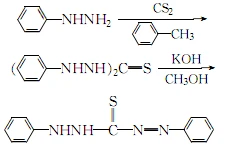
They are washed with cold toluene and ethanol. The resulting white crystal is phenylthiocarbamide. Then, diphenylcarbazide is added to the methanol solution of potassium hydroxide, heated and refluxed for 5 ~ 10min, cooled to about 30 ℃ with ice water, filtered out the insoluble matter, stirred, and added with 0.5mol/l sulfuric acid aqueous solution to the filtrate until the answer is just acidic to Congo red test paper. The crystals obtained after filtration are washed with cold water, then dissolved with 5% sodium hydroxide solution, filtered out the insoluble matter, and the filtrate is cooled with ice water; at the same time, acidify the Congo red test paper with cold 0.5mol/l sulfuric acid until it is just acidic, filter after total precipitation, wash the filtered crystal with ice water until so42- ion is qualified, and dry it at 40 ℃ after draining to obtain the finished Diphenylthiocarbazone. The process reaction is:
Operation steps for determination of lead content in samples by its Spectrophotometry.
(1) Sample pretreatment
In addition to proving that the digestion and treatment of water samples are unnecessary, for example, groundwater without suspended solids and clean surface water can be directly determined. Otherwise, pretreatment shall be carried out according to the following two conditions.
① For turbid surface water, add 1ml nitric acid to every 100ml of the water sample, put it on an electric heating plate to digest for 10min, filter it with a quick filter paper after cooling, and wash the filter paper with 0.2% nitric acid solution for several times, and then dilute it to a specific volume with this acid for determination.
② For surface water or wastewater containing a lot of suspended solids and organic matter, add 5 ml nitric acid to every 100 ml of the water sample, heat it on an electric heating plate, digest it to about 10 ml, cool it slightly, add 5 ml nitric acid and 2 ml perchloric acid, continue heating and digestion, and steam it to nearly dry. After cooling, use 0.2% nitric acid solution to warm and dissolve the residue. After cooling, use rapid filter paper to filter. The filter paper is washed with 0.2% nitric acid several times. The filtrate is diluted with this acid to volume for determinaMeasurementlank tests shall be conducted in parallel for each batch of samples analyzed.
③ Accurate measurement shall not exceed 30 μ. Put an appropriate amount of sample of G lead into a 250 ml separatory funnel, add water to 100 ml, add 3 drops of 0.1% thymol blue indicator solution, and adjust it with 6 mol/l sodium hydroxide solution or 6 mol/l hydrochloric acid solution until stable yellow appears. At this time, the pH value of the solution is 2.8 for determination.
(2) Sample determination
① Chromogenic extraction: add lead to the sample placed in a 250 ml separating funnel (the lead content does not exceed 30 μ g. The maximum volume is not more than 100 ml). Add 10 ml of 20% nitric acid and 50 ml of citrate potassium cyanide reducing solution, plug it tightly, shake it well and cool it to room temperature. After adding 10 ml of dithizone, measure it tightly, shake the separating funnel violently for 30 s and place it in layers.
② Measurement: insert a small ball of lead-free absorbent cotton into the neck of the separating funnel, release the lower organic phase, discard 1 ~ 2ml of chloroform layer, and then inject it into a 10mm cuvette. With chloroform as the reference, measure the absorbance of the extract at 510nm, deduct the blank test absorbance, and then find the lead content from the calibration curve.
③ Blank test: take lead-free water instead of the sample, use the same amount of other reagents, and handle according to the above steps.
(3) Drawing of the calibration curve
Add 0, 0.50, 1.00, 5.00, 7.50, 10.00, 12.50, and 15.00 ml of a standard lead solution to a series of 250 ml separators.Measurementropriate amount of lead-free deionized water to 100ml, and perform color development and measurement according to the sample determination steps below.