


Fosun Pharma GLP-1 drug and Huiruida have reached an exclusive cooperation and licensing agreement
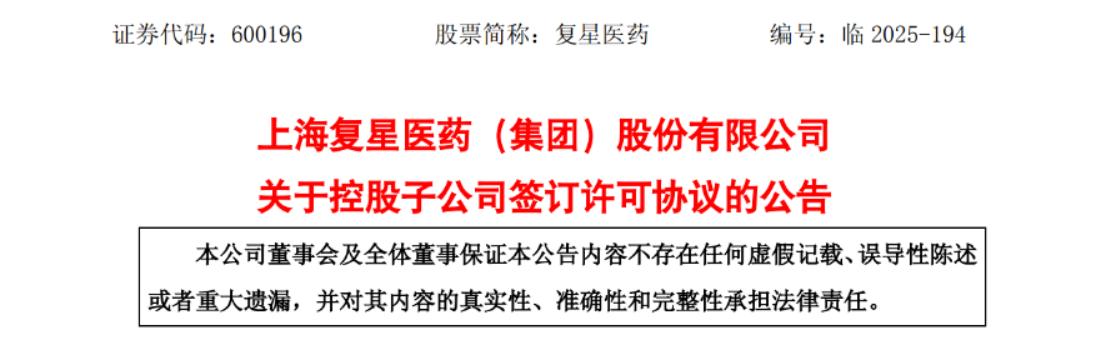
On December 9, 2025, Fosun Pharma (600196. SH; 02196. HK) announced today that its controlling subsidiaries Chongqing Yaoyou Pharmaceutical Co., Ltd. ("Yaoyou Pharmaceutical"), Shanghai Fosun Pharmaceutical Industry Development Co., Ltd. ("Fosun Pharmaceutical Industry"), and Pfizer Inc. (Pfizer, NYSE: PFE) have jointly signed a "License Agreement", granting Pfizer exclusive development, use, production, and commercialization rights worldwide for oral small molecule glucagon like peptide-1 receptor (GLP-1 capsules) agonists (including VP05002) and products containing the active ingredient. The license covers the treatment, diagnosis, and prevention of all indications in humans and animals. According to the terms of the agreement, Yaoyou Pharmaceutical will complete VP05002 in Australia! Conduct clinical trials and grant Pfizer exclusive licenses for further development, production, and commercialization worldwide. Yaoyou Pharmaceutical will receive a down payment of $150 million and be eligible for milestone payments up to $1.935 billion related to specific development, registration, and commercial milestones, as well as tiered royalty fees after the product is approved for sale.
The small molecule glucagon like peptide-1 receptor (GLP-1R) agonist licensed this time is independently developed by Yaoyou Pharmaceutical, a subsidiary of Fosun Pharmaceutical, and has independent intellectual property rights. The potential indications for the treatment of diseases related to metabolism include but are not limited to long-term weight management, type 2 diabetes, metabolic dysfunction related steatohepatitis (MASH) (that is, nonalcoholic steatohepatitis (NASH)). Currently, it is in clinical phase I in Australia.
The world's first! Sanofi RNAi therapy Fentosiland approved for market in China
On December 10, 2025, Sanofi announced that its RNAi therapy, fitusiran (Chinese trade name: Sanofin, English trade name: Qfitlia), has been approved by the National Medical Products Administration (NMPA) for routine prophylactic treatment in children and adult patients aged 12 and above with the following diseases to prevent bleeding or reduce bleeding frequency: ① severe hemophilia A with or without coagulation factor V inhibitors (congenital coagulation factor VI deficiency, FVI<1%) or ② presence or absence of coagulation factors! Patients with severe hemophilia B (congenital coagulation factor | X deficiency, FIX<1%) caused by inhibitors. This product is the first RNAi therapy in the hemophilia field, requiring at least 6 injections per year.
Fentosiland is an RNA therapy independently developed by Alnylam Pharmaceuticals, targeting antithrombin I (AT I). In January 2014, Sanofi spent $700 million to acquire a 12% stake in Alnylam Pharmaceuticals, winning related rights to four RNAi therapies including Fentosiland. As of now, Sanofi only holds the rights to two drugs, Fentosilan and Revusiran.
Fitusiran (Chinese trade name Safine, English trade name Qfitlia) is the world's first innovative hemophilia RNAi therapy developed by AlInylam Pharmaceuticals and promoted by Sanofi. It was approved by the US FDA in March 2025 and was approved for market in China in December of the same year. Its listing application has been included in the China Rare Disease Drug Development Pilot Program; This drug is suitable for patients with severe hemophilia A or B aged 12 years and above, regardless of the presence or absence of coagulation factor inhibitors in the body. It can be used for routine preventive treatment by targeting the inhibition of liver antithrombin production through RNAi technology, rebalancing the hemostatic function in the body, reducing the risk of false bleeding attacks, and using subcutaneous injection. The initial dose is 50 milligrams every two months, and the dosing regimen can be adjusted according to antithrombin activity. At least 6 injections are needed per year, which significantly reduces the frequency of administration compared to traditional therapy and provides a more convenient treatment option for hemophilia patients.