


Chinese enterprises are transitioning towards technology driven exports
1. Challenges and Opportunities
Since February 2025, the US government has continuously announced the imposition of tariffs on Chinese goods imported to the US. International trade involving chemical raw materials has attracted much attention, especially with the recent US tariffs and China's countermeasures. China's chemical exports are facing significant challenges. But in the industry's view, structural opportunities still exist in the chemical industry.
At the same time, domestic chemical enterprises are actively expanding their domestic market, increasing their efforts in technological innovation and product research and development to meet the market's demand for high-end chemical products.
She stated that the core opportunities for China's chemical industry to participate in global market competition are mainly reflected in three aspects: firstly, during the window period of global industrial chain restructuring, European and American companies have reduced production capacity due to high energy costs and environmental pressures. China, relying on supply chain stability and cost advantages, has undertaken the transfer of high-end manufacturing industries, including specialty chemicals and lithium battery materials.
Secondly, the "dual carbon" policy has promoted industrial upgrading, and new energy and biodegradable materials have received policy support and tilt. Thirdly, the acceleration of industrialization in emerging markets has driven the export of cost-effective chemical equipment and refining technology from China.
At present, there are still some shortcomings in China's chemical industry. Ma Yingjun believes that the localization rate in key areas such as high-end materials and catalysts is insufficient, and the pricing power is weak; Low carbon technology development lags behind and faces pressure from EU carbon tariffs; The coordination between the upstream and downstream of the industrial chain is insufficient, and the connection between new energy materials and terminal applications needs to be further strengthened.
To overcome these constraints and bottlenecks, the future of China's chemical industry needs to focus on independent technological innovation and green transformation, expand the export of high value-added products, and achieve a leap from scale expansion to high-quality development, "said Ma Yingjun.
Affected by the so-called "equivalent tariffs" of the United States, the international trade situation has attracted attention. Despite the overall pressure on the chemical industry since 2024, the export of chemical products has grown against the trend. How to interpret the future import and export situation of chemical products in China has become a focus of attention for investors.
It is reported that China's chemical industry is transitioning from "scale expansion" to "technology driven", and its international market competitiveness is constantly increasing. Industry insiders believe that the current global industrial chain restructuring is entering a window period, and the "dual carbon" policy is promoting industrial upgrading, as well as the acceleration of industrialization in emerging markets, which has facilitated the core opportunities for export growth in China's chemical industry. At the same time, in response to the adjustment of US tariff policies, Chinese chemical companies are increasing their expansion in markets such as Southeast Asia, the Middle East, and Africa, reducing their dependence on the US market.
2. Export growth against the trend
Data shows that the organic chemical index only slightly increased by 0.39% for the whole year of 2024, while WTI crude oil fell by 1.34% during the same period. Among the 36 key monitored products, only 47% achieved price increases, with MMA (24%), pure benzene (14%) and other four products experiencing price increases of over 10%; Five types of products, including petroleum coke (-25%) and fuel oil (-8%), led the decline.
From the perspective of listed companies, chemical enterprises in 2024 show obvious structural differentiation characteristics, with mixed performance. However, many of these companies have stated that overseas business revenue has become a growth highlight.
Ma Yingjun analyzed that since 2024, China's overseas exports of chemical products have significantly increased, driven by multiple factors such as changes in global supply and demand patterns, domestic capacity expansion, price advantages, policy support, and short-term factors.
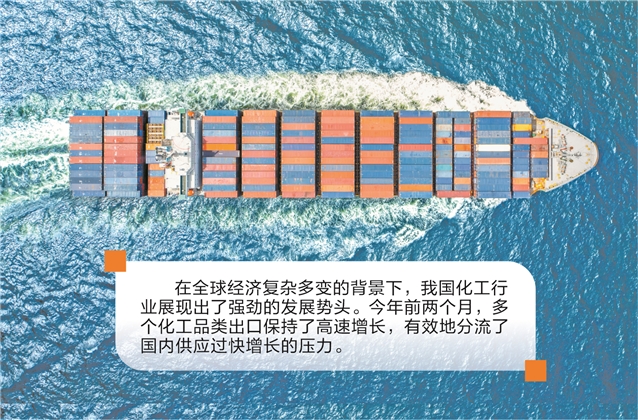
Since the beginning of this year, against the backdrop of complex and volatile global economy, China's chemical industry has shown strong development momentum. In the first two months of this year, exports of multiple chemical categories including TDI, BOPET, refrigerants, titanium dioxide, etc. maintained high-speed growth, effectively diverting the pressure of rapid domestic supply growth.
According to the monitoring of Zhuochuang Information, in February 2025, the total export volume of major petrochemical products increased by 1.97% month on month and 15.24% year-on-year. Among them, the export volume of multiple products has surged, such as the export volume of styrene, which increased by 1327% month on month, and the export volume of ethyl acetate, which increased by 82% month on month.
In addition, among the 62 major petrochemical products monitored by Zhuochuang Information, 47% of the products had a high export volume of over 70% in February, indicating that the export volume of petrochemical products is still at a relatively high level in the past five years.
In February of this year, domestic supply was abundant but demand was average, while overseas demand improved, opening up an export arbitrage window and driving an increase in product export volume, "analyzed Ma Yingjun.