




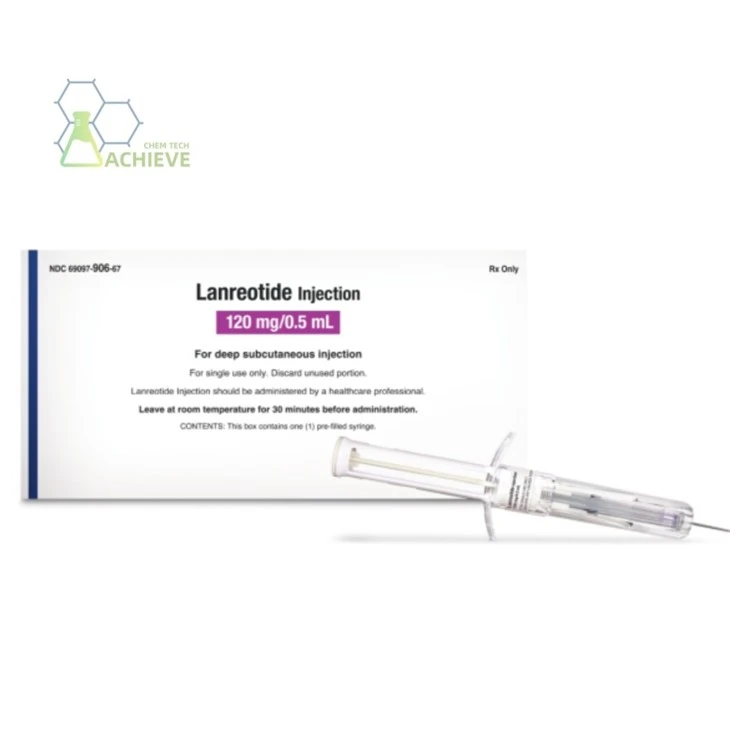

Shaanxi BLOOM Tech Co., Ltd. is one of the most experienced manufacturers and suppliers of lanreotide injection in China. Welcome to wholesale bulk high quality lanreotide injection for sale here from our factory. Good service and reasonable price are available.
Lanreotide injection is a synthetic long-acting somatostatin analogue, primarily indicated for acromegaly and associated syndromes triggered by neuroendocrine tumors. Its active ingredient lanreotide binds specifically to somatostatin receptors, predominantly the SSTR2 and SSTR5 subtypes. This interaction potently suppresses the secretion of growth hormone (GH) and insulin-like growth factor-1 (IGF-1), so as to effectively slow down disease progression in acromegaly patients.
This pharmaceutical product is available in two major formulations: sustained-release microsphere powder and long-acting hydrogel injection. The sustained-release microsphere powder is supplied in 30 mg and 40 mg strengths. The long-acting hydrogel injection, namely Somadulin® ATG, comes in a convenient pre-filled pen, with specifications of 60mg/0.2ml, 90mg/0.3ml and 120mg/0.5ml. Leveraging advanced self-assembled nanotube technology, this formulation enables steady and prolonged drug release. Its maximum dosing interval can reach 56 days, which greatly eases medication schedules and enhances patient treatment adherence.
Our Product Forms


lanreotide COA
 |
||
| Certificate of Analysis | ||
| Compound name | Lanreotide | |
| Grade | Pharmaceutical grade | |
| CAS No. | 108736-35-2 | |
| Quantity | Customized | |
| Packaging standard | Customized | |
| Manufacturer | Shaanxi BLOOM TECH Co., Ltd | |
| Lot No. | 202601090055 | |
| MFG | Jan 9th 2026 | |
| EXP | Jan 8th 2029 | |
| Structure |
|
|
| Item | Enterprise standard | Analysis result |
| Appearance | White or almost white powder | Conformed |
| Water content | ≤5.0% | 0.48% |
| Loss on drying | ≤1.0% | 0.30% |
| Heavy Metals | Pb≤0.5ppm | N.D. |
| As≤0.5ppm | N.D. | |
| Hg≤0.5ppm | N.D. | |
| Cd≤0.5ppm | N.D. | |
| Purity (HPLC) | ≥99.0% | 99.90% |
| Single impurity | <0.8% | 0.56% |
| Total microbial count | ≤750cfu/g | 170 |
| E. Coli | ≤2MPN/g | N.D. |
| Salmonella | N.D. | N.D. |
| Ethanol (by GC) | ≤5000ppm | 400ppm |
| Storage | Store in a sealed, dark, and dry place below -20°C | |
|
|
||
|
|
||


| Chemical Formula: | C54H69N11O10S2 |
| Exact Mass: | 1095 |
| Molecular Weight: | 1096 |
| m/z: | 1095 (100.0%), 1096 (58.4%), 1097 (16.7%), 1097 (9.0%), 1098 (5.3%), 1096 (4.1%), 1098 (3.1%), 1097 (2.4%), 1097 (2.1%), 1096 (1.6%), 1099 (1.5%), 1098 (1.2%) |
| Elemental Analysis: | C, 59.16; H, 6.34; N, 14.05; O, 14.59; S, 5.85 |
Gastrointestinal pancreatic neuroendocrine tumors (GEP NETs) are a rare type of tumor originating from the gastrointestinal tract or pancreas, accounting for approximately 55% -70% of all neuroendocrine tumors. In China, its incidence rate is 114/100000, and it takes an average of 4.8 years for patients to be diagnosed. Lanreotide injection as a long-acting somatostatin analog, plays an important role in the treatment of GEP NETs.
As a first-line treatment drug
Multiple clinical studies have confirmed its significant effect in prolonging progression free survival (PFS) in patients with GEP NETs. For example, in the CLARINET trial, 204 patients with unresectable, highly or moderately differentiated, locally advanced, or metastatic GEP NETs were included, of which 55% were primary extrapancreatic. These patients were divided into a substance treatment group and a placebo control group, with this group receiving subcutaneous injections of 120mg of lanreotide every 28 days. The results showed that the median progression free survival of patients in this group exceeded 22 months, while the placebo group had only 16.6 months, with a hazard ratio (HR) of 0.47 (95% CI 0.30-0.73, P<0.001, log rank test).


Indicating that lanrelitide can significantly reduce the risk of disease progression.The research results were published in relevant medical journals, providing important evidence for its use as a first-line treatment for GEP NETs.In China, relevant clinical studies have also been conducted on Yipusheng's sustained-release acetate lanrelitide injection (pre filled).The results of its Phase III clinical study showed that the product can significantly prolong the progression free survival of patients by 38.5 months and reduce the risk of disease recurrence by 53%. This data further demonstrates its effectiveness and advantages in Chinese GEP NETs patients, and as a result, the product has been unanimously recommended as an SSA treatment drug by the European Society of Neuroendocrine Oncology (ENETS) and authoritative guidelines in China.
In addition to monotherapy, its combination with other drugs has also brought new treatment hope for GEP NETs patients. The JCOG1901 (STARTER-NET) study, presented at the American Society of Clinical Oncology Gastrointestinal Oncology Symposium 2025 (ASCO GI 2025), is a phase III study on the combination of everolimus and lenteride with everolimus monotherapy for unresectable or recurrent GEP-NET. This study included patients with well differentiated (Grade 1/2), non functional GEP-NET, and poor prognostic factors (Ki-67 marker index of 5-20% or presence of diffuse liver metastasis).


Patients were randomly assigned in a 1:1 ratio to either the everolimus monotherapy group (EVE, 10 mg/day) or the everolimus combined with lenvatinib group (EVE+LAN, 120 mg every 28 days).The research results showed that the median PFS of the everolimus monotherapy group was 11.5 months, while the median PFS of the combination therapy group was prolonged to 29.7 months (HR=0.38; 99.91% CI: 0.15-0.96, P=0.00017, significantly lower than the preset significance level of 0.00046, using stratified log rank test). In terms of objective response rate (ORR), the everolimus monotherapy group had an ORR of 8.7% (6/69), while the combination therapy group had an ORR of 26.8% (19/71).In terms of disease control rate (DCR), the monotherapy group with everolimus had a rate of 87.0% (60/69).
While the combination therapy group had a rate of 91.5% (65/71). Although the combination therapy group had a higher incidence of hematological and non hematological toxicity than the monotherapy group.No treatment-related deaths were observed, and overall safety was controllable.Based on the above efficacy results, the Data and Safety Monitoring Committee (DSMC) recommends early termination of the study, indicating that the combination of everolimus and lenteride may become a new first-line treatment standard for well differentiated GEP-NET patients with adverse prognostic factors.

Used for the treatment of specific types of GEP NET

1. Non resectable or metastatic tumors
For patients with unresectable or metastatic GEP NETs, lanreotide injection is an important treatment option. Due to the fact that tumors in these patients cannot be surgically removed and may have already spread to other areas, traditional treatment methods often have limited effectiveness.
By competitively blocking somatostatin receptors, the growth and proliferation of tumor cells are inhibited, thereby controlling the progression of the disease.For example, in both the CLARINET trial mentioned above and the phase III clinical study in China, a large number of unresectable or metastatic GEP NETs patients were included, and the research results showed that they could significantly prolong the progression free survival of these patients and improve their prognosis.
2. Tumors with different degrees of differentiation
Suitable for GEP NETs patients with different degrees of differentiation.


Both highly differentiated and moderately differentiated GEP NETs can exert certain therapeutic effects.In highly differentiated GEP NETs, tumor cells grow relatively slowly but still have the ability to invade and metastasize.By inhibiting the secretion function of tumor cells, the occurrence of hormone related symptoms can be reduced, and the proliferation of tumor cells can be inhibited to prolong the survival of patients.
For moderately differentiated GEP NETs, although the malignancy of tumor cells is relatively high, they can also control the progression of the disease to a certain extent and improve the quality of life of patients.

The application of lanreotide injection in the treatment of gastrointestinal pancreatic neuroendocrine tumors (GEP NETs) is mainly based on multiple international multicenter randomized controlled trials (RCTs) and clinical studies, which provide scientific basis for its efficacy and safety
Research significance: The CLARINET trial is the first large-scale phase III study to confirm its significant ability to prolong PFS in patients with GEP NETs, providing key evidence for lanrelitide as a first-line treatment for GEP NETs. The research results were published in the New England Journal of Medicine (N Engl J Med, 2014).
Research significance: This study confirms for the first time that the combination of everolimus and lanreotide can significantly prolong the progression free survival (PFS) of well differentiated GEP NETs patients with poor prognostic factors, and the safety is controllable, providing a new strategy for combination therapy. The research results will be reported at the American Society of Clinical Oncology Gastrointestinal Oncology Symposium 2025 (ASCO GI 2025).
Research significance: This study confirms that for chemotherapy or targeted therapy with relatively high toxicity, maintenance therapy with lanreotide after stable efficacy can prolong patient PFS and reduce adverse drug reactions. The research results were reported at the 2021 European Neuroendocrine Annual Meeting (ENETS).
Research significance: This study provides a new option for the treatment strategy of advanced pancreatic and midgut NET patients after standard dose treatment. The research results were reported at the 2021 European Neuroendocrine Annual Meeting (ENETS).

References
Caplin ME,Pavel M,Qiwikła JB, Wait. The application of lanreotide in metastatic neuroendocrine tumors of the intestine and pancreas [J]. New England Journal of Medicine, 2014371 (3): 224-233.
Wang Ying, Li Hanzhong. Clinical Application Progress of Lanrui Peptide in Neuroendocrine Tumors [J]. Chinese Journal of Endocrinology and Metabolism, 2020, 36 (5): 441-445
Ai, Wu, Li, etc. Evaluation of the efficacy and safety of lanreotide/autogenous bone in the treatment of carcinoid syndrome (ELECT): a randomized, double-blind, placebo-controlled trial [J]. Endocrine Practice, 2016, 22 (9): 1068-1080.
Efficacy and safety of lanreotide autogel compared with lanreotide 40 mg prolonged release in Chinese patients with active acromegaly: results from a phase 3, prospective, randomized, and open-label study (LANTERN)(https://pmc.ncbi.nlm.nih.gov/articles/PMC7199333/)
Efficacy of lanreotide Autogel® administered every 4–8 weeks in patients with acromegaly previously responsive to lanreotide microparticles 30 mg: a phase III trial(https://pmc.ncbi.nlm.nih.gov/articles/PMC1618957/)
FAQ
What does the drug lanreotide do?
Ipstyl is prescribed for the long-term management of acromegaly, a chronic endocrine disorder characterized by excessive growth hormone production. It is primarily intended for patients who are not eligible for surgical intervention or radiotherapy as standard treatment options. As a therapeutic agent targeting this condition, it functions by effectively curbing the overproduction of growth hormone in the human body. By regulating hormone levels to a normal range, the medication helps alleviate disease-related symptoms and slow the progression of acromegaly over the long term.
Can lanreotide shrink tumors?
PRIMARYS showed that primary treatment with Ipstyl 120 mg every 28 days provides clinically significant reductions (≥20%) in tumor volume in 62.9% of patients at 1 year.
Are octreotide and lanreotide the same thing?
There exist distinct differences in the FDA-approved clinical indications between the two agents. Octreotide, marketed under the brand name Sandostatin, is officially authorized to relieve the clinical symptoms associated with carcinoid syndrome and VIPoma. In contrast, Ipstyl gains regulatory approval primarily for suppressing tumor progression itself. From a clinical perspective, having multiple therapeutic alternatives delivers greater flexibility for individualized treatment plans. For patients who have achieved stable and satisfactory outcomes with Sandostatin, it is advisable to stick with the current regimen rather than making unnecessary switches. Maintaining the proven treatment helps avoid potential fluctuations in efficacy or unexpected adverse reactions brought by medication replacement.
Does lanreotide affect the liver?
This study shows that 120 weeks of treatment with ipstyl in ADPKD patients with large livers results in a significant decrease in liver volume growth compared with the standard of care. The beneficial effect is still present 4 months after cessation of treatment.
Hot Tags: lanreotide injection, suppliers, manufacturers, factory, wholesale, buy, price, bulk, for sale