




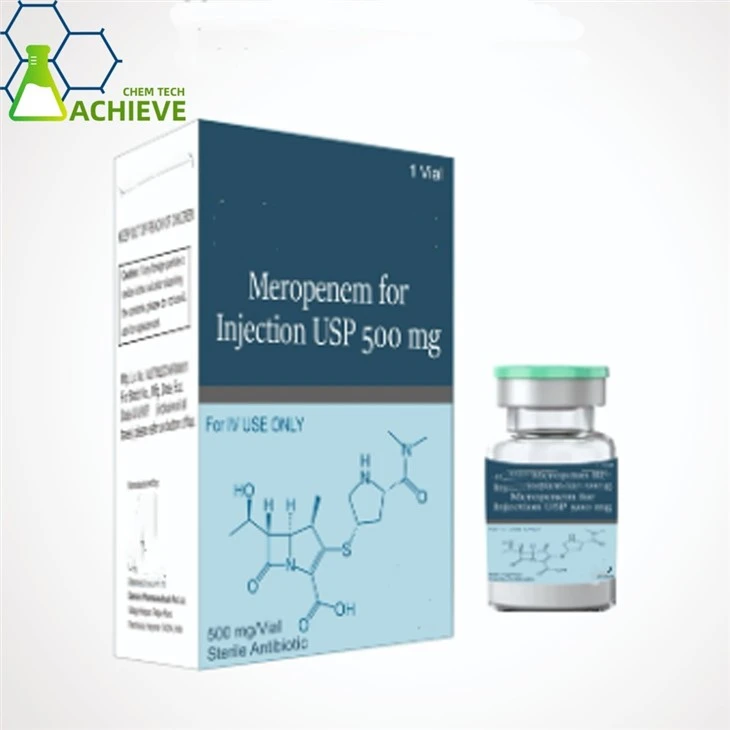


Shaanxi BLOOM Tech Co., Ltd. is one of the most experienced manufacturers and suppliers of meropenem injection 1000mg in China. Welcome to wholesale bulk high quality meropenem injection 1000mg for sale here from our factory. Good service and reasonable price are available.
Meropenem Injection 1000mg belongs to the carbapenem class of antibiotics, and its active ingredient is meropenem. Its chemical structure is a 1- β - methylcarbapenem bicyclic nucleus, which enhances its antibacterial activity against gram-negative bacteria and stability against β - lactases through side chain modification. The drug is provided in sterile powder form, with each bottle containing meropenem trihydrate (equivalent to 1000 milligrams of anhydrous meropenem) and a buffering agent (such as sodium carbonate).
It needs to be dissolved in sterile injection water or physiological saline before intravenous injection or drip. Carbapenem antibiotics are a subclass of beta lactam antibiotics, known as the "last line of defense" among antibiotics due to their extensive coverage of Gram positive bacteria, Gram negative bacteria (including ESBLs producing strains), and anaerobic bacteria. Meropenem, as a representative of second-generation carbapenems, is more stable against renal dehydropeptidase I (DHP-I) compared to the first generation imipenem, does not require the use of combined enzyme inhibitors, and has lower central nervous system toxicity.
Our products



Additional information of chemical compound:

|
|
|


Meropenem COA

Meropenem Injection 1000mg is the "ceiling" of aseptic production: the ultimate pursuit of non terminal sterilization process:
In the field of severe infection treatment, the carbapenem antibiotic Meropenem has become the core weapon against multidrug-resistant bacteria due to its broad-spectrum antibacterial activity and unique bactericidal mechanism. Among them, Meropenem, as a representative product of non terminal sterilization process, has raised the level of sterility assurance (SAL) to the industry benchmark through strict aseptic production process, precise environmental control and process validation, becoming the "ceiling" of aseptic formulation production.
Non terminal sterilization process: the "high difficulty challenge" of aseptic production
Aseptic Processing refers to the use of aseptic techniques to eliminate the risk of microbial contamination throughout the entire pharmaceutical production process, without the final product undergoing terminal sterilization steps. Compared with terminal sterilization processes (such as wet heat sterilization), non terminal sterilization processes have more stringent requirements for production environment, equipment, personnel, and materials. Its core lies in achieving product sterility through "full process aseptic control" rather than relying on the "final guarantee" of the sterilization process.


Meropenem Injection adopts non terminal sterilization process, mainly based on the following considerations:Drug stability limitations: Meropenem Injection 1000mg is prone to decomposition under high temperature or radiation conditions, and terminal sterilization may lead to degradation of active ingredients, affecting efficacy;
Urgent clinical needs: Patients with severe infections require rapid drug administration, and non terminal sterilization processes can shorten production cycles to ensure timely drug supply.
Advantages of process controllability: Through precise environmental control and operational standards, non terminal sterilization processes can achieve a sterility assurance level equivalent to terminal sterilization processes (SAL ≤ 10 ⁻ ³), while avoiding loss of drug activity.

Sterility Assurance Level (SAL): The 'gold standard' for measuring processes

SAL is a core indicator for evaluating the effectiveness of sterilization processes, representing the probability of microbial survival after sterilization of the product. International standards stipulate that:
The SAL of terminal sterilization process should be ≤ 10 ⁻⁶ (parts per million);
The SAL for non terminal sterilization processes should be ≤ 10 ⁻ ³ (one thousandth).Although the SAL value of non terminal sterilization processes is relatively high, they can achieve practical sterility assurance comparable to terminal sterilization processes through strict aseptic operations and environmental control. For example, the production workshop of Meropenem Injection 1000mg needs to meet ISO Level 5 (Class 100) cleanliness standards, and operators need to wear sterile clothing, gloves, and masks, and enter the production area through an airlock system to minimize the risk of microbial contamination.
Production process: "sterile closed-loop" from raw materials to finished products
The Meropenem Injection 1000mg non terminal sterilization process includes five major steps: raw material processing, liquid preparation, filling, sealing, and packaging. Each step must be completed in a sterile environment and multiple verifications must be conducted to ensure process reliability.
Raw material processing: "strict screening" of sterile starting points
Raw material procurement: Meropenem raw materials must comply with the standards of the Chinese Pharmacopoeia or the European Pharmacopoeia, and suppliers must provide microbiological contamination control data.


Pre treatment
The raw materials are crushed and mixed in an ISO Class 7 (Class 10000) clean area, and potential microorganisms are removed through sterilization filtration (0.22 μ m filter membrane);Aseptic testing: Microbial limit testing is required for each batch of raw materials to ensure that the total bacterial count is ≤ 10 CFU/g and no pathogenic bacteria are detected.
Solution Preparation: Precise Control of Aseptic Environment
Solvent selection: Use sterile injection water or 0.9% sodium chloride solution as the solvent, which needs to be sterilized at 121 ℃ for 15 minutes;
Liquid preparation environment: The liquid preparation tank is located in an ISO Class 5 clean area and maintains positive pressure through a laminar flow system to prevent external microbial invasion;


Mixing process
using magnetic stirring or circulating pump mixing to avoid particle pollution caused by mechanical stirring;
Online detection: Real time monitoring of pH value, osmotic pressure, and clarity during the preparation process to ensure that the quality of the medication meets the standards.
Filling and sealing: the "core link" of aseptic operation
Filling equipment: Using a fully automatic sterile filling machine, the operating area is isolated through RABS (Restricted Access Barrier System) to reduce personnel intervention;
Filling accuracy: The single dose error should be controlled within ± 5% to ensure the accuracy of clinical medication;


Sealing process:
aluminum-plastic composite caps or foldable ampoules are used for sealing, and leakage detection is required after sealing to ensure the integrity of the container;
Environmental monitoring: The filling area needs to be continuously monitored for microorganisms (settling bacteria ≤ 1 CFU/dish · 4h) and particles (≥ 0.5 μ m particles ≤ 3500 particles/m ³).
Packaging and Storage:
The "Last Line of Defense" for Aseptic Assurance
Packaging materials: Use low-density polyethylene (LDPE) or polypropylene (PP) bottles, and the bottle body needs to be sterilized with ethylene oxide;
Labels and instructions: Using aseptic printing technology to avoid ink microbial contamination;
Storage conditions: The finished product should be stored in a dark environment below 25 ℃ to prevent drug degradation or microbial growth.

Quality Control: "Full Chain Management" from Process Validation to Continuous Monitoring
The quality control of non terminal sterilization processes needs to be integrated throughout the entire production process, ensuring product sterility and quality stability through process validation, environmental monitoring, and stability studies.
Process Validation: Scientific Basis for Aseptic Assurance
Culture medium filling test: Simulate actual production conditions, fill sterile culture medium into containers, and check for microbial contamination after incubation. The process validation of Meropenem Injection requires three consecutive batches of medium filling tests with zero contamination before the process can be deemed qualified;Thermal distribution and penetration test: Verify the temperature uniformity and sterilization effect of sterilization equipment (such as dry heat sterilization cabinets) to ensure the sterility of auxiliary materials and packaging materials;


Environmental Monitoring: Real time Protection of Aseptic Production
Air monitoring: using particle counters and settling petri dishes to monitor the levels of particles and microorganisms in the production area;
Surface monitoring: Regularly wipe and sample the equipment surface, operating platform, and personnel gloves with cotton swabs to detect microbial contamination;
Personnel monitoring: Operators need to perform hand disinfection and changing test before entering the clean area to ensure the standardization of aseptic operation.
Stability Study: Long term Commitment to Drug Quality
Accelerated test: Place at 40 ℃ and 75% humidity for 6 months to detect changes in drug content, related substances, and sterility;
Long term experiment: Place the drug at 25 ℃ and 60% humidity for 24 months, regularly test the quality of the drug, and determine the expiration date;
Light test: Place the drug under 4500l X-ray conditions for 10 days to evaluate its sensitivity to light and provide a basis for packaging design.

Clinical significance: the "life line of defense" for severe infections
The Meropenem Injection non terminal sterilization process provides a safe and effective treatment option for critically ill infected patients through strict aseptic control and quality assurance.

Indications coverage: the "nemesis" of multidrug-resistant bacteria
Respiratory system infections, such as hospital acquired pneumonia and ventilator-associated pneumonia (VAP), have an effective rate of over 85% against drug-resistant bacteria such as Pseudomonas aeruginosa and Klebsiella pneumoniae;
Abdominal infection: such as complex peritonitis and liver abscess, combined with metronidazole can cover anaerobic bacteria and increase the cure rate to 90%;Central nervous system infections, such as meningitis, can maintain cerebrospinal fluid concentration at 2-3 times the MIC by extending the infusion time (3 hours), significantly reducing mortality.


Medication Plan Optimization: Precise Regulation of Time Dependent Sterilization
Conventional dose: 1g administered every 8 hours via intravenous drip, suitable for most hospital acquired infections;
Severe dose: 1g administered every 6 hours or continuously pumped (2-4mg/kg/h), suitable for sepsis or septic shock;
Special population: Patients with renal insufficiency need to adjust their dosage according to creatinine clearance rate to avoid drug accumulation and epilepsy.


Drug resistance prevention and control
Combination therapy: When used in combination with aminoglycosides (such as amikacin) or fluoroquinolones (such as ciprofloxacin), it can prolong the after effect (PAE) and reduce the selection pressure of drug-resistant mutant strains;
Course control: Depending on the site of infection and the type of pathogen, the course of treatment is usually 7-14 days to avoid long-term monotherapy leading to drug resistance;
Monitoring and feedback: Regularly conduct pathogen resistance monitoring and adjust empirical treatment plans in a timely manner.

Frequently Asked Questions
1.What is meropenem injection used for?
Meropenem injection is used to treat skin and abdominal (stomach area) infections caused by bacteria and meningitis (infection of the membranes that surround the brain and spinal cord) in adults and children 3 months of age and older. Meropenem injection is in a class of medications called antibiotics.
2.How long should meropenem be given?
aeruginosa, a dose of 1 gram every 8 hours is recommended. MERREM IV should be administered by intravenous infusion over approximately 15 minutes to 30 minutes. Doses of 1 gram may also be administered as an intravenous bolus injection (5 mL to 20 mL) over approximately 3 minutes to 5 minutes.
3.Does meropenem cause dizziness?
Central nervous system effects are also reported with Meropenem use. Some patients may experience headache, dizziness, or confusion. More serious neurological side effects include seizures and encephalopathy, particularly in patients with renal impairment or those receiving high doses of the drug.
4.Is meropenem a safe antibiotic?
Among antibiotic drugs, meropenem is relatively safe. The most common adverse effects are diarrhea (4.8%), nausea and vomiting (3.6%), injection-site inflammation (2.4%), headache (2.3%), rash (1.9%) and thrombophlebitis (0.9%).
Hot Tags: meropenem injection 1000mg, suppliers, manufacturers, factory, wholesale, buy, price, bulk, for sale