


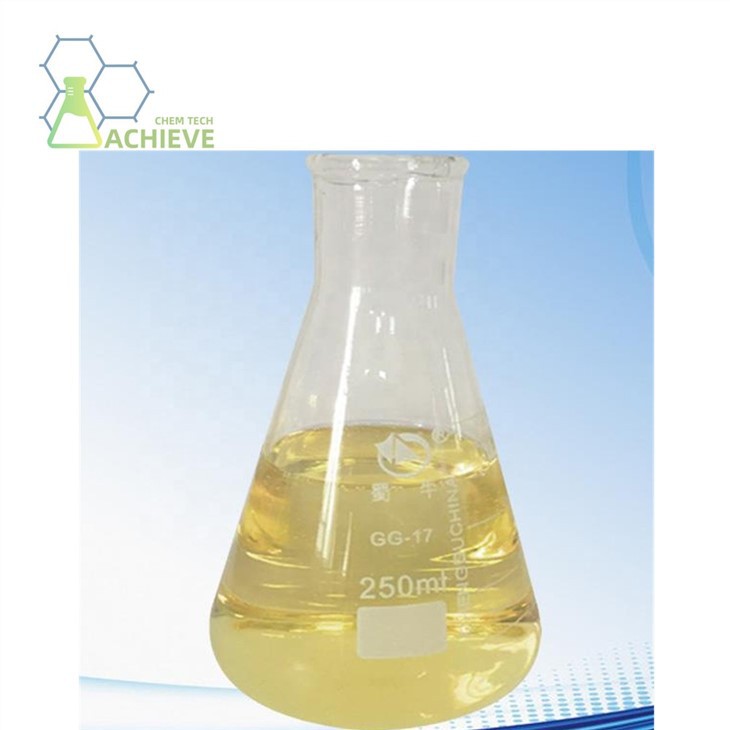
Shaanxi BLOOM Tech Co., Ltd. is one of the most experienced manufacturers and suppliers of span 80a cas 1338-43-8 in China. Welcome to wholesale bulk high quality span 80a cas 1338-43-8 for sale here from our factory. Good service and reasonable price are available.
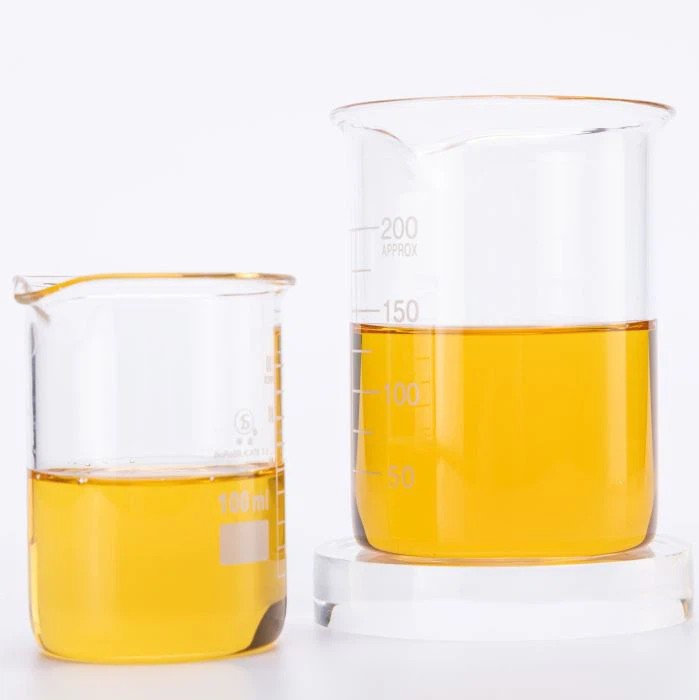
Span 80A is a yellow oily liquid, soluble in oil and organic solvents, and dispersed in water as a semi-emulsion liquid. It can be dispersed in warm water and ethanol, dissolved in organic solvents such as propylene glycol, liquid paraffin, ethanol, methanol or ethyl acetate, HLB=4.3, and is often used as emulsifier of water-in-oil emulsion. This product is mainly used as solubilizer or emulsifier for injection and oral liquid; Dispersant for capsule; Emulsifier and matrix for ointment; Matrix for suppository, etc. It is used as emulsifier in food industry.

|
|
|
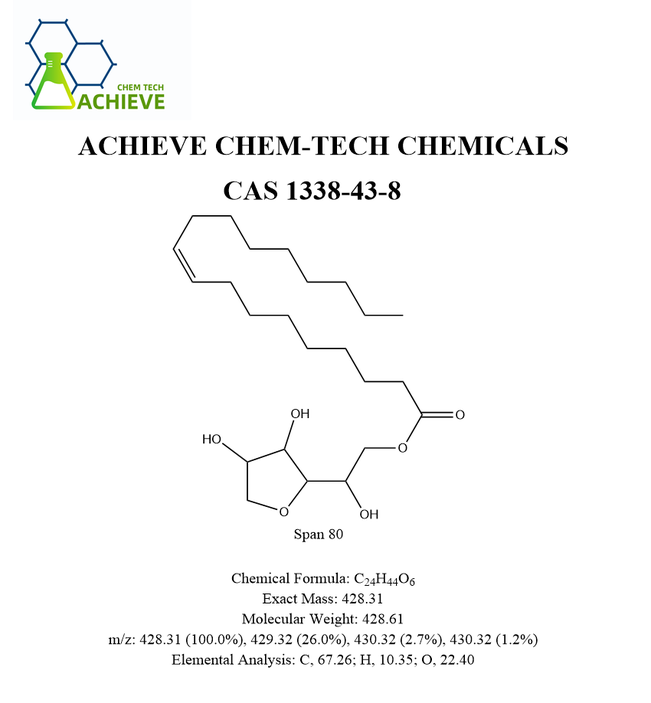
| Chemical Formula | C24H44O6 |
| Exact Mass | 428.31 |
| Molecular Weight | 428.61 |
| m/z | 428.31 (100.0%), 429.32 (26.0%), 430.32 (2.7%), 430.32 (1.2%) |
| Elemental Analysis | C, 67.26; H, 10.35; O, 22.40 |

Food Industry:
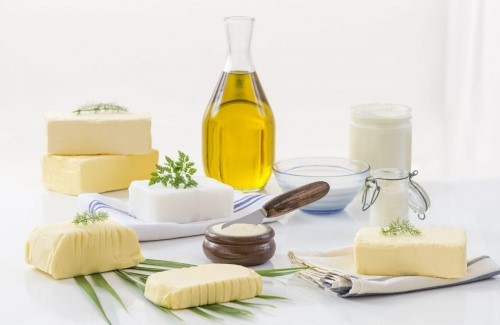
Emulsifier: Span 80 is used to stabilize emulsions in food products such as mayonnaise, salad dressings, and sauces. It helps to prevent the separation of oil and water phases, ensuring a uniform texture and consistency.
Dispersant: It aids in the dispersion of solid particles in liquids, making it useful in the production of beverages, baked goods, and confectionery items.
Cosmetics and Personal Care Products:
Emulsifier: Span 80 is used to create stable emulsions in creams, lotions, and other cosmetic formulations. It helps to mix oil-based ingredients with water-based ingredients, ensuring a smooth and consistent texture.
Wetting Agent: It improves the spreadability and absorption of cosmetic products on the skin.
Pharmaceuticals:
Emulsifier: Span 80 is used in the formulation of emulsions and suspensions for oral and topical medications. It helps to ensure the uniform distribution of active ingredients in the formulation.
Solubilizer: It can be used to enhance the solubility of poorly soluble drugs, improving their bioavailability.
Agricultural Chemicals:
Emulsifier: Span 80 is used in the formulation of pesticides, herbicides, and fungicides. It helps to create stable emulsions and suspensions, ensuring even distribution of the active ingredients when sprayed on crops.
Wetting Agent: It improves the wetting and spreading of agricultural chemicals on plant surfaces, enhancing their effectiveness.
Textile Industry:
Dyeing and Finishing: Span 80 is used as a dispersing agent for dyes and pigments, ensuring even coloration and finishing of textiles.
Scouring and Cleaning: It aids in the removal of oils, waxes, and other impurities from textile fibers during the scouring process.
Oil and Gas Industry:
Emulsifier: Span 80 is used in the formulation of drilling fluids and completion fluids. It helps to stabilize emulsions and suspensions, preventing the separation of oil and water phases.
Corrosion Inhibitor: It can be used to form protective films on metal surfaces, reducing corrosion in oil and gas equipment.
Chemical Industry:
Emulsifier: Span 80 is used in the production of various chemical emulsions and suspensions, such as waxes, polymers, and resins.
Dispersant: It aids in the dispersion of solid particles in liquids, making it useful in the production of paints, inks, and coatings.
|
|
|

If span 80A is indeed a variant of Span 80, it may have similar or enhanced properties, making it suitable for the same or additional applications. For example, it may offer improved emulsifying, dispersing, or wetting properties, making it more effective in certain formulations or processes.

synthesis of span 80A
Preparation
Raw material dehydration: put sorbitol (88kg) into the reaction kettle for decompression dehydration.
Add catalyst: after dehydration, press in refined oleic acid (130kg) and appropriate amount of sodium hydroxide (used as catalyst).
Reaction: start stirring, vacuumize, slowly raise the temperature, keep the reaction at 200~210 ℃, and the reaction time is about 6 hours.
Acid value measurement: take out the sample and measure the acid value. When the acid value is 6-7mgKOH/g, the esterification reaction is completed.
Cooling: cool down and place for 24 hours. After finishing, it is divided into upper and lower layers. The lower layer is black colloidal substance, which is separated and discarded. Put the upper clarification hydraulic pressure into the decolorizing kettle, heat it to about 65 ℃, decolorize it with activated carbon, and decolorize it at 80~85 ℃ for 1 hour.
Filtration: the filtrate is dehydrated under vacuum for 5 hours. After the above steps, the pan 80 can be prepared.
In the laboratory, the synthesis of span 80A requires the preparation of the following materials and equipment:
Methanol (CH3OH): As the starting material, the methanol used for synthesizing span 80 A should be of analytical purity to ensure the purity and quality of the product.
P-toluenesulfonic acid (p-TsOH): As a catalyst, it promotes the polymerization reaction of methanol and styrene.
Styrene: As a monomer in the polymerization reaction, it undergoes a polymerization reaction with methanol.
Sodium hydroxide (NaOH): used to neutralize p-toluenesulfonic acid for subsequent treatment.
Experimental grade solvents: such as ether, ethanol, etc., used for extracting and purifying products.
Thermometer: used to monitor reaction temperature.
Agitator: used for mixing and stirring reactants.
Condenser: used to collect volatile substances generated during the reaction process.
Vacuum pump: used to reduce the pressure of the reaction system and promote reaction progress.
experimental steps
Mix methanol and styrene in a 1:1 ratio, and add an appropriate amount of p-toluenesulfonic acid as a catalyst. The amount of catalyst is usually 0.5% to 1% of the total amount of methanol and styrene.
Heat the mixture to reflux temperature (approximately 100 ℃) and continue stirring to promote polymerization reaction. At this point, the water and methanol in the reaction system will gradually evaporate and be collected through the condenser.
After the water and methanol in the reaction system have evaporated completely, stop heating and stirring, and let the reaction system naturally cool to room temperature.
Add an appropriate amount of sodium hydroxide solution to the cooled reaction system to neutralize the remaining p-toluenesulfonic acid. Then, extract the product using experimental grade solvents.
Filter and dry the extracted product to obtain the crude product. At this point, the crude product may contain unreacted impurities such as methanol, styrene, and p-toluenesulfonic acid.
Separate the crude product by column chromatography to further purify pan 80A. Column chromatography is a commonly used separation method that can achieve separation through the distribution coefficients of different substances between the stationary and mobile phases. In the column chromatography process, experimental grade solvent is used as the mobile phase to elute impurities from the crude product, and then another experimental grade solvent is used as the mobile phase to elute pan 80A from the column.
Collect the eluted pan 80A solution, evaporate and dry it to obtain high-purity pan 80A.
Span 80A, also known as Sorbitan Monooleate, is a non-ionic surfactant widely used in various industries due to its emulsifying, dispersing, and wetting properties. It belongs to the Span series of sorbitan esters, which are derived from sorbitol and fatty acids, in this case, oleic acid. It is particularly valued for its effectiveness in creating stable water-in-oil emulsions, making it a staple in formulations where oil-based systems are required.
One of the primary applications is in the food industry, where it serves as an emulsifier in products like baked goods, dairy items, and confectionery. Its ability to improve texture and shelf life by preventing separation of ingredients makes it indispensable in many recipes. Additionally, it is used in cosmetics and personal care products, such as creams, lotions, and hair care formulations, where it helps to blend oil and water phases smoothly, enhancing product stability and feel.
In the pharmaceutical sector, it plays a crucial role in drug delivery systems, particularly in the formulation of emulsions and suspensions. It aids in improving the solubility and bioavailability of poorly water-soluble drugs, thereby enhancing their therapeutic efficacy. Its non-ionic nature makes it compatible with a wide range of active ingredients, reducing the risk of interactions that could affect drug performance.
Beyond these applications, it is also utilized in agrochemicals, where it acts as a wetting agent and dispersant, improving the spread and coverage of pesticides and fertilizers on plant surfaces. Its low toxicity and biodegradability further contribute to its appeal in environmentally conscious formulations.
Overall, the versatile properties and broad compatibility make it a valuable ingredient across multiple industries. Its role in enhancing product stability, texture, and performance underscores its importance in both everyday consumer products and specialized applications. As industries continue to seek effective and sustainable solutions, it remains a key player in formulation chemistry.
adverse reaction
Span 80A (chemical name sorbitan monooleate) is a widely used non-ionic surfactant, belonging to the category of dehydrated sorbitan fatty acid esters. Its molecular structure is composed of sorbitan and oleic acid connected by ester bonds, and it has good emulsifying, dispersing, and stabilizing properties. It is widely used in food, cosmetics, pharmaceuticals, and industrial fields. Although Span 80A is considered a relatively safe compound, it may cause adverse reactions under specific conditions.
Skin irritation&eye irritation
Animal experimental data
The skin irritation test on rabbits showed that Span 80A can cause mild erythema and edema under closed patch conditions of 500 mg/24 hours. According to the scoring criteria of the "Technical Specification for Safety of Cosmetics" (2021 edition), a score of ≤ 1.0 for erythema or edema is considered non irritating, 1.0-2.0 for mild irritation, 2.0-3.0 for moderate irritation, and ≥ 3.0 for severe irritation. The test results of Span 80A met the criteria for mild irritation, but the symptoms were completely relieved within 72 hours without leaving scars or pigmentation.
Human exposure cases
Among the occupational exposure population, workers who have been exposed to Span 80A for a long time may occasionally experience dry and flaky skin, but severe dermatitis is rare. In the application of cosmetics, individual consumers reported that they experienced a temporary burning sensation after using lotion containing Span 80A, but there was no systemic allergic reaction.
Animal experimental data
The rabbit eye stimulation test showed that 0.1 mL Span 80A liquid dripped into the rabbit eye caused conjunctival congestion, edema, and tearing, but no corneal opacity or iris damage was observed. According to the Draize test scoring criteria, the eye irritation score of Span 80A is 8/110 (total score 110, ≥ 55 is severe irritation), which belongs to mild eye irritant substances.
Human exposure cases
In industrial accidents, Span 80A solution splashing into the eyes may cause temporary blurred vision and foreign body sensation, but symptoms usually improve within 24 hours after rinsing. No cases of permanent eye damage or vision loss have been reported.
Hot Tags: span 80a cas 1338-43-8, suppliers, manufacturers, factory, wholesale, buy, price, bulk, for sale, Hinokitiol powder, Pamoic acid, s allyl l cysteine, 5 hydroxymethylfurfural synthesis, spermidine powder