


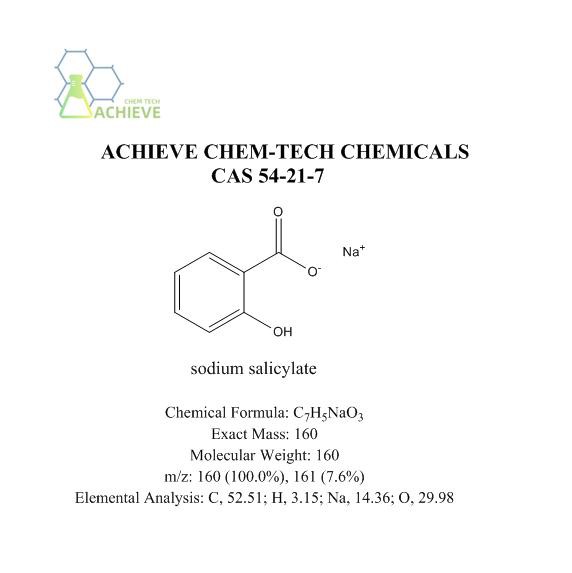


Shaanxi BLOOM Tech Co., Ltd. is one of the most experienced manufacturers and suppliers of sodium salicylate powder cas 54-21-7 in China. Welcome to wholesale bulk high quality sodium salicylate powder cas 54-21-7 for sale here from our factory. Good service and reasonable price are available.
Sodium salicylate powder is an organic substance with the chemical formula of C7H5O3Na. It is white scale or powder, odorless, and turns pink in long exposure light. It turns pink in the long exposure light. Soluble in water and glycerin, insoluble in ether, chloroform, benzene and other organic solvents. Combustible in case of fire. Combustible in case of open fire and high heat. Its powder and air can form an explosive mixture. When it reaches a certain concentration, it will explode when encountering Mars. Toxic gas is released due to high thermal decomposition. It is mainly used for pain relievers and rheumatic drugs, and also used for organic synthesis. It can be obtained by neutralizing and crystallizing salicylic acid with alkali.

|
Chemical Formula |
C7H5NaO3 |
|
Exact Mass |
160 |
|
Molecular Weight |
160 |
|
m/z |
160 (100.0%), 161 (7.6%) |
|
Elemental Analysis |
C, 52.51; H, 3.15; Na, 14.36; O, 29.98 |
|
|
|


Sodium Salicylate, as a long-standing organic compound, has the chemical formula C ₇ H ₅ O ∝ Na, a molecular weight of 160.1, and a CAS number of 54-21-7. Its appearance is white scales or powder, odorless, and will turn pink when exposed to light for a long time. It is soluble in water and glycerol, but insoluble in organic solvents such as ether, chloroform, and benzene. With its unique chemical properties, sodium salicylate has demonstrated extensive application value in pharmaceuticals, industry, analytical testing, and emerging fields.
The core value of sodium salicylate lies in its antipyretic, analgesic, anti-inflammatory, and anti rheumatic effects. As a representative of nonsteroidal anti-inflammatory drugs (NSAIDs), its mechanism of action is similar to aspirin, which reduces prostaglandin synthesis by inhibiting cyclooxygenase (COX), thereby exerting its therapeutic effect.
1. Antipyretic and analgesic
Antipyretic: sodium salicylate can promote the heat dissipation process by acting on the hypothalamic temperature regulation center, and is suitable for fever caused by infectious diseases such as colds and influenza. However, it should be noted that it is contraindicated for children with viral infections and fever, which may lead to Reye's Syndrome, a serious disease characterized by acute encephalopathy and hepatic steatosis.


Analgesia: It has a relieving effect on physical pain such as headache, toothache, and muscle soreness, and its analgesic mechanism is related to the inhibition of peripheral pain sensitivity. For postoperative pain or traumatic pain, it is often used in combination with other analgesics to enhance efficacy and reduce adverse reactions.
2. Anti inflammatory and anti rheumatic
Chronic inflammatory diseases: commonly used in clinical practice to treat rheumatoid arthritis, osteoarthritis, etc., can alleviate joint swelling and pain, and improve joint function. Its anti-inflammatory effect is achieved by inhibiting the synthesis of inflammatory mediators such as prostaglandins and leukotrienes, thereby reducing the inflammatory response.
Rheumatic fever treatment: As a first-line treatment for rheumatic fever, sodium salicylate can significantly improve joint redness, swelling, and pain symptoms, and delay the progression of rheumatic heart damage.
During the treatment period, it is necessary to regularly monitor the blood drug concentration and maintain a treatment window of 50-100mg/dL. Excessive levels may cause salicylic acid reactions such as tinnitus and dizziness.
Other medicinal uses
Dermatological application: Used to treat keratinization disorders such as psoriasis and seborrheic dermatitis, by inhibiting epidermal cell proliferation.
Otology application: Occasionally used to prepare ear drops to alleviate inflammation of the external auditory canal, but contraindicated for patients with tympanic membrane perforation to avoid adverse reactions caused by medication entering the middle ear.
Cardiovascular field: Low dose use can inhibit platelet aggregation and prevent thrombosis, but the dosage needs to be strictly controlled to avoid the risk of bleeding.

Industry Applications: Practical Materials Across Fields

The use of sodium salicylate is not limited to the pharmaceutical field, but it also plays an important role in industries, analytical testing, and agriculture.
Industrial sector
Organic synthesis raw materials: Sodium salicylate is an important intermediate for synthesizing various organic compounds, such as methyl salicylate (wintergreen oil), phenyl salicylate (sunscreen), etc. It is widely used in the production of fragrances, dyes, and pharmaceutical intermediates.
Preservatives: Their antibacterial properties make them a preservative additive for food, cosmetics, and industrial products, which can extend product shelf life and prevent microbial contamination.
Metallurgical industry: Sodium salicylate is used as a drop analysis reagent in uranium ore extraction for microanalysis and determination of uranium dioxide, improving extraction efficiency.
Analysis and testing
Gastric acid analysis: Sodium salicylate can be used as a reagent for measuring free acids in gastric acid, quantitatively determining gastric acid concentration through chemical reactions, and assisting in the diagnosis of digestive system diseases.
Fluorescent powder composition: As a common vacuum ultraviolet fluorescent powder for detecting radiation and electrons, sodium salicylate has special applications in nuclear physics and electron microscopy.
In the agricultural field (although not directly applied with sodium salicylate, salicylic acid analogues provide reference)

Improvement of plant stress resistance: Salicylic acid (structurally similar to sodium salicylate) can enhance plant cold resistance, drought resistance, salt resistance, and heat resistance. For example, in cold environments, plants treated with salicylic acid can better maintain physiological metabolism and reduce the impact of freezing damage.
Disease resistance induction: Salicylic acid, as a signaling molecule, can activate plant defense mechanisms, induce the production of disease-related proteins (PR proteins) and phytohormones, and enhance resistance to pathogens.
Fruit preservation: Salicylic acid can reduce fruit respiration, inhibit ethylene production, delay aging and decay, and extend shelf life. For example, after treatment with salicylic acid, the cell membrane permeability and malondialdehyde content of apples decrease, and the respiratory rate significantly decreases.
With the deepening of scientific research, the potential application of sodium salicylate in emerging fields is gradually being explored, showing broad development prospects.
drug delivery system
Application of penetration enhancers: Sodium salicylate can be used as a penetration enhancer in topical formulations to enhance the transdermal absorption efficiency of drugs. For example, adding sodium salicylate (0.01-3%) to recombinant streptokinase ointment can significantly improve transdermal efficacy and be used to treat hemorrhoids.
Nanocarriers: Derivatives of sodium salicylate have been studied for constructing nanocarriers that enhance drug bioavailability and reduce systemic adverse reactions through targeted delivery.


Cancer treatment adjuvant
Inducing apoptosis of cancer cells: Studies have shown that sodium salicylate can induce apoptosis or necrosis of cancer cells, providing new ideas for cancer treatment. The mechanism may be related to inhibiting cancer cell proliferation, promoting oxidative stress, and activating cell death pathways.
Combination therapy: Sodium salicylate can be used in combination with other anti-cancer drugs to enhance efficacy and reduce drug resistance. For example, the combination with cisplatin can enhance the killing effect on ovarian cancer cells.
Environmental protection field
Heavy metal adsorption: Sodium salicylate modified materials have been studied for the adsorption of heavy metal ions such as lead and cadmium in wastewater treatment, achieving efficient removal and reducing environmental pollution through chelation.
Photocatalytic degradation: Sodium salicylate derivatives, as photocatalysts, can degrade organic pollutants such as dyes and pesticides, providing green technology for environmental remediation.
material science
Preparation of hydrogel: sodium salicylate participates in the cross-linking reaction and can prepare hydrogels with self-healing and stimulus response characteristics, which are used in tissue engineering, drug controlled release, flexible sensors and other fields.
Fireproof material: Sodium salicylate as a flame retardant additive can improve the thermal stability of polymers, reduce smoke generation during combustion, and enhance material safety.

Sodium salicylate, with its unique chemical properties and diverse functions, has become a bridge connecting traditional medicine and modern technology. From classic antipyretic and analgesic drugs to cutting-edge materials in nanocarriers, from key raw materials in industrial synthesis to green technologies for environmental remediation, their application boundaries are constantly expanding.

1. Phenol reacts with sodium salicylate powder to produce sodium phenol. After distillation and dehydration, carboxylation reaction is carried out with carbon dioxide to obtain sodium salicylate, which is then acidified with sulfuric acid to obtain crude product. The crude product is refined to a finished product. Raw material consumption quota: phenol (98%) 704kg/t, caustic soda (95%) 417kg/t, sulfuric acid (95%) 500kg/t, carbon dioxide (99%) 467kg/t. The method is divided into atmospheric pressure method and medium pressure method.
(1) Sodium phenolate is prepared from phenol and 50% sodium hydroxide solution under normal pressure to keep free alkali within 1%. After decompression dehydration, phenol is added as solvent for azeotropic dehydration. Then sodium phenol is carboxylated by adding dry carbon dioxide into the solvent phenol, and then acidified with sulfuric acid to obtain the finished product.
Add phenol and 50% sodium hydroxide into the reactor at the ratio of 1: 1.02 (mol) for reaction dehydration, control "x alkali ≤ 1%, and then add phenol as the solvent for azeotropic dehydration after decompression dehydration. Then, sodium phenol is introduced into phenol with dry carbon monoxide gas. After carboxylation reaction for 3h, carbon dioxide is introduced for 2h for the second time, and then phenol is recovered under reduced pressure, that is, the carboxylation is completed. Then add water to the above sodium salicylate solution to dissolve it into 50% solution, add 7% - 8% sulfuric acid under stirring to acidifie it to pH 1-2, then cool it, filter it, vacuum dry it to obtain crude salicylic acid, and then sublimate the crude product under reduced pressure to obtain 99% finished salicylic acid, with a yield of 50% - 70%.
(2) In the medium pressure method, phenol is still used as raw material to produce sodium phenolate, which is then carboxylated with carbon dioxide under medium pressure to generate phenol carbonate, and then molecular rearrangement under pressure to generate sodium salicylate, which is then acidified to obtain salicylic acid. Neutralize phenol with 50% liquid alkali, vacuum dry it, then cool the kettle temperature to 100 ° C, slowly introduce dry=carbon oxide, when the pressure in the kettle reaches 0.7-0.8Mpa, stop the introduction of carbon dioxide, at this time, sodium phenol carbonate is generated, and then the intramolecular rearrangement isomerization occurs at 130-140 ° C, becoming sodium salicylate, and then acidified with sulfuric acid to obtain crude salicylic acid. The crude product is sublimated under reduced pressure to obtain refined salicylic acid with content of 99% and yield of over 98%. Consumption quota (kg/t): phenol (98%) 704, caustic soda (95%) 417, sulfuric acid (95%) 500, carbon dioxide (99%) 467.
(3) Preparation method Phenol reacts with sodium hydroxide to form sodium phenolate salt, and then combines with carbon dioxide to synthesize sodium orthohydroxybenzoate. Salicylic acid is prepared by acidification. The crude product is dissolved in water, decolorized by active carbon, and then purified by recrystallization.
(4) Phenol with the same mass and 50% sodium hydroxide are reacted at 105~130 ° C to produce sodium salicylate powder, and the free alkali is controlled within 1%. After the reaction, it is dehydrated under reduced pressure and then azeotropically dehydrated with phenol as solvent. After cooling to 100 ° C, dry carbon dioxide is introduced for 3h carboxylation reaction, and the temperature rises from 128 ° C to 200 ° C. After the temperature drops, recover the solvent phenol. After 2~3h, enter carbon dioxide for carboxylation for 2h, and recover phenol under reduced pressure. (Another method of carboxylation is to pass=carbon oxide at 140~180 ° C, and control the reaction pressure to 0.7~0.8MPa for carboxylation reaction for 12h.) After the end of carboxylation reaction, add water to dissolve sodium salicylate, prepare a 50% solution, add 7%~8% sulfuric acid solution while stirring, and make the ph value reach 1~2. Cool down, filter and dry, wash with water for several times, after drying, heat and dissolve with distilled water, add a small amount of active carbon, boil, filter while hot, and repeatedly dissolve with distilled water when the filtrate is cooled, Filter and dry several times to obtain pure salicylic acid. The crude salicylic acid can also be refined by vacuum sublimation.
Anti inflammation, anti rheumatism, antipyretic and analgesic. Sodium salicylate tablet is a non steroidal anti-inflammatory drug. Its mechanism of action is similar to that of aspirin. By inhibiting the synthesis of prostaglandins, it can play an anti-inflammatory, anti rheumatic, antipyretic and analgesic role. The anti-inflammatory and anti rheumatic effects are similar to aspirin, but the antipyretic and analgesic effects are relatively weak. Sodium salicylate tablets were once used for the treatment of rheumatic fever or rheumatoid arthritis, but they are rarely used in clinical practice.
Hot Tags: sodium salicylate powder cas 54-21-7, suppliers, manufacturers, factory, wholesale, buy, price, bulk, for sale, Pamoic acid, Hinokitiol powder, s allyl l cysteine, spermidine powder, 5 hydroxymethylfurfural synthesis