


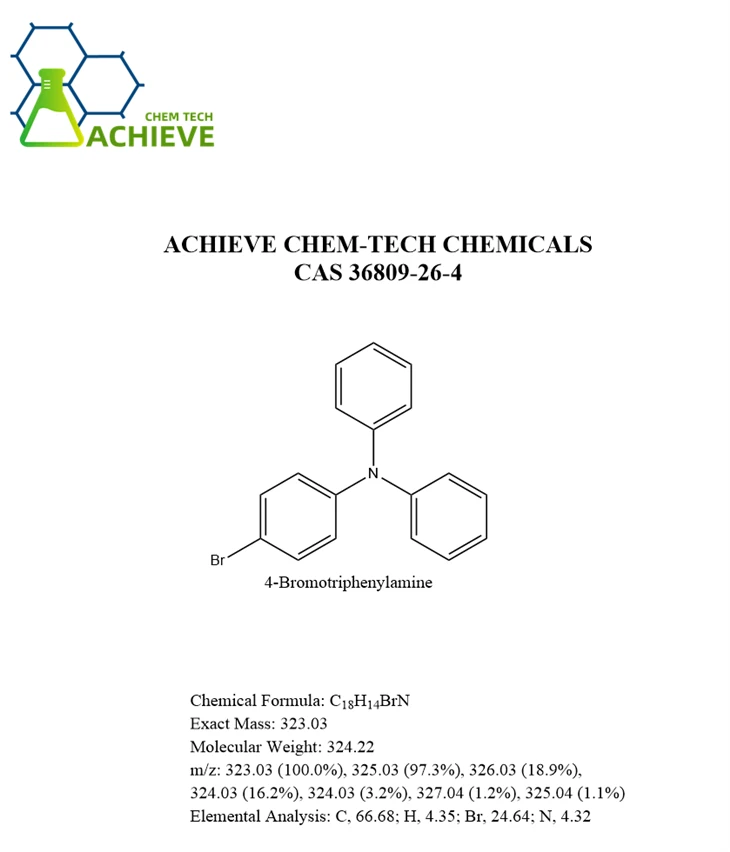


4-Bromotriphenylamine, also known as 4-bromo-N, N-diphenylaniline , is an organic compound that appears as a white to pale yellow powder or crystal. It is soluble in organic solvents such as toluene, stable under normal conditions, and has no dangerous reactions. It can be prepared from diphenylamine and 1-bromo-4-iodobenzene by coupling reaction in the presence of catalysts such as Pd2 (DBA) 3, P (t-Bu) 3, etc. It is mainly used for synthesizing optical materials such as fluorescent powders, which have important applications in display technology, lighting engineering, and other fields. As an important intermediate in organic synthesis, it is used to synthesize other complex organic compounds such as drugs, dyes, functional materials, etc. In chemical laboratories, it is often used as a reagent or synthetic block to participate in various organic synthesis reactions.

Additional information of chemical compound:
|
Chemical Formula |
C18H14BrN |
|
Exact Mass |
323.03 |
|
Molecular Weight |
324.22 |
|
m/z |
323.03(100.0%),325.03(97.3%),326.03(18.9%), 324.03(16.2%),324.03(3.2%),327.04(1.2%),325.04(1.1%) |
|
Elemental Analysis |
C, 66.68; H, 4.35; Br, 24.64; N, 4.32 |
|
Melting point |
108-112℃(lit.) |
|
Boiling point |
185℃/ 2.5mmHg |
|
Density |
1.369±0.06 g/cm3(Predicted) |
|
|
|


4-Bromotriphenylamine has a wide range of applications, mainly in the fields of optoelectronic materials, polymer materials, functional coatings, pharmaceuticals, pesticides, dyes, and organic synthesis. The following are its specific uses:
Application in the field of optoelectronic materials
4-bromo-N, N-diphenylaniline has excellent electron transfer properties, mainly due to the conjugated system in its molecular structure. The π electrons in conjugated systems can move freely within the molecule, allowing electrons to quickly transfer from one atom to another, thereby improving the conductivity of the material. At the same time, its molecular structure stability ensures that the molecular structure will not be easily damaged during electron transfer, ensuring the durability of material properties. In organic solar cells, 4-bromo-N, N-diphenylaniline derivatives can serve as important components of the photoactive layer. Its unique molecular structure enables it to form good interface contact with other electron donor or acceptor materials, promoting the separation and transport of photo generated charge carriers. For example, a photoactive layer is prepared by blending 4-Bromotriphenylamine with fullerene derivatives. The 4-Bromotriphenylamine derivative serves as an electron donor and the fullerene derivative serves as an electron acceptor. Under illumination conditions, the photoactive layer absorbs photons to generate excitons, which are separated into electrons and holes at the interface and then transported to the corresponding electrodes by the electron acceptor and electron donor, thereby achieving the conversion of light energy to electrical energy.

Application in Organic Semiconductor Materials

4-bromo-N, N-diphenylaniline can be used to synthesize luminescent layer materials for OLEDs. By modifying its molecular structure and introducing different luminescent groups such as fluorene and carbazole, materials with different luminescent colors and efficiencies can be prepared. Under the action of an electric field, these materials recombine electrons and holes in the luminescent layer, exciting the luminescent groups to the excited state. When the excited luminescent groups return to the ground state, photons are released, thereby achieving luminescence. In addition to serving as luminescent layer materials, 4-Bromotriphenylamine derivatives can also be used as charge transport layer materials for OLEDs. For example, 4-Bromotriphenylamine derivatives with good hole transport performance can be used as hole transport layer materials to promote the injection and transport of holes from the anode to the luminescent layer, thereby improving the luminescence brightness and efficiency of the device. At the same time, by designing the molecular structure reasonably, the hole mobility and energy levels of the material can be adjusted to better match the adjacent functional layer materials and optimize the performance of the device.
4-bromo-N, The amine group in N-diphenylaniline has high reactivity and can react with other compounds containing functional groups such as carbonyl and acyl chlorides to synthesize various photosensitive dyes. For example, amine groups can undergo condensation reactions with aldehyde compounds to generate Schiff base structured dyes; Dyes that undergo acylation reaction with acyl chlorides to form amide structures. These photosensitive dyes have specific absorption spectra and photoresponsive properties, and can undergo photochemical reactions under illumination. The synthesized photosensitive dyes have important applications in the field of photocatalysis. In photocatalytic reactions, photosensitive dyes act as photosensitizers and can absorb specific wavelengths of light to produce excited dye molecules. Excited dye molecules transfer energy to catalysts or other reactants, triggering chemical reactions. For example, in the photocatalytic decomposition of water to produce hydrogen, the photosensitive dye absorbs sunlight and injects electrons into the conduction band of the catalyst, promoting the reduction reaction of water and generating hydrogen gas. In addition, photosensitive dyes can also be used in optical sensors to detect and analyze specific substances by detecting changes in light signals.

Application in photosensitive materials

In the system of photocatalytic degradation of organic pollutants, 4-bromo-N, N-diphenylaniline photosensitizer also plays an important role. It can absorb light energy and generate active species with strong oxidizing properties, such as hydroxyl radicals (· OH), superoxide anion radicals (· O ₂⁻), etc. These active species can undergo redox reactions with organic pollutants, decomposing them into harmless small molecules such as CO ₂ and H ₂ O. By designing photosensitizers with specific structures and properties, the degradation efficiency and selectivity of different types of organic pollutants can be improved. For example, certain test substances may form complexes with photosensitive dyes, causing shifts in the absorption peak or changes in fluorescence intensity of the dyes. By detecting changes in these optical signals, qualitative and quantitative analysis of the substance under test can be achieved. In the field of environmental monitoring, 4-Bromotriphenylamine based optical sensors can be used to detect heavy metal ions (such as mercury ions, lead ions, etc.) and organic pollutants (such as phenols, pesticides, etc.) in water. In the biomedical field, it can be used to detect biomolecules (such as proteins, nucleic acids, etc.) and biomarkers, providing important information for the diagnosis and treatment of diseases.
Application in the field of dyes
4-bromo-N, N-diphenylaniline is often used as an important intermediate in dye synthesis, which reacts with other compounds through its bromine atoms and amino functional groups to construct complex dye molecular structures. For example, in the synthesis of azo dyes, 4-Bromotriphenylamine can undergo coupling reactions with diazonium salts. Firstly, aromatic amines are reacted with sodium nitrite and acid at low temperatures to form diazonium salts, which then undergo coupling reactions with 4-Bromotriphenylamine under appropriate conditions to generate dye molecules with azo structures. This azo dye has bright colors and good fastness, and is widely used in the textile printing and dyeing industry. By changing the substituents or reaction conditions of 4-bromo-N, N-diphenylaniline, dyes with different colors and properties can be synthesized. For example, introducing different aromatic or heterocyclic compounds into molecules can adjust the conjugation system and electron cloud distribution of dyes, thereby changing the absorption and emission spectra of dyes and achieving precise control of dye color.

Application in Fluorescent Dyes

4-bromo-N, N-diphenylaniline can be used to synthesize dyes with efficient fluorescence emission properties. The conjugated system and electron transfer properties in its molecular structure enable the synthesized fluorescent dye to effectively absorb light energy and convert it into fluorescent emission when exposed to excitation light. For example, by combining 4-Bromotriphenylamine with fluorescent groups such as fluorescein, dye molecules with strong fluorescence emission can be synthesized. This fluorescent dye has important applications in fields such as biological imaging and fluorescent probes. In biological imaging, efficient fluorescent dyes can label biomolecules such as proteins, nucleic acids, etc., and achieve localization and dynamic monitoring of biomolecules in cells or tissues by detecting fluorescent signals. Compared with traditional fluorescent dyes, fluorescent dyes synthesized based on 4-Bromotriphenylamine have higher fluorescence quantum yield and better photostability, and can maintain stable fluorescence emission for a longer period of time, providing a more reliable tool for biological imaging research.
In terms of biological imaging, 4-bromo-N, N-diphenylaniline based fluorescent dyes can be used for cell imaging, tissue imaging, and in vivo imaging. In cell imaging, dyes can specifically label specific organelles or biomolecules within cells, and observe changes in cell structure and function through fluorescence microscopy. For example, combining dyes with mitochondrial targeting groups can achieve specific labeling of mitochondria and study their morphology, distribution, and metabolic activity. In the field of fluorescent probes, 4-bromo-N, N-diphenylaniline based fluorescent dyes can be used to detect ions, small molecules, and biomolecules in living organisms. By designing fluorescent probes with specific recognition functions, when the target analyte binds to the probe, it will cause changes in the fluorescence signal, such as increased or decreased fluorescence intensity, shifted fluorescence emission wavelength, etc., thus achieving quantitative or qualitative detection of the target analyte. For example, using 4-Bromotriphenylamine based fluorescent dyes to design calcium ion fluorescent probes can monitor changes in intracellular calcium ion concentration in real time, providing an important means for studying the role of calcium ions in cellular signal transduction.

Future Perspectives
The demand for 4-bromotriphenylamine is expected to grow due to its versatility in organic electronics and materials science. Future research directions include:
1) Green Synthesis: Developing eco-friendly bromination methods (e.g., electrochemical bromination).
2) Biodegradable Derivatives: Designing TPA-based materials with reduced environmental persistence.
3) Advanced Applications: Exploring its use in quantum dot solar cells, perovskite LEDs, and bioimaging agents.
4-Bromotriphenylamine is a versatile compound with significant applications in organic electronics, materials science, and pharmaceutical research. Its synthesis, though straightforward, requires careful control to ensure regioselectivity. While its electronic properties make it valuable in high-tech industries, safety concerns necessitate responsible handling and disposal. Future research should focus on greener synthesis methods and expanding its biomedical applications while mitigating environmental risks.
By understanding its properties and limitations, scientists and engineers can harness the full potential of 4-bromotriphenylamine in next-generation technologies.
Frequently Asked Questions
Is 4-Bromotriphenylamine suitable for use in food or pharmaceuticals?
+
-
Not for food or direct medicinal use. For laboratory research and industrial applications only.
How to remove byproducts during synthesis?
+
-
Purification is achieved through column chromatography, recrystallization, or extraction, with the specific method adjusted according to the type of impurity.
Do you support custom synthesis?
+
-
Most suppliers offer customization services, requiring the target structure and purity specifications to be provided.
Hot Tags: 4-bromotriphenylamine cas 36809-26-4, suppliers, manufacturers, factory, wholesale, buy, price, bulk, for sale, ciprofloxacin powder, epinephrine powder, colchicine powder, Tetrahydrobiopterin BH4 Powder, pontocaine, Diphenhydramine Hydrochloride Powder CAS 147 24 0