


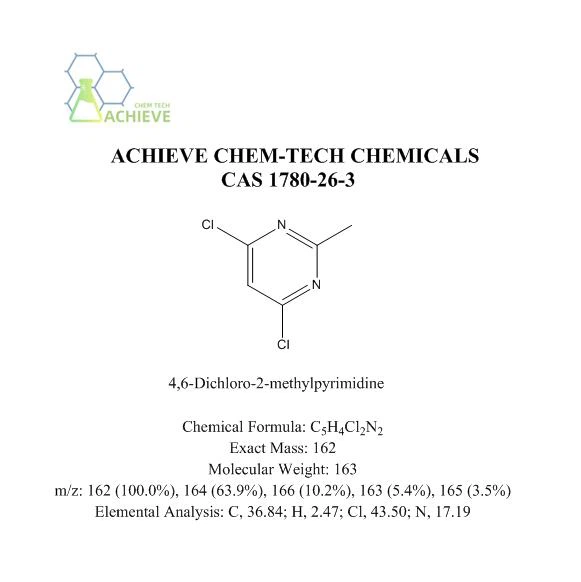


Shaanxi BLOOM Tech Co., Ltd. is one of the most experienced manufacturers and suppliers of 4,6-dichloro-2-methylpyrimidine cas 1780-26-3 in China. Welcome to wholesale bulk high quality 4,6-dichloro-2-methylpyrimidine cas 1780-26-3 for sale here from our factory. Good service and reasonable price are available.
4,6-Dichloro-2-methylpyrimidine is an organic compound with molecular formula C5H4Cl2N2, colorless to light yellow crystal. Insoluble in water, easily soluble in ethanol, dimethyl sulfoxide, chloroform, ether and other organic solvents. In conclusion, as an organic intermediate compound, it has a wide range of uses and can be functionally modified by different chemical reactions to meet different application requirements.

|
Chemical Formula |
C5H4Cl2N2 |
|
Exact Mass |
162 |
|
Molecular Weight |
163 |
|
m/z |
162 (100.0%), 164 (63.9%), 166 (10.2%), 163 (5.4%), 165 (3.5%) |
|
Elemental Analysis |
C, 36.84; H, 2.47; Cl, 43.50; N, 17.19 |
 |
 |

4,6-Dichloro-2-methylpyrimidine is an important organic intermediate compound with a wide range of applications, such as:
This compound is a key intermediate for the treatment of mild to moderate primary hypertension with the active pharmaceutical ingredient moxonidin. It provides the necessary chemical structural basis for the preparation of this important antihypertensive drug by participating in the synthesis process of moxonidin. In addition, this substance is also an important intermediate for the raw material dasatinib used to treat specific types of leukemia, such as Philadelphia chromosome positive chronic myeloid leukemia that is resistant or intolerant to imatinib mesylate. It plays a crucial role in the synthesis pathway of dasatinib, helping to prepare drug molecules with high anti leukemia activity. In addition to serving as an intermediary between the two drugs mentioned above, it can also be used in the development process of other drugs. Due to its specific chemical structure and reactivity, it may serve as a starting material or key fragment for constructing new drug molecular structures, providing new synthesis strategies and ideas for pharmaceutical chemists. Although it has broad application prospects in the field of pharmaceutical intermediates, strict adherence to relevant safety operating procedures and regulatory requirements is still necessary during use. It is for research and development purposes only and is not intended for pharmaceutical, household, or other non professional use. At the same time, it is necessary to ensure its safety and stability during production, storage, and transportation to prevent accidents from occurring.

Organic synthetic block

This compound belongs to the organic synthesis block members and can be used for modular assembly of molecular structures, such as supramolecular complexes, metal organic frameworks, and nanoparticles. This modular assembly approach enables researchers to design and construct complex molecular structures as needed to meet specific application requirements. It is a solid compound with a certain melting point and boiling point. Its chemical properties are stable, but it can react with oxidants and acidic substances at room temperature and pressure. To ensure its stability and safety, it should be stored in a sealed and cool, dry place, away from oxides and acidic substances.
This compound can be used as a biochemical reagent for life science related research. In the field of scientific research, it may serve as a probe or marker for studying the interactions between biomolecules, signal transduction, and other processes. In addition, it can also be used as a raw material for synthesizing other organic compounds, for exploring new chemical reactions and synthetic pathways. Although its direct application in industry is relatively limited, as a member of organic synthetic blocks, it may indirectly participate in the manufacturing process of certain industrial products. For example, in the synthesis of chemicals such as pesticides, dyes, and fragrances, the compound may act as an intermediate or one of the raw materials, participating in specific synthesis reactions. With the continuous development of science and technology, the potential applications of this compound are also constantly expanding. For example, in the field of materials science, it may serve as a precursor for functional materials and be used to prepare new materials with special properties. In the field of environmental protection, it may also serve as an effective reagent for treating certain pollutants, used to purify the environment or reduce the toxicity of pollutants.

Under what conditions will its chemical properties change?
The chemical properties of 4,6-Dichloro-2-methylpyrimidine may change under specific conditions. Here are some conditions that may affect its chemical properties:
1.Temperature
High temperature: Under high temperature conditions, it may undergo decomposition reactions and generate other compounds. This decomposition reaction may lead to significant changes in its chemical properties.
Melting point and boiling point: 4,6-dichloropyrimidine changes from a solid state to a liquid state when it reaches its melting point, and to a gas state when it reaches its boiling point. These changes in physical states may also affect their chemical activity.
2.Pressure
High pressure: Under high pressure conditions, its boiling point may increase, thereby affecting its evaporation and volatilization rate. In addition, high pressure may also affect its reaction rate with other substances.
Low pressure: Under low pressure conditions, the boiling point of 4,6-dichloropyrimidine will decrease, making it easier to evaporate and evaporate. This may make it more prone to react with other gases or vapors.
3.Illumination
Long term exposure to light may cause photochemical reactions of 4,6-dichloropyrimidine, resulting in the formation of other compounds. This photochemical reaction may alter its chemical properties.
4.Chemical reaction
Oxidation reaction: 4,6-dichloropyrimidine can react with oxidants to produce oxidation products. This reaction may alter its chemical properties, such as increasing its polarity, changing its solubility, etc.
Acid base reaction: 4,6-dichloropyrimidine may have a certain acidity or alkalinity, so it can react with acids or bases to generate corresponding salts or acid-base addition products.
Substitution reaction: Due to the presence of chlorine atoms in its molecules, substitution reactions can occur to produce other substitution products.
5.Other factors
Solvent: 4,6-dichloropyrimidine may exhibit different solubility and chemical activity in different solvents. The choice of solvent may affect its reaction rate and product distribution with other substances.
Catalysts: Some catalysts can accelerate the reaction rate of 4,6-dichloropyrimidine with other substances, thereby changing its chemical properties.
How does moxonidin lower blood pressure?
4,6-dichloro-2-methylpyrimidine is also an important intermediate in the synthesis of the novel central antihypertensive drug moxonidin, which is used to treat mild to moderate primary hypertension.
1.Mechanism of action
Central role
Mononidin can stimulate imidazoline receptors (some say α 2-adrenergic receptors) in the medulla oblongata, which can reduce the release of norepinephrine. Norepinephrine is a strong vasoconstrictor substance, and its reduced release can lower peripheral sympathetic nerve activity, thereby reducing vascular constriction and lowering peripheral vascular resistance.
Calcium channel blocking effect
Mosonidine can also act on calcium ion channels on vascular smooth muscle, preventing calcium ions from entering the cell. This effect can relax vascular smooth muscle, further reduce peripheral resistance, and achieve the effect of lowering blood pressure.
2.Pharmacological characteristics
Hypovoltage effect
Mosonidine has significant antihypertensive effects and is suitable for the treatment of mild to moderate primary hypertension. It lowers blood pressure by reducing peripheral vascular resistance and lowering cardiac output, restoring blood pressure to normal or near normal levels.
Other pharmacological effects
In addition to its blood pressure lowering effect, moxonidin also has sedative, analgesic, anti anxiety, and antidepressant effects. These effects may be related to their regulatory effects on the central nervous system.
3.Precautions for drug use
Indication
Mosonidine is mainly used for the treatment of mild to moderate hypertension. For refractory severe hypertension, moxonidin may not be suitable, and other antihypertensive drugs or combination therapy should be used in this case.
Side effect
Mosonidine may cause side effects such as headache and nausea. During use, it is necessary to closely monitor changes in blood pressure to avoid dizziness or hypotension symptoms caused by excessive blood pressure reduction.
Drug interactions
Mosonidine may interact with other drugs, affecting their efficacy or increasing side effects. Therefore, when using Mosoni, it is necessary to inform the doctor of other medications being used to avoid drug interactions.
Medication for special populations
For pregnant women, lactating women, elderly people, and patients with liver and kidney dysfunction, special caution should be taken when using Moxone. These populations may need to adjust their medication dosage or choose other antihypertensive drugs.
What are the side effects of moxonidin?
Mononidin (including its hydrochloride form, moxonidin hydrochloride), as a antihypertensive drug, may have some side effects during use. The following is a summary of the side effects of moxonidin:
1.Common side effects
Competitive advantage
The company conducted a competitive advantage analysis to identify its strengths and weaknesses compared to its rivals.
Dizziness
Possible effects of medication on the vestibular nervous system may lead to obstruction of lymphatic reflux or lymphedema in the inner ear, resulting in symptoms such as dizziness and instability. In severe cases, it may lead to falls, so it is important to pay attention to safety when using Mosoni.
01
Sleepiness
Medications may inhibit the activity of the central nervous system, leading to inhibition of the reuptake of neurotransmitters such as serotonin and norepinephrine, which in turn can cause sleep disorders. Patients may experience fatigue and difficulty concentrating during the day, and long-term presence may affect their daily life and work abilities.
02
Headache
Mosonidine may dilate cerebral blood vessels, increase cerebral blood flow, and thus trigger headaches. Headaches can manifest as persistent dull or pulsating pain, sometimes accompanied by symptoms such as nausea and vomiting.
03
Dry mouth
Drugs have anticholinergic effects, which can competitively block receptors on the postsynaptic membrane and reduce saliva secretion. Patients may experience symptoms such as dry oral mucosa and discomfort in the throat, which may lead to dental caries or other oral diseases if left untreated for a long time.
04
Constipation
Mosonidine has a sedative effect on the central nervous system, which may reduce the frequency of gastrointestinal peristalsis, leading to problems such as reduced bowel movements and difficulty in defecation. In severe cases, bloating and decreased appetite may occur.
05
Hot Tags: 4,6-dichloro-2-methylpyrimidine cas 1780-26-3, suppliers, manufacturers, factory, wholesale, buy, price, bulk, for sale, Synthetic Chemical, 3 Nitrobenzonitrile, 2 5 Dihydroxybenzaldehyde, squaric acid treatment, 2 Chloro 4 pyridinecarboxylic acid, Additive