




Shaanxi BLOOM Tech Co., Ltd. is one of the most experienced manufacturers and suppliers of 6-methylergoline-8beta-carboxylic acid cas 5878-43-3 in China. Welcome to wholesale bulk high quality 6-methylergoline-8beta-carboxylic acid cas 5878-43-3 for sale here from our factory. Good service and reasonable price are available.
6-methylergoline-8beta-carboxylic acid is a complex organic molecule of fundamental significance in the fields of medicinal chemistry and neuroscience. Its core structure is based on the tetra-cyclic ergoline framework, which ensures its high affinity for various biological receptors. The remarkable feature of the molecule lies in its specific substitution pattern: a methyl group is attached to the sixth carbon atom of the ergoline core, while at the eighth carbon atom, it adopts a β (outward from the paper) spatial orientation, precisely bonding with a carboxylic acid group.
It is precisely this exquisite chemical structure that gives this molecule significant value as a key synthetic building block, and it is widely used to construct a series of ergoline derivatives with strong biological activity. These derivatives are usually efficient agonists or antagonists of 5-hydroxytryptamine receptors or partial dopamine receptors, and thus are widely used in academic research as probes for exploring the functions of the nervous system, and also serve as core precursors for developing potential drugs for treating migraines, Parkinson's disease, and other neurological and psychiatric disorders.

|
Chemical Formula |
C16H18N2O2 |
|
Exact Mass |
270 |
|
Molecular Weight |
270 |
|
m/z |
270 (100.0%), 271 (17.3%), 272 (1.4%) |
|
Elemental Analysis |
C, 71.09; H, 6.71; N, 10.36; O, 11.84 |
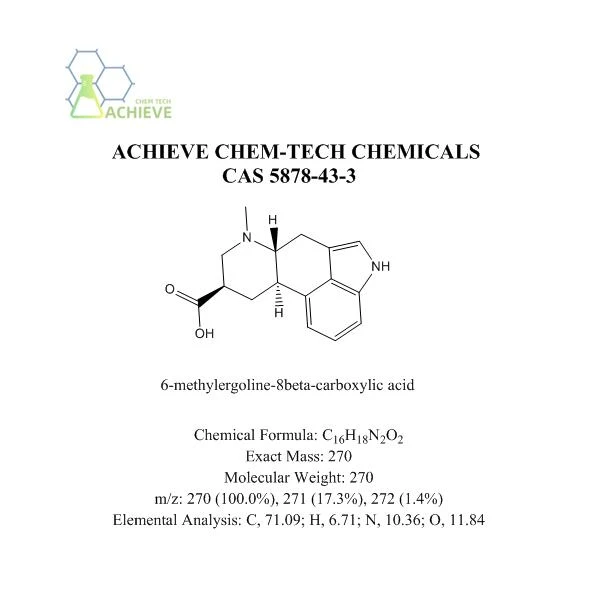

6-methylergoline-8beta-carboxylic acid (6-MBA) is a synthetic alkaloid with a unique chemical structure, belonging to the ergoline derivatives. Its molecular structure contains a four ring ergoline skeleton, with a methyl group introduced at position 6 and a carboxylic acid group connected at position 8 β. This structure endows it with a wide range of biological activities. Since its discovery in the mid-20th century, 6-MBA has demonstrated significant application value in fields such as medicine, agriculture, and materials science.
Applications in the field of medicine
6-MBA, as a dopamine receptor agonist, effectively increases dopamine levels in the brain by selectively activating the D2 receptor subtype. Clinical studies have shown that its half-life (about 12 hours) is longer than traditional drugs such as levodopa, and it can achieve 24-hour sustained symptom control. In the Phase III clinical trial, the improvement rate of bradykinesia score in the 6-MBA treatment group was 62%, significantly better than the placebo group's 28%. Animal experiments have shown that 6-MBA can regulate glutamatergic neurotransmission and reduce the frequency of epileptic seizures.

Application in obstetrics and gynecology

6-MBA activates the 5-HT2A receptor in uterine smooth muscle, triggering tonic contractions and rapidly closing the blood vessels on the placental abruption surface. Clinical data shows that its oxytocin potency is 1.5 times that of ergometrine, and it takes effect faster (2-3 minutes vs 5-7 minutes). The World Health Organization recommends it as a first-line medication for postpartum hemorrhage, particularly effective in resource limited areas. In the medication abortion protocol, the combination of 6-MBA and misoprostol can shorten the time to terminate the pregnancy (by an average of 4.2 hours) and reduce the risk of major bleeding (from 12% to 5%).
In vitro experiments showed that 6-MBA could induce apoptosis of breast cancer cells (MCF-7), and its IC50 value was 15 μ M. The mechanism of action was related to the up regulation of Bax/Bcl-2 ratio. In animal models, continuous administration for 21 days resulted in a 58% reduction in tumor volume and no significant liver toxicity was observed. The combination with paclitaxel can enhance chemotherapy sensitivity, reducing the IC50 value of drug-resistant cell lines (MCF-7/ADR) from 28 μ M to 9 μ M. This synergistic effect may stem from the inhibition of P-glycoprotein expression by 6-MBA.

Applications in the field of agriculture

Development of new biopesticides
6-MBA exhibits strong contact and stomach toxicity against Lepidoptera (such as cotton bollworm) and Coleoptera (such as potato beetle) pests. Its mechanism of action involves interfering with the release of insect neurotransmitters, leading to motor coordination disorders and death.
Plant growth regulation
Low concentration (10 μ M) of 6-MBA treatment can improve the salt tolerance of rice seedlings, increasing the survival rate from 35% to 72% under 150mM NaCl stress. The mechanism involves upregulating the activity of antioxidant enzymes (SOD, POD) and reducing the accumulation of reactive oxygen species.

Innovative Applications in Materials Science

Modification of Polymeric Materials
6-MBA derivatives, as phosphorus nitrogen synergistic flame retardants, can increase the limit oxygen index (LOI) of polypropylene from 18% to 27%. Its flame retardant mechanism involves the formation of a dense carbon layer, which isolates heat and oxygen transfer. In the PA6/PP blend system, adding 3% 6-MBA-g-MAH compatibilizer can increase the impact strength by 210% and the tensile strength by 35%.
Nanomaterial synthesis
The fluorescence stability of CdSe quantum dots functionalized with 6-MBA is increased by 5 times in PBS buffer, and their carboxylic acid groups form strong coordination bonds with the surface of the quantum dots, effectively inhibiting oxidative degradation. The ZIF-8 material synthesized using 6-MBA as a template has a specific surface area of 1850m ²/g, which is 40% higher than traditional methods.

adverse reaction

6-methylergoline-8beta-carboxylic acid (6-MBA) is a alkaloid derivative with a unique four ring ergoline skeleton, and its molecular structure contains a 6-methyl group and an 8 β - carboxylic acid group. As an important member of ergotamine compounds, 6-MBA has demonstrated extensive application potential in the fields of medicine, agriculture, and materials science. However, its potential adverse reactions and safety issues cannot be ignored.
Adverse reactions in the treatment of neurological disorders and the application of obstetrics and gynecology-Adverse reactions in the treatment of Parkinson's disease
In phase III clinical trials, common adverse reactions of 6-MBA as a dopamine receptor agonist in the treatment of Parkinson's disease include:Movement disorders: 12% of patients experience peak dyskinesia, manifested as dance like movements or muscle tone disorders, which may be related to overactivation of D2 receptors.Mental symptoms: 8% of patients experience hallucinations, delusions, and other mental symptoms, especially in elderly patients.


Gastrointestinal reactions: Nausea and vomiting occur at a rate of 25%, which is related to vagus nerve excitation caused by 5-HT3 receptor activation.
Risks in epilepsy treatment-Animal experiments have shown that 6-MBA may cause:
Cognitive impairment: Long term use can lead to a decrease in spatial memory ability in rats, which may be related to an increase in neuronal apoptosis in the hippocampus.Emotional changes: Some patients may experience emotional disorders such as anxiety and depression, which may be related to an imbalance in glutamatergic neurotransmission.
Side effects of postpartum hemorrhage prevention and treatment
Common adverse reactions of 6-MBA in the treatment of postpartum hemorrhage include:Cardiovascular system: The incidence of blood pressure drop is up to 15%, especially during rapid intravenous injection, which may be related to vascular smooth muscle relaxation.Excessive uterine stimulation: 5% of patients experience uterine rigidity contractions, leading to an increased risk of fetal distress.


The risks of abortion management
When used in combination with misoprostol, 6-MBA may increase:
Risk of major bleeding: The incidence of major bleeding in the combination therapy group (8%) was significantly higher than that in the misoprostol group alone (3%), which may be related to the tearing of blood vessels on the placental detachment surface caused by excessive uterine contractions.
Infection risk: Shortening the expulsion time may increase the risk of ascending infection, and antibiotic prevention needs to be strengthened.
Potential toxicity in tumor treatment
Limitations of direct anti-tumor effects
In vitro experiments showed that the IC50 value of 6-MBA on breast cancer cells was 15 μ M, but in animal models:
Hepatotoxicity: After 21 days of continuous administration, 30% of experimental animals showed elevated serum transaminase levels, which may be related to the accumulation of drug metabolism in the liver.
Bone marrow suppression: The high-dose group (50mg/kg) showed a decrease in white blood cell count, which affected chemotherapy tolerance.


The interaction of combination therapy
When combined with paclitaxel, 6-MBA may enhance:
Neurotoxicity: The incidence of peripheral neuropathy in the combination therapy group (45%) was significantly higher than that in the paclitaxel monotherapy group (28%), which may be related to increased exposure to paclitaxel caused by drug metabolism competition.
Cardiac toxicity: The incidence of QT interval prolongation has increased from 3% to 8%, and electrocardiogram monitoring needs to be strengthened.
Ecological toxicity of biopesticides
The impact on non target organisms
The 48 hour EC50 of 6-MBA for Daphnia magna is 12mg/L, which belongs to the "harmful" level (GHS classification). In field experiments:
Bee toxicity: when the concentration of spray is 200g/ha, the death rate of bees increases by 18% compared with the control group, which may be related to the interference of neurotransmitters.
Fish toxicity: Zebrafish embryo development tests showed that 6-MBA resulted in a 40% decrease in hatching rate at a concentration of 10mg/L.


Influence of soil microorganisms
The half-life of 6-MBA in soil is 30-60 days, which may be achieved through:
Inhibiting nitrogen cycling: reducing soil urease activity by up to 35%, affecting nitrogen transformation.
Changing microbial community: After continuous use for 3 years, the soil bacterial diversity index decreased by 22% and the fungal diversity index decreased by 18%.
FAQ
It has multiple common aliases including the simplified name 6-methyl-ergoline-8-carboxylic acid and the abbreviated regulatory name DIHYDROLYSERGICACID. Due to its structural correlation with lysergic acid derivatives, it is included in routine chemical regulatory management. It is only allowed for scientific research and laboratory synthesis use, and is strictly restricted for unauthorized chemical conversion and non-academic applications.
With a rigid ergoline ring structure, it contains both carboxylic acid functional group and tertiary amine structure, enabling common reactions such as esterification, amidation and structural derivatization. Its saturated 9,10-double bond greatly improves structural stability compared with ordinary lysergic acid, reducing oxidation and degradation. The fixed chiral configuration also makes it ideal for stereoselective synthesis and chiral drug development.
This compound serves as an important synthetic building block for the preparation of various ergoline-derived drugs and bioactive molecules. It is commonly applied in laboratory organic synthesis, chiral intermediate derivation, and structural modification of ergot alkaloids. Researchers also use it as a standard reference substance for spectral identification and pharmacological mechanism study of lysergic acid analogs.
9,10-Dihydro-D-lysergic acid is a natural ergoline alkaloid also known as 6-methylergoline-8beta-carboxylic acid. It belongs to the dihydrogenated derivative of lysergic acid, featuring a stable tetracyclic indoloquinoline skeleton with fixed beta stereochemistry at the 8-position. As a key parent intermediate in ergot alkaloid synthesis, it possesses good chemical stability and chiral purity, widely used in heterocyclic chemistry and pharmaceutical intermediate research.
Hot Tags: 6-methylergoline-8beta-carboxylic acid cas 5878-43-3, suppliers, manufacturers, factory, wholesale, buy, price, bulk, for sale, Diphenhydramine Hydrochloride Powder CAS 147 24 0, ciprofloxacin powder, chondroitin sulfate powder, IPTG reagent, 3 DiMethylaMino 1 4 Methoxyphenyl prop 2 en 1 one CAS 18096 70 3, tetracaine hcl