




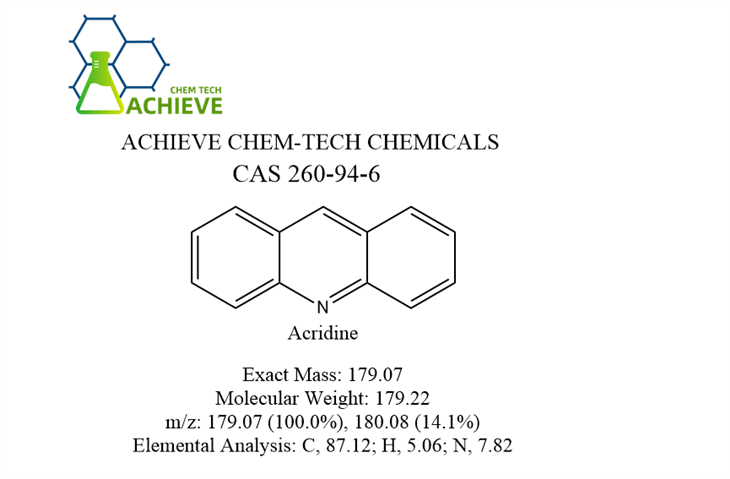
Shaanxi BLOOM Tech Co., Ltd. is one of the most experienced manufacturers and suppliers of acridine cas 260-94-6 in China. Welcome to wholesale bulk high quality acridine cas 260-94-6 for sale here from our factory. Good service and reasonable price are available.
Acridine is an organic compound belonging to the class of aromatic amines. Akridin has the chemical formula C13H9N and the molecular weight is 179.22. It consists of a central pyridine ring and two benzene rings, forming a triangular structure. This structure gives akridin unique physical and chemical properties. Akridin is usually a yellow to yellow-brown crystalline powder with a melting point of about 106~109°C and a boiling point of 346°C. It has good solubility in organic solvents such as dioxane. Akridin has a certain degree of alkalinity, and it can react with acids to form salts. It can also react chemically with certain reagents by substitution, addition and oxidation.
|
|
|


Akridin itself may not be used directly as a product, but it may be used as a raw material or intermediate in certain specific areas or products. In the laboratory, akridin may be used in a variety of chemical studies and experiments, including organic synthesis, photophysical and photochemical studies.

|
|
|


|
Chemical Formula |
C13H9N |
|
Molecular Weight |
179.22 |
|
Exact Mass |
179.07 |
|
m/z |
179.07 (100.0%), 180.08 (14.1%) |
|
Elemental Analysis |
C, 87.12; H, 5.06; N, 7.82 |
|
Melting point |
106-109 °C |
|
Boiling point |
346 °C(lit.) |
|
Density |
1,005 g/cm3 |
|
Storage conditions |
Refrigerator |
|
Solubility |
dioxane: 0.1 g/mL, clear |
|
Flash Point |
346°C |
|
Index Of Refraction |
1.7270 (estimate) |
|
Acidity Coefficient (pKa) |
5.58(at 20℃) |
|
Form |
Crystalline Powder |
|
Color |
Yellow to yellow-brown |
|
Water Solubility |
57.35mg/L(24 ºC) |
|
Stability |
Stable. Combustible. Incompatible with strong oxidizing agents. |

Acridine is a planar aromatic heterocyclic compound formed by the fusion of two benzene rings and a nitrogen-containing pyridine ring. It can be extracted from coal tar, mainly concentrated in the anthracene oil fraction, with a content of about 0.6%, and can also be obtained through chemical synthesis. This seemingly simple organic molecule, due to its unique rigid planar structure, large π - conjugated system, excellent fluorescence performance, and rich chemical reactivity, has shown remarkable application value in various fields such as dye industry, medicine, optoelectronic materials, chemical analysis, environmental governance, etc. It can be called the "versatile spirit" of the chemical industry.

1. Dyes and pigments industry - the most classic stage of akridin
The oldest and most mature application in industry is undoubtedly the manufacturing of dyes and advanced pigments. Akridin has stable chemical properties and can be used as a dye (such as Yin Dan Shilin) and advanced pigment (such as quinacridone). After the hydrogen on the benzene ring of akridin is replaced by an amino group, it becomes an important intermediate of akridin dye. Its derivatives can be used to produce a variety of brightly colored and high-performance dye products, which are widely used in the textile printing and dyeing industry.
In addition, processing and transforming products also have great applications. For example, oxyfluorenyl-2,3-acid can be used for the production of dyes; 3-aminoalkyloxyfluorene can be used in pharmaceuticals; Fluorine oxychloride can be used as an additive for electrical insulation materials; Sulfonated condensates can be used as textile auxiliaries and wetting agents. These downstream products further expand the industrial scope of akridin.
In the field of hair dyeing, akridin compounds also occupy a place. Due to its strong coloring ability and good color fastness, akridin derivatives are used in hair dye formulations, providing consumers with a diverse range of hair dye choices.


2. Medical field - the core force that saves lives
The application in the field of medicine can be regarded as its most socially valuable use, covering multiple directions such as anti-tumor, antibacterial and anti-inflammatory, neurological disease treatment, metabolic diseases, etc.
2.1. Anti tumor drugs
Acridine compounds are an important class of compounds with anti-tumor potential, and the study of their mechanisms has become a hot topic and focus in medicinal chemistry research.
(1) Direct cytotoxic drugs: They have direct cytotoxic effects and mainly act on the S phase of the cell cycle, inhibiting the synthesis of purines, RNA, and proteins, as well as affecting DNA synthesis. 30 minutes after a single intravenous injection, the concentration in the plasma reaches its peak, and 45% (50% prototype drug and 50% metabolite) is excreted from the urine within 0-6 hours, but cannot pass through the blood-brain barrier. Clinically, it is mainly used for the treatment of Hodgkin's disease, melanoma, and soft tissue sarcoma. The intravenous dose is 200-400mg/m ² per day, used continuously for 5-10 days, with an interval of 4-8 weeks before the second course of treatment.


(2) Amsacrine, also known as aminophenylacridine, has a mechanism of action similar to anthracycline drugs. It can interact with adenine thymidine base pairs, prevent DNA from serving as a template for replication and synthesis, and interfere with the structure of cell membrane proteins to produce anti-tumor activity. Mainly used for adult acute non lymphocytic leukemia, the intravenous dose is 90-120mg/m ², once every 3-4 weeks, and one course of treatment is 500-750mg/m ².
(3) Mitoxantrone: a synthetic sugar free anthracycline anticancer drug with a structure similar to doxorubicin. It has a broad anti-tumor spectrum and is used for breast cancer, acute leukemia, malignant lymphoma and digestive tract cancer.
(4) Tacrine, also known as 9-amino-1,2,3,4-tetrahydroacridine or Cognex, is an acetylcholine ester inhibitor approved by the US FDA in 1993 for the treatment of Alzheimer's disease. It plays an important role in the field of neurology.
(5) The synergistic anti-tumor effect of akridin yellow and leflunomide: Research has found that the combination of acridine yellow and classical bifunctional alkylated melphalan can significantly enhance the DNA damage induced by the latter, promote tumor cell apoptosis, and thus synergistically exert anti-tumor effects in vitro and in vivo, providing scientific basis for clinical medication.
(6) Research on the anti-tumor effects of novel akridin derivatives: Qu Xiaona et al.


studied human leukemia cells and doxorubicin resistant leukemia cells and found that novel akridin derivatives have a significant inhibitory effect on the growth of doxorubicin resistant leukemia cells. They can induce apoptosis and autophagy by inhibiting the function and expression of P-glycoprotein, and exert a reversal effect on multidrug resistance. The akridin polyamine derivatives designed and synthesized by Li Xiaoliu et al. showed high activity against human leukemia cells, lung cancer cells, and cervical cancer cell lines. The akridin amide thiourea derivatives studied by Li Junwei and others have anti-tumor activity in vitro against pancreatic cancer cells, cervical cancer, neuroblastoma, nasopharyngeal cancer and lung cancer.
2.2. Anti inflammatory, antibacterial, antimalarial, and anticancer properties
Akridin compounds have significant biological and pharmacological activities in anti-inflammatory, antibacterial, antimalarial, and anticancer activities. Its activity originates from the wide application of hydrogen bonding and π - π interactions in supramolecular networks. Akridin dilute solution can be used as a fungicide and plays an auxiliary role in clinical infection control. Related studies also indicate that akridin compounds can play an important role in the symptoms that occur during pregnancy in women.


Research by Gao Sujuan et al. found that uterine artery embolization combined with methotrexate and ethacridine lactate can effectively reduce the amount of bleeding, shorten hospital stay, and lower the rates of cesarean section and hysterectomy in women undergoing induced abortion with placenta previa in mid pregnancy.
3. Anti type 2 diabetes - the latest breakthrough
The latest research results published in May 2026 show that the team led by Shen Xin from the Air Force Medical University has discovered a new type of acridone ketone GPR40 agonist ADD-16.
The EC ₅₀ value of this compound for GPR40 is 12.33 μ mol/L, which has a stronger insulin secretion promoting effect and lower in vitro liver toxicity than TAK875. ADD-16 can reduce postprandial blood glucose in T2DM rat models, improve glucose tolerance and insulin resistance, lower serum free fatty acid levels, improve lipid metabolism disorders, and reduce liver fat accumulation. Its pharmacokinetic properties are good, with a half-life of 30.2 hours, and it has pancreatic targeting properties. The LD ₅₀ value of the acute toxicity test in vivo was 1168mg/kg, and there was no significant toxicity at the therapeutic concentration. The safety evaluation was good.


This study laid the foundation for the development of GPR40 agonist drugs and provided a new approach for the treatment of T2DM.
2. 4. Treatment of reproductive system diseases
Acridinone acetic acid (its sodium salt is water-soluble) has been authorized by SDFS in Russia and other countries. Its salts and lipids can affect androgens in human body through hormone therapy, and can be used to treat and prevent malignant tumors of female reproductive system, such as breast cancer, uterinecancer, ovarian cancer, and can also be used to treat male hair loss, prostate adenoma, prostate cancer, prostate cancer recurrence and other diseases. The clinical effect is good.
3. Chemiluminescence immunoassay - a star reagent in the field of diagnosis
Acridinium ester is a chemiluminescent marker with an acridine ring as its core structure. It is one of the most efficient luminescent reagents in modern chemiluminescent immunoassay (CLIA), and its application has penetrated into all aspects of clinical diagnosis.
3.1. Luminescence mechanism
Akridin ester undergoes chemiluminescence reaction in alkaline hydrogen peroxide solution: When the akridin ester is subjected to hydrogen peroxide.


The active groups in the molecule are oxidized, and the C-9 substituent reacts with H ₂ O ₂ to generate an unstable ethylene oxide intermediate. This intermediate rapidly decomposes into CO ₂ and the electron excited state of N-methylacridone. When it returns to the ground state, it releases photons with a maximum emission wavelength of 430nm. Its luminescence is of the "flash type", reaching its peak in 0.4 seconds after adding the starter reagent, with a half-life of about 0.9 seconds.
3.2. Core advantages
Akridin ester, as a label, has significant advantages such as low background luminescence, high signal-to-noise ratio, minimal interference factors in luminescence reaction, rapid and concentrated light release, high luminescence efficiency, easy binding with proteins without reducing photon yield, and stable label (can be stored for several months at 2-8 ℃). Compared with traditional markers, akridin ester luminescence immunoassay technology has higher accuracy and faster and more convenient operation.


3.3. Clinical application
By using akridin ester chemiluminescence immunoassay technology combined with biotin avidin magnetic particle separation technology, a quantitative detection method for carcinoembryonic antigen (CEA) content in serum can be established, making the medical determination of serum CEA content faster and more convenient. This technology can also be used to detect cytokines such as human interleukin-1 alpha, interleukin-1 beta, and interferon gamma, as well as environmental pollutants such as bisphenol A.
At present, akridin esters have developed multiple series of products, including AE-NHS,DMAE-NHS,Me-DMAE-NHS,NSP-DMAE-NHS,NSP-SA,NSP-SA-NHS,NSP-SA-ADH Wait. Among them, akridin sulfonamides (such as NSP-SA-NHS) have stronger resistance to hydrolysis due to the C-N bond order being greater than the C-O bond, and the introduction of propane sulfonate internal salt groups increases water solubility. The quantum number decay of chemiluminescence at 37 ℃ for 4 weeks is less than 10%, indicating superior performance. The Kang Chuanqing team at Changchun Yinghua Institute has achieved mass production of a chemiluminescence immunoassay kit based on a new type of akridin sulfonamide.

Acridine is usually synthesised in several ways.
Method 1: From Acridone
Acridone is obtained from diphenylamine-2-carboxylic acid by cycling with sulphuric acid, and then oxidising akridin by reduction to 9,10-dioxoacridine with pentanol and sodium.
Laboratory preparations can also be made by mixing acridone Chemicalbook with zinc powder and heating.
Akridin sublimation generated by the reaction is dissolved in hydrochloric acid, and then alkalised with sodium hydroxide solution, precipitate, filtered to obtain the crude product.
Recrystallisation with methanol gives a fine product with a melting point of 110°C.
Method 2: Based on the condensation reaction of aniline and aldehyde or ketone
firstly, aniline is condensed with formaldehyde under acidic conditions to produce N-methylaniline.
C6H5NH2 + CH2O → C6H5NHCH3 (N-methylaniline)
Next, N-methylaniline reacts with bromine under suitable conditions to give N-methyl-N-bromoaniline.
C6H5NHCH3 + Br2 → C6H5N(CH3)Br (N-methyl-N-bromoaniline)
finally, two N-methyl-N-bromoaniline molecules react by coupling to form akridin.
2C6H5N(CH3)Br → C13H9N + 2 HBr + 2 CH3Br
Frequently Asked Questions
What does acridine do?
+
-
Acridine is a polycyclic aromatic dye with antineoplastic, antimicrobial and imaging activities. Acridine and its derivatives intercalate within DNA and RNA by forming hydrogen-bonds and stacking between base pairs resulting in DNA crosslinks and strand breaks.
What is the mutation caused by acridine dyes?
+
-
This is called a frameshift mutation. Proflavin is an acridine dye that intercalates itself between base pairs of the DNA chain thereby causing loss or gain of a single nucleotide. The gene mutation alters the base sequence of the whole genetic frame from the point of mutation called frameshift mutation.
Is acridine orange carcinogenic?
+
-
Toxicity and carcinogenicity of AO. Since AO is mutagenic in bacteria (24, 25), it might also be carcinogenic in humans.
Hot Tags: acridine cas 260-94-6, suppliers, manufacturers, factory, wholesale, buy, price, bulk, for sale, Adrenochrome Powder, Sapropterin Hydrochloride, articaine hydrochloride powder, 4 Methylpropiophenone, raloxifene powder, Uracil Powder CAS 66 22 8