




Shaanxi BLOOM Tech Co., Ltd. is one of the most experienced manufacturers and suppliers of agomelatine powder cas 138112-76-2 in China. Welcome to wholesale bulk high quality agomelatine powder cas 138112-76-2 for sale here from our factory. Good service and reasonable price are available.
Agomelatine powder molecular formula is C15H17NO2, CAS 138112-76-2, and relative molecular mass is 243.3 g / mol. It is a white or almost white crystalline powder with fragrance. It can be slightly soluble in water and easily soluble in organic solvents such as ethanol, chloroform, dimethyl sulfoxide and ethyl acetate. The near-infrared spectrum shows that it has an obvious absorption peak at about 7500 cm-1. The melting point is 106-109 ° C, and the melting process can be tested by differential scanning calorimeter ( DSC ). Drug quality standards usually require that the impurity content does not exceed 1 %, including impurities A, B, C, etc., some of which may have a negative impact on drug efficacy and human health. Therefore, its purity and impurity content are also one of the important indicators to measure its quality. It is a new type of antidepressant drug. Its mechanism of action is different from the traditional selective serotonin reuptake inhibitor ( SSRI ) and tricyclic antidepressants. It enhances the activity of melatonin and 5-HT by acting as a melatonin receptor agonist and 5-HT 2C receptor antagonist, thereby exerting its antidepressant effect. Please note that the product produced by Shaanxi Achieve chem-tech Co.,Ltd is a primary chemical product and is only for laboratory use.

|
|
|


Agomelatine powder is a novel antidepressant drug that exhibits multidimensional therapeutic effects in clinical applications due to its unique dual mechanism of action - melatonin receptor activation and 5-hydroxytryptamine 2C receptor antagonism. Its use not only covers traditional depression treatment, but also extends to fields such as sleep disorders, anxiety disorders, cognitive function improvement, and emotional regulation for special populations.
Its core use is to treat adult depression, and its efficacy has been validated through multiple clinical trials, especially for patients with sleep disorders or circadian rhythm disorders.
1. Antidepressant mechanism and efficacy
Dual mechanism of action: By activating melatonin receptors (MT1/MT2) to regulate the biological clock, while antagonizing 5-hydroxytryptamine 2C receptors (5-HT2C) to promote dopamine and noradrenaline release, core depressive symptoms such as low mood and loss of interest are improved.
Clinical evidence: A meta-analysis involving over 2000 patients showed that antidepressant efficacy is comparable to paroxetine, but with faster onset (within 2 weeks) and less impact on sexual function.


Another study on refractory depression showed that combined treatment with agomelatine can significantly improve remission rates.
Symptom improvement: After medication, the patient's symptoms such as low mood, fatigue, and low self-evaluation have been alleviated, and the speed of social function recovery is faster than traditional drugs. For example, a study targeting the working population showed that after 6 weeks of agomelatine treatment, patients' work error rate decreased by 40% and interpersonal relationship satisfaction increased by 35%.
2. Synchronous treatment for sleep disorders
About 70% of patients with depression have sleep problems, and by regulating the melatonin system, it has become one of the few drugs that can simultaneously improve depression and sleep.
Sleep structure optimization: It can shorten the time to fall asleep (by an average of 22 minutes), increase the total sleep time (by an average of 1.2 hours), and reduce the number of nighttime awakenings (from 3.2 to 1.1). Its mechanism of action is similar to melatonin, but there are no daytime drowsiness side effects.
Circadian rhythm reconstruction: For circadian rhythm disorders caused by shift work, time difference, or age-related degenerative diseases, the sleep wake cycle can be reconstructed. For example, a study on elderly insomnia patients showed that after continuous medication for 4 weeks, the patient's sleep efficiency increased from 65% to 82%, and daytime fatigue was significantly reduced.

Extended Application: Multivariate Regulation from Anxiety to Cognition

Its use is not limited to depression, but it is also effective for anxiety disorders, cognitive function, and special emotional disorders by regulating neurotransmitters and the biological clock.
1. Adjuvant treatment for anxiety disorders
Depression often coexists with anxiety disorders by antagonizing 5-HT2C receptors and reducing amygdala overactivation, thereby alleviating anxiety symptoms such as tension and anxiety.
Clinical data: An open label study on generalized anxiety disorder (GAD) showed that after 8 weeks of treatment with agomelatine, patients' Hamilton Anxiety Scale (HAMA) scores decreased from 24 to 12, and there was no risk of dependence on benzodiazepines.
Advantageous population: Suitable for patients who are intolerant to traditional anti anxiety drugs (such as benzodiazepines) or need to avoid daytime sedation, such as drivers and high-altitude workers.
2. Improvement of cognitive function
By promoting dopamine release in the prefrontal cortex, attention, memory, and executive function are enhanced, especially for elderly patients with depression accompanied by cognitive impairment or mild cognitive impairment (MCI).
Alzheimer's disease related depression: A study on Alzheimer's disease patients with depression showed that after 6 months of treatment with agomelatine, the patients' Mini Mental State Examination (MMSE) scores remained stable, while the control group decreased by 2.3 points, suggesting that agomelatine powder may delay cognitive decline.
Attention Enhancement: A study on healthy volunteers showed that after a single oral administration of 25mg agomelatine, the accuracy of Continuous Attention Test (CPT) increased by 15% and the error rate decreased by 20%.


3. Regulation of special emotional disorders
Its use also extends to the following fields:
Perimenopausal mood disorders: In response to depression, anxiety, and sleep problems in perimenopausal women, agomelatine improves mood swings and hot flashes by regulating the interaction between melatonin and estrogen receptors.
Internet addiction accompanied by depression: A study on adolescent internet addiction showed that agomelatine combined with cognitive-behavioral therapy (CBT) significantly reduced depression scores (BDI-II from 28 to 14) and reduced internet time (from 8.2 hours per day to 3.5 hours per day).
Somatic autonomic nervous system disorder: For anxiety patients with physical symptoms such as palpitations and dizziness, agomelatine can alleviate somatic symptoms by regulating autonomic nervous system function, with an effective rate of 68%.

The synthesis of Agomelatine mainly includes four steps:
Step 1: Synthesis of ethyl 7-hydroxy-6-methoxy-2-phenylpropionate
This is a precursor compound for the synthesis of AGOMELATINE. Its commonly used synthetic method is the Barr-Finkler rearrangement reaction described in reference (1). First, p-methoxyphenylacetonitrile and acetone are condensed in the presence of catalysts such as sulfuric acid, glacial acetic acid and cuprous chloride to obtain propiophenone. Then propiophenone is esterified with catalysts such as benzoic acid and methyl diethylthioacetate to prepare ethyl 7-hydroxy-6-methoxy-2-phenylpropionate.
Step 2: Synthesis of 5-bromo-2-nitrophenol
Dissolve 3,5-dinitrophenol in hydrochloric acid, and add excess concentrated hydrochloric acid to dissolve it completely. Then, at 0°C, concentrated sodium bromide aqueous solution was added dropwise to generate 5-bromo-2-nitrophenol.
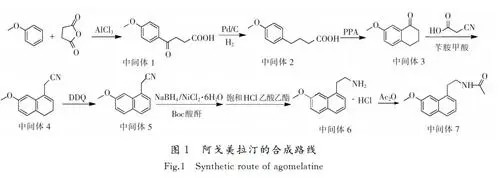
Step 3: Synthesis of AGOMELATINE intermediate
Condensation reaction of ethyl 7-hydroxy-6-methoxy-2-phenylpropionate and 5-bromo-2-nitrophenol in benzene gave compound (1). Then compound (1) and 3-methoxyphenol were subjected to a multi-step reaction in iodobenzene to finally obtain the intermediate of AGOMELATINE, which was named compound (2) here.
Step 4: Synthesis of AGOMELATINE
The intermediate (2) of AGOMELATINE is cyclized under the catalysis of sulfuryl chloride and DMF to obtain AGOMELATINE. This step can also use other methods, such as the preparation method described in reference (2).
In summary, AGOMELATINE is completed by synthesizing 4 intermediates. Wherein, 7-hydroxyl-6-methoxyl-2-phenylpropionic acid ethyl ester and 5-bromo-2-nitrophenol are the first two intermediates, and the third intermediate compound ( 2), and finally get AGOMELATINE. Although the synthesis process is relatively complicated, AGOMELATINE has become one of the important drugs for the treatment of depression due to its significant antidepressant and sleep regulating effects.

|
Chemical Formula |
C15H17NO2 |
|
Exact Mass |
243 |
|
Molecular Weight |
243 |
|
m/z |
243 (100.0%), 244 (16.2%), 245 (1.2%) |
|
Elemental Analysis |
C, 74.05; H, 7.04; N, 5.76; O, 13.15 |
The molecular structure of Agomelatine powder is characterized by its ability to simultaneously act on 5-hydroxytryptamine 2C receptors (5-HT2C) and melatonin receptors MT1/MT2, with high selectivity and affinity.
The chemical formula of AGOMELATINE is C15H17NO2, and its structure contains an amphetamine-like group and an alkoxy-substituted benzene ring. The molecular weight is about 243.3 g/mol. The physical and chemical properties of the drug show that AGOMELATINE is not easily soluble in water and ethanol, but is easily soluble in organic solvents such as dimethyl sulfoxide and dichloromethane.
Pharmacologically, AGOMELATINE can act on both 5-HT2C and MT1/MT2 receptors. The 5-HT2C receptor is a G protein-coupled receptor widely distributed in the central nervous system and is closely related to emotional regulation and appetite control; while the MT1/MT2 receptor is the main receptor for melatonin, It plays an important role in regulating the biological clock and sleep cycle, etc.
In the molecular structure of AGOMELATINE, the amphetamine group mainly acts on the 5-HT2C receptor, and its antagonistic effect on the receptor can reduce the activation of the 5-HT2C receptor, thereby improving mood and abnormal behavior. The alkoxy-substituted benzene ring mainly acts on MT1/MT2 receptors, which can bind to the receptors and simulate the biological effects of melatonin, thereby regulating sleep cycles and biological clocks.
In addition, the molecular structure of AGOMELATINE also contains binary bonds between benzene rings. This structural feature makes it have a stronger affinity for oxidases, thereby enhancing the stability and bioavailability of the drug. Compared with other antidepressants, AGOMELATINE has higher selectivity and affinity, which can reduce the impact on other neurotransmitter receptors, thereby reducing side effects and safety risks.
In conclusion, the molecular structure of AGOMELATINE includes an amphetamine-like group and an alkoxy-substituted benzene ring, which can simultaneously act on 5-HT2C and MT1/MT2 receptors, with high selectivity and affinity, and has a relatively strong effect on oxidases. Strong affinity, and can reduce side effects and safety risks.

Here are the highlights of Agomelatine powder's discovery history:
AGOMELATINE was first developed by French pharmaceutical company Servier Laboratories in 2001 and approved for marketing in 2009. The drug was originally named S-20098, and in further research and development, the commercial name AGOMELATINE was finally determined.
The discovery of AGOMELATINE is closely related to its mechanism of action. In the 1980s, melatonin, as an important endogenous biological substance, attracted great attention from scientists. Studies have shown that melatonin can not only regulate the body's biological clock and sleep cycle, but also have a certain impact on emotional regulation and the occurrence of depressive symptoms. This inspired scientists to look for molecular targets that have both antidepressant effects and improved sleep quality for antidepressant treatment.

In this context, Servier Laboratories began to study melatonin mimics in 1990 and discovered the molecule AGOMELATINE in 1999. The structure of AGOMELATINE contains both 5-hydroxytryptamine 2C receptor (5-HT2C) antagonist and melatonin receptor agonist, and has high selectivity. This structure also enhances its efficacy in improving mood and sleep quality, making it a new type of drug for the treatment of depression.
The clinical trials of AGOMELATINE also confirmed its significant antidepressant effect. In a multicenter comparative trial of 520 patients with depression, AGOMELATINE was comparable to conventional antidepressant drugs SSRI in improving depressive symptoms without significant side effects. Such results make AGOMELATINE one of the important drugs for the treatment of depression.
In the clinical application of AGOMELATINE, in addition to its antidepressant effect, it has also been proven to improve flipping mood disorder, social phobia, female vaginitis symptoms, etc., and it can regulate biological clock, improve skin aging, regulate blood sugar and lipid metabolism, etc. Both have good potential. Therefore, the discovery of AGOMELATINE not only promotes the development of antidepressant drugs, but also provides new ideas for research in other fields.
In summary, AGOMELATINE is a new antidepressant drug developed by Servier Laboratories in 2001. Its discovery process originated from the research of melatonin, combined with the structural characteristics of 5-HT2C receptor antagonist and melatonin receptor agonist, it has significant antidepressant and sleep regulation effects, and has become an important drug for antidepressant treatment one.
Hot Tags: agomelatine powder cas 138112-76-2, suppliers, manufacturers, factory, wholesale, buy, price, bulk, for sale, 4 Methylpropiophenone, Pure Creatine Monohydrate Powder CAS 6020 87 7, articaine hydrochloride powder, L Sulforaphane CAS 142825 10 3, Articaine Hcl powder, Cyproheptadine hydrochloride sesquihydrate