




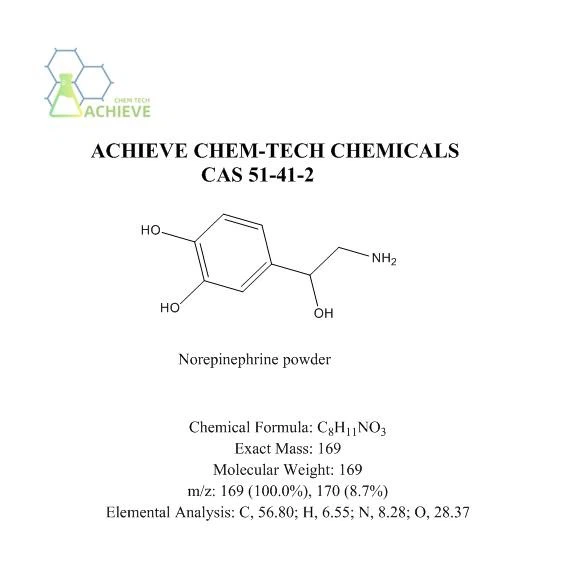


Shaanxi BLOOM Tech Co., Ltd. is one of the most experienced manufacturers and suppliers of norepinephrine powder cas 51-41-2 in China. Welcome to wholesale bulk high quality norepinephrine powder cas 51-41-2 for sale here from our factory. Good service and reasonable price are available.
Norepinephrine powder is the pure powdered form of the endogenous catecholamine neurotransmitter and hormone in the human body. Its chemical name is (R)-4-(2-amino-1-hydroxyethyl)-1,2-benzenediol. It is not only a key neurotransmitter in the central nervous system responsible for arousal, attention, and emotional regulation, but also a core hormone released by the peripheral sympathetic nervous system during the stress response ("fight or flight" response). Its pharmacological effects are mainly achieved by activating α1, α2 and β1 adrenergic receptors, which can cause strong vasoconstriction, resulting in a significant increase in peripheral resistance and a sharp rise in diastolic and systolic blood pressure. It can also enhance myocardial contractility, accelerate heart rate and increase blood sugar. Therefore, in medical practice, its sterile formulation is strictly used for intravenous infusion to rescue and treat various acute hypotensive shock states, especially distributive shock (such as sepsis shock) and cardiogenic shock, which are indispensable pressor emergency drugs in the intensive care unit. The raw material of this powder itself has unstable chemical properties and is prone to discoloration and inactivation due to light and air oxidation. It must be strictly stored under conditions of avoiding light, sealing and low temperature, and must be prepared into intravenous infusion by professionals under high-density monitoring. Any improper use may lead to extremely serious hypertensive crises, tissue ischemic necrosis and even arrhythmias.

|
|
|


Norepinephrine powder (NE) is an important biologically active molecule, and its diverse physiological effects make it have a wide range of applications. The use of it will be described in detail below.
Medical application:
NE has a wide range of applications in the medical field, mainly because it plays an important regulatory role in the central nervous system and peripheral nervous system as a neurotransmitter. NE binds to α- and β-adrenergic receptors to regulate multiple physiological processes such as heart rate, blood pressure, and metabolic rate. Therefore, it is widely used in the treatment of many diseases, including the following:
Cardiovascular disease:
NE can treat patients with cardiovascular disease by constricting blood vessels, increasing blood pressure, and increasing myocardial contractility. The common cardiovascular clinical application of NE is mainly for the treatment of symptoms such as shock and hypotension. The purpose is to increase cardiac output, maintain organ perfusion, and help restore vital signs.
Respiratory system diseases:
NE has an excitatory effect on the respiratory center and can promote the recovery of respiratory function, so it is widely used in the treatment of bronchial asthma, chronic obstructive pulmonary disease and other diseases.
Nervous system diseases:
NE can promote the growth and regeneration of nerve cells, so it is widely used in the treatment of neurodegenerative diseases, such as Parkinson's disease and stroke.
The field of neuroscience:
NE also has a wide range of applications in neuroscience research. To better understand the role NE plays in neuromodulation, neuroscientists have studied its role in neurons and neuronal networks such as:
 a. Release and reuptake of NE: The release and reuptake of NE is an important regulatory mechanism in the central nervous system, which plays a vital role in regulating the level of NE.
b. Classification of NE receptors: NE binds to α- and β-receptors, thereby triggering different biological effects. Neuroscientists can better understand the role of neurotransmitters by studying the classification of NE receptors.
c. Regulation of NE: As a neurotransmitter, the regulation mechanism of NE in neurons and neuronal networks has been extensively studied. These studies help to gain insight into the pathogenesis of neural circuits and related diseases.
Psychological research:
NE is also widely used in psychological research. Because NE can affect people's emotions, thinking and behavior, it is widely used in the field of psychology. For example:
Emotion regulation:
NE can affect emotions and make people feel positive or negative, so it is widely used in the treatment of affective disorders and depression.
Memory and learning:
NE plays an important role in the neuron network, which can regulate the synaptic connection between neurons, thus affecting human memory and learning ability.
Prevent cognitive decline:
NE can promote the formation and stability of neuronal dendrites, thereby helping to prevent the decline of cognitive function, which is of great significance to the cognitive rehabilitation of the elderly.
Drug research:
Because of its extensive role in the human body, NE is also a research object in the field of pharmaceutical research. Drug researchers have designed drugs that can affect NE by studying the structure and mechanism of NE, such as β receptor blockers, adrenaline synthetase inhibitors, etc. These drugs are effective in the treatment of cardiovascular diseases, nervous system diseases and emotional disorders. etc. have important clinical application value.
In general, Norepinephrine, as an important biologically active molecule, has a wide range of applications in many fields such as medicine, neuroscience, psychology and pharmaceutical research. With further in-depth research on its mechanism of action, it is believed that the application value of NE will become more significant.

Norepinephrine powder (NE) is a molecule with important biological activity, which has a wide range of applications in the fields of physiology, pharmacology and medicine. There are many ways to synthesize NE, and the commonly used ones include extraction from natural sources and chemical synthesis, which are completed through multi-step reactions.
Extraction of natural origin:
Natural sources of NE mainly come from the human body or other animal tissues, such as rats, dogs, gorillas, etc. NE is mainly secreted by the adrenal medulla, but can also be released from neuronal synaptic terminals. Therefore, extracting NE from these tissues can be used as one of the simple and reliable methods to produce NE.
The process of extracting NE usually includes the following steps:
(a) Pretreatment and extraction of tissue samples: First, the collected tissue samples need to be properly pretreated and processed, such as shelling, viscera removal, etc. Next, cut up the sample, freeze it, or add a suitable stabilizer (such as chloroform, etc.) to protect the target molecule from degradation or oxidation. Subsequently, the molecular mixture is extracted using a specific solvent such as ヘキサン or methanol.
(b) Separation and purification: The extracted molecular mixture is separated and purified by techniques such as chromatographic columns, liquid-liquid separation and gel chromatography. For NE, high performance liquid chromatography or gas chromatography is often used to achieve its separation and purification.
(c) Crystallization and crystallization purification: A common way to obtain elemental NE from solution is to use a crystallization process for purification. This is usually achieved by adjusting conditions such as pH, temperature and addition of appropriate hydrochloric acid.
(d) Identification and characterization: The obtained NE was identified and characterized by methods such as nuclear magnetic resonance and mass spectrometry.
Although the method of extracting NE from natural tissue is relatively simple, it usually requires a large number of tissue samples, and the extracted yield is low, so it is not suitable for large-scale production of NE.

Chemical synthesis method:
Chemical synthesis is a reliable method to achieve large-scale production of NE, and other NE analogs (such as norepinephrine) can also be synthesized. Chemical synthesis usually involves the following steps:
(a) Methyleneation: The initial step is catalytic hydrogenation to produce methylenedihydroxyphenethylamine or methylenetrihydroxyphenethylamine. The method of adding a methylene group to an aromatic ring usually starts from styrene or propiophenone, and undergoes multi-step addition, dehydration, and oxidation reactions to obtain the target product.
(b) Hydroxylation: Hydroxylation of the methylene system can be carried out by various methods such as sulfonic acid hydrogenation (such as isobutyl sodium hydrosulfate/sulfur dioxide) or aldehyde group reduction (such as formaldehyde and DBU, etc.).
(c) Splicing: Then, two aromatic ring molecules are spliced into a NE system. This step requires the help of special reagents, such as TRIzol, trifluoroacetic acid or bromoacetonitrile.
(d) Hydrogenation: Finally, add an appropriate amount of hydrogen and Pd/C catalyst to reduce NE. This step also requires the use of specific solvent systems, such as isobutanol and sodium chloride.
(e) Purification and characterization: The synthesized NE products were purified and characterized by techniques such as liquid-liquid separation, chromatography, and crystallization purification.
Although the chemical synthesis method can produce NE on a large scale, the disadvantage of this method is that the multi-step reaction requires a lot of time and money, and the purity of the product is affected by many factors such as reaction conditions and reagents.

In conclusion, both extraction from natural sources and chemical synthesis are effective methods for Norepinephrine powder production, despite some drawbacks. Which method should be used depends on specific needs, such as data reliability, output, cost and production cycle, etc. to make decisions.

|
Chemical Formula |
C8H11NO3 |
|
Exact Mass |
169 |
|
Molecular Weight |
169 |
|
m/z |
169 (100.0%), 170 (8.7%) |
|
Elemental Analysis |
C, 56.80; H, 6.55; N, 8.28; O, 28.37 |
Acidity and alkalinity
Norepinephrine is a weakly alkaline substance with a pKa value of 8.8. When NE is dissolved in water, some of the hydrogen ions will be dissociated and form NE^+ and OH^- ions. Under natural conditions, NE usually takes the free state, but in biological tissues, it often exists in the form of hydrochloride or citrate plasma. Therefore, the acidity and alkalinity of NE has an important influence on its biological effects.
Redox property:
NE has weak redox properties. It can react with oxidants and undergo oxidation reactions, such as CuSO4 or AgNO3, which can produce precipitation, which proves that NE has redox reactions. In addition, the hydroxyl group of NE can also undergo a reduction reaction, such as reacting with NaBH4 to obtain the corresponding reduced derivative of Norepinephrine.
Coordination chemistry:
NE has a weaker coordination chemistry. It can form complexes with metal ions, such as Cu^2+ and Zn^2+, etc. For example, NE can form a brown precipitate Cu(OH)2, which is caused by the formation of coordination bonds between the hydroxyl groups of NE and Cu^2+. In addition, NE can also form other higher-order reducers. However, the coordination chemistry of NE has not been extensively studied due to its susceptibility to oxidative decomposition under physiological conditions.
Other reactions:
Norepinephrine powder also exhibits several other chemical reactions. For example, NE can form hydrochloride or citrate with organic acids. NE and aldehyde will undergo nucleophilic substitution reaction to form hydroxylamine derivatives. NE also undergoes phosphorylation, methylation and other reactions to produce different metabolites. These reactions all reflect the complex chemical properties of NE.
Overall, Norepinephrine is a complex bioactive molecule with diverse chemical properties. Understanding its chemical properties and how to perform corresponding chemical detection and transformation is of great significance in related fields.
Hot Tags: norepinephrine powder cas 51-41-2, suppliers, manufacturers, factory, wholesale, buy, price, bulk, for sale, Larocaine powder, iptg powder, articaine hydrochloride powder, Articaine Hcl powder, Medetomidine HCl, Tetracaine hydrochloride powder